Showing posts with label theatre. Show all posts

Sunday, May 22, 2011

New Play Map Source Code Released!

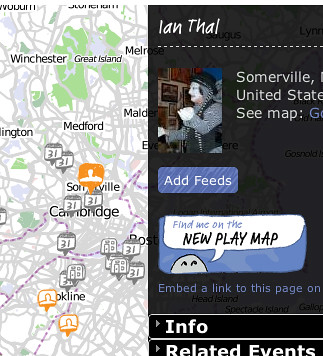
NewPlayMap1Back in January, I presented my initial thoughts regarding the New Play Institute's New Play Map, a platform for an open-source, user generated, map of the new play sector. The Institute has since continued work on developing the code for the map, while I have noticed that in my greater Boston metropolitan area, more "generative artists" (a term that embraces both playwrights and collaboratives), and presenting organizations have slowly begun to appear on the map. Locally, the playwright development organization, Playwrights' Commons has even launched a campaign to map Boston area plays and playwrights.

On May 19th, the New Play Institute announced that the source code for the latest version of the New Play Map has been posted to GitHub.

Of course, the immediate question is: what could be done with this code now that it has been open sourced? The Institute asks:

We're dying to find out what you could imagine doing with it.

(Theatre organizations in other countries: Why not take the source code to map the theatre infrastructure of your own country? That would be the simplest and easiest adaptation of this project.)


Since the introduction of the Map, I have considered what other art sectors would be well served by the platform. Plays are not the only works that can be tracked in this manner. My attention went to some of the other performing art forms: dance, opera, (and for a lack of a better term, "performance art"), are amongst a number of composed pieces that can be performed and presented in any number of venues, by various performers, presenting organizations, and can even go through a development process of workshops, conferences and festivals.

So why not a New Dance Map? New Opera Map? New Performance Map?

Sunday, February 27, 2011

Thoughts After The Reading

Staged Reading, February 21st, 2011
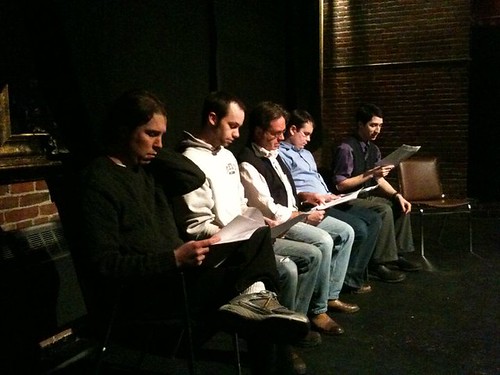
Left to right: Jesse Strachman, Chris Larson, John Greiner-Ferris, Kevin Mullins, and MJ Halberstadt, reading the parts of Il Capitano Spavento, Lorenzo, Antonio, Launcelot Gobbo, and Shylock in a scene from The Conversos of Venice as part of the Small Theatre Alliance's Open Mic Night at the Factory Theatre on the evening of February 21st. Photograph courtesy of the Small Theatre Alliance of Boston.

After grabbing a slice of pizza with CoLab Theatre artistic director Kenny Steven Fuentes, we headed to the Factory Theatre for an evening of staged readings. This was the first time I've participated in a reading where I was not actually running the show. That was left to Ron Pullins and Leslie Powell.

While in the past, when I have produced staged readings, I have often auditioned actors myself to make sure they were suited to the part (there's generally a smaller pool of actors to choose from for staged readings); this evening the actors were chosen at random from whomever came through the door with little time to review the scripts they were handed before.

I noticed over the course of the evening was the over-all high quality of the scripts. This is remarkable because I attend a lot of staged readings and though this was a completely uncurated event (hence, "Open Mic Night") the quality was better than what is presented at many companies' curated staged-reading series (which tells me that some companies playing in the "new play sector" are dropping the ball.) I will not be posting comments on anyone else's works-in-progress, especially since a number of them were only excerpts from longer works, though I will mention that I loved reading a part in Ron Pullin's short play, Pico.

Of course one of the ways we measure the value of a staged reading (despite what The New York Times says) is what the playwright learns about the play when it's read by actors in front of an audience.

I learned that I write in a style that necessitates the involvement of a dramaturg to keep the actors informed of cultural and historical context (the play, after all, is set in the Venetian Republic of 1601 and the scene in question has the characters referencing everything from religion to economics to folklore of the time while making allusions to both Shakespeare and the Bible.) In staged readings of Total War, which takes place in the far less alien world of an American university in the 1990s, I had been unwittingly playing the role of the dramaturg, figuring it was just my role as writer and producer. It's simply a tough piece to "cold-read" without rehearsal, even after I simplified the script by changing some Ladino, Veneto, and Italian words to their English cognates.

I learned that my predilection towards including clown characters when other characters are engaged in dramatic dialogue is a good instinct. There was also an interesting split in the audience that caught the various historical and literary allusions (often framed in jokes) those who did not, and those who were anxious because they were afraid that they were missing an important reference.

All I can do at this point, though, is get back to work!

Tuesday, February 8, 2011

Small Theatre Alliance of Boston: Open Mic Night


February 21st: The Small Theatre Alliance of Boston is hosting its first ever Open Mic Night for playwrights at The Factory Theatre. let us understand that in this case, the "Open Mic" is a metaphor, as there will not be a microphone and playwrights were asked to sign up over a week ago.

More simply: it's an evening of staged readings of six short plays or excerpts by six local playwrights. I will be presenting an excerpt from my work-in-progress, The Conversos of Venice, which is my on-going response to Shakespeare's Merchant of Venice (Some readers might note that I have a bit of an obsession with said play).

I will update once I know who the other playwrights might be.

The event starts at 7:30pm. The Factory Theatre is located at 791 Tremont Street, Boston in the back of the Piano Factory.

Actors: Show up by 7pm if you want a part!

Event is free, though there is a suggested $5 donation. Space will be limited, so reserve a seat!

Sunday, January 30, 2011

New Play Map

NewPlayMap1
A few weeks ago, The New Play Institute at Arena Stage launched the New Play Map an open-source, user-generated, collaborative project to map the American new play sector. The purpose is to

...to make visible – for the first time ever – all the organizations, activity, and generative artists that comprise our yet unknown infrastructure for new work.
Essentially, as the map becomes better known, theater companies, conferences, and festivals that present or develop new plays as well as generative artists (which could be either playwrights or collaboratives) can add themselves and the organizations with whom they work. The idea is that much like various projects of the WikiMedia Foundation, the more users providing information, the more useful the map.

I admit that when I first placed myself on the map, I did not fully grasp the utility of the tool, and shared some concern with Dan Rubin at Dark Knight Dramaturgy that the system could be "overwhelmed" and I even expressed concerns that only an early adopter would reap the benefits, but I'm beginning to see that my understanding of the potential was limited.

Trisha Mead, writing on the New Play Blog, suggests a number of uses:

• An easy visual snapshot of the new play work happening nationally, helping playwrights, funders (and possibly journalists) identify hot spots as they emerge

• A research resource for literary managers and artistic directors to discover new projects in development and join the group of institutions helping to bring them to fruition.

• Built in documentation for funders of a given project, creating a public and verifiable reference for each step in a play’s development.


The more obvious use for me, as a playwright, is that of identifying organizations that might wish to present and develop my work. As Mead suggests, for those attempting to identify how the new play sector actually functions, as opposed to how we imagine it functions, there's a place where empirical data is being compiled:
NewPlayMap3
For instance, were one to investigate how I operate (and I still haven't put in all my data points) one would notice that much of the time, I tend to either self-produce in, or have my work presented by, non-traditional venues. Someone could ask: Is this a viable strategy for playwrights developing and presenting new work? Am I unusual in that regard or are there a number of playwrights out there using similar strategies? Should more traditional presenting organizations adjust their policies to take in account that this is going on? Alternately, does being entered into the map provide a potential opening for a similarly operating artist to "go mainstream?" Will the map show us models to be adopted or show us where initiatives are needed?

How do I work this?

(Yes, I did once describe the Talking Heads' major accomplishment as being "letting a generation of geeks and nerds know that it was okay to dance." Dancing is cool. I highly recommend it.)

Friday, January 21, 2011

NYT Misses The Point Of Staged Readings

New York Times writer Erik Piepenburg enthuses on the topic of staged readings of plays and while not exactly missing the point that staged readings are primarily for play development, seems to regard play development as an afterthought:

NEW Yorkers love nothing more than to boast, “I was there first,” whether it’s getting a reservation at a buzzworthy restaurant, snatching up the latest handbag or seeing a new film before the rest of the country.

[...]

One way to catch the next potential It play or musical is to attend a reading. Before a show gets a full-fledged production, it has to start somewhere.


So the whole point of a staged reading is to give bragging rights to the audience members? Piepenburg actually spends the first three paragraphs making this argument.

[...] they allow playwrights, directors and troupes to put a work in front of an audience and gauge the reaction with little expense and relatively few risks. (Critics aren’t invited to weigh in.)


Actually, I do invite critics. Should any attend, I do expect them to keep to ethical standards of not publishing a review, but the feedback of a critic (or indeed any professional or semi-professional) who is only motivated by their personal standard of good theatre is invaluable. Actors, playwrights, directors, designers, techies, critics, and audience members all want the same thing: good theatre. So if the aim is to identify flaws within the script so that they can be corrected in a later draft, why would I not invite a critic? Not only have I invited critics but after they come I have invited them back when I'm ready to present a subsequent draft.

Although readings don’t promise quality, in some cases they guarantee star sightings. The actor Philip Seymour Hoffman and the playwright Stephen Adly Guirgis were both in the audience last month at the LAByrinth Theater Company’s reading of Mr. Guirgis’s new work, directed by Mr. Hoffman.


Why would anyone be remotely surprised that the playwright should be in attendance at a reading of his own play, especially when he is co-artistic director of the presenting organization, or for that matter, at the presence of the play's director who also happens to be on the board of directors for LAByrinth. This is not a "star-sighting" because Messrs Guirgis and Hoffman are at work, and whatever past arguments I have had with Mr. Guirgis, I have no doubt he takes his work seriously. It simply is not a "star-sighting" when one views a notable individual precisely where one should expect them, doing their job.

This is like somebody being amazed not by the artistry of Marcel Marceau, but Marcel Marceau showing up for his own gig.

It is only thirteen paragraphs into the article that Piepenburg actually has a playwright discuss the value of a staged reading to the writer who is serious about doing his or her job:

Andrew Hinderaker [...] whose play has been produced in Chicago, said readings give him a chance to see his own words with fresh eyes. “Part of what you’re looking for is the audience response,” he said. “I’ll probably tweak things a little bit to some degree. What’s great about a reading is that it’s an opportunity to really hear your work again and focus on any changes.”


Now to be fair, Piepenburg does eventually describe the value that a staged-reading might have to a dedicated theatre goer: the excitement of seeing a work-in-progress, but to sensationalize this experience into being one of bragging rights does not contribute much to theatre journalism.

(Thanks to Matthew Freeman for bringing this to my attention!)

Sunday, January 16, 2011

Playwright Laureate? A Response to Lauren Gunderson

Recently in her Huffington Post column, Lauren Gunderson asks the question "Why Are US Literary Laureates Only Poets? Why Not a Dramatist?":

The position of Poet Laureate started officially when in 1616 King James I of England gave the title to Ben [Jonson] -- a noted poet and playwright. In 1937, the United States established a similar position that, while at first a title-only kinda gig, is now a lauded (and paying) appointment.

Not to crash the poet party, but why can't the Library of Congress's appointments include playwrights, fiction-writers, or creative essayists? Why only poets?
Of course, Jonson would never have called himself a "playwright": he viewed his plays and the plays of those he considered rivals (like a certain man from Stratford-on-Avon who happened to pass away that same year) as poetry. He reserved the title "playwright" for those with less literary gifts, comparing them to wheelwrights or shipwrights: mere artisans, not artists; "rude mechanicals" if you will.

Still, Gunderson makes a great point. The relative high profile of the post of U.S. Poet Laureate which in recent decades had been held by such poets as Rita Dove, Robert Pinsky, Stanley Kunitz, Billy Collins and Charles Simic amongst others, has not only increased the visibility of poetry in the American cultural landscape (for example, through Pinsky's "Favorite Poem Project") but has had a snowball effect in recent years: Indeed, most states of the United States now have Poet Laureates. While Massachusetts, where I live, does not have a state Poet Laureate, individual cities, like Boston, or Gloucester do, and Cambridge, being Cambridge, has a post of "Poet Populist." (My friend, Doug Holder, has been lobbying the city of Somerville to create a Poet Laureate post.)

Of course, many American Poet Laureates have written plays even though they are by no means most widely recognized as playwrights. However, I have to ask, as much as I would like to see theatre receive greater recognition within American culture, how would a the post of Playwright Laureate work? Not just on a national level, but on a state or municipal level? Would a Playwright Laureate be charged with composing new plays for public occasions? (Jonson and his contemporaries composed court masques.) Promoting the idea of reading scripts as literature? (Students frequently get their first exposures to Shakespeare not through performance but by reading the script in English classes, often with a teacher who has minimal theatrical experience.) Promoting theatre in general? (In which case, why specifically a playwright, when a public spirited actor or director might do?) Theatre is a collaborative artform, so while many plays can be read as literature, they are ultimately meant to be performed. Would a Playwright Laureate have access to a federal (or state, or municipal) stage? What about access to actors, designers and techies?

Now while I share Gunderson's desire for "raising the status of poetic and dramatic literature in the everyday conscience of the American public" her proposal leaves me with more questions. Would this get more people attending live theatre? More interesting plays on stage? Free up more spaces for performances? Give "emerging playwrights" a better shot at being produced? Make it easier for playwrights to make a living on their writing? Get more playwrights interviewed on National Public Radio?

Is the Library of Congress really the agency best suited to this work?

Monday, October 4, 2010

Teatro delle Maschere From Another Angle

After viewing the video I posted yesterday of Teatro delle Maschere's October 2nd performance. Anya Malkina, a friend, graphic designer and web designer who has done work for Behind the Mask Studio & Theatre and had shot photos ofa recent performance of Arlecchino Am Ravenous, sent in this video she took of the second half of our performance, but from stage left.


What I find fascinating about comparing the two videos is how the comparison illustrates that unlike film or television, which, have evolved , theatre is a three-dimensional art form. In this particular clip, even when the Dottore (Jonathan Samson) is obscuring Columbina (Stacey Polishook) and Arlecchino (myself) one can see the two servants' shadows dancing on the back wall.

Saturday, April 3, 2010

Belated Post-Reading Report

The March 28th reading was as rewarding as was stressful. As with the previous reading in October, I had had a few roles to recast, but I was also still dealing with the loss of my cat, Omi, who had been my companion for some 16 years. Grief has a way of putting one off schedule.

Then, as my plans finally came together with roles being cast only days before the reading, more chaos ensued. Stage manager Anika Hannibal-Colvin, who had been a valued assistant in the previous two readings fell ill, and Dan Schneider had an emergency to deal with on the day of the show. I was able to appoint Trudi Goodman to be stage manager since she she was reading a minor role that was only needed for a single scene, and she appointed me the understudy and so, I played the role of Jonah, especially strange since my plan was to sit in the back of the room and take notes.

The talk-back after the reading was particularly helpful. Both Thomas Garvey and Art Hennessey were in the audience and had a lot of useful observations as to how the dramatic potential could be better exploited (Art promised me some notes!) A recurring issue with the current draft as I would see with the feedback was that many dramatic turns near the end were left to inuendo, and not made explicit and therefore missed by the audience. In situations like that, it's the playwright, not the audience who is at fault.

As most of my actors were returnees, they seemed more comfortable than before in speaking candidly with me about both the performances and the script (both in terms of the current draft and the over all development)-- something which has continued in email conversations over the following couple of days in which I had superb dialogue with several cast members. I found myself in one exchange citing Adam Szymkowicz' recent interview of playwright Paul Mullin, when asked for advice to playwrights, Mullin said:

Understand the tradition you have joined. Never cede your place in the hierarchy. Directors did not come into existence until the 19th Century. Artistic directors not until the 20th. Only actors outrank you in seniority in the tradition. So treat them with respect. In fact, act on stage as often as you can...
Very good advice, I think.

The following day I received a letter in the post from a literary director, who after reading a ten-page sample was soliciting the full length script. Obviously, I can't name names since no commitment has been made, but sometimes the reward for hard work is simply to be encouraged to go back to work.

Thursday, March 18, 2010

March 28th: A Staged Reading of Total War @ Outpost 186

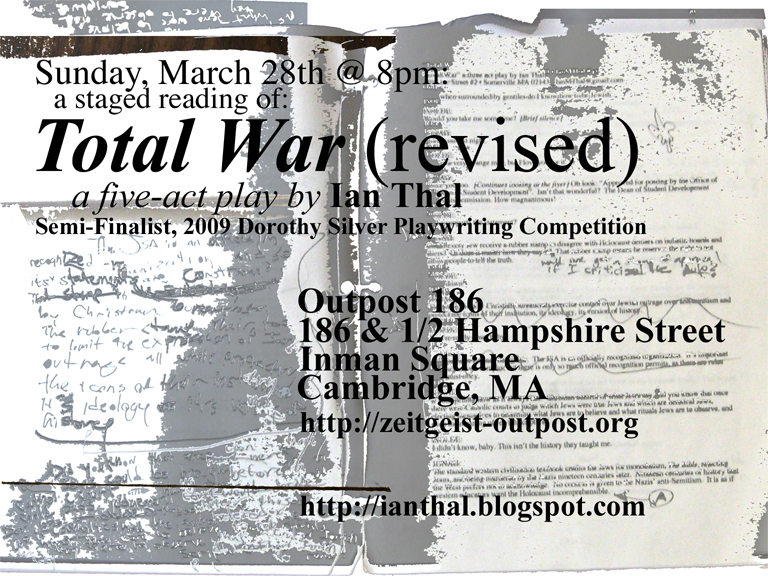
Poster for Staged Reading of "Total War" 3/28/2010
Total War, a semi-finalist in the 2009 Dorothy Silver Playwriting Competition, is a five-act play set at a Catholic university where the student newspaper has published a Holocaust denial advertisement. Before faculty, students, and staff can begin the expected dialogue on free speech and religious pluralism, an anarchist-cell using the nom de guerre of “Total War” begins a campaign of guerrilla art attacks.

This will be the third draft of Total War to be presented at Cambridge’s Outpost 186. The first reading, in April of last year inspired a lone protester to picket the reading from the sidewalk.

The reading will feature the talents of local actors, including: Trudi Goodman, Kate Heffernan, Dan Schneider, Savanah Shaughnessy, Tom Sprague, Kendall Stewart and Matthew Zahnzinger. Anika M. Colvin-Hannibal will stage manage. Three more cast members are to be announced shortly.

Though a work of fiction, Total War was inspired by events I witnessed while attending graduate school. The play explores the history (and potential futures) of Jewish-Catholic relations, historical memory, and the conflict between grass-roots activism and institutional power. It is a story made timely after the recent scandal regarding Vatican’s recent lifting of the excommunication against the anti-Semitic Society of Saint Pius X and its Holocaust-denying Bishop, Richard Williamson.

Facebook users can RSVP here


View Larger Map

Saturday, March 6, 2010

Call for Actors: Staged Read of "Total War": March 28

Poster for Staged Reading of "Total War" 3/28/2010
Having taken a harsher view than much of the audience of the draft presented at the last staged reading of Total War, I did yet another rewrite. The new draft runs three pages shorter: Much of the craft of playwriting seems to be learning out to strip away the unessential. Most of the cast has elected to reprise their roles but three roles will be recast.

As this is simply a reading of a work in progress in front of a small audience, there will be no blocking. My concern is not so much the look or age of of the actors but their interest in the story and enthusiasm and insights into the characters. I will be available to answer any questions actors have about the characters prior to the reading. I will schedule read-throughs with any actors not comfortable with a cold reading.

To quote the press release:

Total War is a five-act play that addresses the legacy of anti-Semitism after the student newspaper at a Catholic university publishes a Holocaust denial advertisement. Before faculty, students, and staff can begin the expected dialogue on free speech and religious pluralism, an anarchist-cell using the nom de guerre of “Total War” begins a campaign of guerrilla art attacks.
If you are an actor and this sounds interesting, continue reading:

Dramatis Personae:

Father Aldobrandini: (Male, early 40s to early 50s.) A priest and university professor. Sees himself as a "traditionalist." Anti-modernist in orientation and argely opposed to the innovations of Vatican II, but his opposition stops just short of becoming a schismatic.

N.B. Martin Comack has been cast as Aldobrandini.

Richard Doncaster: (Male, late 30s to 50s.) Dean of students at a Catholic university. Though a political animal, he has presented modern liberal version of in loco parentis that aims to protect the identity and traditions of the school while also recognizing the increased pluralism of recent years.

Donald Crincoli: (Male, early 20s) Undergraduate who works on the student newspaper. An impulsive and twisted comic vulgarian.

I'm sorry that my budget does not allow for a stipend for the actors, but snacks and beverages will be provided. There will be a talk back session after the reading for the actors and audience to share their observations.

Interested? Drop me a note about the role that interests you. Resumes are helpful but not necessary.

Sunday, January 31, 2010

Aporeia or Dialogue? Guirgis and Thal on "Last Days of Judas Iscariot"

A few days ago, through the comments section of another blog entry, I had an exchange with the playwright, Stephen Adly Guirgis. He took issue with my interpretation of his play, The Last Days of Judas Iscariot which I had written as a letter to the editor some three years ago in response to the Boston's Weekly Dig having picked the Company One production as one of their Best of 2006.

Where we disgreed is that I interpreted the play as hipster revival of the old anti-Semitic canard that places the blame for Jesus' crucifixion on the Jews. Guirgis contends that this was not his intent. I have no reason to doubt his sincerity and at this point choose to look at this as an illustration of the real hazards that Jewish-Christian dialogue can sometimes smash itself upon, even when the interlocutors' intentions are the best. Yet, despite these hazards, this dialogue needs to occur, precisely because of an often horrific shared history.

To begin, a Dig staffer added this bold faced title caption to my letter:

Every point made in a play must be countered by an opposing point consisting of exactly as many words and spoken at a comparable volume. Only that way will theatre come alive again.

Dear Dig,
I wonder by what criteria Jenna Scherer selected to include
The Last Days of Judas Iscariot as part of her roundup of the year's best theatre (12.20.06). While I confess that Stephen Adly Guirgis has a gift for writing dialogue that led to excellent performances by some of Company One's better actors, Guirgis's overall sloppiness placed it close to the bottom of my list for 2006.

Numerous scenes were completely irrelevant to the courtroom drama. Lengthy monologues by characters that appear nowhere else in the story implied that Guirgis either had not finished writing the play before opening night, or that he was simply trying to give some of the actors something to do instead of sitting backstage for over an hour. The ending, to the extent there was one, demonstrated that Guirgis was unable to handle any of the cans of worms that he himself had opened.

Leaving aside the structural problems, the second half of the play repeats again and again the old anti-Semitic canard that the Jews are the ones who murdered Jesus (a central theme of the Passion plays, and Mel Gibson's film version). Pontius Pilate even makes a point that he had washed his hands of the affair, and is a saint in the Ethiopian Church. It is not wrong for a writer to create anti-Semitic characters, but to leave their statements un-countered is highly questionable.

The Last Days of Judas Iscariot also has countless moments of misogyny to which there is never any rebuttal. How does a male witness sexually harass a female defense attorney with impunity? Or a male prosecuting attorney sexually harass a female witness? Guirgis seems to like his female characters neatly classified as mothers, whores and nuns, and he appears to take pleasure in humiliating the mothers and the whores.

Guirgis does a great job writing for the mafia characters on HBO's
The Sopranos, but theology is well beyond his abilities, as is anything whose form demands that the plot threads be tied up by the end of the evening. Does Jenna Scherer pay any attention to the writing?

Ian Thal
Somerville, MA


This letter, no longer available on The Dig's website, simply floated on my soon to be neglected pages on authorsden (neglected because I desired the greater flexibility of the blogger platform) and on rare occasions referenced here and there.

Eventually, some three years later, on January 28, 2010, on an unrelated blog post, I received this comment from an anonymous poster, apparently identifying himself as Stephen Adly Guirgis:
Mr. Thal

I have learned that one never wins when contacting those who criticize one's work. And yet is it curious to me that my play has been performed all over the world and to my knowledge you are the only person to ever accuse me of perpetuating ant-semitic stereotypes. I don't know what you saw in Boston four years ago that compels you to keep associating me with Hate, but it saddens me because I happen to take racism/anti-semitism/hate pretty seriously. Maybe you were in the bathroom during the cross examination of Caiaphas by El-Fayoumy? Maybe you were asleep when the play pins 2000 years of hate -- not on "The Jews" -- but on the writers of the Gospels? I don't know... Clearly, you're completely entitled to dislike my play, dislike me, and say whatever you want to say. And you're not alone in criticizing the play -- some like it, some don't. I only hope that when hurling accusations of anti-semitism, that you feel you've done your due diligence to study the subject matter sufficiently so as to to feel confident in your own mind that you're correct in your assertions. You're an artist yourself so you know the deal: you put your stuff out there and people say what they're gonna say. So, I'm not complaining. My play is wildly imperfect, lots and lots of flaws. But, however you received it, I can assure you it was not written in hate. It was written, in all it's imperfection, with love. And with that, in this late night hour, I send love to you. I just wanted to say my piece. So, thanks. And best wishes to you and yours. SG
Taken at face value, I had to consider Guirgis' point of view as sincere, even if that's not what I saw in his play, so after several hours, I posted this response:
(Allow me to assume that Anonymous is exactly whom he claims to be.)

Dear Mr. Guirgis,

Thanks for writing. I much rather have a dialogue where in the end I can say "I stand corrected" than persist in some intractable feud.

Because of this, I have to accept your stated intentions at face value, and explore why I felt that quite the opposite of those intentions were communicated to me.

Keep in mind that the production I saw of
Last Days of Judas Iscariot was some three-and-a-half years ago: July of 2006, to be exact, and the criticism I wrote was from a few months later after the play was picked for a "Best of 2006." I assure you that I did not nod off or leave for the bathroom during the performance.

I definitely did not get the impression that your play pinned the blame on Christian antisemitism on the Gospel writers , as neither they, nor their sectarian agenda (to make the young Jesus movement appealing to gentiles by stripping it of its Jewish context) was placed on trial.

Instead, the appeal on behalf of Judas (whom some scholars now view to be a fictitious personification of "the Jews") was largely based on finding an alternative Jewish culprit such as Caiaphas, as a representive of the Temple priesthood.

Frankly: I don't remember after all this time whether the other usual suspects of the Pharisees (that is, the Rabbis) and the crowd that chose amnesty for Barabbas were brought up.

And of course, as I mentioned, Pilate and his government are absolved simply because he says he's a Saint in the Ethiopian Church. So it turns into a situation of seeking amnesty for one Jew by finding an alternative Jewish scapegoat.

Now, had there been that meta-textual/meta-mythical turn after the intermission that brought Matthew, Mark, Luke, and John and their sectarian agendas to task (as many "left-leaning" Catholics like James Carroll do,) then much of my criticism would have been invalid. However that leap was never made, and since the motion to simply grant Judas divine forgiveness was denied, the mechanics of the play demanded that the deicide charge be pinned on someone else: either a different Jew or Jews in general. So I found that it brought everything back to the bad old days before
Nostra Aetate opened up lines of interfaith dialogue.

Again, maybe you feel that you had subtly done just what I suggest, in which case, it was completely lost in Company One's production which seemed more interested in finding "the real culprit."
Now the question is: is this an aporeia or an opening for further dialogue?

Friday, January 8, 2010

January 15th: Arlecchino at Perishable Theatre's Blood From A Turnip


As last minute addition to my performance schedule, I will be performing Arlecchino Am Ravenous at Perishable Theatre's late night puppetry Salon, Blood from a Turnip, in Providence, Rhode Island on Friday, January 15th.

Show time starts at 10pm. Facebook users can RSVP here. Tickets are $5.

Perishable Theatre
95 Empire Street
Providence, RI


If you can't make it to Providence, I'm performing Arlecchino Am Ravenous at the PuppetSLAM at Puppet Showplace Theatre the following night.

Last time I performed in Providence was with Cosmic Spelunker Theatre. Here's a 2004 interview in the Providence Phoenix.

Monday, January 4, 2010

January 16th: Arlecchino Am Ravenous at PuppetSLAM

Photography by Shannon O'Connor; Montage by Ian Thal

Saturday, January 16th @ 8pm: I will be performing Arlecchino Am Ravenous as part of the PuppetSLAM at Puppet Showplace Theatre in Brookline.

Also performing:

Wonderspark Puppets
Little's Creatures
Kyle Mackesey
Paul Sedgwick
Jim Sedgwick
and Diane Kordas

Tickets are $15 and you can order them online or reserve them by calling the box office at 617-731-6400

Facebook users can also RSVP here.

Puppet Showplace Theatre
32 Station Street
Brookline MA 02445


I have previously performed Arlecchino Am Ravenous at The Gulu-Gulu Café, and Stone Soup Poetry. The piece originated as a series of improvisation on La Fame dello Zanni or "Starving Zanni" lazzo in preparation for a show at Willoughby & Baltic.

[N.B.: Added new information regarding line-up and links. January 11, 2010.]

Thursday, December 31, 2009

A Modest Proposal 2

I issued a challenge (admittedly, somewhat inspired by Thomas Garvey's provocations) to those critics talking about the lack of diversity in the theatre (especially with regards to the playwrights) to find under-appreciated, and relatively unknown plays and playwrights they deem worthy of production and advocating for them whether their advocacy appears in print, on the blogosphere, or even on the stage. In the ensuing discussion both here and elsewhere, (such as on Guy Yedwab's blog, CultureFuture) I elaborated by noting how common it is for music writers to publish lists of bands, musicians, or recordings, "you probably never heard, but should" and suggested that theatre writers should consider a similar format.

Isaac Butler, whom I concede that I unfairly criticized on several points, did acknowledge in the comments section to my proposal, that while he primarily directs the works of new playwrights who are not part of the MFA system, he hasn't done much to promote those writers much on his own blog-- though in the essentials, we are largely in agreement.

Yedwab (who has since coined the term, "the Ian Thal method of diversity") notes, of course, that this proposal is not enough:

[I]f my friend the playwright isn't being performed, I may not know the right people to pull connections with to get them performed -- and if they don't get performed, I can't send anyone to go see them.
Part of the equation is precisely where a social media platform like BushGreen comes in as a place where new scripts can be posted and read. However, there's also what playwrights can do themselves.

One thing I have done over the course of this past year is realize that Total War was going to be in limbo for a long time if I waited for other parties come in to help develop it, and decided to take a proactive stance, and do it myself: recruiting actors, and presenting readings, and then writing a new draft (in fact, I just booked my next reading for March 28th, so watch this blog for more details.) Any writer can do this.

But I should point out that while I am agitating working around an institutional theatre industry that many seem to believe is not working to produce great new plays, there are some who haven't waited for my call to arms. As August Schulenburg of the Flux Theatre Ensemble pointed out in comments section at CultureFuture, he had already compiled his list of Plays that Need Doing in NYC and noted that
...blogs like Clyde Fitch, Visible Soul, CultureBot, Just Shows To Go You, and Adam Szymkowicz are doing yeoman's work championing lesser known artists through great interview series.
Of course, Szymkowicz' 100 playwrights include a few well-known names, and he does pose the same interview questions to each playwright. I haven't been a regular reader of the other blogs.

In my own community, Whistler in the Dark, a member of the Small Theatre Alliance of Boston, initiated their Whistler Wednesdays which are specifically for presenting staged readings to new plays and playwrights, where I recently attended a reading of Vladimir Zelevinsky's A Brief History of the Soviet Union

I also have to state my appreciation to Thomas Garvey, who not only showed up at the first staged reading of Total War, offered an extensive critique during the talk-back, encouraged me to rewrite the play, but then promoted the second staged reading on Hub Review. That's precisely the sort of advocacy I'm advocating.

Interestingly enough, as I reflect on these efforts, both my own and those of other cultural workers, I realize that this is a theme central to Total War: if the dominant culture is not providing you with a venue; you have to create your own.

Wednesday, December 30, 2009

Response to my Modest Proposal

It took a few days before there was much of a response, probably owing to the fact that I posted my "Modest Proposal" on the Jewish-American Festival of Chinese Food and Movie Night (food was excellent, but the restaurant was understaffed, the service was ridiculously slow, and one of my fellow celebrants did not receive her entrée!) But not only was there an active discussion (in which I discovered that Isaac Butler and I agree on possibly the most salient points) but Guy Yedwab over at Culture Future began to take up some of my ideas into his own thinking about diversity in theatre.

He even named a method after me:

That's the Ian Thal method of diversity: making the work we're passionate[about*] be diverse work, and championing it.


*My addition

I think I need to listen to this "Ian Thal" more. Thanks. Guy.

My proposal is a work-in-progress, and there are certainly other aspects on which I will elaborate in another post.

Thursday, December 24, 2009

A Modest Proposal

More often than not, this blog has focussed on my own activities as an artist, only on occasion discussing larger issues or participating in a larger conversation. This is one of those occasions.

There has been an on-going conversation in the theatrical blogosphere about diversity in theatre. I don't intend to do a full survey, but I'll list off a few items of interest:

There was, of course, Emily Glassberg Sands' "Opening the Curtain on Playwright Gender: An Integrated Economic Analysis of Discrimination in American Theater" which while identifying a real problem also had some real flaws that Thomas Garvey suggests were introduced when others tried to co-opted her work to fit their professional and ideological agenda.

Somewhat facetiously, Isaac Butler suggests suing theatres that don't diversify. Of course, Butler's suggestion is so absurdly impractical that it comes across more as an Ayn Randian nightmare caricature of political correctness than anything a serious liberal or progressive would contribute to the discussion, but I link to it because Butler is supposed to be an important theatre-blogger, and I'm apparently banned from posting to his comments section for reasons that are unclear to me (I'm sure it's all a misunderstanding.)

The pseudonymous 99seats has addressed the issue of diversity frequently, noting the class issue of access to theatre programs, notably the MFA, if one happens to be a playwright, as well as the institutionalized racism that prevents minorities from having similar opportunities. Of course, the troublesome statistic from the Theatre Development Fund's report Outrageous Fortune: The Life and Times of thew New American Play that "seven schools account for almost nine out of ten of the study playwrights with advanced professional training" only raises more questions about the role the academic gatekeepers are having on our culture-- especially when we ask how many of our great living American playwrights actually attended one of these programs? (This is particularly disturbing considering the charges leveled earlier this fall at The O'Neill Theatre regarding their "open" submission policies.)

Now this gets to an important point, brought up by Garvey in his "Meanwhile, over on the theatrical version of Second Life..." that:

To me, of course, art is more important than politics, so what Butler calls "the quality problem" (!) matters a lot, as I think it should to any critic worth his or her salt. And let me say up front that if Butler and Walters had any particular playwright they were promoting, of any gender of race or ethnicity, whose work they claimed had been disadvantaged by the system, I would happily see that writer's work, and be an advocate for them if the quality was there. (As for the insulting idea that people in each ethnic group cannot perceive the excellence of works from other ethnic groups - please, tell it to Alvin Ailey.)

But the diversity partisans never seem to be able to point to any actual work that they feel is being ignored. Add to that issue the troubling fact that the "quality problem" we have is often due to playwrights promoted by the academic-diversity crowd, and you have a situation that - well, does not actually inspire critical confidence.
Essentially, as I often heard growing up in a left-wing household: "If you're not part of the solution, you're part of the problem" or as I wrote in the comments section:
Critics should champion the work of artists that they regard as underappreciated or even deliberately seek out new work? I'm not sure the academy would approve of such a radical notion, Thom.
Garvey flattered me as "you mischievous Ian Thal" which, of course, only incites me to greater mischief.

The successful playwright pool is artificially limited largely to those graduates of elite MFA playwriting programs, who reflect certain class interests and address "diversity issues" primarily in academically fashionable ways. Indeed, if I am granted the opportunity to propose a hypothesis (which I freely admit is but a hunch): the current manner in which "diversity" is treated by the "diversity advocates" (and please note, I am speaking only about plays and playwrights) might actually be creating obstacles that prevent playwrights of diverse backgrounds from emerging.

Despite his frequent self-deprecation, my friend, Chris Rich, who writes about jazz on his blog, Brilliant Corners, has developed something of a reputation for discovering artists and being the first to write about them. Part of that comes from his hanging about Outpost 186, where so many great and oft ignored jazz musicians play. However he has another method as well: He surfs for musicians on MySpace Music where musicians without labels and without buzz post their music. He then uses his own knowledge of the music to sort out the good from the bad. It's that simple. He doesn't wait for a major label to tell him that this musician is important.

So now for my mischief: I challenge you critics, producers, and artistic directors who should be advocating for great theatre. Find an underappreciated, underproduced, perhaps unknown playwright who should be appreciated, produced and known. Better yet: find six, eight, ten, and advocate for them. You need only go to bushgreen.org, a social media platform supported by London's Bush Theatre, where hundreds, if not thousands, of playwrights have already posted their plays, irrespective of whether or not they have the MFA. I'm already there. If you see it as your mission to serve a specific community or constellation of communities, most of the playwrights have already tagged their plays with labels to help you narrow down your search. I'm sure you will find something worthy of your advocacy.

On the other hand, maybe that amounts to usurption of the academic gatekeepers, and we can't have that, can we?

[N.B.12/26/2009: I seem to have overestimated the number of playwrights and plays currently posted to bushgreen.org-- perhaps because I had to search around for that information. There appear to be ~120 playwrights and around 400+ plays.]

Friday, December 18, 2009

Total War on bushgreen

Despite what I now consider to have been an over-reaction to the suggestion that my plays might be made available online, the much deserved ribbing for said over-reaction by fellow blogger 99seats, I still had concerns as to how playwrights could be expected to make their work available online in such a manner that benefits them as well as the potential audience.

Though it may have appeared as if I had taken an ideological hardline with regards to sharing my work; I have decided to try out bushgreen, a new social networking platform for playwrights set up by London's Bush Theatre.

It's an experiment for me, but interested parties can find me here and perhaps read the latest draft of Total War here.

Saturday, November 7, 2009

Judicial Theatre Review of "The Overwhelming" at the Art Fuse


Bill Marx, Editor of The Art Fuse, is conducting a new experiment, the "judicial arts review." To quote Marx:

As coverage of the arts in the conventional, mainstream media wanes, critical discussion of the arts online has settled into two extremes: there’s the corporate dream of an omnipotent “Google” reviewer for all and the chaos of opinions fired off in individual blogs of varying quality and intellectual integrity.

My aim with the Judicial Review, of which there will be one a month in the coming year, is to fashion a mid-way between these two unsatisfying polarities — to create a flexible place where professionals and non-professionals, artists and amateurs can exchange views and judgments about the arts. This will serve as a model for a civil conversational setting that will invite independent discussion as well as encourage participation in the arts.
To this end, he has assembled a panel including myself, playwright Peter-Adrian Cohen, and Timothy Longman, Director of the New African Studies Center at Boston University, to review Company One's production of J.T. Rogers' play about the Rwandan genocide, The Overwhelming.

Notes on Class

I've been following Professor Matthew Isaac Cohen's blog about his course on Bread and Puppet Theatre at Royal Halloway, University of London, with interest in part because my essay "Breaking with Bread and Puppet" which is both a narrative of my decision to stop working with the troupe as well as a critique of the imagery that prompted my decision (for which I've gained a small amount of notoriety.) The main focus of the course to have the students investigate the theatrical techniques most closely associated with Bread and Puppet. Despite any political falling-out with B&P founder, Peter Schumann, I strongly endorse theatre-makers drawing upon these techniques. In fact, despite the fact that Total War is primarily written in a naturalistic style, I do incorporate many of these techniques I learned as well.

This past week, Cohen's class was assigned to use what they were learning to parody the political and racial stances of the far-right, and arguably, neo-Nazi, British National Party. One group of students was assigned the instruction:

Using a ringmaster, explore the idea that the BNP deny the Holocaust.
Which I found particularly ironic since the argument of "Breaking with Bread and Puppet" was that Peter Schumann had deliberately misrepresented the history of the Warsaw Ghetto, and by extension, the Holocaust, in order to misrepresent the West Bank Barrier Wall, and was thus engaged in what can be termed "soft-core" Holocaust Denial.

In my view, the BNP provides too easy a target, now if they were assigned to parody the controversy around the attempted boycotts of Israeli academics by the British University and College Union, that would have been edgy.

Tuesday, November 3, 2009

Nobody Sucks... Except That Guy

Last week, Don Hall, Chicago-based actor, director, theatre-observer, and activist (and well-known enough in the theatrical blogosphere that I trust someone will correct me if I left anything out) has been posting a series on the audition process on his blog An Angry White Guy in Chicago. Having recently been in the position of casting actors for Total War, and like Hall, not being "institutionalized (meaning I didn't go to college to learn how to do this work)" I found myself nodding in agreement with much of what Hall and some of his other readers had to say:

2. Take some time and find out what the director is looking for - I'm happier than shit to tell you what we're up to and what you can do to get "the edge."

3.
[...] I know within about fifteen seconds whether or not I can use you in my show - a good director knows in advance what he's looking for to some degree - and the only reason I let you get through that 2-minute monologue that somehow manages to be five minutes long is because you came all this way, there's no reason to be unnecessarily rude.

The bottom line is:

This means if you don't get called back, it isn't because you suck.

So if you did audition for the reading of Total War and didn't get the part: that's right: you didn't suck; you just weren't right for the role; you might have been right for a completely different role. In fact, since this was a staged reading, and I conducted my audtions in an informal, unorthodox manner, in a neighborhood coffeehouse (I simply didn't have the budget to rent out a space for auditions, though to be fair, I interviewed for my teaching gig with OpenAir Circus in the very same coffeehouse, and the informality seemed to encourage actors to volunteer their personal interest in the project) I might have liked you personally, even if I decided not to cast you.

* * *

As with every rule of social interaction (such as theatre-making) there is always a statistical outlier: in this case, it was someone who, despite having some talent, proceded to so alienate me during the audition that I would not even consider adjusting my sought-for preferences to accomodate his strengths. It all began when I received the following (yes, multiple) emails (Note that the name has been withheld for obvious reasons):

My voice has been described as deep, resonant, beautiful, and hilarious. I have been practicing for five years now and am able to express a wide range of personalities.

[...]

I feel that I would be perfect for the role of Duane McCormack. [...M]y writing has recieved significant praise from my honors professors so the role will come quite naturally to me.

Duane McCormack is a fictitious character, so the actor isn't actually expected to do any writing associated with the play. So while I appreciate that an actor might want to draw upon some aspect of their own life in order to relate to a character or to the themes of the play, this struck me as odd. Nonetheless, I sent a .pdf of the script along with a list of pages where Duane appears, concluding that this would be sufficient for the actor to judge for himself if the character is right for him and if so, provide hints as to how to approach the role.

So, in between meeting other actors at my table (which I rent by ordering espresso and bread pudding) our friend whose "voice has been described as deep, resonant, beautiful, and hilarious" shows up for his audition. His voice is indeed resonant and he has movie-star looks. Then he explains his interpretation into the character:

"Duane is a journalist; he's a truth-seeker."

This struck me as an odd misreading, so I suggested that "He is a student journalist but he's more defined by the attempt to keep his head above water while the comrades to which he's tethered are sinking than by any quest for truth."

The actor ignored my suggestion and read it his way. Not having a lot of actors auditioning for the role, I tried to consider if his interpretation added something I had not seen before (which had already occurred during the first staged reading.)

None of this would have been worth commenting upon until he started exhibiting the oddest behaviors. While I was flipping through the pages of my script to find the next bit of dialogue I wanted to hear him read, he put on his sunglasses, presented his profile and asked me if I saw his resemblance to Tom Cruise and Ashton Kutcher.

As I was conducting this audition in the oddest of places we were interupted when a young woman who had been a friend of a former roommate of mine, dropped by to say hello and asked about my cat. After the brief exchange of pleasantries and my explanation that I was conducting auditions, there was no exchange of email addresses, phone numbers, no words or gestures implying a hoped for future communication, which apparently the the actor missed, he slyly smiled and purred:

"A possible interest?"

He then launched into what must have been a rehearsed speech about how he was going to make my play great because he was going places, which, leaving aside the pathological narcissism, was simply insulting to the talents of the actors who had already volunteered to work on this project.

So, leaving aside his unsuitability for the role, I simply did not want to put my actors in a position of having to work with this guy.

So I sent the standard, diplomatic response:

It was a pleasure meeting you, but alas, I can't offer you the role of Duane. Thank you very much for taking the time to read with me.
Best,
Ian

To which he responded unexpectedly:

Hi Ian, (This is good, just read it)
Too bad, your production will suffer as a result of this unfathomably ignorant decision. Ha Ha Ha Ha Ha. Can you see that put to rhythm? I can, because I much more gifted than you will ever be in your life. Again, I offer my condolences to your woefully inadequate conclusion.
Yours Truly,
The Great And Noble
[Name withheld]

In the end, I found Matthew Zahnzinger, who besides nailing the role, had the added bonus of already being in rehearsal with Mikey DiLoreto on the Factory Theatre's production of Kid Simple, and that's always a nice coincidence.