The CoLab Theatre's Kenny Steven Fuentes responds to a recent discussion on the StageSource blog by citing my gonads and their contribution to the Boston theatre scene:Self produce. Organize. Stir up controversy. Be like Ian Thal or Thomas Garvey, and HAVE SOME BALLS! Nevermind what you think about their opinions, these dudes are heard and people take them seriously.
Kenny has realized that I am so utterly shallow that the mere mention of my testes results in a link. Seriously? People take me seriously?
Showing posts with label thomas garvey. Show all posts
Showing posts with label thomas garvey. Show all posts
Friday, June 24, 2011
"Be like Ian Thal"


Monday, April 25, 2011
IRNE Intrigue, Part II
Previously, I wrote an account of, as best as I understood it, the pressure campaign placed on the Independent Reviewers of New England (IRNE) to dismiss Hub Review critic, Thomas Garvey from their membership. IRNE, had refused to dismiss Garvey, but Garvey announced his resignation in order to take the pressure off of his fellow reviewers. More remarkably, after Garvey had announced his resignation, Director of Press and Public Relations for the American Repertory Theatre, Katalin "Kati" Mitchell, in a comment to the Hub Review, essentially admitted that she had co-authored a letter with Shawn LaCount, Artistic Director of Company One (along with contributions from unnamed individuals supposedly representing six other theatre companies) demanding Garvey's removal.
Leaving aside the fact that I am an avid reader of The Hub Review, this would be an outrageous situation in the case of any critic. Critics are an essential part of the larger theatre community. Even were we to consider a hypothetical situation in which a particular critic was a "bad apple" and needed to be removed from an awards committee, this is the sort of case that needs to be made in public to the theatrical community as a whole, free of threats, not behind the scenes by a select group that does not represent the theatre community as a whole in which IRNE critics are threatened with having their privileges revoked if they do not disbar one of their own. These machinations showed a disrespect for the theatre community. Mitchell and LaCount et alia still have not made their case to the rest of us as to why they believed theirs was the proper course of action (Mitchell had promised to share the letter she and her ad hoc committee had drafted, but no such letter has been forthcoming.)
Last month, I asked:
[P]ro-Garvey or anti-Garvey, this is being discussed on the telephone, by email, and in face to face conversations amongst theatre people, but no one in the local theatre press is covering this story either in print or online. Would the press be so quiet if something similar had occurred on the theatre scene in New York? Chicago? Washington, D.C.? Seattle? Minneapolis?Art Hennesey followed up and asked "When Will Boston Know It's A World Class Theater City?" Boston Globereporter Geoff Edgers, in response to my prodding, did mention the spat at the Exhibitionist blog only to dismissively ask "All right, Ian. We give. Does this count?"
Yesterday, Larry Stark, IRNE member, editor of The Theatre Mirror issued the following Open Letter to the ART:
Regrettably, until further notice, I shall not be attending any productions by the American Repertory Theatre (A.R.T.). Let me explain:
I have frequently been critical of other critics. In some cases, this has been my "internal editor" quibbling about style; at other times, it has been an attempt to let critics feel the personal pain that damaging criticism can cause in people who must get up before another audience knowing that critics' comments have shaped what at least some in that audience might thus believe.
But, even admitting these opinions, I believe even the harshest of critics, deep down, really love theater --- that creators and critics are really "on the same side". Sometimes it may look as though a critic Loves Theater To Death; still, in an austere era many of my colleagues are continuing to write critiques without being paid to do so, their love is that strong. And they try to apply their personal standards in as impartial a manner as possible, though it may not always look that way from outside. That, I think, is the critic's job.
The job of a Public Relations Coordinator for any particular theater company, though, is necessarily biased. The goal there is to get that same potential audience to view the company's shows in the best possible light, to see and appreciate what is there, and to come back again and again for more. And it may seem that P/R people and critics are at war --- especially when they disagree, with one seeing only negatives while the other must accentuate the positive.
But those on both sides operate in what is called "The Free Marketplace of Ideas" --- and audience-members may decide for themselves which one is right. This, at least, is how I assume the game should be played.
Lately, I have heard rumors that a vicious "kill the messenger" attitude threatens this entire structure. I have often voiced my opinions privately or written them publically, but deliberate attempts to disgrace or disbar or silence someone's free voice I cannot tolerate nor condone. I therefore sent the following letter to the producer at the American Repertory Theatre protesting what I see as disgraceful behavior, stretching back over many years, that has no place in that "Marketplace of Ideas" which I fervently hope will remain free.To: Diane Borger, Producer, AMERICAN REPERTORY THEATRE
Dear Ms. Borger:
Of late I have heard astonishing stories and rumors of the antics of a person in your employ referred to as "Catty" by those who have had contact with her. I undertstand that Public Relations work necessarily involves some sorts of manipulation; however, if even half of what I've been told is true, this person has no ethical standards whatever. I am astonished that you continue to employ anyone who so totally misunderstands her profession, and mine.
You must realize that in the climate created by her actions, any positive reviews of your company's work can be construed as written out of fear of this woman's power to ruin the reputation of anyone voicing opposite opinions.
I cannot believe you are ignorant of this situation, but you must be aware that continuing to employ her in such a sensitive position can only be construed as approval of such behavior by the American Repertory Theatre, which I fervently hope cannot be the case.
But if you condone such actions, I cannot.
I cannot in good conscience continue to work with anyone who behaves with such vindictive misunderstanding of her job, and mine. To do so would suggest that I myself condone such behavior, which is decidedly Not the case.
Should there be a change in personnel in future, I would appreciate your notifying me.
Sincerely,
===Larry Stark
of Theater Mirror
Tonight is the IRNE Awards. I generally don't concern myself much with awards ceremonies, but tonight, I am interested.
Wednesday, March 30, 2011
IRNE Intrigue
So what happens when Director of Press and Public Relations for one of the largest theatre companies in the Boston metropolitan area admits to spearheading an effort to exert pressure on the area's main theatre awards committee to remove a theatre critic from its membership?
The answer is: no press coverage.
On March 17th, The Hub Review's Thomas Garvey, the self-described "strongest, most versatile, and most prolific critic in town" (to which I'm inclined to agree, though I'll also add "provocative", and "polemical") announced that he had resigned from the Independent Reviewers of New England (IRNE) just a month before the Awards ceremony. According to Garvey, he did not resign over a disagreement with his colleagues, but because of campaign of pressure against the IRNE.
In Garvey's own words: Director of Press and Public Relations for the American Repertory Theatre, Katalin "Kati" Mitchell had:
[...]not only used to send me crazy emails in all caps after a bad review, but, believe it or not, she even penned the IRNE folks an angry letter declaring that the ART's failure to win more awards every year only made the IRNEs look bad.
However, Mitchell was not alone:
[Shawn LaCount, Artistic Director for Company One] claimed he would boycott the IRNE ceremony unless I left the organization, and would talk other companies into boycotting, too. He threatened that he would not allow his actors to accept their awards should they win. Which was pretty ironic, since one of those nominated actors - Becca A. Lewis - was on the ballot largely because I argued for her to be there. So it's also amusing to ponder that if she wins, and I hadn't resigned, LaCount would have ripped the award right out of her hot little hand. That's how much he loves his "collaborators."
Indeed, both companies had denied Garvey the customary press passes that reviewers are given.
Now. I suppose that given the snarky tone, some readers might be inclined to wonder if Garvey isn't exaggerating for dramatic effect. However on March 18th a commentator claiming to be Kati Mitchell largely confirmed most of Garvey's charges:
kati said...
from the addled old bat:
- I only wrote to Garvey once, when he panned Gatz after leaving at intermission (and yes, it was all in caps)
- I have never met Shawn LaCount, so I could not have influenced him in any way. Though we did correspond recently during the exchange with numerous members of the theatre community, whereby a letter was written requesting Garvey's removal from the committee for his unprofessional and insulting behavior towards members of the artistic community (but never sent because he was removed from the committee before we sent it) and the 8 signing companies included Speakeasy and New Rep. Happy to share the letter with you if you wish.
This note only scratches the surface of the multitude of incorrect and false statements you make. But enough already.
March 18, 2011 3:04:00 PM EST
Mitchell admitted that such a letter existed, and named four out of the eight signers, but as of this writing still seems not to have shared the letter to either Garvey or to the general public. Of course, here's the rub: ART received over twenty IRNE nominations in 2011 and not only did Company One garner seven nominations, but Garvey states that he advocated for one of them-- so clearly Garvey's criticism of both companies is pretty irrelevant to either company's chances of winning at the IRNEs!
But the bigger story is: pro-Garvey or anti-Garvey, this is being discussed on the telephone, by email, and in face to face conversations amongst theatre people, but no one in the local theatre press is covering this story either in print or online. Would the press be so quiet if something similar had occurred on the theatre scene in New York? Chicago? Washington, D.C.? Seattle? Minneapolis?
Where's the letter that Mitchell promised?
[Nota Bene: Earlier today I erroneously stated that the ART had not received a single IRNE nomination. This error was mine and mine alone.]
Saturday, April 3, 2010
Belated Post-Reading Report
The March 28th reading was as rewarding as was stressful. As with the previous reading in October, I had had a few roles to recast, but I was also still dealing with the loss of my cat, Omi, who had been my companion for some 16 years. Grief has a way of putting one off schedule.
Then, as my plans finally came together with roles being cast only days before the reading, more chaos ensued. Stage manager Anika Hannibal-Colvin, who had been a valued assistant in the previous two readings fell ill, and Dan Schneider had an emergency to deal with on the day of the show. I was able to appoint Trudi Goodman to be stage manager since she she was reading a minor role that was only needed for a single scene, and she appointed me the understudy and so, I played the role of Jonah, especially strange since my plan was to sit in the back of the room and take notes.
The talk-back after the reading was particularly helpful. Both Thomas Garvey and Art Hennessey were in the audience and had a lot of useful observations as to how the dramatic potential could be better exploited (Art promised me some notes!) A recurring issue with the current draft as I would see with the feedback was that many dramatic turns near the end were left to inuendo, and not made explicit and therefore missed by the audience. In situations like that, it's the playwright, not the audience who is at fault.
As most of my actors were returnees, they seemed more comfortable than before in speaking candidly with me about both the performances and the script (both in terms of the current draft and the over all development)-- something which has continued in email conversations over the following couple of days in which I had superb dialogue with several cast members. I found myself in one exchange citing Adam Szymkowicz' recent interview of playwright Paul Mullin, when asked for advice to playwrights, Mullin said:
Understand the tradition you have joined. Never cede your place in the hierarchy. Directors did not come into existence until the 19th Century. Artistic directors not until the 20th. Only actors outrank you in seniority in the tradition. So treat them with respect. In fact, act on stage as often as you can...Very good advice, I think.
The following day I received a letter in the post from a literary director, who after reading a ten-page sample was soliciting the full length script. Obviously, I can't name names since no commitment has been made, but sometimes the reward for hard work is simply to be encouraged to go back to work.
Thursday, December 31, 2009
A Modest Proposal 2
I issued a challenge (admittedly, somewhat inspired by Thomas Garvey's provocations) to those critics talking about the lack of diversity in the theatre (especially with regards to the playwrights) to find under-appreciated, and relatively unknown plays and playwrights they deem worthy of production and advocating for them whether their advocacy appears in print, on the blogosphere, or even on the stage. In the ensuing discussion both here and elsewhere, (such as on Guy Yedwab's blog, CultureFuture) I elaborated by noting how common it is for music writers to publish lists of bands, musicians, or recordings, "you probably never heard, but should" and suggested that theatre writers should consider a similar format.
Isaac Butler, whom I concede that I unfairly criticized on several points, did acknowledge in the comments section to my proposal, that while he primarily directs the works of new playwrights who are not part of the MFA system, he hasn't done much to promote those writers much on his own blog-- though in the essentials, we are largely in agreement.
Yedwab (who has since coined the term, "the Ian Thal method of diversity") notes, of course, that this proposal is not enough:
[I]f my friend the playwright isn't being performed, I may not know the right people to pull connections with to get them performed -- and if they don't get performed, I can't send anyone to go see them.Part of the equation is precisely where a social media platform like BushGreen comes in as a place where new scripts can be posted and read. However, there's also what playwrights can do themselves.
One thing I have done over the course of this past year is realize that Total War was going to be in limbo for a long time if I waited for other parties come in to help develop it, and decided to take a proactive stance, and do it myself: recruiting actors, and presenting readings, and then writing a new draft (in fact, I just booked my next reading for March 28th, so watch this blog for more details.) Any writer can do this.
But I should point out that while I am agitating working around an institutional theatre industry that many seem to believe is not working to produce great new plays, there are some who haven't waited for my call to arms. As August Schulenburg of the Flux Theatre Ensemble pointed out in comments section at CultureFuture, he had already compiled his list of Plays that Need Doing in NYC and noted that
...blogs like Clyde Fitch, Visible Soul, CultureBot, Just Shows To Go You, and Adam Szymkowicz are doing yeoman's work championing lesser known artists through great interview series.Of course, Szymkowicz' 100 playwrights include a few well-known names, and he does pose the same interview questions to each playwright. I haven't been a regular reader of the other blogs.
In my own community, Whistler in the Dark, a member of the Small Theatre Alliance of Boston, initiated their Whistler Wednesdays which are specifically for presenting staged readings to new plays and playwrights, where I recently attended a reading of Vladimir Zelevinsky's A Brief History of the Soviet Union
I also have to state my appreciation to Thomas Garvey, who not only showed up at the first staged reading of Total War, offered an extensive critique during the talk-back, encouraged me to rewrite the play, but then promoted the second staged reading on Hub Review. That's precisely the sort of advocacy I'm advocating.
Interestingly enough, as I reflect on these efforts, both my own and those of other cultural workers, I realize that this is a theme central to Total War: if the dominant culture is not providing you with a venue; you have to create your own.
Thursday, December 24, 2009
A Modest Proposal
More often than not, this blog has focussed on my own activities as an artist, only on occasion discussing larger issues or participating in a larger conversation. This is one of those occasions.
There has been an on-going conversation in the theatrical blogosphere about diversity in theatre. I don't intend to do a full survey, but I'll list off a few items of interest:
There was, of course, Emily Glassberg Sands' "Opening the Curtain on Playwright Gender: An Integrated Economic Analysis of Discrimination in American Theater" which while identifying a real problem also had some real flaws that Thomas Garvey suggests were introduced when others tried to co-opted her work to fit their professional and ideological agenda.
Somewhat facetiously, Isaac Butler suggests suing theatres that don't diversify. Of course, Butler's suggestion is so absurdly impractical that it comes across more as an Ayn Randian nightmare caricature of political correctness than anything a serious liberal or progressive would contribute to the discussion, but I link to it because Butler is supposed to be an important theatre-blogger, and I'm apparently banned from posting to his comments section for reasons that are unclear to me (I'm sure it's all a misunderstanding.)
The pseudonymous 99seats has addressed the issue of diversity frequently, noting the class issue of access to theatre programs, notably the MFA, if one happens to be a playwright, as well as the institutionalized racism that prevents minorities from having similar opportunities. Of course, the troublesome statistic from the Theatre Development Fund's report Outrageous Fortune: The Life and Times of thew New American Play that "seven schools account for almost nine out of ten of the study playwrights with advanced professional training" only raises more questions about the role the academic gatekeepers are having on our culture-- especially when we ask how many of our great living American playwrights actually attended one of these programs? (This is particularly disturbing considering the charges leveled earlier this fall at The O'Neill Theatre regarding their "open" submission policies.)
Now this gets to an important point, brought up by Garvey in his "Meanwhile, over on the theatrical version of Second Life..." that:
To me, of course, art is more important than politics, so what Butler calls "the quality problem" (!) matters a lot, as I think it should to any critic worth his or her salt. And let me say up front that if Butler and Walters had any particular playwright they were promoting, of any gender of race or ethnicity, whose work they claimed had been disadvantaged by the system, I would happily see that writer's work, and be an advocate for them if the quality was there. (As for the insulting idea that people in each ethnic group cannot perceive the excellence of works from other ethnic groups - please, tell it to Alvin Ailey.)Essentially, as I often heard growing up in a left-wing household: "If you're not part of the solution, you're part of the problem" or as I wrote in the comments section:
But the diversity partisans never seem to be able to point to any actual work that they feel is being ignored. Add to that issue the troubling fact that the "quality problem" we have is often due to playwrights promoted by the academic-diversity crowd, and you have a situation that - well, does not actually inspire critical confidence.
Critics should champion the work of artists that they regard as underappreciated or even deliberately seek out new work? I'm not sure the academy would approve of such a radical notion, Thom.Garvey flattered me as "you mischievous Ian Thal" which, of course, only incites me to greater mischief.
The successful playwright pool is artificially limited largely to those graduates of elite MFA playwriting programs, who reflect certain class interests and address "diversity issues" primarily in academically fashionable ways. Indeed, if I am granted the opportunity to propose a hypothesis (which I freely admit is but a hunch): the current manner in which "diversity" is treated by the "diversity advocates" (and please note, I am speaking only about plays and playwrights) might actually be creating obstacles that prevent playwrights of diverse backgrounds from emerging.
Despite his frequent self-deprecation, my friend, Chris Rich, who writes about jazz on his blog, Brilliant Corners, has developed something of a reputation for discovering artists and being the first to write about them. Part of that comes from his hanging about Outpost 186, where so many great and oft ignored jazz musicians play. However he has another method as well: He surfs for musicians on MySpace Music where musicians without labels and without buzz post their music. He then uses his own knowledge of the music to sort out the good from the bad. It's that simple. He doesn't wait for a major label to tell him that this musician is important.
So now for my mischief: I challenge you critics, producers, and artistic directors who should be advocating for great theatre. Find an underappreciated, underproduced, perhaps unknown playwright who should be appreciated, produced and known. Better yet: find six, eight, ten, and advocate for them. You need only go to bushgreen.org, a social media platform supported by London's Bush Theatre, where hundreds, if not thousands, of playwrights have already posted their plays, irrespective of whether or not they have the MFA. I'm already there. If you see it as your mission to serve a specific community or constellation of communities, most of the playwrights have already tagged their plays with labels to help you narrow down your search. I'm sure you will find something worthy of your advocacy.
On the other hand, maybe that amounts to usurption of the academic gatekeepers, and we can't have that, can we?
[N.B.12/26/2009: I seem to have overestimated the number of playwrights and plays currently posted to bushgreen.org-- perhaps because I had to search around for that information. There appear to be ~120 playwrights and around 400+ plays.]
Monday, July 20, 2009
After the Staged Reading: Rewriting "Total War"
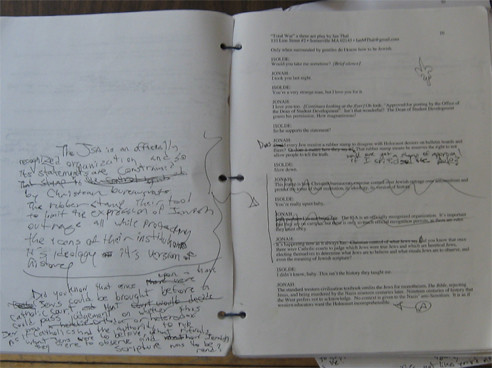
A couple of weeks ago, I completed the latest set of rewrites to Total War. It was an intense bit of work that began with a trimming of both the longer passages and more philosophically dense passages and an extension of the more character driven drama, trying to expand upon some of the ironies that Thomas Garvey noted during the talk-back session at the end of the April 26th staged reading.
Another important structural element was seeing that each of the five acts had their own themes, and that an epistemological question dealt with in the first act did not need to be reintroduced in the fourth act except in the most oblique manner.
Trudi Goodman, who had also been in the audience, had some interesting notes about the derivation of the Yiddish slur, "shiksa" that also managed to find its way into the rewrite.
Mikey DiLoreto's reading of the character of Donald was somewhat unexpected and caused me to rethink the character to a point where I recited the mantra of "Donald is the type of guy who..." whenever I worked on a scene in which he appeared.
The final stage of the rewrite was helped along by the sudden arrival of summer weather in the first week of July, during which I could spend some time on my back porch along with my modest garden of basil and mint plants with a copy of the script, a pen, and a large mug of coffee, proofreading, and cutting unnecessary repetitions. Every twenty or thirty pages or so, I would get out of the sun, and type up those changes.
The result is a draft with a stronger ending (oddly enough, revolving around the same three characters), more character-based drama, and a shorter page count.
The next staged reading is booked for the evening of October 11, once again at Outpost 186, but I'm going to wait a few weeks before I start putting a cast together. Afterwards, I will see what else I need to change.
Thursday, April 30, 2009
The Staged Reading and What I Learned

Cast of the April 26th reading of Total War at Outpost 186. Note that Anthony DiBartolomeo has been replaced by Stuart G. Levy. The author regrets not taking more photographs.
Despite whatever the lone protester outside of Outpost 186 during the staged reading of Total War was attempting to do, the main event was inside.
Over the previous few days of read-throughs with some of the actors, and conversations with my stage manager, Anika Hannibal-Colvin, certain problems with the current draft became evident. Corrections were often made on the fly and and some notes regarding the next draft were written down. Some of these issues were reaffirmed when I listened to the staged reading with script in one hand and a pen in the other.
Before I engage in some-lengthy self critique, I should note that on the positive end, most of the comedic banter seemed to work, the more poetic florishes were effective, the characters came across as fleshed out, and the audience seemed engaged by the subject matter and storyline, but I had not produced the reading for the purpose of self-congratulation or solicitation of allocades. The purpose was to identify the flaws, and to give direction to the next rewrite.
The Reading:
As I listened, I noted that the second scene of the first act, which had been effective as a piece of written text and would likely work well if staged by a competent director, is dreadfully boring as a purely spoken text. While there are a few good dramatic moments in the scene, but it's basically an info-dump. I still think the play needs the scene, but the scene needs trimming.
The repetitions through the play were not nearly as bad as I feared during the read-throughs, but "not nearly as bad" does not mean "great."
The last scene was somewhat anticlimactic (as I had feared,) and while I am certain a good director could stage it so that it would be more dramatically satisfying, it seemed to me that the director's job is not to make up for the authors' short-comings.
The Talk Back:
Nika took charge during the talk-back, allowing me to take a minimal role in the conversation that followed between the audience and actors. I tried to take whatever notes I could, since the goal was neither to explain nor defend the work, but to listen to others.
Andrew Hicks, amongst the actors, was the most forthright in his criticism of over-reliance on "dialectics" in certain scenes. If I understand correctly that he means philosophical back and forth about epistemology that strays away from the more concrete issues explored by the rest of the play. Jonah, the character Andrew portrayed, certainly should be concerned with epistemology, but for him to go on at length about epistemology without reference to Jewish-Catholic relations or Holocaust denial (the two historical issues the play dwells upon) amounts to a distraction and fails to convey how intertwined Jonah's emotional and intellectual life are. Some of the audience (again, otherwise engaged by other aspects of the story) stated that they felt somewhat alienated in those sections.
A number of other notes from the audience concerned simply placement of scenes, or emotional content of specific scenes. One phenomenon I noticed more than once was that when members of the audience (even in one case, a veteran actor) questioned the emotional tone of certain scenes or relationships between the characters, the actors playing those scenes were quick to defend the emotional aspect. This, I suppose, might a consequence of the very different ways the actors and audience experience the characters.
While some would balk at inviting a critic to attend the reading of a work-in-progress, Thomas Garvey's presence was invaluable during the talk-back. Besides complementing my use of several layers of irony, and his exploration of the less-than-noble qualities of the protagonist, he keenly identified the central conflict arc, and how it failed to advance beyond a certain point, though also pointing out that to fully develop this arc would require a substantial rewrite.
Observations:
The play is not hurt by the research I conducted, but there is such a thing as putting too much of my research into the dialogue. The characters who are motivated by ideology (whether political or theological) were made authentic by the research, but if I made an error, it is that I felt the need to present a logical proof of their authenticity.
Scenes are weighed down by dialectics about historiography, truth in the post-modern era and theology, and a few audience members reported not being able to follow the discussion even if they were engaged by the rest of the story. It's not just a matter of shortening these passages: the lines from these scenes that use more metaphorical or allegorical language are more successful: they convey the emotion and they give the actors and audience more with which to work. After all, Plato's dialogues are rarely performed on stage, and to the extent anyone outside the world of Plato scholarship remembers any part of his ouvre, it's because of a notable allegory or sensual subject matter. Those who enjoy dialectics should be able to extrapolate the argument from the poetry, but for the rest, give them poetry.
I was working with a smart group of actors, but there were several points where I let them down at times by inserting jokes that not only required specialized knowledge to understand (and therefore deliver) but they were further obscured by the fact that the script did not even provide a hint to the actor as to where the could look up the concept being lampooned. (Even from my perspective, they were not the funniest jokes in the play.) Telling the actors (as I did to Andrew Hicks and Tom Sprague during the read-throughs) that "deliver anything that looks like a joke as a joke" simply isn't giving the actors a chance to inhabit the characters.
And now, to begin the rewriting...
Subscribe to:
Posts (Atom)


