Showing posts with label Anika M. Colvin-Hannibal. Show all posts

Friday, March 26, 2010

Cast for March 28th Staged Reading of "Total War"

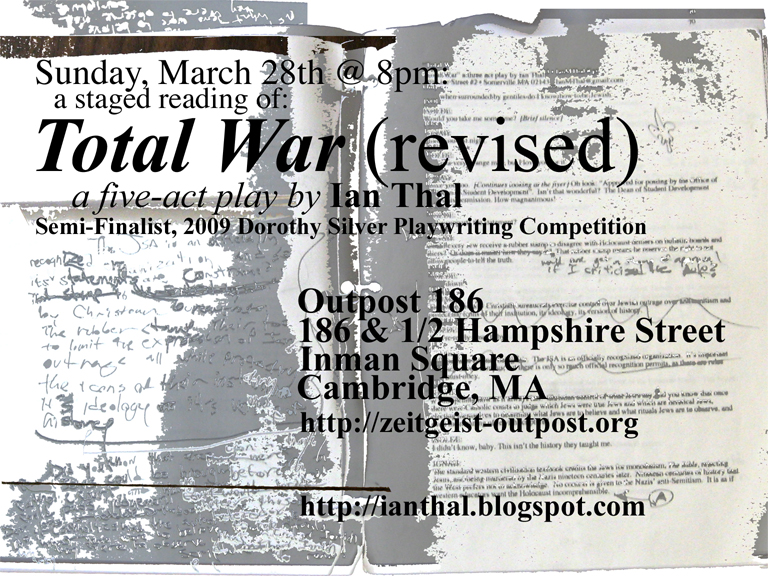
Poster for Staged Reading of "Total War" 3/28/2010

Sunday, March 28th at 8pm at Outpost 186
186 1/2 Hampshire Street, Inman Square, Cambridge MA

A staged reading of Total War, a play by Ian Thal

Cast:

Jonah Gringer: Dan Schneider

Andrea Kunst: Savanah Shaughnessy

Edith Havilland: Kate Heffernan

Erica Weiss: Kendall Stewart

Father Aldobrandini:Martin Comack

Father John Bullock: Tom Sprague

Richard Doncaster: James Bocock

Duane McCormack: Matthew Zahnzinger

Donald Crincoli: Andrew Gerst

Campus Police Officer: Trudi Goodman


Stage Manager: Anika M. Colvin-Hannibal

Thursday, October 29, 2009

Time Question

In a recent thread on the Plays and Playwrights Yahoogroup a number of participants asked what it meant when it is written in the body of the play that it takes place in "the present" (presumingly when it was written) but that "present-day" references are often dated by the time of a given production.

Of course to my mind, even "the present" is a specific milieu; stories set in "the present" rapidly recede into historical fiction. Certainly, when I chose to set Total War in the 1990s, and not "the present" it meant that the characters would be making cultural and political references and using technologies of that era and not of "the present" I currently inhabit.

As a consequence, I made a small number production notes throughout the script in order to explain some of these technologies that are either no longer in use, or may be disappearing in the foreseeable future. The result was an instance of an unintended outburst of laughter when at the last staged reading, the audience heard stage manager, Anika M. Colvin-Hannibal read aloud:

[NOTE: Due to the time period in which this play is set, a "Dictionary" is a large bound book with a finite number of pages of paper, and not a potentially infinite digital hypertext.]

Sunday, October 18, 2009

Total War: Post-Reading Analysis

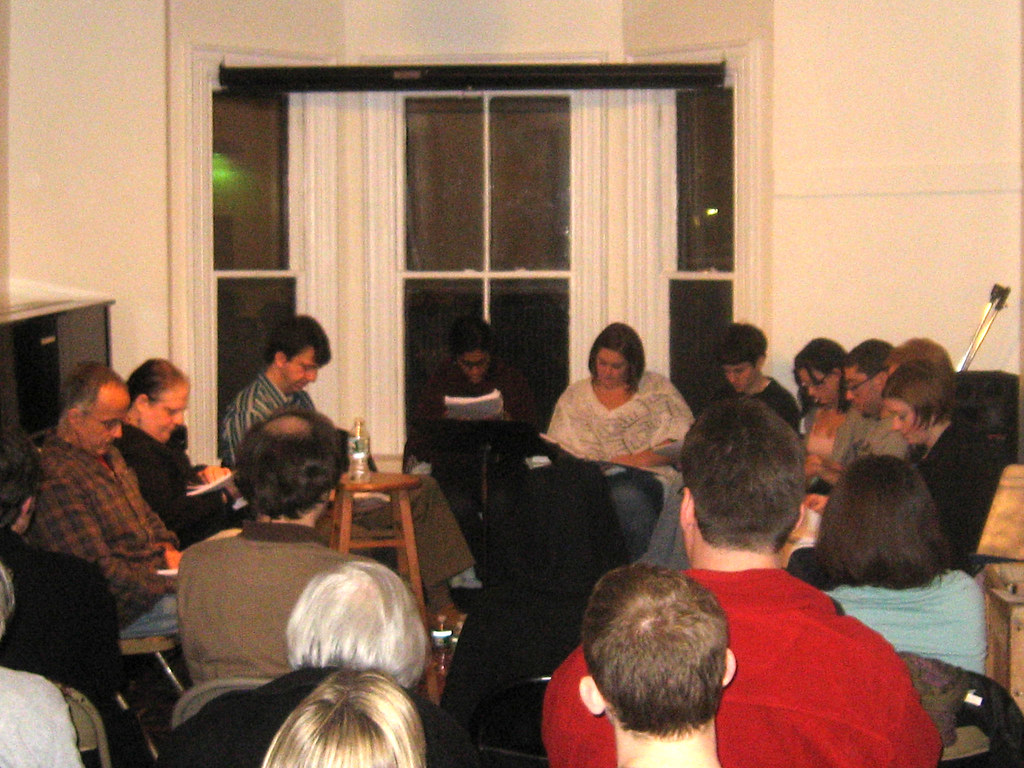
October 11, 2009 staged reading of "Total War"Cast from left to right: Lou Fuoco, Trudi Goodman, Tom Sprague, Anika Colvin-Hannibal, Savanah Shaughnessy, Daniel Schneider, Kendall Stewart, Mikey DiLoreto), Matthew Zahnzinger (sadly barely visible), and Kate Heffernan. Once again, I forget to take a lot of photographs.

And now for the post-reading analysis.

The event received blurbs from Art Hennessey's Mirror up to Nature as well as from Thomas Garvey's Hub Review. Garvey was good enough to point out that:

The topic is a fascinating one - the legacy of Catholic anti-Semitism on a very Boston-College-like campus that is, of course, not, not Boston College.


Garvey is correct: The student newspaper in the play does not even have the same name as any Boston College student publication and due to my utter lack of imagination, I did not even bother to name the school in the play. Though many theatre artists have an antagonistic relationship with critics, as we see, critics fulfill an important function clarifying such misunderstandings that the audience might have. The notion that a graduate of Boston College might write a play set at Boston College, while an easily made error, is clearly ludicrous when examined with a critical eye.

But on to the evening's main event:

Unlike last time, there was not an inarticulate Hamas supporter accosting actors and audience members as they approached (a friend reports that Rolde has also been absent from his usual activities loudly denying war-crimes in Darfur.)

However, we were not without minor crises of a more theatrical nature. John M. Costa was called away at last moment; and thankfully, though it amounted to unconventional casting, Trudi Goodman was on hand. Trudi was already reading the small role of the unnamed campus police officer, but was up for the role of Richard Doncaster, Dean of Students. The the result was plenty of unintentional comedy as actors either did or did not improvise around the changed gender of the actor! Trudi was great, by the way, and I really need to think about writing roles for her to play if I'm going to continue with this playwright thing.

As the audience filled in, and we waited for a couple of late arriving actors, I noticed a far larger turn out than the last reading. In fact, every seat in the room was filled and I even gave up my seat and spent most of the time perched on a coffee table in the back of the room.

I scribbled notes and corrections in the back as I read along with the actors. Though the play was only two pages shorter than the previous draft, the rewrites had made for a faster pace ("crisper" was the adjective used by some of the returning actors.)

I'm definitely much happier with this version, though I still feel that the pace seemed to slow down right in the middle-- not as much as with the previous draft-- but it's something I noticed. One audience member noted that including intermission, the run-time was two hours and twenty minutes and a that's too long in my mind for there to be a slow moment. The audience seemed divided as to whether the play was just a little too long or just the right length.

Another observation: I really need to put a pronunciation guide in the play. There are French, German, Hebrew, Latin, Polish, and Yiddish words and place names scattered throughout the script.

Most of the audience comments were positive though there were a few interesting questions:

One audience member wondered why at a Catholic school, why one of the key characters be so clearly identified as a lapsed-Protestant (perhaps not so unusual in the United States, but the speaker had spent some years living in Ireland) yet she also gave me kudos for properly using the term "deconstruction."

Another felt I should expand on my allusions to a certain Jewish prophet but also thought I should run the play by a Catholic theologian to make sure I am accurately representing doctrine. (Probably good advice, even though I did research the theology pretty carefully and did get an "A" in my Thomas Aquinas class in grad school.)

One of my young commedia students asked if I plan to write a sequel. No plans for writing a sequel and no intention of revisiting the setting, but there are certain themes and even a character or two I might want to revisit.

One audience member took such a dislike to Donald (played by Mikey DiLoreto) and attempted the argument that Donald was a supernumerary character. Mikey's job is safe though if for no other reason than some of the biggest laughs came from Donald's vulgar mouth, though the look on Mikey's face was priceless (sadly, I was taking notes at the time and so had pocketed my camera.)

Kate Heffernan (who played Edith) made this playwright very happy when she noted the revelation of the lack of a conspiracy which had been foreshadowed from the very first act-- despite the fact that Edith isn't in any of the scenes where this motif is brought up.

There were a number of other interesting side conversations between the actors and audience about the themes that the play explored but not necessarily about the the writing itself-- but interesting enough for me to ponder as as I consider rewrites.

Afterwards, people grabbed a few more bites of cheese and chocolate and cleared out. I was surprised that everyone shied away from the hummus.

Nika and I met several days later to go over the reading (it's useful to have the stage manager's opinions since she was more proximate to the actors during the reading than I) and we were able to unravel what differences were the result of a rewrites since the previous reading and which differences were the result of a change of certain cast members. We agreed that the cutting away of extraneous material brought certain characters into sharper focus

I still need to tighten Act III.
Wednesday, September 23, 2009

Cast for October 11th Staged Reading of "Total War"

Sunday, October 11th at 8pm at Outpost 186
186 1/2 Hampshire Street, Inman Square, Cambridge MA

A staged reading of Total War, a play by Ian Thal

Cast:

Jonah Gringer: Dan Schneider

Andrea Kunst: Savanah Shaughnessy

Edith Havilland: Kate Heffernan

Erica Weiss: Kendall Stewart

Father Aldobrandini: Lou Fuoco

Father John Bullock: Tom Sprague

Richard Doncaster: John M. Costa

Duane McCormack: Matthew Zahnzinger

Donald Crincoli: Mikey DiLoreto

Campus Police Officer: Trudi Goodman


Stage Manager: Anika M. Colvin-Hannibal


N.B. As of September 30, Matthew Zahnzinger has been cast as Duane McCormack.

Thursday, April 30, 2009

The Staged Reading and What I Learned


Cast of the April 26th reading of Total War at Outpost 186. Note that Anthony DiBartolomeo has been replaced by Stuart G. Levy. The author regrets not taking more photographs.


Despite whatever the lone protester outside of Outpost 186 during the staged reading of Total War was attempting to do, the main event was inside.

Over the previous few days of read-throughs with some of the actors, and conversations with my stage manager, Anika Hannibal-Colvin, certain problems with the current draft became evident. Corrections were often made on the fly and and some notes regarding the next draft were written down. Some of these issues were reaffirmed when I listened to the staged reading with script in one hand and a pen in the other.

Before I engage in some-lengthy self critique, I should note that on the positive end, most of the comedic banter seemed to work, the more poetic florishes were effective, the characters came across as fleshed out, and the audience seemed engaged by the subject matter and storyline, but I had not produced the reading for the purpose of self-congratulation or solicitation of allocades. The purpose was to identify the flaws, and to give direction to the next rewrite.

The Reading:

As I listened, I noted that the second scene of the first act, which had been effective as a piece of written text and would likely work well if staged by a competent director, is dreadfully boring as a purely spoken text. While there are a few good dramatic moments in the scene, but it's basically an info-dump. I still think the play needs the scene, but the scene needs trimming.

The repetitions through the play were not nearly as bad as I feared during the read-throughs, but "not nearly as bad" does not mean "great."

The last scene was somewhat anticlimactic (as I had feared,) and while I am certain a good director could stage it so that it would be more dramatically satisfying, it seemed to me that the director's job is not to make up for the authors' short-comings.

The Talk Back:

Nika took charge during the talk-back, allowing me to take a minimal role in the conversation that followed between the audience and actors. I tried to take whatever notes I could, since the goal was neither to explain nor defend the work, but to listen to others.

Andrew Hicks, amongst the actors, was the most forthright in his criticism of over-reliance on "dialectics" in certain scenes. If I understand correctly that he means philosophical back and forth about epistemology that strays away from the more concrete issues explored by the rest of the play. Jonah, the character Andrew portrayed, certainly should be concerned with epistemology, but for him to go on at length about epistemology without reference to Jewish-Catholic relations or Holocaust denial (the two historical issues the play dwells upon) amounts to a distraction and fails to convey how intertwined Jonah's emotional and intellectual life are. Some of the audience (again, otherwise engaged by other aspects of the story) stated that they felt somewhat alienated in those sections.

A number of other notes from the audience concerned simply placement of scenes, or emotional content of specific scenes. One phenomenon I noticed more than once was that when members of the audience (even in one case, a veteran actor) questioned the emotional tone of certain scenes or relationships between the characters, the actors playing those scenes were quick to defend the emotional aspect. This, I suppose, might a consequence of the very different ways the actors and audience experience the characters.

While some would balk at inviting a critic to attend the reading of a work-in-progress, Thomas Garvey's presence was invaluable during the talk-back. Besides complementing my use of several layers of irony, and his exploration of the less-than-noble qualities of the protagonist, he keenly identified the central conflict arc, and how it failed to advance beyond a certain point, though also pointing out that to fully develop this arc would require a substantial rewrite.

Observations:

The play is not hurt by the research I conducted, but there is such a thing as putting too much of my research into the dialogue. The characters who are motivated by ideology (whether political or theological) were made authentic by the research, but if I made an error, it is that I felt the need to present a logical proof of their authenticity.

Scenes are weighed down by dialectics about historiography, truth in the post-modern era and theology, and a few audience members reported not being able to follow the discussion even if they were engaged by the rest of the story. It's not just a matter of shortening these passages: the lines from these scenes that use more metaphorical or allegorical language are more successful: they convey the emotion and they give the actors and audience more with which to work. After all, Plato's dialogues are rarely performed on stage, and to the extent anyone outside the world of Plato scholarship remembers any part of his ouvre, it's because of a notable allegory or sensual subject matter. Those who enjoy dialectics should be able to extrapolate the argument from the poetry, but for the rest, give them poetry.

I was working with a smart group of actors, but there were several points where I let them down at times by inserting jokes that not only required specialized knowledge to understand (and therefore deliver) but they were further obscured by the fact that the script did not even provide a hint to the actor as to where the could look up the concept being lampooned. (Even from my perspective, they were not the funniest jokes in the play.) Telling the actors (as I did to Andrew Hicks and Tom Sprague during the read-throughs) that "deliver anything that looks like a joke as a joke" simply isn't giving the actors a chance to inhabit the characters.

And now, to begin the rewriting...

Friday, April 17, 2009

Cast for Staged Reading of "Total War"

In the process of learning that self-producing a staged reading is harder work than I expected, I have assembled a cast of players to help me with the April 26th reading of Total War at Outpost 186:

Duane McCormack: Anthony DiBartolomeo

N.B.: Stuart G. Levy played the part of Duane on April 26th.

Edith Havilland: Kate Heffernan

Donald Crincoli: Mikey DiLoreto

Jonah Gringer: Andrew Hicks

Andrea Kunst: Krystle Spoon

Father Aldobrandini: Lou Fuoco

Erica Weiss: Lesley Anne Moreau

Father John Bullock: Tom Sprague

Richard Doncaster: John M. Costa

Campus Police Officer: Dale Appel

Stage Directions: Anika M. Colvin-Hannibal