Showing posts with label World War II. Show all posts

Friday, August 24, 2012

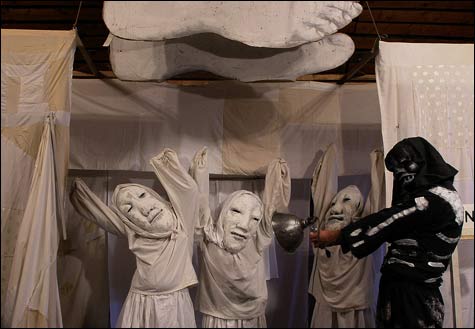
Nothing But Trouble: Bread & Puppet Theater's Peter Schumann

Left: 1934 issue of Die Brennessel portrays a Jewish press magnate subverting Germany with a phallic tube of lies
Right: Bread & Puppet iconic avatar of the evils of modernity, Uncle Fatso, with phallic cigar.

In the latest installment of my "Nothing But Trouble" column at the Clyde Fitch Report, I discuss the politics of Bread & Puppet Theater founder, Peter Schumann on the occasion of his receiving Goddard College's Second Annual Presidential Award for Activism. Goddard President Barbara Vacarr, in her speech introducing Schumann, noted:

[...J]ust as individuals do, human societies tend to see what they want to see. They create national myths of identity out of a composite of historical events and fantasy narratives that, if not challenged, lead to destruction[...]

[...V]isionary artists like Peter Schumann are our sharpest eyes, our keenest ears, our most adept linguists as they see that which has been made invisible or unwelcome, they hear the voices missing from our dominant narratives and they speak in languages that pierce unconsciousness and translate slick sound bites into nuanced and deeper understandings of our world.

Of course, the visionary artist is another myth, and when we start examining the myth of Peter Schumann, we find something that should at least give us pause:

Schumann speaks frequently of being born in 1934 in a region called Silesia, but he neglects to mention that it was part of the Third Reich and that his hometown of Breslau (now Wroclaw, Poland) was a major base of support of the National Socialist German Workers’ Party. Indeed, the local German population provided a fertile ground for Naziism to take root: in the 1920s, mob violence had already forced much of the city’s Jewish and Polish populations to leave, and, over the course of Schumann’s childhood, the city was rendered Judenfrei through deportations. Breslau was a city surrounded by a network of concentration camps and slave labor camps providing commercial products for the city. Despite the political nature of his art, Schumann never addresses the fact that for the first 11 years of his life, he was a child of Nazi Germany. He never discusses whether or not his parents were party members, whether or not he was a member of the Deutsches Jungvolk (the Hitler Youth subdivision for boys aged 10-14), or how these experiences influenced him. Popular book-length studies of Schumann and Bread & Puppet (like George Dennison’s An Existing Better World: Notes On The Bread & Puppet Theater and Marc Estrin’s essays for Rehearsing with Gods: Photographs and Essays on the Bread & Puppet Theater) make no mention of Schumann’s life in Nazi-era Silesia.

The question I have been asking since 2007 since I stopped performing with Bread & Puppet has been how much of Schumann's politics are influenced by his childhood in Nazi Germany?

Read the rest in The Clyde Fitch Report!

Wednesday, April 25, 2012

Vicariously Duped About Dresden, Or How Dare I Note That Venerated German American Novelist Kurt Vonnegut May Have Spent His Entire Career Making Erroneous Statements About The Fire Bombing Of Dresden, Germany As Told In YouTube Comments And Blog Posts

Last month, I noted that a 2005 BBC programme memorializing the 1945 Allied bombing of Dresden during World War II featured an interview with American novelist and humanist Kurt Vonnegut. Vonnegut had been in Dresden during the bombing as a prisoner of war, and drew on his experiences of the bombing and its aftermath in his famed novel, Slaughterhouse Five. The problem is that in the novel, the interview, as well as in other writings, Vonnegut erroneously states that the death toll of the bombing was 135,000.

135,000 is a piece of disinformation hatched up by German neo-Nazi, Hans Voigt, and disseminated in English by the British Holocaust denier and fraudulent historian, David Irving. Historical consensus has since placed the actual death toll much lower: generally somewhere between 18 and 25 thousand (most estimates I have seen support the lower figure.)

I posted the following comment to the YouTube video:

The figure of 135,00 that Vonnegut cites is derived from the "The Destruction of Dresden" by David Irving, an infamous Nazi-sympathizer and Holocaust denier. He knowingly based his figures on Nazi propaganda. The figures compiled by the city of Dresden at the time resulted in the estimate of 25,000. A more recent study commissioned by the city of Dresden places the death toll at around 18,000.

I certainly do not believe that Kurt Vonnegut used the 135,000 figure out of sympathy with Irving or Irving's politics. Irving's book, The Destruction of Dresden was was simply the most widely available book on the subject at the time that Vonnegut was attempting to make sense of his wartime experiences and incorporate those experiences into his novel. I am more concerned with the fact that since Slaughterhouse Five and Vonnegut's other literary accounts comprise the primary source for most English speakers' knowledge of the Dresden bombing, that he was repeating the 135,000 figure in 2005, long after Irving had been widely discredited, and that the BBC apparently did not fact check that statement in a programme about the bombing.

My comment was met with hostility as I expected it would. As I learnt when I first took Peter Schumann of Bread and Puppet fame to task on his misrepresentations of both the Warsaw Ghetto and the Israeli-Palestinian conflict, I found that criticizing venerated figures results in a backlash. What follows are some highlights:

From "vaporcobra" who argued from authority and accused me of being a conspiracy theorist:
You kidding me? Take your conspiracy elsewhere. I didn't mind up until you insulted someone who is obviously a genius and obviously is not manipulated as easily as you infer he is.
Get YOUR facts straight before you insult someone whose work is in the canon.
"masterchiefer123" used some particularly colorful invective:
You're a disgusting brain washed sheep obviously biased its despicable...Trying to make it sound like the allies did no wrong. go learn history, you werent there, kurt vonnegut was...his words or yours?...id choose him obviously
"aboxandtheghostinit" was particularly inventive:
Published in 2008 you say, Vonnegut died and this program was aired in 2007. I don't disagree with the revised numbers but love how you embrace this study yet Irving is a "Holocaust denier" for questioning the numbers that died in the camps. You sound like a Dresden denier and mass murder-sympathizer to me ;)

"aboxandtheghostinit" actually suggests that accepting the the general consensus of historians who have examined all the evidence about the bombing of Dresden over the unsupported statements of Hans Voigt is on par with denying the Holocaust, the best documented genocide in human history.

However, the most clever response was from "ssJokatu":
The numbers keep on dropping. Does it really matter that much in the end?
Vonnegut was hardly a historian, but a fiction writer. We could argue the factual existence of characters in the end.
I don't deny the overestimation by Nazi propaganda, but in the end, in truth, people died. Jews, Refugees, Soldiers, Children, Japs, Chinese, Nazis, and morals. It's immoral to justify death with death, or justify death with different statistics.
135,000 died in a story with aliens in the end. War is cool..

"135,000 died in a story with aliens in the end." I do not suppose that the BBC fact checked the existence of Tralfamadorians either.

Thursday, March 29, 2012

Slaughterhouse Five and Being Duped About Dresden

As an occasional reader of Dangerous Minds, I took interest when contributor Paul Gallagher posted the following video taken from an interview of Kurt Vonnegut by BBC news presenter James Naughtie for a 2005 episode of This Week that commemorated the 60th anniversary of the Allied Forces' bombing of Dresden.

Vonnegut's experience of the bombing of Dresden, which he survived while being kept in an underground meat locker as a prisoner of war, famously informs what is arguably his most celebrated novel, Slaughterhouse Five.

Note that in the interview, he gives the death toll of the bombing of Dresden as 135,000. This is consistent with the 1969 novel. It is also consistent with the autobiographical note from the introduction of Mother Night:

Everything was gone but the cellars where 135,000 Hansels and Gretels had been baked like gingerbread men. So we were put to work as corpse miners, breaking into shelters, bringing bodies out.

During the 1960s, when he was researching his novel, not much was known by the general American or British public regarding the bombing, and so he relied on what appeared to be the most authoritative account available: David Irving's The Destruction of Dresden. The original 1963 edition of The Destruction of Dresden claimed that the raids by the United States Army Air Force and Royal Air Force are "estimated authoritatively to have killed more than 135,000 of the population" of Dresden. There are several problems with this figure, not only have historians subsequently shown that the figure is much smaller, but Irving, going against all scholarly protocols, relied on a single source for this figure of 135,000–– namely the testimony of Hans Voigt. Voigt had been an assistant schoolmaster in Dresden who had been placed in charge of a dead persons department by the Saxon Ministry of the Interior. Voigt's office identified approximately 40,000 victims, but Voigt told Irving that the dead were likely 135,000. This statement was Irving's only evidence for that figure. Voigt, however, was not a simple former schoolmaster who had an unpleasantly morbid wartime job: By the time he was in touch with Irving in 1961, he was under observation by local authorities for fascist activities. Irving, taking this figure of 135,000 to be authoritative also gives an estimate of a death toll as high as 250,000 (derived entirely from Nazi propaganda.)

In subsequent years, Irving would come to revise his earlier estimate, but as late as 1993 still estimated that that more than 100,000 people had died in the bombing.

David Irving is no longer taken seriously as a historian. Over a career spanning decades, he became more and more associated with Holocaust denial and Nazi apologetics. As each new book came under increased scrutiny, numerous reviewers had noted that Irving was unscrupulous with historical evidence, routinely manipulating the evidence to promote a pro-Hitler agenda. In 1993, Deborah Lipstadt wrote in her book, Denying The Holocaust: The Growing Assault on Truth and Memory:

A review of [Irving's] recent book, Churchill's War, which appeared in New York Review of Books, accurately analyzed his practice of applying a double standard of evidence. He demands "absolute documentary proof" when it comes to proving the Germans guilty, but he relies on highly circumstantial evidence to condemn the Allies. This is an accurate description not only of Irving's tactics, but of those of [Holocaust] deniers in general.

In 1996 Irving filed a libel suit against Lipstadt and her British publisher, Penguin Books. Richard J. Evans, a historian who had been hired by the defense to analyze Irving's writings and handling of the evidence, was able to substantially demonstrate in his testimony that Irving, in fact, consistently manipulated evidence in order, if not to cast Nazi Germany and the Allies as moral equivalents, to portray Germany as the victim and the Allies as villains of World War II. (Note: While Evans' testimony addressed the entirety of Irving's published works, we are focussed on Irving's claims about Dresden. Evans recounted his work as an expert witness in Lying About Hitler: History, Holocaust, And The David Irving Trial which was published in 2001; the UK edition is titled Telling Lies About Hitler: The Holocaust, History and the David Irving Trial.)

Even before the trial, Irving's figures were already widely discredited amongst WWII historians and were largely contradicted by documentary evidence. A "Final Report" issued by the Dresden Police on March 15, 1945 placed the death toll at 18,375. The police report was classified as "secret" and suppressed by the local party. Most official reports of the time give death tolls ranging from 20,000 to 22,000. A 2008 study commissioned by the city of Dresden, entitled “Dresden Commission of Historians for the Ascertainment of the Number of Victims of the Air Raids on the City of Dresden on 13/14 February 1945” gives an estimate of 18,000. While other historians had before that point proposed higher figures, up until the 2008 report. Quite simply, no serious investigation of the bombing of Dresden on February 13th and 14th 1945 has proposed a death toll higher than 25,000.

The point is that over the course of his career Vonnegut had many opportunities to learn that the figure of 135,000 dead from the bombing of Dresden was not backed up by evidence, especially as his main source had been repeatedly discredited-- not merely in scholarly publications but in a high profile court decision that was issued in April of 2000–– five years before the BBC interview. As Vonnegut's fiction and non-fiction essays are arguably the most persistent manner by which the bombing of Dresden has entered into the popular consciousness within the Anglophone world, it strains credulity that no one had attempted to contact Vonnegut about his repeated misstatement. If Vonnegut were understandably reluctant to alter the text of his novels, it still seems odd that he would not issue a correction in the introductions or postscripts of subsequent printings, or at least a clarification in an interview. It is even more disturbing that neither James Naughtie nor any other BBC staff working on a story about the bombing of Dresden attempted to correct Vonnegut during the interview, or edit out a misstatement of fact.

Vonnegut is not the only artist who may have been duped by David Irving. As I have noted elsewhere, British playwright Michael Frayn, while researching Copenhagen, his 1998 play about Werner Heisenberg, Niels Bohr and the nuclear bomb, similarly relied upon Irving's writings, citing Irving's 1967 book, The Virus House (published the following year in the U.S. as The German Atomic Bomb.) Also citing correspondence between Werner Heisenberg and David Irving in his postscript to the play.) Frayn similarly draws a false moral equivalence between his two physicists, making much of Heisenberg's anguish at the bombing of German cities while downplaying not just the horrors that Germany visited from the air, but portraying Bohr as morally aloof, ignoring his humanitarian efforts that helped save the Jews of Denmark from extermination (Frayn's also play insinuates that Heisenberg had an indirect role in the rescue.) While Frayn is hardly the Nazi-apologist that Irving is, he too obscures historical facts in such a way as to present a story of German victimhood (though in a "Post-Postscript" of which I was not previously aware he defends himself from this criticism merely by stating that German war crimes are well enough known to the general public.)

These numbers become even more problematic for Vonnegut because he makes a direct comparison between Dresden bombing and the Holocaust noting that the exaggerated death-toll "is between two and three percent of the number of Jews who were killed in the Holocaust." (The 2% to 3% figure results in either the impossibly low figure of 4,455,000 to the high estimate of 6,750,000–– but we must not fault Vonnegut for not using decimals in an interview.) Even as David Irving is reviled within the field of World War II history as a fraud and a Holocaust denier, by duping Vonnegut, he has successfully mythologized Dresden in the popular consciousness, thus enlisting many a self-identified humanist in an effort to draw a false moral equivalence between the Third Reich and the Allies–– precisely what Hitler apologists try to do, even as they deny or attempt minimize the scale or significance of the Holocaust.

Saturday, January 28, 2012

If Amnesty International Had Its Own Theater Company

Boston Herald theatre critic Jenna Scherer writes:

If Amnesty International had its own theater company, Bread & Puppet would just about fit the bill.

In the course of its nearly 50-year existence, the Vermont-based collective has tackled more human rights issues than any other troupe out there. B&P’s viewpoints are incendiary and its style unorthodox, and attending one of its shows is a totally unique theatrical experience.

I would not dispute the point that Bread & Puppet's style is unorthodox; so at variance with the rest of the theatre world that I regard the rich dramaturgical vocabulary is worthy of study by both theatre artists and scholars, indeed "Bread & Puppet" has become a generic term to refer to a style of protest theatre: any usage of large allegorical papier-mâché puppets. However, I question Scherer's assertion that B&P should be representing any human rights group. After all, how do you square a concern for human rights with public statements by B&P founder and artistic director, Peter Schumann?

I think it’s awful that the Western community does not interfere with what Israel’s doing as an occupation force [in the West Bank]. The Western community does not do anything about it. They don’t even speak up against it. They don’t do anything. They basically serve as the Israeli propaganda for the events there.

In this statement, from a 2008 interview with the New England Journal of Aesthetic Research, Schumann does more than criticize Israeli policies in the West Bank (in this specific instance, it was the the wall that was built to prevent suicide bombers from entering Israel.) He claims that "the Western community" by which he appears to mean the governments and media outlets of the European and North American nations are somehow under Israeli control. How does Israel get the "Western community" to produce propaganda for Israel and obey Israeli interests? Money? Well-placed people in government? If it is the influence of money or well-placed people, how is this substantially different than other forces influencing the "Western community." I have noted this implausibility elsewhere. This "Western community" is either made up of sovereign states or media outlets that reside in sovereign states that have interests other than serving as "Israeli propaganda" organs.

Schumann is not "criticizing" Israel, rather, he is openly propounding an anti-Semitic conspiracy theory, using the fuzzy logic of allusion and moralistic pronouncements. This conspiracy theory is not unlike those he would have encountered during his childhood in Nazi Germany. While Schumann often speaks of his childhood in Silesia, often bitterly complaining that it was annexed to Poland after World War II, he rather consistently neglects to mention that Silesia was part of the Third Reich. He has also managed to solicit cooperation from interviewers in misrepresenting his childhood. By Schumann's logic, one could accuse the Vermont press of serving as Schumann propaganda by helping him hide his origins.

Take this cover from a 1942 issue of Fliegende Blätter depicting Winston Churchill, Franklin Delano Rosevelt, and Joseph Stalin as puppets of "The Jews.":

Another 1942 cartoon portraying the same world leaders as puppets of a Jewish puppeteer, this time in the Lustuge Blätter:

This 1940 cover to the Lustige Blätter reads "Englands Führung Liegt in Guten Handen!" or "England's leadership is in good hands!" while depicting Winston Churchill being led like a child by a stereotypical Haredi Jew:

While in this 1934 cartoon from Die Brennessel portrays a Jewish controlled press subverting Germany from abroad:

The imagery in these cartoons certainly were incendiary: They had the overall effect of making anti-Jewish legislation, street violence, deportations, and genocide more palatable to the German public-- even to those Germans who did not buy into biological racism. So it is disheartening to find a German artist who grew up during that time period repeating the same canards.

It becomes even more disturbing when we consider the strong semblance between some of these grotesque Jewish caricatures and Schumann's own personification of the evil powers-that-be, Uncle Fatso:

I have been raising these difficult questions since I walked out of a 2007 rehearsal with Bread & Puppet after Schumann made a series of installations comparing the West Bank to the Warsaw Ghetto. I was too knowledgeable about the history to not to realize that this was a misrepresentation of the Israeli-Palestinian conflict as well as a form of "soft-core" Holocaust denial, in that it deliberately trivialized and misrepresented the facts of the Holocaust.

The point is that a theatre company whose artistic director creates anti-Semitic propaganda (even thinly disguised anti-Semitic propaganda) and makes anti-Semitic statements in interviews should not be proposed as the theatrical arm of a human rights NGO, as Jenna Scherer does. Not that I believe that Scherer is making a serious proposal, but it is clear that she is also not engaged in serious thought, having succumbed to the notion that theatre criticism amounts to writing blurbs.

Note: I previously took issue with Jenna Scherer when she was still at The Weekly Dig.

Nazi-era cartoons courtesy of Randall Bytwerk's German Propaganda Archive.

Saturday, January 14, 2012

Some Thoughts on Michael Frayn's "Copenhagen"


Last night, I caught Flat Earth Theatre's production of Michael Frayn's Copenhagen. It was not my first encounter with the play: I had attended the 2008 production at American Repertory Theater and had read the script a few months ago. Copenhagen, like very few contemporary plays, holds up both as a script for performance and as a literary work. Furthermore, after seeing Flat Earth's production (directed by Jake Scaltreto who shows himself to be more imaginative, thoughtful, and understanding of the text than A.R.T.'s Scott Zigler) I felt vindicated in my 2008 intuition that the play demands both multiple viewings and multiple productions.

However, the more I consider the script and the moral argument that Frayn seems to be making, the more I come to doubt that earlier intuition. What follows is not a review, but a few questions that bother me every time I encounter this play. One of the major themes of Copenhagen is the moral responsibility of scientists during wartime, specifically focussing on Niels Bohr and Werner Heisenberg, and their work on developing the nuclear bomb for America and Germany respectively. Of course, as history tells us, Germany failed to develop nuclear weapons, while America, famously benefiting Germany's racial laws that drove most of the top physicists out of both Germany and German-occupied Europe, succeeded.

Much is made of Heisenberg's moral calculations as to why he chose to work on the bomb. He was relatively apolitical, and showed a sufficient intellectual independence from Nazi ideology to get himself in trouble with SS Reichsfürhrer Heindrich Himmler for his opposition to the Deutsche Physik movement. Heisenberg's own consciousness had been formed during his adolescence, undergoing hardships, as Germany has been defeated in the First World War. Even if he did not personally believe that a nuclear weapon was practical, even if he had distinct misgivings about the ideology of Naziism and the government's policies, he could neither be certain that other minds could not devise a practical nuclear fission weapon, nor consider the possibility that his homeland would be target of an Allied nuclear attack.

Little, by contrast, is made of Niels Bohr's moral calculations. Frayn does not mention Bohr's own humanitarian work during the era: prior to German occupation of Denmark, providing refuge to German-Jewish scientists, nor does it mention Bohr's important role in the rescue of Denmark's Jews: When Bohr escaped to Sweden, he refused to board the plane that would take him to America to work in Los Alamos on the Manhattan Project until the Swedish government agreed to give asylum to Denmark's Jews, most of whom would arrive a few days later, narrowly escaping deportation to the Theresienstadt concentration camp. In other words, Bohr made his contributions to the American bomb dependent on the rescue of eight-thousand people who were otherwise destined for extermination.

Instead, in the voice of Heisenberg, we hear much of German victimhood from Allied bombings and ultimately the horror of the nuclear bombings of Hiroshima and Nagasaki that the Manhattan project made possible. Heisenberg complains about the humiliation of former friends, who had developed the American bomb, refusing to shake his hand though he had failed to develop a German bomb, as if these were moral equivalencies. They are not: the scientists at the Manhattan Project were saving the world from fascism and genocide; had Heisenberg succeeded he would have unleashed more genocide and a more muscular fascism.

The point being that when we look at civilian casualties during World War II, they are estimated to amount to roughly 40 to 52 million, or approximately 62% or nearly two-thirds of those killed during the War. However, ~58% of those killed were Allied civilians while only ~4% of the total dead were civilians of the Axis powers. Bohr knew not only of Germany's genocidal intent against European Jewry (his mother was Jewish) but he knew of Germany's strategy of massive bombing campaigns against civilian populations in order to demoralize the enemy. When one looks at the statistics, there really is no comparison: considering the civilian death toll of World War II, both Nazi Germany and Imperial Japan got off fairly lightly compared to the countries they invaded.

So, the question that bothers me each time I encounter the play is why is Copenhagen's Heisenberg allowed to draw such moral equivalencies in a situation where the contrast is so stark? Is it merely because the play was written for a British audience that is well aware of the constant bombings that British civilians endured during the War-- and are thus assumed not to accept such equivalencies? Is it because Bohr's own reasoning is deemed so obvious to the British audience that only Heisenberg's need be explored? Is it because it ties in with the play's guiding question of why Heisenberg visited Neils Bohr in his Copenhagen home in 1941? Is it because we, as the victors living in democratic societies, have the luxury of questioning ourselves? Or perhaps, more nefariously, Frayn's own reliance on David Irving's 1967 The Virus House for information on the German bomb program (Irving, rather infamously, has come to be known as a fraudulent historian, Holocaust denier, and Hitler-apologist)?

(I would be remiss not to mention the excellent Copenhagen blog by Flat Earth's dramaturg David Rogers, which explores many of the other themes of the play.)

Nota Bene: Art Hennessey reminded me that he raised similar questions about Frayn's moral and historical relativism during A.R.T.'s production in 2008, though while I noted Frayn's connections with David Irving, he notes Frayn's philosophical writings. I also clarified Bohr's own Nazi-era humanitarian work that Frayn doesn't discuss in the play.

Sunday, January 9, 2011

Analyzing Peter Schumann's Palestine Controversy in the Burlington Free Press

As mentioned previously I had been interviewed by Burlington Free Press reporter Tim Johnson as part of a sidebar article regarding the controversial 2007 exhibitions of a series of murals by Bread and Puppet founder Peter Schumann in which he juxtaposed his stylized images of the West Bank with text from John Hersey's 1950 novel The Wall which is set in the Warsaw Ghetto.

At the time I saw the murals at the Boston Center for the Arts in February of 2007, I was preparing to rehearse with Bread and Puppet for the show The Battle of the Terrorists and the Horrorists as I had done for other Boston area shows with Bread and Puppet over the previous four years. The one thematic link in "Independence Paintings" was between the wall that surrounded the Warsaw Ghetto as a German effort to segregate, confine, starve, enslave, and in 1943, exterminate European Jewery and the West Bank wall that was built with the short-term goals of preventing suicide bombers from entering Israel and eliminating the need for Israeli Defense Forces to launch counter-terrorism efforts thus providing an opportunity for greater stability in the West Bank (arguably, this has worked.) I concluded that the comparison between conditions in the Warsaw Ghetto and the West Bank, likening an act of genocide (over a two-year period 500,000 to 600,000 Jews died from forced starvation and overcrowding in Nazi-run Ghettos (roughly 10% of the deaths in Germany's "Final Solution" to "The Jewish Question") to something that, however controversial, had actually saved lives in the middIe of a protracted conflict amounted to cynical trivialization of the Holocaust in order inflame anti-Israeli sentiment, if not a form of Holocaust denial. He was coy as to what he meant but most audience members, including his supporters, seemed to to understand this as an attempt to pin a genocide charge on Israeli. In fact, his supporters used the phrases "Zionist Nazi" and "Zionist Genocide" in order to shut down any critic. I could not morally justify continuing to associate with either Bread and Puppet or Peter Schumann and so I left after one day of rehearsals. I After being verbally harangued in public over my decision to leave, I decided to recount the reasons for my departure.

I did not see the subsequent exhibition in Burlington, but I followed press accounts. (Also see part 2part 3Part 4)

In the interview with Johnson, however, Schumann said:

"It wasn't meant as a comparison. I simply quoted from a famous book."
Then why quote from that book unless one wants to make a comparison?

At this point I wish to discuss Schumann's statements on the matter in the Free Press article:
Schumann's work was regarded as offensive by some who saw it as equating policies of the Nazis and of the Israeli government. "Independence Paintings" drew that reaction earlier the same year when exhibited in Boston, where critics saw the juxtaposition of the two walls, and their respective scenes of human suffering, as an odious comparison. Schumann was called a "Holocaust-denier," among other things.

"Ridiculous," Schumann said recently. "Offensive and stupid." For anyone of German descent, he said, the Holocaust is "one of the most horrible things."
I already noted one anonymous commentator's response. Let us unpack this statement further, Schumann describes himself as being of "German descent." In actuality he was born in 1934 in Breslau, Silesia. What Schumann ellipses is that the part of Silesia in which he was born and raised was at the time part of Germany (the remainder of Silesia would be seized by Germany at the outbreak of World War II.) This meant that for the first eleven years of his life, Peter Schumann lived as a child of the Third Reich. He saw his country's territory expand and then shrink as it was defeated in WWII. The Schumann family were amongst the millions of Germans who became refugees as a consequence of, amongst other things, Allied reaction to Germany's immoral earnings off of genocide, deportations, slave labor, and seizures. In a March 1, 2006 interview in Real Change News [N.B.: Real Change News removed the article from their website, but it is available on archive.org.] Schumann stated:
I was born in Silesia, which was German. It became Polish in 1945, after the war. It was part of Germany that was given to Poland by the Yalta Conference. Ninety-nine percent of the population of Silesia was made into refugees at the end of the War and we were part of that 99 percent. We were all looking for a new life, so we live as refugees for a few years.
Indeed, I found it odd that Johnson, despite spending a few paragraphs of a feature length-article on Schumann's life before coming to America, also never mentions the Third Reich, only identifying Silesia as "a region in central Europe now part of Poland." (Note: I did mention this in my telephone interview with Johnson.)
"It's very hard in America to speak about that subject[the Israeli-Palestinian conflict]," Schumann said. "It needs to be said, but it's not being said."
Actually, it's very easy to speak about the Israeli-Palestinian conflict. There are a diversity of views on the topic, and I certainly have little problem finding such diversity. What Schumann's problem is that in America, there is a strong consensus that Israel is the Jewish homeland and that it has a right to exist within secure borders. There is also a consensus that the the desired resolution to the conflict would feature two states, Israel and Palestine, peacefully side by side. Within that consensus there is a heated debate as to how best to arrive at that desired goal and whether the involved parties are constructively working towards that desired goal, and indeed, whether that goal is reachable in the foreseeable future.

However a January 2008 interview with Schumann with Greg Cook, in the New England Journal of Aesthetic research is quite telling regarding Schumann's views on why "it's very hard in America to speak":
I think it’s awful that the Western community does not interfere with what Israel’s doing as an occupation force. The Western community does not do anything about it. They don’t even speak up against it. They don’t do anything. They basically serve as the Israeli propaganda for the events there.
Note that he shifts from arguing that the "Western community does not interfere" to arguing that the "Western community" is actively serving Israel. This is the old anti-Semitic canard of Jews or Zionists controlling multiple governments and the international media.
He said the shows often draw picketers, as have talks by other "friends of mine" -- such as Noam Chomsky or the late Howard Zinn
In our telephone interview, Johnson had mentioned to me that Schumann had complained about picketers. It is hard for me to fathom how an elder statesman of "radical" theatre would complain about being the subject of protests. My work has also been picketed. Perhaps this is a cultural difference, but growing up in a democracy where I was permitted, before attaining adulthood, to read books by Mark Twain, George Orwell, Aldous Huxley, J.D. Sallinger, Yevgeny Zamatyn, Franz Kafka, or Harlan Ellison, attend plays like Candide, view films like A Clockwork Orange, or The Great Dictator, to listen to comedians like Lenny Bruce, the idea of being picketed is a badge of honor. Perhaps for somebody who grew up in Nazi Germany (though he avoids mentioning it) where dissent could send one to a concentration camp, disagreement is to be feared, and being confronted with disagreement is threatening. I write material which is intentionally controversial, I expect criticism, and I have experienced protest. The price I pay for my freedom of expression is having to acknowledge others' freedom of expression.

It's also a badge of honor because when I look at the small handful of picketers, writers of email invective, abusive visitors to this blog's comments section, I see several consistencies: anti-intellectualism, anti-Semitic rhetoric, conspiracy theories, and ad hominem attacks. I am proud that these are the sorts of people who feel threatened by the words I write. Schumann is upset that his critics are, in his own words, "a faction of the Jewish community."

It seems quite odd that an elder statesman of "radical" theatre and his supporters are shocked that his work is viewed as controversial, to the point of his supporters routinely white-wash his biography on Wikipedia.

If Schumann can not handle being called to task for trivializing the Holocaust by either minimalizing the Nazi "Final Solution" or by making insinuations that Israel is pursuing a genocidal program; if he cannot handle the fact that Jews have the same free speech, free press, and free assembly rights as "anyone of German descent"; if his only explanation for the reason why his views are not more widely accepted are because the "western community [... serves] as the Israeli propaganda [apparatus]" then Peter Schumann is an anti-Semite.

Saturday, June 12, 2010

Henry V meets John Yoo for Fun and Torture

[N.B.Thomas Garvey's account of the same event is at The Hub Review.]

"What," you might ask me, "would bring you of all people to a Federalist Society function?" What if I told you that the function was co-sponsored by Commonwealth Shakespeare Company that it was a staged-reading of Henry V followed by a panel discussion entitled "Shakespeare's Henry V And The Law And War" featuring former White House Chief of Staff, Andrew Card, and former Deputy Assistant Attorney General, John Yoo who is generally credited with authoring the memos that are now seen as laying the legal groundwork for the Bush administration's use of torture?

The Federalist Society is an association founded by conservative and libertarian lawyers and judges associated with the Reagan administration. Their rallying cry is "original intent" (or as Yoo would tellingly joke in the panel discussion, "Our original intent." A quick look at the list of participants made it very clear that the evening's agenda would likely be using Shakespeare's play to validate the Bush administration's wartime record.

Of course, when Commonwealth Shakespeare Company director Steven Maler last staged Henry V it was in 2002, in the wake of the 9/11 attacks. The framing narration was set in the London tube during the Battle of Britain, when the underground doubled as a public bomb shelter for the people of London seeking refuge from German bombs and rocket attacks:

The narrator was a glamourous woman in green who tells the story of King Harry's victory in Agincourt to reassure a little boy who fled underground while still in his pajamas that Britain and its allies will ultimately emerge victorious over the Germans:

So given the time, when many Americans were still reeling from the September 11 attacks, and political consensus had not yet been rattled by the morass that emerged in Iraq, the allegory that director Steven Maler was presenting was clear: King Harry's multinational army (which is presented as including English, Scots, Welsh, and Irish) were standing in for the Allied forces who fought the Axis powers during World War II, who in turn, were standing in for the multinational North Atlantic Treaty Organization forces who were deploying against al-Qaeda and their Taliban supporters in Afghanistan. Never mind that Harry's claim on France was probably as dubious as Germany's claim on the Sudatenland, Silesia, Alsace-Lorraine, and other parts of Europe that were incorporated into Großdeutschland. That's the problem with allegories: they start to break down once one extends them too far.

It was probably the most brilliant piece of political propaganda I had seen on stage. That this is not a criticism: Henry V, like all of Shakespeare's histories, contain elements of propaganda. This was just the most effective use I had seen of those elements. Contrarily, Actors' Shakespeare Project more intimate 2008 production which had been staged after pubic dissatisfaction with the Iraq war was widespread, gave greater emphasis on the hard lives of the soldiers than on Henry's heroic status (though it was also the most effective performance of the courtship of Henry and Katherine I've seen-- but maybe that's just because Molly Schreiber rocks. Disclosure: I frequently usher for ASP.)

"How did you like the play, Mister Thal?" The text was dramatically cut to only a little more than an hour, but that was just as well as Thomas Garvey noted lawyers don't make very good actors. They were mostly adequate in the chorus but lacked the ability to present characters or hint at subtext, something most actors seem to be able to do even when reading cold. Former Lieutenant Governor Kerry Healey was actually somewhat amusing as Princess Katherine (she had played the role before.) Senior Vice President of Raytheon and former Associate Attorney General (2001-2002) seemed to be cast as King Henry largely due to his physical resemblance to George W. Bush: As we will see, the George and Henry comparisons would never end, though they seemed pretty much limited to the idea of a ne'er-do-well son of a political dynasty ascending to power despite most observers' low expectations and then starting a war. Oh yes, did I mention the dubious causae belli? Actually, none of the panelists made any of explicit comparisons, they only encouraged me to free-associate.

In his remarks, Bernard Dobski of Assumption College noted that Henry rejected Christian just war theory in his formulation of his causae belli as well as in many of his wartime actions (though he left out that he received approval from the Church to make unprovoked war) and made some non-argument that Henry was upholding the dignity of the law even as he was acknowledging the "incompleteness" of the law. Dobski forgot that in the play, the Church appears to have abandoned just war theory as well.

Michael Avery, in his role as the panel's token left-winger, suggested that Shakespeare should write a play called George II about a monarch who claims the power of the unitary executive, that no treaty or domestic law puts limitations on a president's war powers while making hypothetical claims of weapons of mass destruction, with Colin Powell in the role of the hero. David Hare already wrote that play: it's called Stuff Happens. Avery then pointedly addressed John Yoo by noting that when one wars upon the Constitution one wars upon the country. This an added extraordinary level of irony to Andrew Card's earlier fantasia of George W. Bush thinking about his Presidential Oath of Office on September 11, 2001 after he told Bush that the country was under attack:

I do solemnly swear (or affirm) that I will faithfully execute the Office of President of the United States, and will to the best of my ability, preserve, protect and defend the Constitution of the United States.
Republicans have problems with irony.

Yoo had apparently also never heard of David Hare and suggested a sequel entitled Obama I in which George II's successor loses all of his predecessor's gains (by contrast, Andrew Card would prove to be more charitable, applauding President Obama's intellect and ability to make decisions based on intelligence reports that, as president, he receives on a daily basis). Before I go into the details of John Yoo's arguments, let me note how disappointed I was with his performance. I had been expecting him to have a coherent legal theory, but instead he seemed to be relying the idea that we in the audience was not paying close attention, he also seemed not to have understood the play and generally had problems distinguishing between a 16th century dramatization of 15th century politics and 21st century political reality. Card had similar problems but, he's an apparatchik and not an academic.

Yoo rather anachronistically appeared to view Harry's seeking Church permission to wage war on France as George Bush's moral authority to wage war over and against any objections from the international community. Yoo seemed to miss that the Archbishop of Canterbury and the Bishop of Ely do not make any moral claims, but rather support Henry's belligerance out of their own political interests, and furthermore: the Church they represent was the equivalent of the international community. Yoo will continue to talk of morality above the law as justification for Henry and George's decisions to flaunt both jus ad bellum and jus in bello in the interest of political expediency. He expanded on this by pointing out the inability of the international community today embodied by the United Nations to represent a universal morality when many of the nations are dictatorships. Instead of insisting that the international community be held to higher standards Yoo took the sophistic position of moral nihilism. Despite Henry's threats to the citizens of Harfleur, Yoo continues to claim Henry fights on behalf of morality:
If not, why, in a moment look to see
The blind and bloody soldier with foul hand
Defile the locks of your shrill-shrieking daughters;
Your fathers taken by the silver beards,
And their most reverend heads dash'd to the walls,
Your naked infants spitted upon pikes,
Whiles the mad mothers with their howls confused
Do break the clouds, as did the wives of Jewry
At Herod's bloody-hunting slaughtermen.
What say you? will you yield, and this avoid,
Or, guilty in defence, be thus destroy'd?

(III.iii 33-43)
Moral nihilism goes beyond the realm of simple amoralism in that it makes continual reference to the language of morality, i.e. Yoo's call for a morality that is above the amoral standards of the international community while endorsing the claim that no moral standard, not even the moral standards of the United States as embodied in U.S. laws, should bind the President and even argues on behalf of specific actions that arguably have no practical purpose: like torturing children. I would be tempted to call John Yoo the "Noam Chomsky of the right" in light of Chomsky's own morally nihilistic apologetics for genocide, terrorism, and genocide denial, except that Chomsky is really little more than a self-aggrandizing cult-leader, and John Yoo is a moral nihilist with political influence.
[Doug Cassel asked]"If the president deems that he's got to torture somebody, including by crushing the testicles of the person's child, there is no law that can stop him?"

"No treaty," replied John Yoo.
Of course, in the interests of the "civility" that the Federalist Society maintains for its panel discussions, the act of crushing children's testicles wasn't discussed, while the sadomasochistic techniques seen at Abu-Ghraib were only alluded to and waterboarding, whose use by the Spanish Inquisition was widely condemned by 16th century English writers (Shakespeare's contemporaries) as barbaric, was only mentioned in passing.

John Yoo's production of "Henry V"Card and Yoo were clearly focussed on a defense on the Bush administration's wartime record. Both of them using the September 11, 2001 attacks as the causae belli for the 2003 invasion of Iraq. Insisting that the threat of terrorism had changed the rules. Thus Card engaged in apologetics for the "are you with us or against us" doctrine noting that the invasion of Iraq was necessitated by Iraq not being "with us." Of course, Card was rewriting history: Iraq had already caved in to international pressure and had permitted UN arms inspectors to return, the Coalition invasion of Iraq was done before the arms inspectors could finish their job and was without regard to what they had not discovered. Speaking of writing history, they also frequently evoked the war records of Abraham Lincoln and Franklin Delano Roosevelt as giving legitimacy to Bush policy. Note: Lincoln and Roosevelt were demonstrably, highly effective war-time presidents who also did perceive limits on even their most controversial exercises of power while neither case can be made for Bush. Defense attorney J.W. Caney Jr., who had played Fluellen, raised the point that the measure of a society's justice system is how it treats those whom the society despises,but ultimately, neither Bush administration veteran could make the case that either the particular acts of the administration: invasion without a justifiable causae belli, the use of torture, extraordinary rendition, or the theory of the unitary executive who is above and not bound by treaties, laws, or the Constitution he is sworn to defend was actually needed in order to defend democratic societies from either foreign nation states or terrorists. All they could say was that the world had changed after 9/11 and unreflectively enlist a misreading of a truncated version of Henry V to support their thesis.

Thursday, May 1, 2008

When Wikipedia Renders One an Un-Person

Frequent readers of this blog will note that I frequently link to Wikipedia articles on and in most cases, I have found the articles I cite to be reasonably good introductions the topics I mention in passing. When I found myself to be written into a Wikipedia article only to be made an "un-person" a month later in what appeared to be a ideologically motivated revision, I decided to dig deeper into a world of topsy-turvy wiki redaction. In this case, it was not an example of editors determining that I was not a notable individual, but rather an anonymous user erasing certain inconvenient facts, such as myself. This story begins when my attention was called to an article on Peter Schumann because I was mentioned as a critic of his:

the series ["Independence Paintings: Inspired by Four Stories"] was the subject of a sermon by Burlington Rabbi Joshua Chasan on Rosh Hashanah [2] and made longtime company contributor Ian Thal cut relations with Bread and Puppet Theater over the paintings and over the fact that the content of the new B&P show The Battle of the Terrorists and the Horrorists[sic][3].


The revision came from an anonymous editor from the IP address 76.19.64.64, which belongs to server that appears to be based in Mount Laurel, New Jersey and is owned by Comcast. The revision is dated February 8, 2008, the week that Bread and Puppet Theater was performing in Boston. While Greg Cook would not publish his series to The New England Journal of Aesthetic Research that included interviews with both Schumann and myself for another day, his preview of the show had already appeared The Boston Phoenix.

Leaving aside the need for proofreading, the article was incomplete in that it spoke about the dispute surrounding Schumann's work on the Israeli-Palestinian conflict yet gave scant attention to any of his notable accomplishments (of which are many.) This is not the worst flaw in a Wikipedia, as articles are collaborative endeavours, someone would be expected to eventually fill in the details, however far off into the future "eventually" may be. What caught my eye was not so much that I was mentioned but this particular passage:

Schumann denied any such accusations [of anti-Semitic content], pointing to how his family escaped from Nazi rule when he was 10, accusing his critics of "over-interpreting" his work and saying :I’m not saying that what’s happening in Palestine is the same as what happened in Warsaw...but it's certainly a reminder. [4].


The citation was from Ken Picard's Septemeber 19, 2007 article for Seven Days, "Over the Wall" in which Picard writes:

For his part, Schumann has repeatedly denied the accusations of anti-Semitism and Holocaust denial — after all, he and his family fled Nazi Germany when he was 10.


Note that Picard did not specifically state that Schumann claimed to be a refugee from Nazi Germany as the anonymous author from 76.19.64.64 had done. Picard may very well have made a statement that he mistakenly believed to be common knowledge (an error that few, if any, have never made.) However, this is contradicted by other statements made by Schumann, such as in this interview conducted by Rosette Royale that appeared in the March 2, 2006 edition of Real Change News:

I was born in Silesia, which was German. It became Polish in 1945, after the war. It was part of Germany that was given to Poland by the Yalta Conference. Ninety-nine percent of the population of Silesia was made into refugees at the end of the War and we were part of that 99 percent.


Without going too in depth into the complex history of Silesia, one ought note that up until 1939, when Germany invaded Poland, only parts of Silesia had been part of Germany. Of the "Ninety-nine percent of the population" that was deported after the 1945 redrawing of Germany's borders, many of those Germans were settlers who had taken up homes, land, and property from Silesian Poles who had been either assigned to slave labor camps or deported to the General Government area of occupied Poland, or the Silesian Jews who were walled into ghettos or exterminated in death camps such as Auschwitz-Birkeneau, conveniently located in Silesia. Clearly, Schumann's family was a refugee not from Nazi Germany but from the defeat of Nazi Germany.

An article in the August 5, 2007 The New York Times tells a parallel story:

[Schumann] was born in Silesia, now part of Poland, in 1934, the son of a Lutheran schoolmaster. During World War II the family fled to northern Germany, where, as refugees, they lived on scraps gleaned from local farms.


Which indicates that Schumann's family fled from Silesia not due to redrawing of borders but by the advance of Soviet troops or Allied bombing campaigns, not from Nazi Germany, but rather deeper into Nazi Germany. Other articles tell similar stories.

Though I first commented on what I presume to be Picard's error on this blog, I also broached the topic in a letter to the editor which led to a stimulating email exchange with Picard. However, because of my understanding of Wikipedia ethics, I felt constrained from correcting or altering the Peter Schumann article, and instead left a note in the discussion section attached to the article on February 15, 2008:

Obviously, since I am named in this article, it would be inappropriate for me to contribute directly, but I should note that there appears to be a major factual error regarding Schumann's childhood[....]

The points being, 1.) It appears to be an error; and 2.) my understanding of wiki ethics requires that I not touch the article, 3.) somebody else needs to fix it.


However, on March 20, 2008 revision, an anonymous contributor with the IP address of 68.56.17.70 (a server operated by Comcast out of Cherry Hill, New Jersey) to the article changed the text to:

In 2007 Schumann premiered "Independence Paintings: Inspired by Four Stories" in Boston and Burlington, Vermont [2]. The series was inspired by ten days Schumann spent in the Occupied Territories of Palestine, as well as John Hersey's The Wall", a graphic account of the birth, development, and destruction of the Warsaw Ghetto, the largest of the Jewish ghettos established by Nazi Germany during the Jewish Holocaust. Though some members of the Jewish community deemed Schumann's equation of the concentration camps for Palestinians in the Occupied Territories with the concentration camps of the Jews in Nazi Germany "offensive", the general reception to the work was quite positive. Schumann denied accusations of anti-Semitism, emphasizing how his family escaped from Nazi rule in his childhood. [3].


The heading was also changed from "Accusations of anti-semitism" to "Palestine Exhibit." The writer from 68.56.17.70 stated:

I've edited political distortions out of the "Anti-semitic accusations" section, as well as created a section on the Domestic Resurrection Circus, which I can update again soon.


The writer from 68.56.17.70's removal of the "political distortions" included:

a.) repeating a politically sanitized myth about Schumann's childhood and misrepresenting his family as victims of the Nazis, so to deny any criticism that his work may have an anti-Semitic character or in anyway misrepresents the history of the Holocaust;

b.) deleting the names and acts of any of the exhibit's critics and content of their critiques, thus trivializing the criticism;

c.) trivializing concern regarding antisemitism by using scare-quotes around the word "offensive" as if the likening of the Palestinian West Bank to the Warsaw Ghetto were merely impolitic as opposed to a distortion of known facts; and

d.) characterizing the reception of the exhibit as "quite positive" when press coverage from Seven Days, The Burlington Free Press, The Boston Phoenix, and WCAX; blogs such as my own and The New England Journal of Aesthetic Research, and Joshua Chasan's letters indicates that the reception in both Boston and Burlington was best described as "contentious."

Essentially, the writer from 68.56.17.70 has engaged in a form of politically motivated vandalism, possibly motivated by some personal affinity for Peter Schumann or Bread and Puppet Theater or an affinity for the causes Schumann espouses, but most certainly not out of an affinity for Wikipedia's mission to be a high quality free encyclopedia. The lesson that can be gleaned is that while parts of Wikipedia may be well policied by the community of editors, it is possible for less frequently visited articles to either carry unintentional distortions and that articles covering particularly contentious subjects might be manipulated by partisans and must read with vigilance .

Wednesday, May 23, 2007

Corrections to "Breaking with Bread and Puppet"

I have made some corrections to my April 11th entry "Breaking with Bread and Puppet" which describes my parting ways with Bread and Puppet Theater when I determined that the performance and acompanying art exhibit contained Holocaust denial and anti-Israeli propaganda and little factual basis.

The corrections fill in more detail on Silesia, and the Warsaw ghetto uprising.

Friday, May 18, 2007

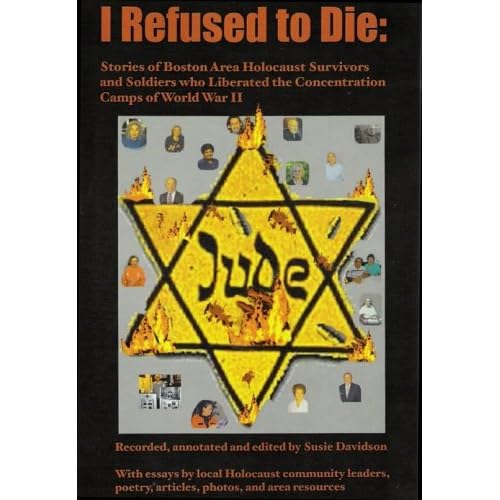
May 17th: "I Refused to Die" Reading at McIntyre and Moore


On the evening of May 17th, after my stroll through Boston City Hall, I attended a reading for Susie Davidson's anthology, I Refused to Die at McIntyre & Moore Booksellers in Davis Square. The book is a collection of essays oral histories by Holocaust survivors and camp liberators living in the Boston metropolitan area.

Typically, Davidson's appearances are with Kovno ghetto survivor, Rosian Zerner, and Dachau camp liberator, Cranston "Chan" Rogers. Zerner was unable to attend that evening and Rogers was running late, so Davidson spent time describing the process of putting together the book, (which included a cross country trip on a Greyhound bus to organize her assembled notes without the distraction of home) and read excerpts from the tales of other survivors. In addition, as the book also includes contributions from local poets, she asked Rafael Woolf and me to read. Woolf's poem was a polemic directed at Holocaust denier, Bradley Smith.

Because there are so many accounts of great literary merit written by actual survivors and I am not a trained historian, I have thus far avoided writing directly on the subject, but this sublimation appears to manifests itself in confronting theological anti-Judaism, exposing Holocaust denial, such as the play I am currently developing. Somehow, in the process, I've also written a couple of poems.

The first, "Numbers" is one I wrote because I had been invited to participate in a poetry reading at The New England Holocaust Memorial for no particular reason beyond the fact that I am Jewish. It was in memory of a cousin of mine who had survived Auschwitz-Birkenau. I long considered it an act of pretentiousness on my part, so I read it so infrequently, but editors keep asking permission to reprint it, so I must be the one in error. The second is entitled "Metathesis of the Books" and was inspired by a series of paintings by Samuel Bak, a child survivor of the Vilna ghetto, whose allegorical works have inspired me for many years.

Chan Rogers, a native of Florida, arrived and spoke informally in a gravelly Southern accent about his experiences as a sergeant in the 45th Infantry Division often taking questions. After the war, he went on to study at MIT and became a civil engineer who designed many features in the Boston area including the Cambridge Street underpass that goes under the Harvard University campus. He explained that he and other veterans never spoke much about their World War II experiences for years since after the war, so many of them ended up going to school and working with other men who had had similar experiences, and it was a matter of passing these stories on to other generations that has caused him to speak.

Rogers spoke of April 29, 1945, the day when 45th Thunderbird Division entered the Dachau concentration camp by way of a railroad bridge after a surrender had been arranged by the Red Cross. (In 2001 I was present to hear a friendly disagreement between a veteran of the 45th and one from the 42nd Rainbow Division over whose division was the first into Dachau as the 42nd had entered the camp from the other direction.) Rogers explained that while he had already seen much carnage already in the war, he was unprepared for Dachau, having only been told that it was a prison where "Hitler kept his enemies." Senior SS officers had abandoned the camp in advance of the surrender, leaving their underlings to be captured by advancing American forces.

He also made mention of the Dachau massacre that occurred that day after troops from both the 45th and 42nd discovered not only the starvation, disease, and overcrowding of the 32,000 prisoners, but thousands of corpses, including the 39 rail cars each filled with over 100 bodies. Rogers' own research indicates that trains had come from the Buchenwald concentration camp and that the prisoners had died primarily of starvation having been shipped out without food in advance of American troops who liberated the camp on April 11th. The Dachau massacre resulted in the death of 35 captured SS "Death's Head" guards, for which several American soldiers faced court-martial, though General Patton decided they deserved no further punishment.

Rogers made a number of parallels to current events, most notably the recent Holocaust denial conference hosted by Mahmoud Ahmadinejad, noting that the deniers' agenda in this particular was clearly to de-legitimize Israel's right to exist.

Given the informality of the event Rogers also recounted a number of anecdotes, including an encounter with the daughter of German-American Bund leader, Fritz Kuhn, who taunted Rogers and his troops with threats that the German Army would return to rout the Americans out. He grinned as he quipped, "That never happened."

Wednesday, April 11, 2007

Breaking with Bread and Puppet


This past February, I walked out of rehearsals for Bread and Puppet Theater's Battle of the Terrorists and the Horrorists. Normally this would not be something worth commenting upon in a public statement, as performers leave projects all the time, but because my relationship with Bread and Puppet had been an ongoing one since 2003 and most importantly, because it was a matter of conscience, I feel compelled to comment, especially since it has become the subject of scuttlebutt about the local scene.

But before I explain why I departed, I ought to describe Bread and Puppet's significance to me. To those unfamiliar with the company's history: Bread and Puppet Theater was founded in the early 1960s in New York City by German immigrant Peter Schumann, an artist whose formal training was in dance and sculpture. In the early 1970s he relocated the company to Glover, Vermont, where it stages pageants during the summers, while spending much of the rest of the year performing both in the United States and abroad. Due to the scale of Schumann's theatrical vision and the costs involved in running a theatre company that receives no outside institutional support, the company relies heavily on volunteer performers. Some of these volunteers are veteran company members, while others are fans or local artists who feel some resonance with Schumann's artistic vision, and camaraderie with him and his company.

Since 2003, I had been one of Bread and Puppet's Boston area volunteers. I estimate that I have participated in some 37 individual performances with the company. During this time, I had made a habit of keeping a web log of my experiences at these shows, an activity to which Schumann gave his blessing after he and many others had become aware of it.

Actively reflecting and writing about rehearsing and performing under a maverick theatre director was to have a powerful influence on my development as an artist. From the very first rehearsals, I learned techniques of staging and object manipulation that have added to my toolkit -- more importantly, I saw first hand how to take philosophically complex concepts and translate them into an allegory for the stage (Indeed, I was unable not to see parallels between Martin Heidegger's later work, most specifically, "The Question Concerning Technology" and Schumann's own Oratorio of the Possibilitarians).

As this past February came around, I was preparing to spend another week-long run with Bread & Puppet. This time we would be performing at the Boston Center for the Arts' Cyclorama, a 23,000 square-foot red brick rotunda located in the South End of Boston, originally built in the nineteenth century to display a panoramic painting. I was excited to be in such a space. Since the size of the venue allowed for it, an exhibition of Schumann's two-dimensional art all along the interior walls of the structure was also planned.

On February 5th, 2007, I was contacted by freelance journalist and activist Susie Davidson (Disclosure: Davidson is editor and primary author of I Refused to Die: Stories of Boston-Area Holocaust Survivors and Soldiers who Liberated the Concentration Camps of World War II, an anthology that includes two of my poems, and is a personal friend) as she had received word that a new piece, not mentioned in previous press releases, had been added to the art exhibit, one that was based on Schumann's experience of working with a group of Palestinian artists in the West Bank. To quote Schumann in the revised press release:

Last November I went for nine days to the West Bank to the town of Beit Sahour to conduct a puppet workshop with an on-and-off company of about twenty. We built puppets and masks from garbage retrieved cardboard. And on Palestinian Independence Day, November 15, the Palestinian Branch of the Bread and Puppet Theater performed on Manger Square , Bethlehem a short spectacle titled “Independence” consisting of four stories made from recent local incidents.

This description was vague enough that anyone could interpret it in terms of their own fears or hopes and as the press release began to circulate, members of the local Jewish and Holocaust survivor communities began to show alarm. Davidson had hoped that I could clarify the content of the show and exhibit.

My own experience had been that, except for the slapstick variety, Schumann is opposed to all sorts of violence. It is also my feeling that working with Palestinian artists, and having sympathies with Palestinian non-combatants must not be interpreted as sympathies for those who advocate violence against Israelis or Jews in general. However, I lacked the certainty to assure anyone that the concerns were not justified, and could only caution that one should not jump to a conclusion out of fear. However, I persuaded a number of my interlocutors to attend the opening reception of the exhibit and to ask questions at the symposium that was to follow.

On February 12th, I attended the reception. On entering the Cyclorama, I was greeted with smiles and open arms by many of the friends I have made over the years through Bread and Puppet. However, already aware that I was in the middle of a potential maelstrom, I turned my attention to Peter Schumann as he walked us through the art exhibit, which ranged from political works that directly referred to current events like the Bush Administration's practice of "extraordinary rendition" to a more fanciful adventure of Kaspar, who is something of a Germanic equivalent to the Neapolitan Pulcinella or English Mister Punch.

When Schumann began his narrative of "Independence Paintings: Inspired by Four Stories" he explained that he had gone to the West Bank on invitation from local peace activists, and that he had been reading John Hersey's The Wall, an account of the Warsaw Ghetto. The result was a large piece that juxtaposed scenes from the Warsaw Ghetto (with inmates clearly represented as Jews) and a narrative of how Palestinian non-combatants are affected by Israeli Defense Force's (IDF) counter-terrorist operations. Schumann noted how the West Bank wall and security checkpoints between Israel and the West Bank had led to economic privation and "humiliation" for Palestinians, though he was quick to note that it "was not as bad" as conditions in the Warsaw Ghetto.

As at the symposium (a question and answer session moderated by John Bell, a former Bread and Puppet company member, current member of Great Small Works, one of my favorite puppet theatre troupes, and Emerson College professor) began, I found myself in an alienated state and thought it best to sit back and observe, sensing that while I would have to make a choice, I did not have to at that moment. Susie Davidson spoke up. She noted that the juxtaposition of imagery of the Warsaw Ghetto and a narrative of the West Bank invites a claim that the two are equivalent. Schumann responded by asking her to point out where he makes that claim in his art. He only reiterated that he had just read Hersey's book and that there were economic deprivations that resulted from the West Bank Wall, specifically citing an unemployment rate of over 80%, while never acknowledging that the West Bank Wall had been constructed as a non-lethal means to end suicide bombings in Israel and that it had been largely successful.

(Of course, how much of that unemployment can be blamed on the construction of the wall and not on corruption within the Palestinian Authority, something Schumann did acknowledge, is open to debate.)

The Warsaw Ghetto is an icon in the historical memory of the Holocaust, and though originally conceived before Germany decided upon the "Final Solution," it is impossible to view the ghetto except as a stepping-stone towards the Holocaust, and this is what makes it such a powerful source of imagery. Schumann, an artist who has been refining his own personal pantheon of icons over decades, is certainly aware of the power of images, especially when placed in relationship to one another. The idea that he was merely putting the scenes of IDF counter-terrorism alongside those of the ghetto because he was reading a specific book while visiting a specific place, might be understandable had a much younger, less mature artist made the work, but from an artist of his experience, it seemed a cop-out.

Davidson pressed on, questioning Schumann: if one is comparing the Warsaw Ghetto with the West Bank, where are the slave labor camps, the gas chambers, and the Zyklon-B canisters? Schumann was silent, but much of the audience, who probably saw themselves as supporters of Schumann and Bread and Puppet, were not.

Frank Levine, who was seated next to Davidson, described the ensuing debate in the March 2, 2007 letters section of The Boston Phoenix:
[...]Schumann’s installation was a collage of photos of the walls of the Warsaw Ghetto, with text underneath referring to the wall in Israel, “jackboots,” “people being pulled from their homes,” “the oppressor and occupier,” etc., leading to no other conclusion but that he was equating the policies of the Israeli government with those of the Nazis.

[...]at the symposium, [Susie Davidson] asked Schumann what the basis of his comparison was; she was met with a chorus of “Zionist Nazi,” denunciations of the Israeli government, and insulting, dead-end rounds of clapping. Schumann then incredulously stated he did not mean to equate Israeli and Nazi policy, when it would be an insult to any viewer’s intelligence to conceive that the impression would be anything but.

I was not seated near either Davidson or Levine, and did not hear anyone use the phrase, "Zionist Nazi" as Levine describes, but the account otherwise matches my observations. I did, however, see scrawled in large red marker, the phrase "Zionist Genocide" on a sheet of paper left behind after the fact.

The point is that, even if Schumann intended no such comparison, his audience explicitly interpreted him as making the comparison. Schumann, an artist who has spent decades cultivating his own personal iconography is certainly intelligent enough to realize that a large segment of his audience would interpret the work as a statement of equivalency between the Warsaw Ghetto and the West Bank.

The Warsaw Ghetto was part of a system of ghettos that Germany built and operated in the Nazi puppet-states it established in Poland and the Baltic between 1939 and 1941. According to the Raul Hilberg's seminal study The Destruction of the European Jews (all references are to the 1973 edition), 500,000 to 600,000 Jews died from starvation and disease in the ghettos of forced labor camps of Poland. Translation: about one fifth of Poland's Jewish population died in the ghettos in less than two years. (Hilberg, pp. 173-174.) Nothing of that sort has occurred in the West Bank-- in fact, the Palestinian population on the West Bank has grown since 1967.

Indeed, Schumann went on to interpret the the failure of the April 19-May 16 1943 Warsaw Ghetto uprising as "the failure to reach out to the Polish resistance." However, to again refer to Hilberg, in preparing for the uprising, 22 battle groups under the command of Modechai Anielewicz received weapons from the Communist People's Guard under the command of General Rola-Zymierski and from the Home Army -- the military wing of the Polish government in exile in London (Hilberg, pp 322-323.) In addition, Polish partisans carried out diversionary attacks outside the ghetto (p. 324). The failure was being outnumbered and outgunned by the Germans, and their Polish and Ukranian allies -- and perhaps in not taking up armed resistance earlier.

Though I am young, the world has witnessed much genocide in my lifetime. We know how to measure genocide in cold statistics without reference to emotionally charged icons. The population of a group targeted for genocide simply does not increase, especially when the alleged murderers have military superiority. IDF entered the West Bank in 1967, and while it would be absurd to state that there have been no injustices committed against Palestinian non-combatants, no genocide has occurred, no genocide is in the making, unless we are to believe that this is the most ineptly-managed genocide in history.

At best, the juxtaposition Schumann presents in "Independence Paintings: Inspired by Four Stories" is what historian Deborah Lipstadt refers to as "soft core Holocaust denial" in that rather than deny that a historical event (like the Holocaust) has occurred, it seeks to rewrite history without concern for actual facts. So Israelis are compared to Nazis and the West Bank is compared to the Warsaw ghetto -- in short, the idea of a phony genocide is promoted. Outrage over a phony genocide diverts from outrage over real genocides like those in Rwanda, Darfur, the former Yugoslavia, and Iraq.

At worst, Schumann's statements on behalf of "Independence Paintings: Inspired by Four Stories" are normal Holocaust denial: that the ghettos were sites of merely massive unemployment and security checkpoints -- and not places in which one fifth of the population died through deliberate starvation , over-crowding, and denial of medical care over a period of less than two years. This sort of denial was implicit in the fact that these ghettos were called "ghettos" as the ghettos of Europe had never before been so deadly. The word "ghetto" was a euphemism.

Listening to these evasions by an artist I admire left me in a daze of cognitive dissonance, where I had to wrestle with conflicting feelings of loyalty and friendship, but also for the value I place on truth and critical analysis. The conclusions above are not ones I could reach at the symposium, but ones I struggled with over the next day and night. So despite these feelings of dissonance, I still greeted my old friends, and I still pictured myself working with them. The next evening, I attended the first night of rehearsals, hoping that perhaps the show would provide the counterpoint to the tension I felt.

This was the description of The Battle of the Terrorists and the Horrorists in the press release that had been sent out in a mass email on January 11, 2007, when I had first committed myself to performing in the show:

THE BATTLE OF THE TERRORISTS AND THE HORRORISTS is a black and white dance and puppet show with a few colored exclamation marks!! As the U.S. sets out to achieve victory over the terrorists, it becomes necessary to make citizens acquainted with the promoters of victory: the horrorists. Under the banner of the two major divinities who rule over our present day existence — the God of Everything and the God of Nothing — the horrorists demonstrate, with the help of a cardboard citizenry, the progressive stages on the way to victory, including Ice Cold Reality, a dumbshow, which describes a week of horror under the feet of the occupier. The march to victory is a giant sailboat that drowns in stormy seas, and war is genocide.


From the press release, it appeared that the show was to be a satire about the Bush Administration's "War on Terror" as seen through the lens of the mythology that Peter Schumann had developed. "Horrorist" is a neologism that I first encountered in Bread and Puppet's How to Turn Distress into Success in 2004 (indeed, the monologue and cards in which the term is introduced are used in both plays.) It is understood as the dialectical antithesis to the terrorist, an opposing faction that enjoys "peace defined as complete military superiority". Clearly, this well describes America in the age of George W. Bush.

In rehearsal, The Battle of the Terrorists and the Horrorists was an alternation between satirical and allegorical tableaux, lazzi, and skits, the most brilliant of which was the "cardboard citizenry," a group of puppet characters whom the puppeteers introduce to the audience, only to abuse without warning, and then assure the audiences that no harm has been done, as the citizens are mere cardboard. This bit of comedy well satirizes the tendency to make distinctions between , victims of terrorism, victims of war crimes and the euphemism of "collateral damage". While I do accept such distinctions as valid for purposes of International Law, there is no reason why these distinctions should not be questioned by either ethicists or satirists.

But in the middle of the rehearsal came the bait-and-switch. Just as I had thought I was in an allegorical satire of contemporary America and that I was marching off to Iraq (or perhaps Iran), we were in the "Ice Cold Reality of Palestine." Schumann had transformed American soldiers (he had had us hum The Star Spangled Banner) into IDF soldiers. The dumb show curtains opened and puppet characters representing Palestinian women were being shown with a wall closing in on them, while large puppet feet trampled them from above. We were directed first to mime throwing rocks at the wall and then to mime tearing the wall down.

The scene disturbed me because I knew that tearing that wall down in reality would result in a return to suicide bombings in Israel, which would necessitate IDF reprisals, and so lead to needless deaths of both Israelis and Palestinians. I hoped that as we went through the scenes we would see something of what the terrorists would do, or a call for peace. But nothing of that sort came. Indeed, even what little nuance Schumann had demonstrated at the symposium, his criticisms of Palestinian society, notably, its sexism and the corruption of its leaders, were completely absent.

By the time I arrived at home, I decided I could not in good conscience remain in the cast, and then began to compose an explanation to a friend involved in the production. It took me a day to find the words, but in summation: If peace is a goal we seek, we cannot acquire it by demonizing the enemy, accusing them of crimes that they have not committed, nor can we insist that no injustice has been done to them. By performing in The Battle of the Terrorists and the Horrorists I would have lent my body to increasing the polarization that I witnessed that Monday night and make dialogue between people of good conscience more difficult. I have no idea if my explanation was passed on to anyone else in the company, and chose not to discuss my decision in detail to more than a few individuals until the production ended.

The response I received, in fact, the only disapproving response, was to suggest that I had succumbed to peer pressure, and that if I truly objected, that I should have worked within the system of Bread and Puppet to change the show, instead of giving up, and that I should have known that Bread and Puppet treats controversial material. Of course: I largely lack the behavioral pattern of "peer pressure" response, Bread and Puppet is not a democracy, and I was apparently on the other side of the "controversy."

Peter Schumann was born in 1934 in Silesia. This much appears in all the biographic accounts of Schumann's life, very little else. While Lower Silesia was at the time firmly within Germany's borders, Upper Silesia was divided between Germany, Poland, and Czechoslovakia. In 1939, Germany's invasion of Poland resulted in the annexation of all of Silesia. The German SS, along with Silesian ethnic German paramilitaries, rounded up Silesian Poles and sent them to forced labor camps in the Reich or deported them to the General Government (the part of Nazi-occupied Poland not formally annexed to the Reich, but placed under the government of General Governor Hans Frank). The Jews of Silesia were deported to the ghettos. Silesian Germans and newly arrived Germans from the west took control of formerly Polish and Jewish-owned properties.

In 1941, once the ghettos had become unmanageable, plans were made to for surviving residents not killed by Mobile Killing Units to be sent to the camps, such as the death camps at Auschwitz-Birkenau and the concentration camps at Groß-Rosen, both of which were located in Silesia. This history is not mentioned in the hagiographies written about Peter Schumann (Notably George Dennison's An Existing Better World: Notes on the Bread & Puppet Theater and Richard T. Simon and Marc Estrin's Rehearsing With Gods: Photographs and Essays on the Bread & Puppet Theater). Indeed, we only have to look at an interview dated March 1, 2006 given to Real Change News:

I was born in Silesia, which was German. It became Polish in 1945, after the war. It was part of Germany that was given to Poland by the Yalta Conference. Ninety-nine percent of the population of Silesia was made into refugees at the end of the War and we were part of that 99 percent. We were all looking for a new life, so we live as refugees for a few years.

[N.B.: Real Change News removed the article from their website, but it is available on archive.org.]

This quote is an example of historical denial. Never in the interview does he mention that one of the most notorious sites of the Holocaust is located in Silesia or that Germany had invaded Silesia and that the adults in his community had either profited from or committed acts of ethnic cleansing, enslavement, and genocide, or even that he was a child under the Nazi regime. In many cases, surviving Jews were still in displaced persons camps for years. 1945 is the year that the surviving Poles returned to their lands, wanting nothing of the people who had enslaved them.

This is not to dismiss the horrible experience of being a child refugee for the crimes of the adults in one's community, but the context of a little talked about, and incredibly complex aspect of the Post-World War II era has gone missing. The lands that Germany seized, ethnically cleansed, and then settled, were forcibly returned after the defeat of the Reich. In Poland, it is estimated that 6 million Germans fled or were evacuated, while another 3.6 million Germans were deported. It is estimated that as these lands were restored to Poland, Czechoslovakia, Russia, Lithuania, Yugoslavia, and other states in Eastern Europe, as many as 16.5 million Germans either fled or were deported to Germany between 1944 and 1948. Because of poor logistics, it is estimated that as many as two million Germans died in the process. Most Germans who fled from Silesia and other German-held lands in the east, not because of deportations though, but in the face of the Soviet military who were pressing toward Berlin (and had to, as a matter of military necessity.) As to the redrawing of Germany's eastern borders after World War II, there were many reasons, too complex to discuss here.

However, this inability to talk about what really happened is very telling about his attitudes regarding the Arab-Israeli conflict. To quote the same interview:

Palestine is an ice-cold reality under the feet of the occupiers. Palestine is homelessness that results from the gestures of politicians. Palestine is a giant body arrested, crushed, and rises up and lives.

In 1948, the formally British Palestine was partitioned into two states: Israel and Palestine. The Arabs of Palestine, alongside the armies of Egypt, Syria, Jordan, Iraq, Lebanon as well as smaller forces from Sudan, Yemen, Saudi Arabia, and Morocco, invaded Israel. The intent was to destroy any Jewish state. The ultimate aims of the Arab protagonists ranged from a reinstitution of dhimma to, judging by statements by Mohammad Amin al-Husayni, the Grand Mufti of Jerusalem, Chairman of the Arab Higher Committee, recruiter and organizer of Muslim SS Units on behalf of the Nazis, and suspected war criminal, a second genocide. Ultimately, the invasion failed. The conflict resulted in the creation of about 711,000 Palestinian Arab refugees and 900,000 Jewish refugees. No Arab state has offered to repatriate or compensate the Jewish refugees.

The ice-cold reality is that Schumann's identification with the Palestinian cause is so one-sided that one is forced to consider the hypothesis that it is an emotional stand-in for the Silesia he lost as a child.

It is a failure of those who sympathize with the Palestinian cause when they engage in Holocaust denial of either soft core or "hard core" variety, often by crassly appropriating the very iconography of the Holocaust. Those who survived the genocide and mass murder committed by the Soviet Union and its client states, the People's Republic of China, the Khmer Rouge, Imperial Japan, Chiang Kai-Shek's Nationalist movement and other such regimes, do not need to appropriate the symbols of the Holocaust in order to educate the world about these histories, but anti-Zionists like the ones encountered and encouraged at the February 12, 2007 symposium are not interested in truth, healing, or reconciliation. They are interested in equating Jews with Nazis. Why?

To quote Hilberg:
Preventive attack, armed resistance, and revenge are almost completely absent in two thousand years of Jewish ghetto history. Instances of violent opposition, which may be found in one or another history book, are atypical and episdoic. The critical period of the 1930's and 1940's is marked by that same absence of physical opposition.
On the other hand, alleviation attempts are typical and instantaneous responses by the Jewish community. Under the heading of alleviation are included petitions, protection payments, ransom arrangements, anticipatory compliance, relief, rescue, salvage, reconstruction-- in short, all those activities which are designed to avert danger, or, in the event that force has already been used, to diminish its effects.

- Hilberg, p. 14.

While these stratagems had ensured the survival of Jewish communities over millennia despite having overwhelming force arrayed against them, they became completely dysfunctional when, as during the Holocaust, the oppressors' aims ceased to be conversion, segregation, humiliation, exploitation, scapegoating, and deportation, but a "final solution" of annihilation.

What outrages many who call themselves "anti-Zionists" is that Israel represents a Jewish people who no longer behave as "ghetto Jews" when threatened with violence. In the imagination of an "anti-Zionist" a "bad Jew" is a Jew willing and capable of defending both himself or herself and the community, while a "good Jew" is a pacified Jew, who will suffer under the yoke of tyranny or, if so commanded, die. This line of thought, in most cases, is probably only held on a sub-conscious level by "anti-Zionists" and serves as the conceit by which they deny being anti-Semitic; They simply do not grasp the anti-Semitic logic underlying their beliefs -- but this is because they have absorbed the status quo of the Christian-European and Islamic-Arabic worlds: That Jews are supposed to be a humiliated and weak people.

So even when Israel exercises force in proportion to an actual threat, the very act of defense is deemed to be Nazi-like, which is a convenient belief for Schumann to hold given his own Silesian denial. Because of this complex of historical denial, psychological denial, mallicious use of Holocaust iconography, and fanning the flames of conflict, I could do nothing else but part ways with an iconoclastic artist who had greatly influenced me.