Showing posts with label Palestine. Show all posts

Sunday, April 8, 2012

Artistic Boycotts In The UK: Habima at Shakespeare's Globe

In recent months, part of my "beat" as a contributor to The Arts Fuse has been reporting on Israeli Stage, a Boston-based company devoted to presenting Israeli plays to an American audience, writing commentary on the work on Israeli playwrights Savyon Liebrecht and Motti Lerner as well as conducting an interview with Israeli Stage's Producing Artistic Director, Guy Ben-Aharon. Despite the the fact that I am new to the subject, this recent work has placed me in a position where I now have to pay greater attention to new developments.

On Thursday, March 29, 2012, The Guardian published an open letter signed by 37 British artists associated with film and theatre protesting Shakespeare's Globe's decision to invite the Israeli state theatre Habima (who were mentioned in the Ben-Aharon interview) to participate in an international Shakespeare festival in May. The text of the letter is as follows:

We notice with dismay and regret that Shakespeare's Globe Theatre in London has invited Israel's National Theatre, Habima, to perform The Merchant of Venice in its Globe to Globe festival this coming May. The general manager of Habima has declared the invitation "an honourable accomplishment for the State of Israel". But Habima has a shameful record of involvement with illegal Israeli settlements in Occupied Palestinian Territory. Last year, two large Israeli settlements established "halls of culture" and asked Israeli theatre groups to perform there. A number of Israeli theatre professionals – actors, stage directors, playwrights – declared they would not take part.

Habima, however, accepted the invitation with alacrity, and promised the Israeli minister of culture that it would "deal with any problems hindering such performances". By inviting Habima, Shakespeare's Globe is undermining the conscientious Israeli actors and playwrights who have refused to break international law.

The Globe says it wants to "include" the Hebrew language in its festival – we have no problem with that. "Inclusiveness" is a core value of arts policy in Britain, and we support it. But by inviting Habima, the Globe is associating itself with policies of exclusion practised by the Israeli state and endorsed by its national theatre company. We ask the Globe to withdraw the invitation so that the festival is not complicit with human rights violations and the illegal colonisation of occupied land.


The March 29 letter is a restatement of the position taken in undated letter which (based on the date of the Ynet article that cites it) was published sometime prior to January 2, 2012. Boycott From Within, the organization that issued the letter, appears to be primarily made up of Israeli citizens who support the Boycott, Devestment, and Sanctions (BDS) movement that was initiated by a coalition of Palestinian NGOs in early 2005, several months after the Ariel Sharon-led Israeli government announced plans to withdraw the Gaza settlements, a plan that was accomplished in August of 2005, quite without the assistance of BDS. Indeed, it becomes hard to identify any concrete accomplishment of the BDS movement beyond providing a rallying cry for anti-Israel activists in the west; they certainly have not advanced the goal of a two-state solution, nor can they claim responsibility for any of the small victories of recent years, like Israel's dismantling of checkpoints within the West Bank or the Palestinian Authority's own crack down on militant groups in areas which it controls.

The Boycott From Within document, unlike the March 29 letter, specifically names the two West Bank settlements:
Ariel and Kiryat Arba, like most settlements, are surrounded by walls and fences, closely guarded by soldiers and their own armed security personnel. A theatrical performance in a settlement is by definition a performance to an exclusively Israeli audience, with Palestinians living even in the nearest village being physically excluded from any chance of attending.

[...]on this issue the management of Habima has taken a position which is remote from any kind of social engagement. Claiming to be "non-political", the management has reiterated its decision to perform in West Bank settlements, "like everywhere else". Moreover, the management specifically promised Limor Livnat, Minister of Culture in the Netanyahu Government, to "deal with any problems hindering such performances", i.e. to pressure recalcitrant actors into taking part in them, even against the dictates of their conscience. And it must be pointed out that for several months, Habima has indeed sent out its actors to hold theatrical performances in West Bank settlements, on a regular basis.
The first point that should be made, of course, is that while Ariel and Kiryat Arba are controversial, they are not, strictly speaking, illegal. While there are illegal settlements, of course, such as Migron (which the Israeli Supreme Court recently ordered the Israeli government to demolish), under the 1993 Oslo Accords, the status of settlements like Ariel and Kiryat Arba are pending final status negotiations between Israel and the Palestinian Authority. They might end up as part of a land-swap between the two states, they might be evacuated, or they might become an example of Jewish residents within the future Palestinian state much as there are Arab citizens in Israel (though that possibility is less likely, given recent statements by Mahmoud Abbas and his government.) So whether or not the settlements' establishment was legal (there are differing interpretations on whether the Fourth Geneva Convention applies) the Oslo Accords essentially table it as a legal issue, turning it into a political issue.

The question about the security measures around Ariel and Kiryat Arba are very simple: they exist under a different jurisdiction than the surrounding areas; the authorities on each side of the fences having not finalized a peace treaty. Despite efforts by the Palestinian Authority to crack down on militant groups operating in its own jurisdiction, recent examples such as the Itamar attack of March 11, 2011 in which five members of the Fogel family were murdered in their beds by terrorists, or an August 31, 2010 killing of four settlers in a drive-by shooting outside of Kiryat Arba make these security measures understandable, even if they result in audiences not being drawn from geographically adjacent areas. It should also be noted that under the Oslo Accords, Israeli citizens are essentially required to stay on their side of the fence as well (one of the ways by which Israeli courts determine if a settlement is legal or illegal.) This separation is thusly one that has been agreed upon by the governments representing the two peoples: whether these governments' leaders proceed wisely and courageously or foolishly and fearfully, the status of these settlements made the transition from legal matter to political matter 19 years ago.

Of course, both the March 29th letter and its undated antecedent read politics into Habima's performances in Ariel and Kiryat Arba. According to Haaretz Ilan Ronen, Habima's artistic director, responded thusly:
The attempt to portray Habima as a mouthpiece of this or that policy wrongs the creators, the actors, and anyone who is a part of our endeavor.

Performing in all of Israel is not the initiative of Habima, as the letter presents, by is a result of state law, to which all public cultural institutes are subject.
More recently, in The Guardian, Ronen further explained Habima's position:
It's a disgrace. We don't see ourselves as collaborators with the Israeli government over its West Bank policy. We don't remember artists boycotting other artists.

[...]It is important to emphasise, we express our political views in many of our projects. But like other theatre companies and dance companies in Israel, we are state-financed, and financially supported to perform all over the country. This is the law. We have no choice. We have to go, otherwise there is no financial support.

[...]Artists should create bridges where there is conflict; the issue of Israel and the Palestinians is an area in which European dialogue can be very helpful in creating a better atmosphere. To boycott us prevents any artistic dialogue.
Habima falls under the jurisdiction of the Ministry of Culture and Sport which can mandate that Habima perform anywhere under Israeli jurisdiction much as the Israel Postal Company is mandated to deliver the mail. Minister of Culture and Sport Limor Livnat is a Likud member and generally considered to be rather sympathetic to the Israeli settler movement, and since her post in the Netayahu cabinet is a fairly minor one, there is little she can do for her political constituency but mandate that companies that receive state funding perform in West Bank settlements. Perhaps Habima would not be so mandated were the Ministry controlled by a more left-leaning or centrist party. Theatre artists who are not affiliated with the state are free to be politically engaged and choose to participate in a boycott or politically engaged and oppose a boycott. However, Ronen, according to the April 7th article in The Guardian, states that Habima-affiliated artists who had moral or political objections to performing in the settlements were able to opt-out without fear of retribution. The charge that Habima is somehow violating a principle of being "non-political" accepting its mandate while simultaneously allowing individual artists to opt out of this mandate is nonsensical.

Months before the March 29th letter, Shakespeare's Globe had already issued a response to Boycott From Within's letter on their Facebook page on January 6th, which also anticipates the position of March 29th letter:
[...W]e deliberated long and hard about the issue of inclusion and exclusion of companies – programming such a comprehensive festival requires a huge amount of such consideration, in order to ensure that it is truly an international event. We came to the conclusion that active exclusion was a profoundly problematic stance to take – because the question of which nations deserve inclusion or exclusion is necessarily subjective. Where does one start in such an endeavour? Clearly for you with Israel, but for many others, it would be with a host of different states. And more pertinently, where does one stop?

Rather, we wished to celebrate the huge variety of languages and cultures which have encountered, learnt from and extended the reach of Shakespeare’s work, and as such we were determined to reflect as wide and as comprehensive a variety of languages as possible. In creating our programme, we have tried our best to balance that universality with the infinite variety shown in Shakespeare’s works. Our commitment to universality is reflected in the fact that the Ashtar Theatre from Ramallah, who have done more than any other theatre group to highlight the nature of life in the Gaza Strip with their
Gaza Monologues, are performing Shakespeare’s Richard II at Globe to Globe.

[...]Habima are the most well-known and respected Hebrew-language theatre company in the world, and are a natural choice to any programmer wishing to host a dramatic production in Hebrew. They are committed, publicly, to providing an ongoing arena for sensible dialogue between Jews and Arabs, Israelis and Palestinians.

[...I]t remains our contention, and we think a suitable one for a Shakespearean theatre, that people meeting and talking and exchanging views is preferable to isolation and silence. For that reason, and for the others above, we remain convinced that it is right to work with all the companies we have chosen for the Globe to Globe Festival.
Several of the companies participating in the festival hail from countries undergoing protracted conflict or having recently emerged from conflict: there are companies not just from Israel and Palestine, but South Sudan, Afghanistan, and Pakistan. The People's Republic of China has a notorious human rights record, and is well known for its suppression of both the Tibetan and Uyghur peoples and political dissidents in general, yet the same figures urging a boycott of Habima are silent on the National Theatre of China's presentation of Richard III.

It is also apparent from even the most cursory investigation of the English language version of the Habima webiste, that the company not only employs and trains both Jewish and Arab artists, but also to performs to both Jewish and Arab audiences, which is as much part of their mandate to perform "in all of Israel" as performing in the settlements.

The great irony, of course, is that both Boycott From Within and the 37 British artists are protesting Habima's performance The Merchant of Venice, perhaps the single literary work that most defined the manner in which Jews are portrayed in British literature. Indeed, Habima's plan to perform The Merchant of Venice was received criticism in Israel, including from people involved with the theatre. Many have noted that the character of Shylock is the template from which the vulgar anti-Semitic stereotypes of Charles Dickens' Oliver Twist, T.S. Eliot's Burbank with a Baedeker: Bleistein with a Cigar, and Caryl Churchill's Seven Jewish Children are cut (Churchill, not surprisingly, signed March 29th letter calling for the Globe to revoke Habima's invitation.) Ronen defended his choice to direct The Merchant of Venice this past December:
Dozens of the best Jewish actors, including Antony Sher and Dustin Hoffman, alongside other acting legends, have played the role of Shylock knowing that the play actually deals with the persecution of the Jew and xenophobia.
While it has become the fashion over the past few decades to represent The Merchant of Venice as an anti-anti-Semitic narrative, and see Shakespeare as a critic of prejudice (as the case with the acclaimed Dark Tresnjak-helmed production that had F. Murray Abraham in the role of Shylock) The anti-anti-Semitic reading frequently hinges on ignoring major themes and recurring motifs in the play, such as the theological grounding in medieval and early-modern anti-Judaic polemics, or the thematic linkage between Jews and the Devil that were part of that era's folklore as much as the bond of the pound of flesh. While I am certainly not privy to Ronen's take on the play, I would suggest that to make a truly anti-anti-Semitic statement with The Merchant of Venice one should deliberately horrify the audience by unapologetically playing up every anti-Semitic trope in the play, especially the ones normally ignored in modern productions.

What would banning Habima from performing accomplish when even Israeli governments that have been less friendly with the settler movement than the current one have not been able to reach a mutually agreeable peace with their Palestinian counterparts? Ultimately, the 37 theatre artists who put their names to the March 29th letter to The Guardian are not merely artists urging a boycott of other artists but British artists attacking Jewish artists interpreting the representation of Jews in English literature, which only underlines the anti-Semitic subtext of the "inclusiveness" that the signatories claim to support.

Tuesday, September 9, 2008

Bread and Censorship: Making Radical Theatre Uncontroversial for Wikipedia

Mark Stoneman drew my attention to a CNet article on the sheer number of edits conducted on the Wikipedia article on Sarah Palin not just on the day of her unveiling as a vice-presidential candidate, but in the hours leading up to her announcement.

This caused me to return to a journal entry I had written in May of this year regarding the politically motivated rewrites of the Wikipedia article on Bread and Puppet Theatre founder, Peter Schumann ("When Wikipedia Renders One an Un-Person"), especially since his current exhibit at the Flynndog in Burlington, Vermont has once again placed his work on my radar. I found that the biographical article on Schumann had been censored yet again, this time to remove any discussion of his positions vis-a-vis the Holocaust, or the Israeli-Palestinian conflict.

In my previous article, I had noted that one contributor (an anonymous user with the IP Address of 76.19.64.64 in Cambridge, MA) while acknowledging that there had been some dispute over Schumann's artistic representation of the Israeli-Palestinian conflict, had also introduced the unverified claim that Schumann's family had been refugees from Nazi Germany (a claim that contradicts Schumann's own statements about his childhood.) I also noted that another contributor (with the address of 68.56.17.70 in Sarasota, Florida) erased the names of Schumann's critics, and even went so far as claiming that the reception to the work had been "quite positive" when, in fact, it had been seen as contentious whether it had been exhibited in Boston or Burlington.

I brought these matters to the attention of a wikipedia editor who uses the handle Moonriddengirl, who revised the article to present a neutral point of view, while still mentioning the dispute around the exhibit. ("Update to "When Wikipedia Renders One an Un-Person")

However, on August 24th, an anonymous contributor with the IP address of 97.76.239.11 (somewhere in Seminole, Florida) published a revision in which the entire section entitled "Palestine Exhibits" was deleted. The writer from 97.76.239.11 had only this to say:

Palestine Exhibits: was deleted. It was a thoroughly biased attack on Schumann's character due to political disagreements.


Compare this assessment with what was deleted:

In 2007 Schumann premiered "Independence Paintings: Inspired by Four Stories" in Boston and Burlington, Vermont.[2] The series was inspired by ten days Schumann spent in the Occupied Territories of Palestine, as well as John Hersey's 'The Wall', a graphic account of the birth, development, and destruction of the Warsaw Ghetto, the largest of the Jewish ghettos established by Nazi Germany during the Jewish Holocaust. The series proved controversial, with critics labeling Schumann's works as "anti-Zionist", "anti-Semitic" and "sort-core Holocaust denial", accusations Schumann denied, stating that "I’m not saying that what’s happening in Palestine is the same as what happened in Warsaw . . . but it’s certainly a reminder."[2] While Schumann later acknowledged that he "may have unnecessarily hurt some people's feelings" with the series, he returned in 2008 to the theme of the Israeli-Palestinian conflict in his subsequent art series, "The University of Majd: The Story of a Palestinian Youth", which addresses a case of what Schumann believes to be false imprisonment in Israel.[3]


Was this actually a "biased attack or Schumann's character"? That is something best judged by people other than myself. However, the real problem is that we are seeing censorship of any mention of contentious positions taken by an artist who has for decades been a leading figure in radical theatre in America, censorship of criticisms he has received, and a reluctance by his self-appointed defenders to even write about his immense contributions to puppetry and theatre. Indeed, Schumann's allies are censoring mention of controversy in which Schumann clearly wants to be embroiled.

Thursday, May 1, 2008

When Wikipedia Renders One an Un-Person

Frequent readers of this blog will note that I frequently link to Wikipedia articles on and in most cases, I have found the articles I cite to be reasonably good introductions the topics I mention in passing. When I found myself to be written into a Wikipedia article only to be made an "un-person" a month later in what appeared to be a ideologically motivated revision, I decided to dig deeper into a world of topsy-turvy wiki redaction. In this case, it was not an example of editors determining that I was not a notable individual, but rather an anonymous user erasing certain inconvenient facts, such as myself. This story begins when my attention was called to an article on Peter Schumann because I was mentioned as a critic of his:

the series ["Independence Paintings: Inspired by Four Stories"] was the subject of a sermon by Burlington Rabbi Joshua Chasan on Rosh Hashanah [2] and made longtime company contributor Ian Thal cut relations with Bread and Puppet Theater over the paintings and over the fact that the content of the new B&P show The Battle of the Terrorists and the Horrorists[sic][3].


The revision came from an anonymous editor from the IP address 76.19.64.64, which belongs to server that appears to be based in Mount Laurel, New Jersey and is owned by Comcast. The revision is dated February 8, 2008, the week that Bread and Puppet Theater was performing in Boston. While Greg Cook would not publish his series to The New England Journal of Aesthetic Research that included interviews with both Schumann and myself for another day, his preview of the show had already appeared The Boston Phoenix.

Leaving aside the need for proofreading, the article was incomplete in that it spoke about the dispute surrounding Schumann's work on the Israeli-Palestinian conflict yet gave scant attention to any of his notable accomplishments (of which are many.) This is not the worst flaw in a Wikipedia, as articles are collaborative endeavours, someone would be expected to eventually fill in the details, however far off into the future "eventually" may be. What caught my eye was not so much that I was mentioned but this particular passage:

Schumann denied any such accusations [of anti-Semitic content], pointing to how his family escaped from Nazi rule when he was 10, accusing his critics of "over-interpreting" his work and saying :I’m not saying that what’s happening in Palestine is the same as what happened in Warsaw...but it's certainly a reminder. [4].


The citation was from Ken Picard's Septemeber 19, 2007 article for Seven Days, "Over the Wall" in which Picard writes:

For his part, Schumann has repeatedly denied the accusations of anti-Semitism and Holocaust denial — after all, he and his family fled Nazi Germany when he was 10.


Note that Picard did not specifically state that Schumann claimed to be a refugee from Nazi Germany as the anonymous author from 76.19.64.64 had done. Picard may very well have made a statement that he mistakenly believed to be common knowledge (an error that few, if any, have never made.) However, this is contradicted by other statements made by Schumann, such as in this interview conducted by Rosette Royale that appeared in the March 2, 2006 edition of Real Change News:

I was born in Silesia, which was German. It became Polish in 1945, after the war. It was part of Germany that was given to Poland by the Yalta Conference. Ninety-nine percent of the population of Silesia was made into refugees at the end of the War and we were part of that 99 percent.


Without going too in depth into the complex history of Silesia, one ought note that up until 1939, when Germany invaded Poland, only parts of Silesia had been part of Germany. Of the "Ninety-nine percent of the population" that was deported after the 1945 redrawing of Germany's borders, many of those Germans were settlers who had taken up homes, land, and property from Silesian Poles who had been either assigned to slave labor camps or deported to the General Government area of occupied Poland, or the Silesian Jews who were walled into ghettos or exterminated in death camps such as Auschwitz-Birkeneau, conveniently located in Silesia. Clearly, Schumann's family was a refugee not from Nazi Germany but from the defeat of Nazi Germany.

An article in the August 5, 2007 The New York Times tells a parallel story:

[Schumann] was born in Silesia, now part of Poland, in 1934, the son of a Lutheran schoolmaster. During World War II the family fled to northern Germany, where, as refugees, they lived on scraps gleaned from local farms.


Which indicates that Schumann's family fled from Silesia not due to redrawing of borders but by the advance of Soviet troops or Allied bombing campaigns, not from Nazi Germany, but rather deeper into Nazi Germany. Other articles tell similar stories.

Though I first commented on what I presume to be Picard's error on this blog, I also broached the topic in a letter to the editor which led to a stimulating email exchange with Picard. However, because of my understanding of Wikipedia ethics, I felt constrained from correcting or altering the Peter Schumann article, and instead left a note in the discussion section attached to the article on February 15, 2008:

Obviously, since I am named in this article, it would be inappropriate for me to contribute directly, but I should note that there appears to be a major factual error regarding Schumann's childhood[....]

The points being, 1.) It appears to be an error; and 2.) my understanding of wiki ethics requires that I not touch the article, 3.) somebody else needs to fix it.


However, on March 20, 2008 revision, an anonymous contributor with the IP address of 68.56.17.70 (a server operated by Comcast out of Cherry Hill, New Jersey) to the article changed the text to:

In 2007 Schumann premiered "Independence Paintings: Inspired by Four Stories" in Boston and Burlington, Vermont [2]. The series was inspired by ten days Schumann spent in the Occupied Territories of Palestine, as well as John Hersey's The Wall", a graphic account of the birth, development, and destruction of the Warsaw Ghetto, the largest of the Jewish ghettos established by Nazi Germany during the Jewish Holocaust. Though some members of the Jewish community deemed Schumann's equation of the concentration camps for Palestinians in the Occupied Territories with the concentration camps of the Jews in Nazi Germany "offensive", the general reception to the work was quite positive. Schumann denied accusations of anti-Semitism, emphasizing how his family escaped from Nazi rule in his childhood. [3].


The heading was also changed from "Accusations of anti-semitism" to "Palestine Exhibit." The writer from 68.56.17.70 stated:

I've edited political distortions out of the "Anti-semitic accusations" section, as well as created a section on the Domestic Resurrection Circus, which I can update again soon.


The writer from 68.56.17.70's removal of the "political distortions" included:

a.) repeating a politically sanitized myth about Schumann's childhood and misrepresenting his family as victims of the Nazis, so to deny any criticism that his work may have an anti-Semitic character or in anyway misrepresents the history of the Holocaust;

b.) deleting the names and acts of any of the exhibit's critics and content of their critiques, thus trivializing the criticism;

c.) trivializing concern regarding antisemitism by using scare-quotes around the word "offensive" as if the likening of the Palestinian West Bank to the Warsaw Ghetto were merely impolitic as opposed to a distortion of known facts; and

d.) characterizing the reception of the exhibit as "quite positive" when press coverage from Seven Days, The Burlington Free Press, The Boston Phoenix, and WCAX; blogs such as my own and The New England Journal of Aesthetic Research, and Joshua Chasan's letters indicates that the reception in both Boston and Burlington was best described as "contentious."

Essentially, the writer from 68.56.17.70 has engaged in a form of politically motivated vandalism, possibly motivated by some personal affinity for Peter Schumann or Bread and Puppet Theater or an affinity for the causes Schumann espouses, but most certainly not out of an affinity for Wikipedia's mission to be a high quality free encyclopedia. The lesson that can be gleaned is that while parts of Wikipedia may be well policied by the community of editors, it is possible for less frequently visited articles to either carry unintentional distortions and that articles covering particularly contentious subjects might be manipulated by partisans and must read with vigilance .

Tuesday, February 19, 2008

Notes on the NEJAR interview with Peter Schumann

As noted earlier, Greg Cook interviewed both Peter Schumann and myself regarding Bread and Puppet's recent show at the Boston Center for the Arts and the controversies surrounding his recent work on the Israeli-Palestinian conflict. In his email interview of me, excerpts of which appear both on this site and on the New England Journal of Aesthetic Research, Cook asked me to respond to some of Schumann's statements.

There were also a series of questions that Cook posed during a face to face conversation on February 1st, which while not transcribed, were thought-provoking and I will attempt to explore these issues as I comment on some of Schumann's other statements. Boldface italics represent Cook's questions; plain italics represent Schumann's responses. The first quotes come from part two of the NEJAR interview:

Well, it’s something that we can’t talk about because it’s so electric. It’s very difficult to even begin a discussion. It seems like you’re consciously going there because of that.

Yeah, I think it’s unfairly so. I think it’s awful that the Western community does not interfere with what Israel’s doing as an occupation force. The Western community does not do anything about it. They don’t even speak up against it. They don’t do anything. They basically serve as the Israeli propaganda for the events there. They give us what the embedded reporters give us from Iraq, which is the picture of the perpetrators.


I'm not certain as to which "Western community" Schumann refers. Given such incidents as the British Broadcasting Corporation's 2002 reports of a "Jenin Massacre" in which hundreds of non-combatants were allegedly slaughtered, was later dispelled as propaganda, it would seem that the largest news agency in the world has for some time been serving as anti-Israeli propaganda. In addition, we can look at the failed attempt to sponsor a boycott of Israel by the National Union of Journalists (a union that serves journalists in both the United Kingdom and Republic of Ireland.) Neither conform to the picture Schumann presents. Indeed, if we examine the media of most other Western nations, it is quite probable that we will see quite the opposite of a pro-Israeli bias (I haven't done such a study, and clearly, neither has Schumann-- however the Anti-Defamation League has done a study of European attitudes.) Indeed, this claim that "The Western community [...] serve[s] as [...] Israeli propaganda" seems very similar to the old canard of Jewish or Zionist control of the media.

[Your critics]seem to say your work doesn’t represent that the Israelis are doing this to fight terrorism from the Palestinians. And so that by not representing the Israelis’ problems you’re being unfair.

I don’t know. It’s like when you go to any war naturally the guerillas who rise up against occupation forces are to be blamed for atrocities they commit, but that’s not on the same page with the atrocity of the occupation. Take an extreme case like the Nazis in Poland. Naturally what the Polish and the Russian guerillas probably did against the Nazi soldiers was probably pretty horrible, dismembering them or burning them or putting them into cement walls, or whatever they could to, probably, to punish them. Is that on the same page as the very fact of the invasion?


Leaving aside that Schumann is again comparing Israelis with Germans (which he claims not to be doing) he is conflating the distinction between guerilla warfare and terrorism. Guerilla warfare is generally understood to be the tactics used by small mobile armed groups against larger, less mobile military organizations. Terrorism, on the other hand, is violence against civilians in order to pursue ideological or political objectives, often by irregular forces. While both are acts of violence, it is terrorism, not guerrilla warfare, that the Israeli government considers an obstacle to peace with an entity representing Palestine.

However, this conflation of guerilla warfare with terrorism, is just one conflation among many-- such as the likening of the West Bank Wall with the Warsaw Ghetto Wall, that is, the likening of a non-lethal anti-terrorist strategy with a tool of genocide, that first inspired my parting company with Bread and Puppet, criticism from Rabbi Joshua Chasan, criticism by arts writer, Ric Kasini Kadour, and ultimately a breakdown in civility at last year's ArtHop in Burlington, Vermont.

The other disturbing element of this answer is the repeated word "probably" in the phrase, "what the Polish and the Russian guerillas probably did against the Nazi soldiers was probably pretty horrible, dismembering them or burning them or putting them into cement walls." [My emphasis.] No doubt such behavior would be against the Geneva Conventions regarding the treatment of prisoners of war, but rather than state such atrocities did occur, or that there were contemporary reports of such actions, he stated that such acts of sadism probably happened.

There is no ethical excuse for any of this violent dealings and revenging and so on. There isn’t. Ethically this is wrong. But a state always takes exemptions from these ethics. So as the U.S. does. And so does Israel. It’s a fascist democracy just like the U.S. is. And these fascist democracies that are not real democracies, but fake democracies, they do as they wish. They build their ethics with the help of ethics professors as they go. They just have to find the right ethics professors, and they do all the time. They pay enough and so they find another ethics professor. That’s the sad story.


This is an interesting quote because it forces us to ask several questions of Schumann: If there is no ethical excuse for revenge, then why the opposition to the West Bank Wall, which barring a working peace settlement, is the only non-lethal means of short circuiting any perceived cycle of revenge currently on the table? What are the criteria by which the U.S. and Israel are fascist, not real democracies? If that is the case, are the forces against which Israel is defending itself democratic and anti-fascist? What is the model for "real democracy?" How is this fable of "searching for the right ethics professor" different than Schumann's own pronouncements on truth and ethics?

The sad thing is that "Fascism" has become little more than an epithet and that is precisely how Schumann uses the word-- instead of as an analytical tool to describe ideologies or systems of governance. (Umberto Eco has an excellent essay that attempts to restore some meaning to the term.) However, this an on-going problem with Schumann's rhetoric, as evidenced in this quote from the first part of the interview on NEJAR:

[...]as the show shows [...] Guantanamo is the logical result of the prevailing consumerism and capitalism in its shape as it is right now. It’s not illogical, it’s not an aberration, it’s a totally logical result of that. So I’m saying the School of the Americas or Abu Ghraib or Guantanamo are not ‘rotten apples,’ as Bush called them, but are directly philosophically correct, pin-pointable climaxes of the system.


While I would certainly agree with Schumann that the torture and rendition programs are not aberrations to an otherwise functioning system, as they have been, time and time again, demonstrated to be the direct result of government policy, it is absurd to say that the institutions of torture, "secret" prisons, and detention without due process are products of either capitalism or consumerism. Feudal, communist, fascist and tribal societies have all tortured and held prisoners without due process. The phenomenon is unchecked power over human bodies, and as shown by philosophers from Friedrich Nietzsche to Michel Foucault, there is neither a singular rationale nor a singular meaning. Societies always include elements of the societies that precede them. If capitalism uses torture as a tool, it is because it follows and interacts with societies that have used torture as a tool.

Tuesday, February 12, 2008

Some Additional Excerpts from the NEJAR Interview

Here is some additional material from the interview Greg Cook conducted with me in the New England Journal of Aesthetic Research regarding my criticism of Peter Schumann's presentation of the Israeli-Palestinian conflict and the Holocaust. While Cook and I did have a face to face conversation on the evening of February 1st, the interview was mostly conducted via email on January 25th except for the first question and response which were from a follow-up on February 5th:

NEJAR: Do you really mean to compare Schumann to [Leni] Riefenstahl? That is a powerful charge. Aren't you basically calling him a Nazi?

Thal: I think the picture is far more ambiguous than that. The analogy I make is of how an artist interacts with the world of politics, not of the artist's ideology.

From documentaries and articles I've seen and read about Leni Riefenstahl, the picture I have of her is that of an artist whose work was accomplished and innovative (as is Schumann's) but who enjoys the patronage and association with extremists. In Riefenstahl's case, the extremists were Nazis, in Schumann's case they are Holocaust deniers like Vermonters for a Just Peace in Palestine/Israel or the International Solidarity Movement who support violent terrorism. At the same time Schumann pleads innocence when his association with extremism or the extremist content of his own work is questioned, just as Riefenstahl pleaded that she was just an apolitical filmmaker-- and she did in fact make some good apolitical films early in her career.

Remember: Riefenstahl was not a war criminal. She was a selectively amoral propagandist who could never take ethical responsibility for her art.

Schumann's decision to use misrepresentations of the Holocaust in order to completely demonize Israel and then, depending on the interview, either defend this representation, or state that this was never his intent, is a similar personal moral failing, though lacking the patronage of a powerful nation-state, it's a failing on a much smaller scale.

* * *

NEJAR: Have [your feelings about Bread and Puppet and Peter Schumann] changed at all since a year ago? Or since last fall?

Thal: They solidified further [...] when I discovered his support for the International Solidarity Movement (ISM) which uses western activists as human shields to protect arms smuggling operations for terrorists based in Gaza, and when he worked with Vermonters for a Just Peace in Palestine/Israel (VTJP) whose official website includes Holocaust Denial materials.

* * *

NEJAR: Clearly, comparing people to Nazis (whether intentional or not) shuts down all discussion.

Thal: False charges of genocide, which is ultimately what using the iconography of the Warsaw Ghetto as a metaphor for the Palestinian West Bank, even by insinuation, only enables genocide and war-crime deniers everywhere-- be they Holocaust deniers in Europe, America, and the Middle-East, or Armenian Genocide deniers in Turkey, Japanese deniers of the Rape of Nanking, or Communist deniers of the atrocities of Lenin, Stalin or Mao.

NEJAR: But the Israeli-Palestinian matter is such an important and dear and tense issue that it seems hard for us to talk about it at all. What's your sense of why it's so difficult for our community to talk about?

Thal: It's difficult because too many of the people with strong opinions are unwilling to deal with the complexity of the situation-- consequently they attempt to impose simplistic schema that are completely inappropriate to the subject matter. There's a refusal to address the role that neighboring states have played in perpetuating the conflict for their own political gain. There's often a refusal to see the role that antisemitism and Arab racism against other minorities in the region have had both as a motivating factor and as window through which the situation is viewed. There's a refusal to see how the Palestinians are violently oppressed by the very political parties that claim to represent them.

NEJAR: What might be some ways to aid in a discussion?

Thal: Research. Learn how to distinguish between well researched history and propagandistic pseudo-history.

* * *

NEJAR: Are you going to see the Bread and Puppet performances at the BCA next month? Or Schumann's new paintings there, which he says are about a young Palestinian man whom he believes was falsely imprisoned by the Israeli government? Will you perform with Bread and Puppet this time around? Ever? How come?

Thal: I'm performing my own show at Willoughby and Baltic in Somerville on February 9th, so I'm rather busy, but even if my schedule were not at issue, there would be both ethical and practical matters.

[...]

Given the content of any of Schumann's work regarding the Israeli-Palestinian conflict seems to come from animus and not from a commitment to truth (even the sort of truth found in allegory or satire) it's not worth my while. The experience the past year has left me with grave doubts regarding his intentions and his sincerity-- and I can't work with an artist whom I can no longer trust. I certainly cannot trust his perceptions of what constitutes "a fair trial." The Israeli courts often decide in favor of Palestinians who sue the government-- what makes this situation special?

Monday, February 11, 2008

Thal contra Schumann: The New England Journal of Aesthetic Research Interviews

As mentioned previously, I was interviewed by Boston Phoenix contributor, Greg Cook for his blog The New England Journal of Aesthetic Research regarding my criticism of Bread and Puppet Theater founder and artistic director, Peter Schumann which began last year after ending my relationship with the troupe.

Cook, though by no means endorsing either my position or Schumann's, did an admirable job of asking both of us difficult questions, many of which I am still pondering.

Cook's series begins with an overview entitled "Peter Schumann's Israeli-Palestinian problem?" and continues with a two part interview with Schumann beginning here and ending here. The series concludes with an interview Cook conducted with me via email.

As I digest the contents of Cook's interview with Schumann, I may decide to comment further. However, as of this writing, I wish to note that both Cook and I (largely at Cook's suggestion, though it seems to be keeping in tune with my general practice) have cross-linked and each other's blogs to such a degree. The result, is a potential in hypertext rarely seen exercised in the blogosphere.

Wednesday, January 30, 2008

Going to Hell with Bread and Puppet


Greg Cook previews Bread and Puppet Theater's Divine Reality Comedy in this week's Boston Phoenix. The show, by coincidence, will be running the same weekend as my own show at Willoughby and Baltic. Cook conducted an interview with me regarding the controversies surrounding last year's show and Peter Schumann's exhibition of Independence Paintings: Inspired by Four Stories both here in Boston and in Burlington, Vermont after his deadline. The interview will appear elsewhere in the near future.

[N.B. Part One of the interview appears here on the NEJAR website, Part Two appears here.]

Given the word count limitations that editors must always impose upon their writers, Cook's preview is very thorough in that it covers both the current show and last year's controversies. Interestingly enough, Schumann stated to Cook that “[it] wasn’t my intent [to equate Israelis with Nazis]” as he was so interpreted at the last February, he continued to exhibit the work in question this past autumn despite realizing that he “may have unnecessarily hurt some people’s feelings.”

The stage show is said to be about the United States' "extraordinary rendition" and torture programs with allusions to Dante's Inferno (a promising concept) but the accompanying visual art exhibit is going to be about "one young Palestinian man who he believes was falsely imprisoned by the Israeli government." Given how last year's stage show was advertised to both the players and the public as being about the United States' war in Iraq, yet, once we we showed up for reherasals, turned out to be about Israel and Palestine, I am left to wonder what show will really be seen by audiences.

Cook interviewed Schumann once before for his New England Journal of Aesthetic Research.

Thursday, November 15, 2007

The Wall has Two Sides in Burlington

I was naîve to assume the story of the controversy surrounding the exhibition of Peter Schumann's "Independence Paintings" had come to an end, as I just ran across some more references to it.

I'm not sure how this escaped my notice for over a month but my letter to the editor was published in Seven Days, in it I comment on journalist Ken Picard's article, "Over the Wall" (some of my comments appeared in an earlier blog entry.) In the interim, Picard and I had a civil email exchange where we discussed our differing views on how stories of this complexity should be ideally covered. Ultimately, I think our biggest differences owed to his being concerned with his being a working journalist who has to worry about deadlines and space constraints, while I am a blogger and an artist who doesn't think of such things as often.

Other responses to the story can be read here. That said, I do think his follow-up story, "The Wall has Two Sides" is a very well done story that juxtaposes the reactions of two Vermonters, one of Jewish, and one of Palestinian Arab descent to the exhibition.

KEY ISSUES IGNORED

While Ken Picard’s story, “Over the Wall,” was the most comprehensive story to appear in the Burlington press regarding the controversy surrounding Peter Schumann’s “Independence Paintings” at this year’s Art Hop, it failed to address the key issues of the debate.

The three most vocal critics of the piece and its exhibition — Rabbi Joshua Chasan, Ric Kasini Kadour and I — have never stated any opposition to art representing the Palestinian plight, nor have we advocated censorship. Our position was that the work, by appropriating imagery of the Holocaust in a manner that we found intellectually dishonest, amounted to soft-core Holocaust denial (in terms of minimalizing or trivializing the genocide) and thus, anti-Semitism.

Mr. Kadour’s essay asked that the work be presented in a context where that would be clear. Rabbi Chasan’s letters to Art Hop’s organizers were to ask them to consider the ethical implications of the exhibit, and his letter to his fellow clergy was to ask them to speak their consciences (Rabbi Chasan’s letters have been published on my blog). My own writings explained in explicit detail why the work should be regarded as anti-Semitic. I do not charge anti-Semitism on a whim.

At no point did any of us advocate censorship. We have only attempted to follow bad speech with good speech. While it is sad that would-be censors, unable to articulate their own criticism, attempt to co-opt a cause that does not call for censorship, it is worse when those who court controversy misrepresent all of their critics as censors. I encourage members of the community to work with Art Hop organizers to evaluate what went wrong so that trust can be re-established.

That said, the issue of Holocaust denial is barely addressed in the article, and opinions that have little basis in fact are given equal footing with those that are well researched and well thought out.

Furthermore, Bob Greene and Vermonters for a Just Peace in Palestine/Israel (VTJP) can deny that they advocate anti-Semitism or Holocaust denial all they wish, but, as Chasan, Kadour and I have all pointed out, a simple visit to their website contradicts such denials. Picard could have and should have visited the website and reported on what he saw there, as I did. A libel is only a libel if it has no basis in fact. Labeling me a “motherfucker,” as Greene has done, does not change that.

That Schumann and VTJP have chosen to confuse issues by injecting false analogies with the Holocaust into any discussion of the Arab-Israeli conflict shows that they lack the moral seriousness to discuss the facts of the conflict, the causes, their history, and any possible solutions in an honest and thoughtful manner. They simply have no regard for historical truth.

The reports of the September 8 presentation make an unambiguous case that civil discussion has broken down, and, while there are guilty parties of varying political affiliations, the fault originates with those who inject divisiveness and dishonesty when there should be truthful reasoned dialogue. Ugly statements breed ugly statements.

Ian Thal
SOMERVILLE, MA

Monday, October 8, 2007

Hecklers Abuse Genocide Survivors, October 7, 2007


This past Sunday, I went down to the plaza outside Boston City Hall to attend a rally protesting the targeting of the Fur, Zaghawa, and Massaleit ethnic groups by the Sudanese military and Janjaweed militias that receive weapons from the Sudanese government and with whom they often coordinate attacks. Though the United Nations has yet to do so, this human rights disaster, which has taken between 200,000 and 450,000 lives depending on who is doing the counting, is recognized by the United States and other governments and NGOs as genocide,.

The rally, organized by a coalition of groups including Dream for Darfur and Save Darfur was one of those few instances of an event that made my normally cynical self feel hope for humanity. The main part of the rally included speakers representing genocide survivors ranging from a 95 year old Armenian man, to Rosian Zerner, (a Holocaust survivor whom I have mentioned elsewhere), to a survivor of the Khmer Rouge's Killing Fields, to a young Bosnian Muslim survivor of the Srebrenica massacre, to a Tutsi survivor of the Rwandan genocide, to a Darfurian refugee currently attending Brandeis University, each passing a torch to one another and finally lighting an eternal flame for Darfur to bring to the 2008 Chinese Olympics to protest the People's Republic's financial, diplomatic and military backing of the Sudanese government.

However, every one of the speakers had to endure heckling from a tiny group of counter-protesters on the fringe of the rally. This group was identified by the
Boston Globe representing Boston Anti-Zionist Action and the Troops Out Now Coalition. These hecklers spouted verbal abuse at the survivors regardless of the survivors' native lands, skin colors, mother tongue, or religious belief. A quick check of the Boston Anti-Zionist Action blog shows them misrepresenting a protest that was calling for non-violent action as "a racist pro-war rally against Sudan organized by the [...] Jewish Community Relations Council of Greater Boston." Leaving aside the general anti-Semitic tone of the slur, this sort of disinformation leads one to wonder how much else on their blog is false-- including which groups they are allied with. Does the Green party really want to be identified with people who abuse survivors of genocide? I suspect not-- but BAZA clearly wants to identify with the Green Party.

Needless to say, the six survivors on stage were unfazed, they had suffered and survived far worse than crypto-fascists posing as hippies, shouting slogans like "from Kabul to Jenin, victory to the mujahideen" and "From the river to the sea, Palestine must be free!"


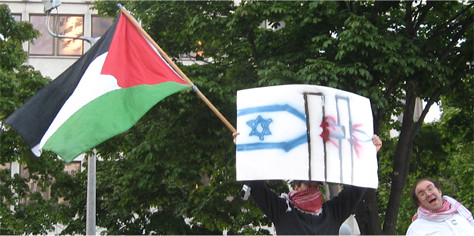
BAZA protesting the Dream for Darfur rally on October 7, 2007. Note the anti-Semitic cartoon claiming Israel engineered the attacks on the World Trade Center.

At one point I noticed a young man standing to the right of the BAZA activists with a sign that read "<--- I'M w/ STUPID" and later a young woman walk up to them with a sign that read "Zionism is not murder." After signing a petition to the Chinese government and having my photo taken I approached the young woman and told her that the BAZA activists were likely a lost cause for persuasion.


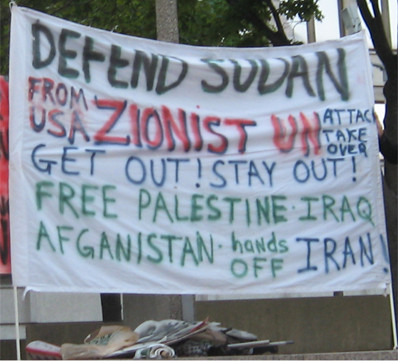
Banner held by BAZA activists supporting the Sudanese government's atrocities in Sudan. Note the horrible grammar and the absurd claim that the United Nations is Zionist-- which it is only in the sense that it established a Jewish homeland in 1948.


One of the BAZA activists, a rotund bespectacled man with a sign reading "DIVEST FROM ISRAEL NOT SUDAN" yelled at me, "Stop denying the Zionist genocide!"

I responded with, "What Zionist genocide?"

"The one against the Palestinians!"

"For something to be a genocide, a people must be decimated. Where are the corpses?"

I started loudly talking to the young woman so that the BAZA activist could hear us, "Genocide is a clearly defined crime under international law and so there needs to be evidence before charges are brought."

The woman smiled and asked rhetorically "Oh, you mean that 'Genocide' is a word with an actual definition?"

"Yes!" so I turned to the BAZA activist, "So what evidence have you? Did you know that the GDP of the West Bank has increased since the building of the West Bank Wall? Did you listen to the speakers? Did it sound like their annual income increased while they were suffering?"

The BAZA people shut their traps, and I noted to my new friend, "These people live in an alternate reality where facts are trifles."

More seriously: falsely charging genocide is almost as trivializing of the crime as genocide denial and it abuses real victims of genocide. The BAZA activists could not accuse Israel of wrong-doing without compulsively attempting to denigrate every survivor who stepped to the podium, whether he or she was a European, an Asian, or an African, whether he or she was a Jew, a Christian, a Muslim, a Buddhist, or an Animist
.

Saturday, October 6, 2007

Independence Paintings in Burlington, Vermont: The End?

Frequent readers of this blog will have noticed the attention I have been giving to a controversy in Burlington, Vermont regarding the exhibition of Independence Paintings: Inspired by Four Stories, mural sized collage of painting and text by Bread and Puppet Theater founder, Peter Schumann. My involvement with the story began with my writing an account of my own break with Bread and Puppet over the exhibition of just that particular work.

The story, at least in Burlington, seems to have drawn itself to a close though there are a few developments that I feel the need to comment upon.

Sally Pollak, in an article in the Burlington Free Press provided both an account of how the piece had come to be exhibited and of the fallout in Burlington. The exhibition was brokered by Marc Estrin (whose defense of the exhibition as "appropriate" I responded to here) working with Vermonters for a Just Peace in Palestine/Israel, a group that hosts anti-Semitic and Holocaust denial material on their website.

I have, like both Chasan and Kadour already noted the anti-Israeli and Holocaust denial material on the VTJP website, to which Bob Greene, a spokesperson for representatives VTJP has stated to Ken Picard in Seven Days:

“We’ve been called a thinly disguised hate group and anti-Semites, despite the fact that a quarter of our regularly attending members are Jewish, including one who escaped Hitler, [....] These are dangerous, ugly libels. If we were a group that had money or made money, we’d sue these motherfuckers.”

Greene and VTJP can deny that they advocate antisemitism or Holocaust denial all they wish, but as Chasan, Kadour, and I have all pointed out, a simple visit to their website contradicts such denials. A libel is only a libel if it has no basis in fact. Labeling me a "motherfucker," as Greene has done, does not change that.

While the September 19 Seven Days piece by Ken Picard, framed the story as one between political art and censorship (despite the fact that many of the most vocal critics of the exhibit, Rabbi Joshua Chasan, Ric Kasini Kadour, and I never called for censorship) Pollak's piece was far more nuanced, identifying the problem as the fact that a group with no connection to the arts community, sponsoring an exhibition for political purposes, to quote Yoram Samets in the Pollak article:

"It is our understanding that the Art Hop is an open community opportunity for artists to display their work and for the community to get involved, [...] In this case, Vermonters for a Just Peace in Palestine/Israel hijacked the venue for their political agenda. What we have here for the first time is the Art Hop being used by a political organization to further their point of view."

However, despite this, rather than discuss ways to prevent Art Hop from being hijacked in the future by a political organization, State Senator Hinda Miller, as reported Picard, has assembled a coalition to "go after" Art Hop's funding (the Pollak piece describes it as a petition "to overhaul policies and procedures at the annual arts celebration.") The artists, including those highly critical of Schumann's work have reason for concern: art festivals, like the larger Open Studios weekends we have in the Boston metropolitan area thrive on free expression-- and indeed, a review process unless highly streamlined, is cost prohibitive due to need for staffing. The fear that any potentially controversial artwork could be dropped from Art Hop is a real one that must be addressed. At the same time, statements by Carlos Hasse, Executive Director of the South End Arts and Business Association, which sponsors Art Hop are clear that there is a willingness to reevaluate its processes and listen to community concerns. The question is: can this be done without endangering artistic freedom in Burlington, Vermont?

If we value freedom of speech, we must oppose censorship, but rather than grit our teeth when ideas with which we disagree are given voice, we should instead explain why those ideas are wrong and why ours are better. This is the practice, not of censorship, but of following bad speech with good, and this is what I have attempted to do in my own critique of Schumann's work and of his apologists.

That said, my critique of press coverage of this event is over the most central issue: what is the truth-value of the art in question? Journalism, which by nature, reports on current events, is often at a failure to account for historical context. Both Picard and Pollak do a good job of identifying the participants in the controversy and what they have to say about one another's positions, but not about the truthfulness of the claims. After all, is not the value of political art the ability to tell truth to power?

Schumann and VTJP have chosen to confuse issues by injecting false analogies with the Holocaust into any discussion of the
Arab-Israeli conflict shows that they lack the moral seriousness to discuss the facts of the conflict, the causes, their history, and any possible solutions in an honest and thoughtful manner-- they simply have no regard for historical truth. The reports of the September 8th presentation make an unambiguous case that civil discussion has broken down, and while there are guilty parties of varying political affiliations, the fault originates with those who inject divisiveness and dishonesty when there should be truthful, reasoned, dialogue. Ugly statements breed ugly statements.

Schumann chose to juxtapose the Warsaw Ghetto with the West Bank Wall in a single piece of art (note that this was not a decision made by the Palestinian artists with whom he worked in Beit Sahour) and it seems to be understood by both his supporters and his critics (nearly everyone except for him) as a statement of near equivalence. The system of ghettos Germany established in the General Government of Poland killed five- to six-hundred-thousand Jews through engineered concentration, overcrowding and famine over a period of two years. A statement of equivalence is either to falsely charge Israel with genocide in the West Bank (where is the evidence?) or to claim that the Warsaw Ghetto was merely a place of high unemployment and humiliating checkpoints (as Schumann described the West Bank in his February presentation at the Boston Center for the Arts.) The Warsaw Ghetto killed over one-hundred thousand, the West Bank Wall, despite some of its worst effects, has prevented terrorist attacks on Israel, eliminated the need for IDF reprisals-- it has saved lives, both Israeli and Palestinian and permitted rebuilding in Palestinian communities-- but neither Schumann nor VTJP are concerned about that.

In the meantime I should note that Pollak did not repeat Picard's erroneous report that Schumann's family were refugees from the Nazis. I have mentioned this issue with Picard via email, and as Picard did not state he was in error when I brought it to his attention, I have to assume that this was an instance of Schumann misrepresenting himself in order to deflect criticism.

Tuesday, September 11, 2007

Independence Paintings in Burlington, Vermont, Part 3

I have been following the dispute over the exhibition of Peter Schumann's Independence Paintings in Burlington, Vermont, from my desk in Somerville, Massachusetts, so I am often forced to wait for and digest reports as they come in.

For those of you who have just joined me, the reason I am following a dispute over a collage being exhibited so far away from me is that for a number of years, I had performed with Bread and Puppet Theater, of which Schumann is founder and artistic director, in their Boston-area shows. It was when this painting was exhibited in conjunction with a Bread and Puppet show at the Boston Center for the Arts that I determined that I could not in good conscience continue with the troupe. I wrote about that event here.

For the past few days I have been digesting reports of the events on Saturday, September 8. That morning Peter Schumann gave a presentation regarding Independence Paintings which was inspired by his experience working with a group of Palestinian performers during a visit he made to the West Bank last year. WCAX reporter Andy Potter wrote an account entitled "Art Exhibit Draws Fire" describing "a flare-up of emotion."

The cause of this "flare-up" was the structure of the work, which, assuming that it was the same piece I saw at the Boston Center for the Arts, comprises of paintings of pained figures, clearly portrayed as Jews juxtaposed with text describing Israeli Defense Force counter-terrorist operations in the West Bank as described by the Palestinian performers. Schumann, in his talk on February 12th, 2007 described these Jewish figures as inmates of the Warsaw Ghetto. During the question and answer segment of the February presentation, he was called to explain why he felt it necessary to make a juxtaposition between the Warsaw Ghetto, an instrument of the Holocaust, and the West Bank, noting that juxtaposition implied an equivalence between the death by engineered starvation, and overcrowding, of one-fifth of Poland's Jewish population and the high unemployment rates on the West Bank. Schumann denied he was making any such comparison, but offered no other explanation as to why the West Bank and the Warsaw Ghetto appeared in the same piece other than the fact that he had chosen to read John Hersey's 1950 book, The Wall on the trip. Vocal critics saw this as a false accusation of genocide against Israel. Vocal defenders of Schumann at the same event, when they were not trying to shout down the critics, saw it as a true accusation.

I have already noted that there is no evidence supporting such comparisons and like a number of other critics, I viewed the work as "soft-core" Holocaust denial and thus, anti-Semitic propaganda.

Based on the reports I have received concerning the event on September 8th, a similar emotional dynamic appears to have been at work, however a key difference is that some in Burlington had read reports of the event in Boston, while the Boston audience had known only that the work was inspired by Schumann's work with Palestinian artists.

As noted before, WCAX reported a "flare-up." A personal email sent to me on September 8th at 11:55pm by Marc Awodey (who was not in attendance) related events as described by people he met that day: "a well orchestrated cadre of about 40 [...] protesters [...] waving [I]sraeli flags, yelling, plugging their ears when [S]chumann tried to speak." Note that Ken Picard's article dated September 12th in Seven Days estimated that the number of disruptive protesters amounted to "about a dozen of the 100 or so people in attendance." One of Awodey's sources reported that at least one of the protesters loudly made racist statements regarding Palestinians.

An email sent by Rabbi Joshua Chasan to local Christian clergy on September 9th (and published here at his request) gave this account:

Unfortunately, some of those hurt [by comparisons between the West Bank Wall and the Warsaw Ghetto] were as rude and hostile as supporters of Vermonters for a Just Peace in Palestine/Israel at the Saturday morning talk by Peter and the fellow he invited, Joe Koval. This issue pushes a lot of buttons.

Awodey forwarded me a piece by Marc Estrin, author with Richard T. Simon of Rehearsing With Gods: Photographs and Essays on the Bread & Puppet Theater entitled "Concerning the Hubbub at the Schumann Exhibit, and Why the Sponsorship and Speaker were Appropriate" which described the following:

[A] contingent [...] leafleting the audience, posting flyers [...] and generally trying to disrupt Kovel’s talk with aggressive muttering, badgering, shouting and flag-waving throughout, and starting a political campaign to get individuals and businesses to withdraw sponsorship from the Art Hop.

Without a transcript of what was said, it is hard to determine whether the "badgering" of Kovel's talk was disruptive heckling and how much was simply a reasonable inquiry from someone who questioned either Koval's or Schumann's positions. There is little doubt from the given reports that some element of the dissent voiced at the presentation was intended to disrupt and silence, however, it is also likely that at least part of the group of dissenters were there to engage in a civil manner.

Clearly, there has been a break down in civil debate in Burlington around the exhibition of Independence Paintings but before I offer an interpretation of what this break down represents and examine its causes, I would like to attend to the rest of Estrin's essay for the light it sheds:

[P]olitical art is political by definition, that is, it addresses the polis about urgent issues affecting the life of people, and Israel/Palestine is an urgent issue. The back room of 696 [Pine Street] is devoted for the month to a show of political art. That it should be accompanied by related speakers, films and community discussion – and even controversy -- sharing its universe of discourse is a legitimate dimension to such work.

Art and artists certainly do have a role in the political life of a democracy, just as journalism and journalists, and history and historians. The most outspoken critics of the exhibition of Independence Paintings: Joshua Chasan, Ric Kasini Kadour, and myself do not deny the value of art in political sphere, and this is a point missed by Marc Estrin when the only critique he permits Schumann's critics is "This is politics [...] It doesn’t belong here."

The point is also missed by Ken Picard when he wrote "political art [...] creates controversy only when it’s done right."

The point on which Chasan, Kadour, and I all agree is that Independence Paintings is not done right, and sadly, very little of the reportage in the Burlington press has either described the content of the work.

What Estrin and Picard miss in discussing political art is the relationship between art and truth. I do not write of "truth" as a transcendent absolute found in speculative metaphysics, or the articles of faith of a given theological tradition, or even the truth understood the ideology of a given state or political movement. I make far more modest claims for truth: an interpretation of events or phenomena supported by a preponderance of evidence.

History is never just whatever somebody declares to have happened in the past, journalism is never just what somebody declares to have happened recently or currently happening. Were either so, we would have no means of distinguishing between history, pseudo history and myth; we would have no means of distinguishing between good journalism, sloppy journalism, and propaganda. Historians assemble a great many pieces of evidence to determine what happened in the past, and its significance. Journalists must rely on multiple sources to assemble a description of what is happening. What does this have to do with political art? Do we not expect artists to take liberties, to use hyperbole, satire, allegory, analogy, and symbolism?

A society becomes dysfunctional when journalists no longer make the attempt to be truthful, when history texts no longer have any relationship to the evidence that the past has left for us. Art is not held to the same rules of evidence of journalism or history, nor should it. However, political art ceases to have a value to the polis when it is no longer truthful, when it lies. At that point the aesthetic life of a society becomes sick and dysfunctional. If we do not acknowledge that art can lie, then we lose the ability to distinguish between the post World War I work of Otto Dix and the propaganda posters approved by the regime that banned so much of his work.

As mentioned before, Schumann juxtaposed images of the Holocaust with a narrative of Palestinian views of the West Bank Wall and IDF counter-terrorist activities in the same piece. The message was taken by both Schumann critic and Schumann defender alike that either a.) Israel is committing genocide in the construction of the West Bank Wall, just as Germany committed genocide in the construction, administration, and destruction of the Warsaw Ghetto, or b.) that the Warsaw Ghetto was only as bad as the high unemployment rates and humiliation of going through an IDF security checkpoint. The evidence supports neither claim. The first interpretation is a false charge of genocide against the people and government of Israel and is antisemitism and "soft-core" Holocaust denial. The latter interpretation is very close to "hard-core" Holocaust denial and is unquestionably anti-Semitic. The act of juxtaposition has made a lie.

If we go back to Picard's aphorism "political art [...] creates controversy only when it’s done right" we see that this line of thought does not apply here. Good political art (such as that of Otto Dix) does create controversy, insight, or gives voice to thoughts that the audience simply has not found the means to articulate. But the controversy here has nothing to do with the quality of the art. The intensity of this controversy over how to interpret this piece, whether the piece should be exhibited or in what context it should be exhibited is a product of two factors: the degree to which Independence Paintings is untruthful and the degree to which the artist is a celebrity.

To further underline the untruthfulness of the work, let us examine Schumann's own statements:

Andy Potter reports that on September 8th,

Schumann explicitly disavowed any connection between his work and the Holocaust. "It wasn't the case, and if you think of it logically it simply doesn't hold up,"

Except that Schumann uses imagery that he admitted on February 12 in Boston was derived from his view of the events of the Warsaw Ghetto. Why would an artist knowingly create and exhibit something that does not logically hold up to the most basic scrutiny?

Schumann also stated at the September 8 talk that "I asked [the Palestinian artists] for the sake of creating this piece to tell me recent and local stories and then wrote these down." The methodology is sound but when compared with this statement from the September 4 article by Jack Thurston, "Schumann says his work is not anti-Semitic, it merely reflects a viewpoint many Palestinians really hold" several questions pose themselves. Can the work be free of antisemitism solely because it reflects viewpoints of "many Palestinians"? Why are the images of Independence Paintings not of life on the West Bank? Did the Palestinian artists suggest the use of the Warsaw Ghetto imagery?

The answer to the last question, appears to be "no." During the February 12 talk, Schumann was explicit that the inspiration to use images of the Holocaust came not from the Palestinians he met, but from the book he brought along with him on his trip, John Hersey's The Wall. The decision to juxtapose the West Bank with Warsaw was Schumann's and may have had little to do with anything said by the Palestinians he met. Indeed, if we consider that he stated that he had brought the book with him, the decision to juxtapose the two walls may have been made before he ever arrived in Palestine.

The break down of civil discourse in the wake of Independence Paintings is precisely because civil discourse must be rooted in truthfulness, and the work entered the political realm without ever having been truthful.

This is particularly disappointing when I consider Schumann's other works, some of which I have performed in, such as Oratorio of the Possibilitarians or World on Fire, which contained rich imagery, wit, sophisticated staging, and most importantly, truth.

Monday, September 10, 2007

Rabbi Joshua Chasan on Peter Schumann's "Independence Paintings"

Recent readers of my blog will note that I have been paying close attention to the events revolving around the exhibition in Burlington, Vermont of Independence Paintings, a collage of painting and text by Bread and Puppet Theater founder and artistic director, Peter Schumann. It was the content of this painting that caused me, someone who for a number of years had performed in Bread and Puppet's Boston area shows, to terminate my relationship with the group when it showed at the Boston Center for the Arts in February of this year. Rabbi Joshua Chasan, of the Ohavi Zedek Synagogue in Burlington, as reported earlier, has been a public critic of the exhibition. Due to the on going nature of the dispute, and his lack of familiarity with blogging, Rabbi Chasan asked me to share the letters he has written to the community as the situation has been developing.

I have made minor editorial glosses for purposes of aiding readability on the web, mostly in terms of providing links to relevant web pages and clarifying the identify of the speakers. I have made one note in bracketed italics that references a report by Ric Kasani Kadour.

Ian Thal


Three Emails from a Rabbi in Vermont to Christian Colleagues Including an Email Exchange Between the Executive Director of the South End Art and Business Association and the Rabbi

By Rabbi Joshua Chasan

On Saturday morning, September 8, 2007, the South End Art & Business Association of Burlington, Vermont featured a presentation of a mural by Peter Schumann, founder of the Bread and Puppet Theater. The mural was created after a nine day visit by the artist to Palestine, a journey from Vermont on which he took along John Hersey's The Wall, a novel about the Warsaw Ghetto. The exhibit and talk by both the artist and his guest, Joseph Koval, author of Overcoming Zion, was sponsored by a local organization that broke away from the tri-partite sister-city program of Bethlehem, Arad, and Burlington, in order to be able to advocate exclusively on behalf of Palestinians. The program on that Saturday morning was attended by Vermonters with a variety of viewpoints, and it was not a civil exchange.


Email from Rabbi to Christian Colleagues, August 31st, 2007:

Shalom Chavayrim,

Chavayrim--remember President Clinton saying "shalom chavair" it at Yitzhak Rabin's funeral--chavayrim (the plural) has the sense of being members of each other's shared spiritual vision. I write to you about a deep concern amongst members of our Jewish community about an exhibit of paintings with accompanying talk by Peter Schumann.

A review of these paintings appeared in the Boston Phoenix (see link below).

Whatever your opinion of the fence/wall (it disrupts Palestinian lives; it saves Israeli lives; both), I would urge you to go see the paintings and listen to the talk by Peter Schumann, whose work many of us have respected for decades. I plan to look at the paintings and will go to hear Peter if he is talking at any time other than Shabbat morning when I plan to be in synagogue. I believe the talk will be on Saturday, September 8. You can contact the Art Hop for more information. I will place at the end of this email some links you may want to look at.

I urge you to experience the exhibit and consider why many of us Jews (not all by any means, but certainly many of us, including me and board member of Vermont Interfaith Action, Jeff Potash) are deeply troubled by what Deborah E. Lipstadt has called "'soft-core denial" of the Holocaust "which, rather than deny the Holocaust, equate[s] Israel's policies with those of the Third Reich, labeling Israelis as Nazis." (Lipstadt, History on Trial, p. 25)

I and many others in the Jewish community are ardent civil libertarians. Ideas artistically expressed need to be challenged in the public square. So I write to ask you to consider the possible consequences of this exhibit being seen by people of all ages. Perhaps you will feel moved to speak out about what this exhibit evidences of our community's acceptance of ideas which are essentially anti-Semitic.

I readily accept that not every criticism of the polices of the State of Israel is anti-Semitism. But attempts to de-legitimate the existence of a Jewish State within living memory of the Holocaust send shivers down the spine of many of us Jews who know that, for all the problems that we have with specific Israeli policies, we know in the sinews of our souls that we still live in the lifeboat that the State of Israel provided for the Jewish people in 1948. Clearly, with pronouncements such as those of the President of Iran and the anti-Semitism in the textbooks and media of many Arab countries, the waters about us still are not safe.

I ask for your support at this time.

With hope for just peace,

Joshua


P.S. I suggest also going to the following web sites:

Vermonters for a Just Peace (VTJP)'s affiliation with Al-Awda:
http://www.vtjp.org/aboutus/aboutus.htm

Frank Levine's Letter to the Boston Phoenix about Schumann's Exhibit
http://thephoenix.com/article_ektid34743.aspx
(scroll down to "Imitating life?")

The original Boston Phoenix article:
http://thephoenix.com/article_ektid33080.aspx

I don't know if it is still up after complaints [weeks later it was], but the following cartoon comparing the Israelis' building the
fence/wall and an iconic image of Auschwitz was on the web site of Vermonters for a Just Peace in Israel/Palestine earlier this week: http://www.vtjp.org/cartoons/AbdullahDourkawi.htm, with the caption, "This political cartoon by Moroccan artist Abdullah Dourkawi won first prize in the Holocaust cartoon contest at the Tehran Museum of Contemporary Arts," sponsored by the State of Iran.


Email from Rabbi to Christian Colleagues, September 7, 2007:

You may recall my email of August 31st (see below) Here is correspondence from and to the director of the South End Art and
Business Association. Some have called for SEABA to pull the one offending painting and to cancel the connected talk and film. I have been careful not to. My position I think speaks for itself below. We in the Jewish community are hopeful that our Christian sisters and brothers will see this for what it is-a hijacking of the Art Hop by Vermonters for a Just Peace in Palestine/Israel who are one-sided in their support for Palestinians and hatred for Israel. See the cartoon below at the end of my first email. It is still on their web site as of five minutes ago. As you know, I am not afraid to criticize Israeli policies and have been side by side with Palestinians during a home destruction by the Israelis and protecting olive farmers near Nablus.

This is not about Israeli policies. This is about hatred for Israel the State which bleeds directly into hatred for Israel the people. The standard of public discourse in Burlington is being lowered. Please speak out publicly and to your members. This kind of hatred spreads easily.


Carlos Haase, Executive Director of the South End Art & Business Association to rabbi and representative of the Israel Center of Vermont with permission of the Executive Director, September 5, 2007:

I want to start off by thanking you for the very constructive phone conversations we've been able to have. Although the conversations have taken place at two different times in this process, both conversations have been very productive.

Below my signature, I am sharing with you our organization's immediate response to the controversy surrounding the Art Hop. I am also attaching it as a PDF.

From our conversations I conclude we have a lot of points in common. That in turn, provides us with the strength and common ground to pursue dialogue, discussion and understanding of this situation.

On that note, on behalf of SEABA, I want to be the first to let you know that we look forward to public response (your opinions of course, included), in order to assess how we can create a dialogue and safe space for discussion to take place in the near future, in whatever shape or that could be. For that, I look forward to directly working with you.

We have a great community here in Burlington. I wholeheartedly hope this whole experience and the dialogue to come from it will only strengthen us as a community.

Respectfully yours,

Carlos Haase,
Executive Director
South End Art & Business Association

SEABA'S POLICY ON ARTISTIC FREEDOM OF EXPRESSION:
The South End Arts and Business Association (SEABA), and by extension, the South End Art Hop, are strongly committed to Artistic Freedom of Expression. We don't pass judgment on any artwork, that is, we neither condone nor condemn any work. We encourage everyone to see the artwork on display and come to their own conclusions about the material. If any questions arise, we also encourage viewers to ask questions of the artist(s) who created the work. The Art Hop is a unique opportunity for creators and viewers to come together and create further dialogue, which furthers understanding. We at SEABA hope that you share our desires for intellectual inquiry and Artistic Freedom of Expression. We hope to see you at the Hop!

Rabbi to Executive Director of Arts and Business Association, September 5, 2007:

Carlos,

I tried to reach you by phone as you suggested.

I have to say that the statement that SEABA issued leaves me bewildered. In our previous conversation, I had assumed that the leadership of SEABA understood the dimensions of the mistake made in allowing Vermonters for a Just Peace in Palestine/Israel to use your organization for blatant political purposes. I had thought that you would be grappling with this problem. Instead, I heard you now using what happened to SEABA to define a policy of moral neutrality about expressions of hatred. If it were African-Americans or homosexuals who were victims of such abuse, I do not think you would be issuing statements of neutrality. I hear no soul-searching at SEABA about the risk created by allowing an expression of hatred. And recently I learned that the showing of Occupation 101 is also on your program. Carlos, it appears to me that SEABA has opened the door of mainstream Burlington culture to the expression of hatred. I fear for my community.

B'shalom,

Rabbi Joshua Chasan

[Editor's note: Ric Kasini Kadour has noted that Art Hop organizers, while unwilling to withdraw any work due to content, had agreed to present Independence Paintings in a context that addressed the anti-Semitic nature of the work, but later "reneged" on this agreement.]


Email from Rabbi to Christian Colleagues, September 9, 2007:

Shalom again. You must be wondering how I have time to write these emails when Rosh Hashanah and Yom Kippur are approaching. The answer is that you are part of my soul searching at this time of year. I value your opinions, treasure our years of working together and, I suppose, I am triumphalist enough (God forbid!) to hope you join me in the soul searching of the first ten days of the Jewish year, beginning this Wednesday evening.

I realize I am missing some names, and have neglected to send these emails to all of our colleagues. I missed Gary Kowalski. I'm sorry. If you see a name missing, please pass this along. A deep hurt remains for many of us in the Jewish community and others about this expression of hatred.

Unfortunately, some of those hurt were as rude and hostile as supporters of Vermonters for a Just Peace in Palestine/Israel at the Saturday morning talk by Peter and the fellow he invited, Joe Koval. This issue pushes a lot of buttons.

I write now to ask those of you who attended the Saturday morning program and/or saw the mural about the Warsaw Ghetto/Palestine, to send me your thoughts. Not everyone sees hatred, animus, in this work. Perhaps you didn't. Or you did. Either way, I want to create a conversation about this issue. Many of us in the Jewish community, with perspectives on Israel/Palestine which range across the spectrum, feel a little less safe in this community than we did before we got word of what we continue to believe was a hijacking of the Art Hop by Vermonters for a Just Peace in Palestine/Israel which has associated itself on its web site with the State of Iran's Holocaust Cartoon Contest.

I hope together we can up the ante for a movement for peace which recognizes the threats to democracy from both within and without the United States; and sees the struggle of Israelis and Palestinians in the context of international relations over the past two hundred years. The world is in chaos now and we must examine carefully rhetoric about a just peace to see if its practitioners really want peace, or they are driving a hard bargain for one side or the other.

As clergy, we know that God knows no sides; God is beyond sides. Yet we also know that the level of violence in our world today--State-sponsored violence and violence sponsored by the ideologues of triumphalism, whether it be religious or national--the level of violence in our world today must be an affront to our conscience that calls us into action.

I ask you to join in conversations, public and private, that begin with honest, calm talk about issues of justice and peace in the Middle East. Once again, just as with Vietnam (at least in my opinion), the peace movement as constituted, has some but limited effect. Just as on other social issues--for example, abortion--our moral influence is limited by our differences of opinion, so too this can become a problem about differing takes about Israel and Palestine.

For the sake of helping to create an effective movement to end the violence, as well as for the sake of those of us Jews who feel threatened by a weakening of moral resolve in the world to protect the independent sovereignty of the State of Israel, can we talk to each other about these issues? Will those of you who resonate to our vulnerability as Jews speak out the public about this issue?