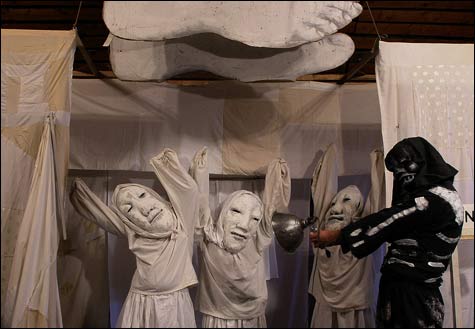
This past February, I walked out of rehearsals for Bread and Puppet Theater's Battle of the Terrorists and the Horrorists. Normally this would not be something worth commenting upon in a public statement, as performers leave projects all the time, but because my relationship with Bread and Puppet had been an ongoing one since 2003 and most importantly, because it was a matter of conscience, I feel compelled to comment, especially since it has become the subject of scuttlebutt about the local scene.
But before I explain why I departed, I ought to describe Bread and Puppet's significance to me. To those unfamiliar with the company's history: Bread and Puppet Theater was founded in the early 1960s in New York City by German immigrant Peter Schumann, an artist whose formal training was in dance and sculpture. In the early 1970s he relocated the company to Glover, Vermont, where it stages pageants during the summers, while spending much of the rest of the year performing both in the United States and abroad. Due to the scale of Schumann's theatrical vision and the costs involved in running a theatre company that receives no outside institutional support, the company relies heavily on volunteer performers. Some of these volunteers are veteran company members, while others are fans or local artists who feel some resonance with Schumann's artistic vision, and camaraderie with him and his company.
Since 2003, I had been one of Bread and Puppet's Boston area volunteers. I estimate that I have participated in some 37 individual performances with the company. During this time, I had made a habit of keeping a web log of my experiences at these shows, an activity to which Schumann gave his blessing after he and many others had become aware of it.
Actively reflecting and writing about rehearsing and performing under a maverick theatre director was to have a powerful influence on my development as an artist. From the very first rehearsals, I learned techniques of staging and object manipulation that have added to my toolkit -- more importantly, I saw first hand how to take philosophically complex concepts and translate them into an allegory for the stage (Indeed, I was unable not to see parallels between Martin Heidegger's later work, most specifically, "The Question Concerning Technology" and Schumann's own Oratorio of the Possibilitarians).
As this past February came around, I was preparing to spend another week-long run with Bread & Puppet. This time we would be performing at the Boston Center for the Arts' Cyclorama, a 23,000 square-foot red brick rotunda located in the South End of Boston, originally built in the nineteenth century to display a panoramic painting. I was excited to be in such a space. Since the size of the venue allowed for it, an exhibition of Schumann's two-dimensional art all along the interior walls of the structure was also planned.
On February 5th, 2007, I was contacted by freelance journalist and activist Susie Davidson (Disclosure: Davidson is editor and primary author of I Refused to Die: Stories of Boston-Area Holocaust Survivors and Soldiers who Liberated the Concentration Camps of World War II, an anthology that includes two of my poems, and is a personal friend) as she had received word that a new piece, not mentioned in previous press releases, had been added to the art exhibit, one that was based on Schumann's experience of working with a group of Palestinian artists in the West Bank. To quote Schumann in the revised press release:
Last November I went for nine days to the West Bank to the town of Beit Sahour to conduct a puppet workshop with an on-and-off company of about twenty. We built puppets and masks from garbage retrieved cardboard. And on Palestinian Independence Day, November 15, the Palestinian Branch of the Bread and Puppet Theater performed on Manger Square , Bethlehem a short spectacle titled “Independence” consisting of four stories made from recent local incidents.
This description was vague enough that anyone could interpret it in terms of their own fears or hopes and as the press release began to circulate, members of the local Jewish and Holocaust survivor communities began to show alarm. Davidson had hoped that I could clarify the content of the show and exhibit.
My own experience had been that, except for the slapstick variety, Schumann is opposed to all sorts of violence. It is also my feeling that working with Palestinian artists, and having sympathies with Palestinian non-combatants must not be interpreted as sympathies for those who advocate violence against Israelis or Jews in general. However, I lacked the certainty to assure anyone that the concerns were not justified, and could only caution that one should not jump to a conclusion out of fear. However, I persuaded a number of my interlocutors to attend the opening reception of the exhibit and to ask questions at the symposium that was to follow.
On February 12th, I attended the reception. On entering the Cyclorama, I was greeted with smiles and open arms by many of the friends I have made over the years through Bread and Puppet. However, already aware that I was in the middle of a potential maelstrom, I turned my attention to Peter Schumann as he walked us through the art exhibit, which ranged from political works that directly referred to current events like the Bush Administration's practice of "extraordinary rendition" to a more fanciful adventure of Kaspar, who is something of a Germanic equivalent to the Neapolitan Pulcinella or English Mister Punch.
When Schumann began his narrative of "Independence Paintings: Inspired by Four Stories" he explained that he had gone to the West Bank on invitation from local peace activists, and that he had been reading John Hersey's
The Wall, an account of the Warsaw Ghetto. The result was a large piece that juxtaposed scenes from the Warsaw Ghetto (with inmates clearly represented as Jews) and a narrative of how Palestinian non-combatants are affected by Israeli Defense Force's (IDF) counter-terrorist operations. Schumann noted how the West Bank wall and security checkpoints between Israel and the West Bank had led to economic privation and "humiliation" for Palestinians, though he was quick to note that it "was not as bad" as conditions in the Warsaw Ghetto.
As at the symposium (a question and answer session moderated by John Bell, a former Bread and Puppet company member, current member of
Great Small Works, one of my favorite puppet theatre troupes, and
Emerson College professor) began, I found myself in an alienated state and thought it best to sit back and observe, sensing that while I would have to make a choice, I did not have to at that moment. Susie Davidson spoke up. She noted that the juxtaposition of imagery of the Warsaw Ghetto and a narrative of the West Bank invites a claim that the two are equivalent. Schumann responded by asking her to point out where he makes that claim in his art. He only reiterated that he had just read Hersey's book and that there were economic deprivations that resulted from the West Bank Wall, specifically citing an unemployment rate of over 80%, while never acknowledging that the West Bank Wall had been constructed as a non-lethal means to end suicide bombings in Israel and that it had been largely successful.
(Of course, how much of that unemployment can be blamed on the construction of the wall and not on corruption within the Palestinian Authority, something Schumann did acknowledge, is open to debate.)
The Warsaw Ghetto is an icon in the historical memory of the Holocaust, and though originally conceived before Germany decided upon the "Final Solution," it is impossible to view the ghetto except as a stepping-stone towards the Holocaust, and this is what makes it such a powerful source of imagery. Schumann, an artist who has been refining his own personal pantheon of icons over decades, is certainly aware of the power of images, especially when placed in relationship to one another. The idea that he was merely putting the scenes of IDF counter-terrorism alongside those of the ghetto because he was reading a specific book while visiting a specific place, might be understandable had a much younger, less mature artist made the work, but from an artist of his experience, it seemed a cop-out.
Davidson pressed on, questioning Schumann: if one is comparing the Warsaw Ghetto with the West Bank, where are the slave labor camps, the gas chambers, and the Zyklon-B canisters? Schumann was silent, but much of the audience, who probably saw themselves as supporters of Schumann and Bread and Puppet, were not.
Frank Levine, who was seated next to Davidson, described the ensuing debate in the March 2, 2007
letters section of The Boston Phoenix:
[...]Schumann’s installation was a collage of photos of the walls of the Warsaw Ghetto, with text underneath referring to the wall in Israel, “jackboots,” “people being pulled from their homes,” “the oppressor and occupier,” etc., leading to no other conclusion but that he was equating the policies of the Israeli government with those of the Nazis.
[...]at the symposium, [Susie Davidson] asked Schumann what the basis of his comparison was; she was met with a chorus of “Zionist Nazi,” denunciations of the Israeli government, and insulting, dead-end rounds of clapping. Schumann then incredulously stated he did not mean to equate Israeli and Nazi policy, when it would be an insult to any viewer’s intelligence to conceive that the impression would be anything but.
I was not seated near either Davidson or Levine, and did not hear anyone use the phrase, "Zionist Nazi" as Levine describes, but the account otherwise matches my observations. I did, however, see scrawled in large red marker, the phrase "Zionist Genocide" on a sheet of paper left behind after the fact.
The point is that, even if Schumann intended no such comparison, his audience explicitly interpreted him as making the comparison. Schumann, an artist who has spent decades cultivating his own personal iconography is certainly intelligent enough to realize that a large segment of his audience would interpret the work as a statement of equivalency between the Warsaw Ghetto and the West Bank.
The Warsaw Ghetto was part of a system of ghettos that Germany built and operated in the Nazi puppet-states it established in Poland and the Baltic between 1939 and 1941. According to the Raul Hilberg's seminal study
The Destruction of the European Jews (all references are to the 1973 edition), 500,000 to 600,000 Jews died from starvation and disease in the ghettos of forced labor camps of Poland. Translation: about one fifth of Poland's Jewish population died in the ghettos in less than two years. (Hilberg, pp. 173-174.) Nothing of that sort has occurred in the West Bank-- in fact, the Palestinian population on the West Bank has grown since 1967.
Indeed, Schumann went on to interpret the the failure of the April 19-May 16 1943 Warsaw Ghetto uprising as "the failure to reach out to the Polish resistance." However, to again refer to Hilberg, in preparing for the uprising, 22 battle groups under the command of Modechai Anielewicz received weapons from the Communist People's Guard under the command of General Rola-Zymierski and from the Home Army -- the military wing of the Polish government in exile in London (Hilberg, pp 322-323.) In addition, Polish partisans carried out diversionary attacks outside the ghetto (p. 324). The failure was being outnumbered and outgunned by the Germans, and their Polish and Ukranian allies -- and perhaps in not taking up armed resistance earlier.
Though I am young, the world has witnessed much genocide in my lifetime. We know how to measure genocide in cold statistics without reference to emotionally charged icons. The population of a group targeted for genocide simply does not increase, especially when the alleged murderers have military superiority. IDF entered the West Bank in 1967, and while it would be absurd to state that there have been no injustices committed against Palestinian non-combatants, no genocide has occurred, no genocide is in the making, unless we are to believe that this is the most ineptly-managed genocide in history.
At best, the juxtaposition Schumann presents in "Independence Paintings: Inspired by Four Stories" is what historian
Deborah Lipstadt refers to as "soft core Holocaust denial" in that rather than deny that a historical event (like the Holocaust) has occurred, it seeks to rewrite history without concern for actual facts. So Israelis are compared to Nazis and the West Bank is compared to the Warsaw ghetto -- in short, the idea of a phony genocide is promoted. Outrage over a phony genocide diverts from outrage over real genocides like those in Rwanda, Darfur, the former Yugoslavia, and Iraq.
At worst, Schumann's statements on behalf of "Independence Paintings: Inspired by Four Stories" are normal Holocaust denial: that the ghettos were sites of merely massive unemployment and security checkpoints -- and not places in which one fifth of the population died through deliberate starvation , over-crowding, and denial of medical care over a period of less than two years. This sort of denial was implicit in the fact that these ghettos were called "ghettos" as the ghettos of Europe had never before been so deadly. The word "ghetto" was a euphemism.
Listening to these evasions by an artist I admire left me in a daze of cognitive dissonance, where I had to wrestle with conflicting feelings of loyalty and friendship, but also for the value I place on truth and critical analysis. The conclusions above are not ones I could reach at the symposium, but ones I struggled with over the next day and night. So despite these feelings of dissonance, I still greeted my old friends, and I still pictured myself working with them. The next evening, I attended the first night of rehearsals, hoping that perhaps the show would provide the counterpoint to the tension I felt.
This was the description of
The Battle of the Terrorists and the Horrorists in the press release that had been sent out in a mass email on January 11, 2007, when I had first committed myself to performing in the show:
THE BATTLE OF THE TERRORISTS AND THE HORRORISTS is a black and white dance and puppet show with a few colored exclamation marks!! As the U.S. sets out to achieve victory over the terrorists, it becomes necessary to make citizens acquainted with the promoters of victory: the horrorists. Under the banner of the two major divinities who rule over our present day existence — the God of Everything and the God of Nothing — the horrorists demonstrate, with the help of a cardboard citizenry, the progressive stages on the way to victory, including Ice Cold Reality, a dumbshow, which describes a week of horror under the feet of the occupier. The march to victory is a giant sailboat that drowns in stormy seas, and war is genocide.
From the press release, it appeared that the show was to be a satire about the Bush Administration's "War on Terror" as seen through the lens of the mythology that Peter Schumann had developed. "Horrorist" is a neologism that I first encountered in Bread and Puppet's
How to Turn Distress into Success in 2004 (indeed, the monologue and cards in which the term is introduced are used in both plays.) It is understood as the dialectical antithesis to the terrorist, an opposing faction that enjoys "peace defined as complete military superiority". Clearly, this well describes America in the age of George W. Bush.
In rehearsal,
The Battle of the Terrorists and the Horrorists was an alternation between satirical and allegorical
tableaux,
lazzi, and skits, the most brilliant of which was the "cardboard citizenry," a group of puppet characters whom the puppeteers introduce to the audience, only to abuse without warning, and then assure the audiences that no harm has been done, as the citizens are mere cardboard. This bit of comedy well satirizes the tendency to make distinctions between , victims of terrorism, victims of war crimes and the euphemism of "collateral damage". While I do accept such distinctions as valid for purposes of International Law, there is no reason why these distinctions should not be questioned by either ethicists or satirists.
But in the middle of the rehearsal came the bait-and-switch. Just as I had thought I was in an allegorical satire of contemporary America and that I was marching off to Iraq (or perhaps Iran), we were in the "Ice Cold Reality of Palestine." Schumann had transformed American soldiers (he had had us hum
The Star Spangled Banner) into IDF soldiers. The dumb show curtains opened and puppet characters representing Palestinian women were being shown with a wall closing in on them, while large puppet feet trampled them from above. We were directed first to mime throwing rocks at the wall and then to mime tearing the wall down.
The scene disturbed me because I knew that tearing that wall down in reality would result in a return to suicide bombings in Israel, which would necessitate IDF reprisals, and so lead to needless deaths of both Israelis and Palestinians. I hoped that as we went through the scenes we would see something of what the terrorists would do, or a call for peace. But nothing of that sort came. Indeed, even what little nuance Schumann had demonstrated at the symposium, his criticisms of Palestinian society, notably, its sexism and the corruption of its leaders, were completely absent.
By the time I arrived at home, I decided I could not in good conscience remain in the cast, and then began to compose an explanation to a friend involved in the production. It took me a day to find the words, but in summation: If peace is a goal we seek, we cannot acquire it by demonizing the enemy, accusing them of crimes that they have not committed, nor can we insist that no injustice has been done to them. By performing in
The Battle of the Terrorists and the Horrorists I would have lent my body to increasing the polarization that I witnessed that Monday night and make dialogue between people of good conscience more difficult. I have no idea if my explanation was passed on to anyone else in the company, and chose not to discuss my decision in detail to more than a few individuals until the production ended.
The response I received, in fact, the only disapproving response, was to suggest that I had succumbed to peer pressure, and that if I truly objected, that I should have worked within the system of Bread and Puppet to change the show, instead of giving up, and that I should have known that Bread and Puppet treats controversial material. Of course: I largely lack the behavioral pattern of "peer pressure" response, Bread and Puppet is not a democracy, and I was apparently on the other side of the "controversy."
Peter Schumann was born in 1934 in Silesia. This much appears in all the biographic accounts of Schumann's life, very little else. While Lower Silesia was at the time firmly within Germany's borders, Upper Silesia was divided between Germany, Poland, and Czechoslovakia. In 1939, Germany's invasion of Poland resulted in the annexation of all of Silesia. The German SS, along with Silesian ethnic German paramilitaries, rounded up Silesian Poles and sent them to forced labor camps in the Reich or deported them to the General Government (the part of Nazi-occupied Poland not formally annexed to the Reich, but placed under the government of General Governor Hans Frank). The Jews of Silesia were deported to the ghettos. Silesian Germans and newly arrived Germans from the west took control of formerly Polish and Jewish-owned properties.
In 1941, once the ghettos had become unmanageable, plans were made to for surviving residents not killed by Mobile Killing Units to be sent to the camps, such as the death camps at Auschwitz-Birkenau and the concentration camps at Groß-Rosen, both of which were located in Silesia. This history is not mentioned in the hagiographies written about Peter Schumann (Notably George Dennison's
An Existing Better World: Notes on the Bread & Puppet Theater and Richard T. Simon and Marc Estrin's
Rehearsing With Gods: Photographs and Essays on the Bread & Puppet Theater). Indeed, we only have to look at an
interview dated March 1, 2006 given to
Real Change News:
I was born in Silesia, which was German. It became Polish in 1945, after the war. It was part of Germany that was given to Poland by the Yalta Conference. Ninety-nine percent of the population of Silesia was made into refugees at the end of the War and we were part of that 99 percent. We were all looking for a new life, so we live as refugees for a few years.
[N.B.: Real Change News removed the article from their website, but it is available on archive.org.]
This quote is an example of historical denial. Never in the interview does he mention that one of the most notorious sites of the Holocaust is located in Silesia or that Germany had invaded Silesia and that the adults in his community had either profited from or committed acts of ethnic cleansing, enslavement, and genocide, or even that he was a child under the Nazi regime. In many cases, surviving Jews were still in displaced persons camps for years. 1945 is the year that the surviving Poles returned to their lands, wanting nothing of the people who had enslaved them.
This is not to dismiss the horrible experience of being a child refugee for the crimes of the adults in one's community, but the context of a little talked about, and incredibly complex aspect of the Post-World War II era has gone missing. The lands that Germany seized, ethnically cleansed, and then settled, were forcibly returned after the defeat of the Reich. In Poland, it is estimated that 6 million Germans fled or were evacuated, while another 3.6 million Germans were deported. It is estimated that as these lands were restored to Poland, Czechoslovakia, Russia, Lithuania, Yugoslavia, and other states in Eastern Europe, as many as 16.5 million Germans either fled or were deported to Germany between 1944 and 1948. Because of poor logistics, it is estimated that as many as two million Germans died in the process. Most Germans who fled from Silesia and other German-held lands in the east, not because of deportations though, but in the face of the Soviet military who were pressing toward Berlin (and had to, as a matter of military necessity.) As to the redrawing of Germany's eastern borders after World War II, there were many reasons, too complex to discuss here.
However, this inability to talk about what really happened is very telling about his attitudes regarding the Arab-Israeli conflict. To quote the same interview:
Palestine is an ice-cold reality under the feet of the occupiers. Palestine is homelessness that results from the gestures of politicians. Palestine is a giant body arrested, crushed, and rises up and lives.
In 1948, the formally British Palestine was partitioned into two states: Israel and Palestine. The Arabs of Palestine, alongside the armies of Egypt, Syria, Jordan, Iraq, Lebanon as well as smaller forces from Sudan, Yemen, Saudi Arabia, and Morocco, invaded Israel. The intent was to destroy any Jewish state. The ultimate aims of the Arab protagonists ranged from a reinstitution of
dhimma to, judging by statements by Mohammad Amin al-Husayni, the Grand Mufti of Jerusalem, Chairman of the Arab Higher Committee, recruiter and organizer of Muslim SS Units on behalf of the Nazis, and suspected war criminal, a second genocide. Ultimately, the invasion failed. The conflict resulted in the creation of about 711,000 Palestinian Arab refugees and 900,000 Jewish refugees. No Arab state has offered to repatriate or compensate the Jewish refugees.
The ice-cold reality is that Schumann's identification with the Palestinian cause is so one-sided that one is forced to consider the hypothesis that it is an emotional stand-in for the Silesia he lost as a child.
It is a failure of those who sympathize with the Palestinian cause when they engage in Holocaust denial of either soft core or "hard core" variety, often by crassly appropriating the very iconography of the Holocaust. Those who survived the genocide and mass murder committed by the Soviet Union and its client states, the People's Republic of China, the Khmer Rouge, Imperial Japan, Chiang Kai-Shek's Nationalist movement and other such regimes, do not need to appropriate the symbols of the Holocaust in order to educate the world about these histories, but anti-Zionists like the ones encountered and encouraged at the February 12, 2007 symposium are not interested in truth, healing, or reconciliation. They are interested in equating Jews with Nazis. Why?
To quote Hilberg:
Preventive attack, armed resistance, and revenge are almost completely absent in two thousand years of Jewish ghetto history. Instances of violent opposition, which may be found in one or another history book, are atypical and episdoic. The critical period of the 1930's and 1940's is marked by that same absence of physical opposition.
On the other hand, alleviation attempts are typical and instantaneous responses by the Jewish community. Under the heading of alleviation are included petitions, protection payments, ransom arrangements, anticipatory compliance, relief, rescue, salvage, reconstruction-- in short, all those activities which are designed to avert danger, or, in the event that force has already been used, to diminish its effects.
- Hilberg, p. 14.
While these stratagems had ensured the survival of Jewish communities over millennia despite having overwhelming force arrayed against them, they became completely dysfunctional when, as during the Holocaust, the oppressors' aims ceased to be conversion, segregation, humiliation, exploitation, scapegoating, and deportation, but a "final solution" of annihilation.
What outrages many who call themselves "anti-Zionists" is that Israel represents a Jewish people who no longer behave as "ghetto Jews" when threatened with violence. In the imagination of an "anti-Zionist" a "bad Jew" is a Jew willing and capable of defending both himself or herself and the community, while a "good Jew" is a pacified Jew, who will suffer under the yoke of tyranny or, if so commanded, die. This line of thought, in most cases, is probably only held on a sub-conscious level by "anti-Zionists" and serves as the conceit by which they deny being anti-Semitic; They simply do not grasp the anti-Semitic logic underlying their beliefs -- but this is because they have absorbed the
status quo of the Christian-European and Islamic-Arabic worlds: That Jews are supposed to be a humiliated and weak people.
So even when Israel exercises force in proportion to an actual threat, the very act of defense is deemed to be Nazi-like, which is a convenient belief for Schumann to hold given his own Silesian denial. Because of this complex of historical denial, psychological denial, mallicious use of Holocaust iconography, and fanning the flames of conflict, I could do nothing else but part ways with an iconoclastic artist who had greatly influenced me.