The Pulitzer committee announced its 2015 prizes this past week, awarding its prize in drama to Stephen Adly Guirgis for Between Riverside and Crazy.
Back in 2010, I had a brief exchange with Guirgis on this very blog. He had objected to comments I had penned in 2006 regarding an earlier play of his, The Last Days of Judas Iscariot -- arguably, my first published piece of theater criticism. While I conceded that the play was filled with the sorts of monologues that actors enjoy performing, I considered the play to be poorly structured, and narratively incoherent, as well as containing a pronounced undercurrent of hipster misogyny (because sexual harassment of women is edgy and cool!) and old-school antisemitism: Most notably the Deicide charge that the Jews are to be held responsible for the crucifixion of Jesus of Nazareth (a doctrine explicitly rejected by the Second Vatican Council with the 1965 publication of Nostra Aetate).
The play takes place in a courtroom in the afterlife in which the defense attorney for Judas Iscariot (whom many scholars believe to be a fictitious character whom the Gospel writers created to personify "the perfidious Jews") tries to overturn his eternal damnation -- her strategy is to pin the crime of the crucifixion on another individual -- and since the Roman military governor, Pontius Pilate has washed his hands of responsibility, she ends up trying to pin the crime on another Jew: Caiaphas, the high priest of the Second Temple.
Some point over the years, Guirgis got wind of my critique, and while he was willing to concede that The Last Days of Judas Iscariot might not be the best written play (he wrote "My play is wildly imperfect, [with] lots and lots of flaws"), he objected to my characterization of the play as anti-Semitic (" I can assure you it was not written in hate. It was written, in all it's imperfection, with love.") Perhaps his intent was muddled by the structural problems in the play. Oddly, he never really addressed my concerns about misogyny.
You can read the whole exchange here.
Saturday, April 25, 2015
A 2010 Exchange With Pulitzer Prize-Winning Dramatist Stephen Adly Guirgis


Wednesday, July 11, 2012
Nothing But Trouble: Philistinism in the UK, Part II

Over at the Clyde Fitch Report, part II of my post-mortem on the on the attempt of British anti-Israeli activists to prevent the Israeli State Theatre, Habima, from performing at Shakespeare's Globe Theatre in London as part of the 37 play Globe to Globe Festival:
Given the Globe’s steadfastness that that it would not bow to any cultural boycott, the March 29th letter was doomed to have little effect; only gaining headlines due to the celebrity status of many of the signatories: film star Emma Thompson’s name appeared in much of the subsequent news coverage, as did that of Mark Rylance, who was former artistic director of Shakespeare’s Globe. It was little surprise to see the name of playwright Caryl Churchill, whoseSeven Jewish Children has been widely criticized as anti-Semitic by such figures as Booker Award winning novelist, Howard Jacobson, attorney and literary scholar Anthony Julius and others due to its invocation of the blood libel, gross distortion of the history of the Israeli-Palestinian conflict, and crude ethnic stereotypes of Jews. (Notably, The Guardian, which makes Seven Jewish Children available on its website has published numerous apologiae effectively making the paper the play’s corporate sponsor.)
With the March 29th letter, the story had gone from activists attempting to silence artists not because of the content of the work but for their identity, to that of artists attempting to silence other artists due to their identity: a particularly dangerous position for artists to take. Once an artist advocates the boycotting of another artist’s work because of their nation of origin or for taking a gig in a specific theatre, they have both given sanction to hooliganism seen on May 28th and 29th and sanction similar retaliation towards their own work.
Read more at the Clyde Fitch Report!
Thursday, July 5, 2012
Nothing But Trouble: Philistinism in the UK, Part I

I have a new column at the newly relaunched Clyde Fitch Report entitled "Nothing But Trouble". The CFR bills itself as "the nexus of arts and politics" and "Nothing But Trouble" will be focussing on just that nexus.
My column will open with a two-part series entitled "Philistinism in the UK" which is a follow-up and expansion upon an earlier piece, "Artistic Boycotts in the UK" and focusses on the attempt of British anti-Israeli activists to prevent the Israeli State Theatre, Habima, from performing at Shakespeare's Globe Theatre in London as part of the 37 play Globe to Globe Festival:
Outside the theatre, one anti-Israel protestor was photographed wearing what anycommedia dell’arte enthusiast might see as a Pantalone mask but to most would be seen as the stereotype of the grotesquely long-nosed Jew; somehow it seems unlikely that he was making commentary on Shakespeare’s indebtedness to the Italian comedy.
Though the most vocal protestors were kept out, Habima’s performances were repeatedly disrupted by anti-Israeli activists, who were photographed waving Palestinian flags, and unfurling banners with anti-Israeli slogans, only to be escorted out by security. Reports describe a group standing silently with their mouths covered by either tape or adhesive bandages apparently in protest of the “censorship” of the more disruptive activists. Several sources that during the trial scene in Act IV, a protester shouted “hath not a Palestinian eyes?” echoing signs seen outside the theatre as well as demonstrating a lack of knowledge of the original text (Shylock’s famous “Hath not a Jew eyes…” speech is from Act III, Scene 3.)
Read more at the The Clyde Fitch Report!
Sunday, April 8, 2012
Artistic Boycotts In The UK: Habima at Shakespeare's Globe
In recent months, part of my "beat" as a contributor to The Arts Fuse has been reporting on Israeli Stage, a Boston-based company devoted to presenting Israeli plays to an American audience, writing commentary on the work on Israeli playwrights Savyon Liebrecht and Motti Lerner as well as conducting an interview with Israeli Stage's Producing Artistic Director, Guy Ben-Aharon. Despite the the fact that I am new to the subject, this recent work has placed me in a position where I now have to pay greater attention to new developments.
On Thursday, March 29, 2012, The Guardian published an open letter signed by 37 British artists associated with film and theatre protesting Shakespeare's Globe's decision to invite the Israeli state theatre Habima (who were mentioned in the Ben-Aharon interview) to participate in an international Shakespeare festival in May. The text of the letter is as follows:
We notice with dismay and regret that Shakespeare's Globe Theatre in London has invited Israel's National Theatre, Habima, to perform The Merchant of Venice in its Globe to Globe festival this coming May. The general manager of Habima has declared the invitation "an honourable accomplishment for the State of Israel". But Habima has a shameful record of involvement with illegal Israeli settlements in Occupied Palestinian Territory. Last year, two large Israeli settlements established "halls of culture" and asked Israeli theatre groups to perform there. A number of Israeli theatre professionals – actors, stage directors, playwrights – declared they would not take part.
Habima, however, accepted the invitation with alacrity, and promised the Israeli minister of culture that it would "deal with any problems hindering such performances". By inviting Habima, Shakespeare's Globe is undermining the conscientious Israeli actors and playwrights who have refused to break international law.
The Globe says it wants to "include" the Hebrew language in its festival – we have no problem with that. "Inclusiveness" is a core value of arts policy in Britain, and we support it. But by inviting Habima, the Globe is associating itself with policies of exclusion practised by the Israeli state and endorsed by its national theatre company. We ask the Globe to withdraw the invitation so that the festival is not complicit with human rights violations and the illegal colonisation of occupied land.
The March 29 letter is a restatement of the position taken in undated letter which (based on the date of the Ynet article that cites it) was published sometime prior to January 2, 2012. Boycott From Within, the organization that issued the letter, appears to be primarily made up of Israeli citizens who support the Boycott, Devestment, and Sanctions (BDS) movement that was initiated by a coalition of Palestinian NGOs in early 2005, several months after the Ariel Sharon-led Israeli government announced plans to withdraw the Gaza settlements, a plan that was accomplished in August of 2005, quite without the assistance of BDS. Indeed, it becomes hard to identify any concrete accomplishment of the BDS movement beyond providing a rallying cry for anti-Israel activists in the west; they certainly have not advanced the goal of a two-state solution, nor can they claim responsibility for any of the small victories of recent years, like Israel's dismantling of checkpoints within the West Bank or the Palestinian Authority's own crack down on militant groups in areas which it controls.
The Boycott From Within document, unlike the March 29 letter, specifically names the two West Bank settlements:
Ariel and Kiryat Arba, like most settlements, are surrounded by walls and fences, closely guarded by soldiers and their own armed security personnel. A theatrical performance in a settlement is by definition a performance to an exclusively Israeli audience, with Palestinians living even in the nearest village being physically excluded from any chance of attending.The first point that should be made, of course, is that while Ariel and Kiryat Arba are controversial, they are not, strictly speaking, illegal. While there are illegal settlements, of course, such as Migron (which the Israeli Supreme Court recently ordered the Israeli government to demolish), under the 1993 Oslo Accords, the status of settlements like Ariel and Kiryat Arba are pending final status negotiations between Israel and the Palestinian Authority. They might end up as part of a land-swap between the two states, they might be evacuated, or they might become an example of Jewish residents within the future Palestinian state much as there are Arab citizens in Israel (though that possibility is less likely, given recent statements by Mahmoud Abbas and his government.) So whether or not the settlements' establishment was legal (there are differing interpretations on whether the Fourth Geneva Convention applies) the Oslo Accords essentially table it as a legal issue, turning it into a political issue.
[...]on this issue the management of Habima has taken a position which is remote from any kind of social engagement. Claiming to be "non-political", the management has reiterated its decision to perform in West Bank settlements, "like everywhere else". Moreover, the management specifically promised Limor Livnat, Minister of Culture in the Netanyahu Government, to "deal with any problems hindering such performances", i.e. to pressure recalcitrant actors into taking part in them, even against the dictates of their conscience. And it must be pointed out that for several months, Habima has indeed sent out its actors to hold theatrical performances in West Bank settlements, on a regular basis.
The question about the security measures around Ariel and Kiryat Arba are very simple: they exist under a different jurisdiction than the surrounding areas; the authorities on each side of the fences having not finalized a peace treaty. Despite efforts by the Palestinian Authority to crack down on militant groups operating in its own jurisdiction, recent examples such as the Itamar attack of March 11, 2011 in which five members of the Fogel family were murdered in their beds by terrorists, or an August 31, 2010 killing of four settlers in a drive-by shooting outside of Kiryat Arba make these security measures understandable, even if they result in audiences not being drawn from geographically adjacent areas. It should also be noted that under the Oslo Accords, Israeli citizens are essentially required to stay on their side of the fence as well (one of the ways by which Israeli courts determine if a settlement is legal or illegal.) This separation is thusly one that has been agreed upon by the governments representing the two peoples: whether these governments' leaders proceed wisely and courageously or foolishly and fearfully, the status of these settlements made the transition from legal matter to political matter 19 years ago.
Of course, both the March 29th letter and its undated antecedent read politics into Habima's performances in Ariel and Kiryat Arba. According to Haaretz Ilan Ronen, Habima's artistic director, responded thusly:
The attempt to portray Habima as a mouthpiece of this or that policy wrongs the creators, the actors, and anyone who is a part of our endeavor.More recently, in The Guardian, Ronen further explained Habima's position:
Performing in all of Israel is not the initiative of Habima, as the letter presents, by is a result of state law, to which all public cultural institutes are subject.
It's a disgrace. We don't see ourselves as collaborators with the Israeli government over its West Bank policy. We don't remember artists boycotting other artists.Habima falls under the jurisdiction of the Ministry of Culture and Sport which can mandate that Habima perform anywhere under Israeli jurisdiction much as the Israel Postal Company is mandated to deliver the mail. Minister of Culture and Sport Limor Livnat is a Likud member and generally considered to be rather sympathetic to the Israeli settler movement, and since her post in the Netayahu cabinet is a fairly minor one, there is little she can do for her political constituency but mandate that companies that receive state funding perform in West Bank settlements. Perhaps Habima would not be so mandated were the Ministry controlled by a more left-leaning or centrist party. Theatre artists who are not affiliated with the state are free to be politically engaged and choose to participate in a boycott or politically engaged and oppose a boycott. However, Ronen, according to the April 7th article in The Guardian, states that Habima-affiliated artists who had moral or political objections to performing in the settlements were able to opt-out without fear of retribution. The charge that Habima is somehow violating a principle of being "non-political" accepting its mandate while simultaneously allowing individual artists to opt out of this mandate is nonsensical.
[...]It is important to emphasise, we express our political views in many of our projects. But like other theatre companies and dance companies in Israel, we are state-financed, and financially supported to perform all over the country. This is the law. We have no choice. We have to go, otherwise there is no financial support.
[...]Artists should create bridges where there is conflict; the issue of Israel and the Palestinians is an area in which European dialogue can be very helpful in creating a better atmosphere. To boycott us prevents any artistic dialogue.
Months before the March 29th letter, Shakespeare's Globe had already issued a response to Boycott From Within's letter on their Facebook page on January 6th, which also anticipates the position of March 29th letter:
[...W]e deliberated long and hard about the issue of inclusion and exclusion of companies – programming such a comprehensive festival requires a huge amount of such consideration, in order to ensure that it is truly an international event. We came to the conclusion that active exclusion was a profoundly problematic stance to take – because the question of which nations deserve inclusion or exclusion is necessarily subjective. Where does one start in such an endeavour? Clearly for you with Israel, but for many others, it would be with a host of different states. And more pertinently, where does one stop?Several of the companies participating in the festival hail from countries undergoing protracted conflict or having recently emerged from conflict: there are companies not just from Israel and Palestine, but South Sudan, Afghanistan, and Pakistan. The People's Republic of China has a notorious human rights record, and is well known for its suppression of both the Tibetan and Uyghur peoples and political dissidents in general, yet the same figures urging a boycott of Habima are silent on the National Theatre of China's presentation of Richard III.
Rather, we wished to celebrate the huge variety of languages and cultures which have encountered, learnt from and extended the reach of Shakespeare’s work, and as such we were determined to reflect as wide and as comprehensive a variety of languages as possible. In creating our programme, we have tried our best to balance that universality with the infinite variety shown in Shakespeare’s works. Our commitment to universality is reflected in the fact that the Ashtar Theatre from Ramallah, who have done more than any other theatre group to highlight the nature of life in the Gaza Strip with their Gaza Monologues, are performing Shakespeare’s Richard II at Globe to Globe.
[...]Habima are the most well-known and respected Hebrew-language theatre company in the world, and are a natural choice to any programmer wishing to host a dramatic production in Hebrew. They are committed, publicly, to providing an ongoing arena for sensible dialogue between Jews and Arabs, Israelis and Palestinians.
[...I]t remains our contention, and we think a suitable one for a Shakespearean theatre, that people meeting and talking and exchanging views is preferable to isolation and silence. For that reason, and for the others above, we remain convinced that it is right to work with all the companies we have chosen for the Globe to Globe Festival.
It is also apparent from even the most cursory investigation of the English language version of the Habima webiste, that the company not only employs and trains both Jewish and Arab artists, but also to performs to both Jewish and Arab audiences, which is as much part of their mandate to perform "in all of Israel" as performing in the settlements.
The great irony, of course, is that both Boycott From Within and the 37 British artists are protesting Habima's performance The Merchant of Venice, perhaps the single literary work that most defined the manner in which Jews are portrayed in British literature. Indeed, Habima's plan to perform The Merchant of Venice was received criticism in Israel, including from people involved with the theatre. Many have noted that the character of Shylock is the template from which the vulgar anti-Semitic stereotypes of Charles Dickens' Oliver Twist, T.S. Eliot's Burbank with a Baedeker: Bleistein with a Cigar, and Caryl Churchill's Seven Jewish Children are cut (Churchill, not surprisingly, signed March 29th letter calling for the Globe to revoke Habima's invitation.) Ronen defended his choice to direct The Merchant of Venice this past December:
Dozens of the best Jewish actors, including Antony Sher and Dustin Hoffman, alongside other acting legends, have played the role of Shylock knowing that the play actually deals with the persecution of the Jew and xenophobia.While it has become the fashion over the past few decades to represent The Merchant of Venice as an anti-anti-Semitic narrative, and see Shakespeare as a critic of prejudice (as the case with the acclaimed Dark Tresnjak-helmed production that had F. Murray Abraham in the role of Shylock) The anti-anti-Semitic reading frequently hinges on ignoring major themes and recurring motifs in the play, such as the theological grounding in medieval and early-modern anti-Judaic polemics, or the thematic linkage between Jews and the Devil that were part of that era's folklore as much as the bond of the pound of flesh. While I am certainly not privy to Ronen's take on the play, I would suggest that to make a truly anti-anti-Semitic statement with The Merchant of Venice one should deliberately horrify the audience by unapologetically playing up every anti-Semitic trope in the play, especially the ones normally ignored in modern productions.
What would banning Habima from performing accomplish when even Israeli governments that have been less friendly with the settler movement than the current one have not been able to reach a mutually agreeable peace with their Palestinian counterparts? Ultimately, the 37 theatre artists who put their names to the March 29th letter to The Guardian are not merely artists urging a boycott of other artists but British artists attacking Jewish artists interpreting the representation of Jews in English literature, which only underlines the anti-Semitic subtext of the "inclusiveness" that the signatories claim to support.
Saturday, January 28, 2012
If Amnesty International Had Its Own Theater Company
Boston Herald theatre critic Jenna Scherer writes:
If Amnesty International had its own theater company, Bread & Puppet would just about fit the bill.
In the course of its nearly 50-year existence, the Vermont-based collective has tackled more human rights issues than any other troupe out there. B&P’s viewpoints are incendiary and its style unorthodox, and attending one of its shows is a totally unique theatrical experience.
I would not dispute the point that Bread & Puppet's style is unorthodox; so at variance with the rest of the theatre world that I regard the rich dramaturgical vocabulary is worthy of study by both theatre artists and scholars, indeed "Bread & Puppet" has become a generic term to refer to a style of protest theatre: any usage of large allegorical papier-mâché puppets. However, I question Scherer's assertion that B&P should be representing any human rights group. After all, how do you square a concern for human rights with public statements by B&P founder and artistic director, Peter Schumann?
I think it’s awful that the Western community does not interfere with what Israel’s doing as an occupation force [in the West Bank]. The Western community does not do anything about it. They don’t even speak up against it. They don’t do anything. They basically serve as the Israeli propaganda for the events there.
In this statement, from a 2008 interview with the New England Journal of Aesthetic Research, Schumann does more than criticize Israeli policies in the West Bank (in this specific instance, it was the the wall that was built to prevent suicide bombers from entering Israel.) He claims that "the Western community" by which he appears to mean the governments and media outlets of the European and North American nations are somehow under Israeli control. How does Israel get the "Western community" to produce propaganda for Israel and obey Israeli interests? Money? Well-placed people in government? If it is the influence of money or well-placed people, how is this substantially different than other forces influencing the "Western community." I have noted this implausibility elsewhere. This "Western community" is either made up of sovereign states or media outlets that reside in sovereign states that have interests other than serving as "Israeli propaganda" organs.
Schumann is not "criticizing" Israel, rather, he is openly propounding an anti-Semitic conspiracy theory, using the fuzzy logic of allusion and moralistic pronouncements. This conspiracy theory is not unlike those he would have encountered during his childhood in Nazi Germany. While Schumann often speaks of his childhood in Silesia, often bitterly complaining that it was annexed to Poland after World War II, he rather consistently neglects to mention that Silesia was part of the Third Reich. He has also managed to solicit cooperation from interviewers in misrepresenting his childhood. By Schumann's logic, one could accuse the Vermont press of serving as Schumann propaganda by helping him hide his origins.
Take this cover from a 1942 issue of Fliegende Blätter depicting Winston Churchill, Franklin Delano Rosevelt, and Joseph Stalin as puppets of "The Jews.":

Another 1942 cartoon portraying the same world leaders as puppets of a Jewish puppeteer, this time in the Lustuge Blätter:

This 1940 cover to the Lustige Blätter reads "Englands Führung Liegt in Guten Handen!" or "England's leadership is in good hands!" while depicting Winston Churchill being led like a child by a stereotypical Haredi Jew:

While in this 1934 cartoon from Die Brennessel portrays a Jewish controlled press subverting Germany from abroad:

The imagery in these cartoons certainly were incendiary: They had the overall effect of making anti-Jewish legislation, street violence, deportations, and genocide more palatable to the German public-- even to those Germans who did not buy into biological racism. So it is disheartening to find a German artist who grew up during that time period repeating the same canards.
It becomes even more disturbing when we consider the strong semblance between some of these grotesque Jewish caricatures and Schumann's own personification of the evil powers-that-be, Uncle Fatso:

I have been raising these difficult questions since I walked out of a 2007 rehearsal with Bread & Puppet after Schumann made a series of installations comparing the West Bank to the Warsaw Ghetto. I was too knowledgeable about the history to not to realize that this was a misrepresentation of the Israeli-Palestinian conflict as well as a form of "soft-core" Holocaust denial, in that it deliberately trivialized and misrepresented the facts of the Holocaust.
The point is that a theatre company whose artistic director creates anti-Semitic propaganda (even thinly disguised anti-Semitic propaganda) and makes anti-Semitic statements in interviews should not be proposed as the theatrical arm of a human rights NGO, as Jenna Scherer does. Not that I believe that Scherer is making a serious proposal, but it is clear that she is also not engaged in serious thought, having succumbed to the notion that theatre criticism amounts to writing blurbs.
Note: I previously took issue with Jenna Scherer when she was still at The Weekly Dig.
Nazi-era cartoons courtesy of Randall Bytwerk's German Propaganda Archive.
Saturday, June 25, 2011
The Federalist Society and the Trial of Shylock
Tuesday, June 21st, 2011, I attended the eleventh annual staged readingand symposium on Shakespeare and the Law jointly presented by the Boston Chapter of the Federalist Society and the Commonwealth Shakespeare Company. I did not know what to expect : last year's reading and discussion of Henry V had been little more than alove-fest for John Yoo and his legal arguments on behalf of George W. Bush's more controversial war-time decisions that inadvertently exposed Professor Yoo's intellectual poverty. However, since the play under consideration was The Merchant of Venice, a play that has been in my thoughts in recent years, I felt the need to attend. By coincidence, the Cutler Majestic Theatre, which hosted the event was the very same room in which I had seen Darko Tresnjak's Theatre for a New Audience production of Merchant of Venice
As with the previous year's presentation, the affair was a highly truncated reading by non-actors (in this case a cast made entirely of judges) that clocked in at about an hour, followed by a panel discussion on the legal themes. It was a pleasant surprise that this year featured as more sober, less partisan discussion than last.
Daniel J. Kelly, Chairman for the Boston Chapter of the Federalist Society, in his role as moderator, established the themes under consideration as "contract, equity, justice, and judging" as such, the scenes that were featured in the reading were those that focussed on the three types of contracts that appear in the play and their related trials: infamous bond of the pound of flesh between Shylock and Antonio and Act IV's trial scene, the will that stipulates the "obtayning of Portia by the choyƒe of three cheƒts" and the oaths regarding the wedding rings and comic early morning trial in Belmont. Helen M. Whall, professor of English at College of the Holy Cross, opened the after-play discussion, offering some of the scholarly insights that were lacking in last year's far more partisan presentation.
I am unable to account for all of the speakers and their insights but I will sketch out some notable comments as well as some general points of consensus.
Whall noted that prior to the incorporation of the first professional theatre company in England in 1576, the primary theatrical experience had been that of morality plays (a genre satirized in Launcelot Gobbo's monologue cut in this version) and thus Shakespeare's audience were accustomed to having such concepts of law, mercy, and justice allegorically dramatized on the stage. Most importantly, Whall underlined that from the Christian perspective of the 1590s, the forced conversion of Shylock from Judaism to Christianity that so upsets the sensibilities of those of us who live in countries that guarantee religious liberty would be seen as a favor (indeed, an act of "mercy.") As this theological perspective is central to my thoughts regarding the play, I will return to it later.
Judge Andrew Grainger of the Massachusetts Appeals Court, who had played the role of Shylock in the reading, was very quick to point out that despite the literary worth of The Merchant of Venice that not only was there a problem of overlaying our 21st century legal sensibilities upon a 16th century play that there were also limitations to how a literary and dramatic presentation can be seen as representing the operations of the law. This was a theme that several of the judges brought up (in fact, Gabrielle Wolohojia, also of the Appeals Court, who played Portia, expressed a strong distaste for Portia's legal practice): Portia's courtroom behavior would at the very least allow Shylock the right of appeal in a modern, western court. Besides impersonating a judge and entering the court under false credentials (not mentioned by the panelists) she has a number of conflicts of interest: the defaulted loan was taken on her husband's behalf, combined with her money being offered in settlement presents her with both a personal and financial stake in the outcome of the trial. Portia also, on a whim, changes roles from judge, to defense attorney, to prosecutor and back, while simultaneously turning what is essentially a civil trial of Antonio into a criminal trial of Shylock.
Daniel Kelly would point out that Portia reads all sorts of conditions into the bond that were not already in the bond in such a way that undercuts the rule of law (indeed, it is precisely by her reading in of conditions that she flips the trial of Antonio into a trial of Shylock.) Of course, several of the Judges present pointed out that whether Shylock was willing to accept a settlement or not, the conditions of his bond (the forfeit of the pound of flesh) were legally absurd and "void as against public policy"-- i.e. the contract would be dismissed because it required an illegal act for its fulfillment. Relying on Jean Favier's history, Gold & Spices: The Rice of Commerce In the Middle Ages it appears that courts did have the power to dismiss bonds of usury if it was determined that the contract placed too onerous a burden upon the debtor (such as something that would be otherwise illegal)-- in which case, the usurer might be subject to a small fine (but never one so harsh to keep the usurer from returning to the business) so despite even Antonio's claims that
The duke cannot deny the course of law:--the "course of law" did then, as it does now, provide an escape from the bond. It is precisely this principle of "void as against public policy" that allowed my parents to purchase the house in which I grew up despite a deed specifically barring "Jews and Negroes" from residing within; such restrictive covenants had been rendered unenforceable by Shelley v. Kraemmer (1948) even if the deeds continue to exist.
For the commodity that strangers have
With us in Venice, if it be denied,
Will much impeach the justice of the state,
Since that the trade and profit of the city
Consisteth of all nations…(Act III, Scene 3, 26-31)
The point being that while Portia demands Shylock be merciful, rather than doing to merciful thing which would be voiding the bond (and perhaps returning Shylock's stolen property), she threatens Shylock with death.
We do see that Portia is quite willing to manipulate the law to further her own agenda not just in the Venetian court (where she is called in a judge, not as an advocate) but in regard to the trial of the three caskets: she is willing to play by the rules, but she also actively schemes to ensure that the suitor that pleases her choose rightly and the suitor that does not choose wrongly:
Therefore, for fear of the worst, I pray thee, set aOr in this song to Bassanio:
deep glass of rhenish wine on the contrary casket,
for if the devil be within and that temptation
without, I know he will choose it. I will do any
thing, Nerissa, ere I'll be married to a sponge.(Act I, Scene 2, 91-95)
Tell me where is fancy bred,
Or in the heart, or in the head?
How begot, how nourished?(Act III, Scene 2, 63-65) [Emphases mine own; they all rhyme with "lead" as in casket.]
This of course, does beg the question as to what causes Portia to threaten Shylock's life, humiliate him, and force his conversion when there was a legal means of voiding the cruelest provisions of the bond and compelling a settlement by which Shylock would be paid the capital, as well as the secondary question as to what made this a pleasing resolution to an Elizabethan audience. First of all, we must follow Grainger's warning not to impose our 21st century sensibilities upon this 16th century play. Whall was correct to note that the forced conversion that is so offensive to 21st century American sensibilities, was, to the at least nominally Christian audience of the 1590s, an act of mercy. Not in the sense that he only had to change his house of worship to avoid the death penalty, but (as I have argued elsewhere) Christian theological positions with regards to Judaism.
As I have noted in my essayregarding the Theatre for a New Audience production, Darko Tresnjak did an excellent job of bringing The Merchant of Venice into the 21st century, and used the play to show how antisemitism can continue to thrive in our age, but in doing so, he lost sight of the anti-Judaism of the 1590s and how that informs both the language and ideology of the play and failed to explain why Jew-hatred is so atavistic: it is rooted not in simple doctrinal misunderstanding, but in folklore and in Christianity itself.
Until Shylock insists on collecting his pound of flesh, he commits no act of villainy. All crimes are committed by Antonio (who is proud to own up to kicking and spitting upon Shylock) and his gang of Bassanio, Lorenzo, Salerio, and Solanio who rob Shylock's house after Antonio lures him away from home. Why does Shylock demand a pound of flesh? When asked, Shylock can only answer:
You'll ask me why I rather choose to haveThe answer is that it is simply what Jews do in European literature. The tale of the Merchant of Florence, Bindo Scali, from Ser Giovani Fiorentino's Il Pecorone (Composed in 1378 though published in 1554), also has a Jewish money lender who demands a pound of flesh, as does the titular Jew of The Ballad of Gernutus. Indeed the story appears throughout European folklore. While storyteller, theatre artist, and folklorist, Diane Edgecomb has informed me that she has come across older versions of this story in Kurdish folklore, in which the money lender is a Christian, it should be noted that the "pound of flesh" dovetails with the blood libel. In short, while it takes an injustice to motivate Shylock towards revenge, the particularly grotesque nature of his vengeance conforms to European prejudices of how Jews behave.
a weight of carrion flesh, than to receive
three thousand ducats: I'll not answer that!
But say it is my humour, --is it answer'd?Act IV, Scene 1, 40-43)
The sentence is also grotesque by Venetian standards. While other Catholic nations allowed the the Universal Inquisition free rein, The Republic of Venice granted Marranos, Jews who had been forcibly converted to Christianity and their descendants who continued to practice some form of Judaism in secret, the right to revert to Judaism without persecution by the Inquisition (see either Cecil Roth's 1932 classic A History of the Marranos or Jane S. Gerber's 1993 The Jews of Spain: A History of the Sephardic Experience.) In other parts of the Catholic world, both in Europe and New World colonies, these Marranos were subject to imprisonment, torture, and execution. Forced conversions may have been the norm elsewhere in Europe; but not in the Serene Republic.
Leaving aside Portia's afore mentioned ethical lapses, it's a theological imperative that results in the sentence against Shylock. The law that is operative in Shakespeare's courtroom, isn't the law of the Republic of Venice, but scripture and its Christian interpretation. Furthermore, when Shylock defends his lending of money at interest as a profession, he does not reference a major trade empire's needs to acquire liquid assets with which to invest in a new venture or deal with an unforeseen setback (something a merchant prince like Antonio would understand) but with reference to scripture, using the story of Jacob tending the flocks of Laban to justify the practice. The question is not economic necessity but the status of Jewish scripture in Christian Europe.
(As a side note: given that loaning at interest a normal business practice in Europe at the time, especially in northern Italy, the fact that Antonio would be seeking a loan from the despised Shylock implies either a desire to set Shylock up or that Antonio has bad credit with all the Christian money lenders.)
As I have argued previously (most recently in my notes on Tresnjak's production) the issue of mercy in Act IV is a theological proposition of the superiority of Christianity over Judaisim: Shylock, the Jew, may have the Law, but he only receives God's mercy by becoming Christian; conversely, the Venetian and Belmontean characters all commit sins: they are accessories to theft, they break oaths, impersonate court officials, yet are recipients of God's mercy on account of being Christians.
This has long been, in the eyes of Christian theologians, the dividing line between Judaism and Christianity: Judaism is presented as a religion of strict laws while Christianity is the religion of mercy (again note Whall's point that Shakespeare's audience was familiar with the allegorical morality plays as well as the sermons of any number of Christian sects, both Catholic and Protestant and as such Mercy and Law could be real characters to them) so not only have we Shylock defending his profession through reference to scripture, but in the courtroom scene he proclaims:
My deeds upon my head! I crave the law,Note that this adherence to "the law" is in the same breath as a line that echoes the "blood curse" from Matthew, 27: 24-25 "His blood be on us, and our children" -- in short, the very passage that Christians had used to place the blame of Jesus' crucifixion upon Jews of subsequent generations.
The penalty and forfeit of my bond.(Act IV, Scene 1, 202-203)
"Law" in The Merchant of Venice is not merely civil law or criminal statutes, but also scripture. Consequently, this dichotomy between mercy and the law is also one of Christianity and Judaism as imagined by Christianity. Christianity has long had the ambivalent position of both insisting that Jewish scripture, the Tanakh was the proof that the ministry of Jesus of Nazareth had fulfilled messianic prophecy, and thus validated the new religion over the old, while also having to contend with the continuing existence of Judaism in the Christian era. The question became one of "if Jews know the prophecies, how could they deny Jesus?"
This question came to a head for Christian theologians during the late middle ages, when in 1230s, the Inquisition, whose mission had up until then to regulate the beliefs of Catholics, intervened in a theological dispute between rabbis over Moses Maimonides' Guide of the Perplexed. While in 1240 Pope Gregory ordered the mendicant orders of the Dominicans and the Franciscans to seize and burn any copies of the Talmud and other Jewish texts a containing doctrinal error. Rabbis were summoned by the Inquisition. This continued under subsequent Popes. The belief was held that the Talmud and other interpretive commentaries had not only strengthened Jewish resolve to reject Christianity, but that exposure to Jewish texts would result in Christian heresy. In short, the Inquisition, with papal backing, decided that it had the authority to determine orthodox versus heterodox Judaism using the weapons of imprisonment, torture, and execution.[Note: I am greatly indebted to Jeremy Cohen's The Friars and The Jews: The Evolution of Medieval Anti-Judaism (1982) regarding the role of the Dominican and Franciscan orders in the persecution of Jews and the formulation of an anti-Judaic ideology.]
By the time of the Barcelona Disputation of 1263, Dominican Friar Pablo Christiani (a Jewish convert once named Saul) had gone so far as to argue that the Talmud reveals that Jewish sages were not merely misguided but that they believed Jesus to be both God and Messiah while also refusing to reject Judaism and adopt Christian rites and beliefs out of sheer wickedness. Rabbi Nachmanides' (who had been forced to defend Judaism in a court whose rules were determined by the Inquisition) response ultimately was that Christiani was presenting a heretical interpretation of the Talmud as well as misrepresenting the canonical status of Talmudic texts. The dispute was largely an aporeia, in part because Nachmanides was barred from presenting certain counter arguments at the very outset of the disputation. Both sides claimed victory, but ultimately the disputation failed to convert Spanish Jewry.
So by the time of Franciscan Hebraist Nicholas of Lyra (c. 1270-1349) composed his Quodlibetum de adventu Christi, he had actually argued that the sole reason the Hebrew text of the Tanakh provides enough ambiguity for Jews to deny that it validates and foretells Jesus' ministry, and his status as both God and Messiah, was that rabbis had deliberately altered the text to deny the Christian truth:
[The Jews] here pervert the true text and deny the truth just as they deny the divinity of Christ. This might best be done from ancient Bibles, which were not corrupted in this and other passages in which there is mention of the divinity of Christ, if they [these Bibles] can be had. In this way our predecessors used to argue against them [the Jews] over this and similar passages. Yet although I myself have not seen any Bible of the Jews which has not been corrupted. I have faithfully heard from those worthy by reason of their lives, consciences, and knowledge, who swear on oath that they have seen it thus in ancient Bibles[Translation found in the aforementioned work by Jeremy Cohen.]
In short, after reading the Tanakh in Hebrew, Nicholas argued that since it did not actually state what his Church wanted it to say that the authentic Hebrew scripture had been suppressed, and that all extant copies (excepting those that he knew of through rumor) had been deliberately altered.
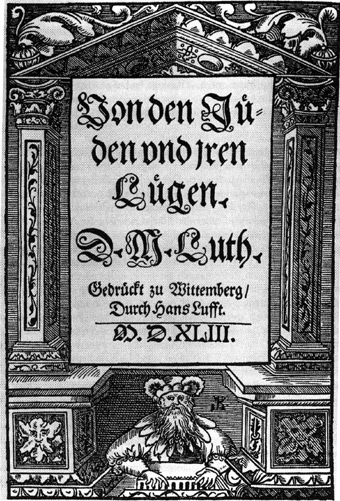 Despite England having recently become a Protestant country, these medieval Catholic views regarding Jews continued to be influential (Nicholas of Lyra's work was very influential on Martin Luther's 1543 polemic On The Jews and Their Lies) indeed it offers historical context to Antonio's response to Shylock's interpretation of the story of Shylock and Laban:
Mark you this Bassanio,I have more than once noted the usage of diabolic rhetoric regarding both Shylock and Jews in general throughout The Merchant of Venice but what is notable here and perhaps chaffing to the 21st century audience is that to Shakespeare's English audiences, the Bible is not a shared text common to both Christian and Jew, but a source of division: at once both holy word in the mouths of Christians and diabolic law in the mouths of Jews and simultaneously affirming both the Christian notion that that same law is superceded by Christianity.
The devil can cite Scripture for his purpose,--
An evil soul producing holy witness
Is like a villain with a smiling cheek,
A goodly apple rotten at the heart.
O what a goodly outside falsehood hath!(Act I, Scene 3, 92-97)
So while I am inclined to view Shakespeare, the author, as a humanist, sensitive to the irony and ambiguity of human experience, the courtroom shenanigans of Portia, like the folkloric and literary sources he relies upon, effectively provide a theological trump to his humanism.
Sunday, April 10, 2011
Notes on Darko Tresnjak's "Merchant of Venice"
Last week I attended the a matinée performance of the touring production of The Merchant of Venice. The production, starring F. Murray Abraham as Shylock, was a revival of director Darko Tresnjak's 2007 mountings with Theatre for a New Audience and the Royal Shakespeare Company. I make no secret of my obsession with this play (in fact, I'm so obsessed that I'm writing "response play") and so there was little chance that I would have missed the performance, but in this case I attended as part of a group outing sponsored by Prism, an initiative of the New Center for Arts And Culture which was offering a post show talk led by Worcester Polytechnic Institute professor, Michelle Ephraim (whose Reading the Jewish Woman on the Elizabethan Stage sounds fascinating.)
What follows is not a review of this particular production. Thomas Garvey at The Hub Review has already written one with which I largely agree, and Rick On Theatre recently reposted a review of the 2007 production. Rather, these thoughts are a response to both the performance and the post-show discussion.
Many argue that of Shakespeare's plays, Hamlet is the greatest work of literature in the Western canon; I contend that while The Merchant of Venice may not be as fine a dramatic poem, it may very well be the most important; for the text is a disturbing portrait of European civilization; In many ways bridging the difference between medieval antisemitism based in theology and superstitions about Jews and the modern antisemitism that presents Jews as people, yet a dangerous people: it underlines that antisemitism is "the oldest hate" and intrinsic to Western civilization. By way of contrast: the literature of the Holocaust, while more horrific, allows Europeans a way of shifting the blame, pretending that horrors of antisemitism was solely the work of the Germans and a few collaborators, or just handful of extremists who had taken over a handful of governments. However, a text like The Merchant of Venice and its continued popularity over the centuries attests to the deep rootedness of antisemitism in European civilization.
This is not to say that Shakespeare is an anti-Semite, or that the play is anti-Semitic propaganda (though it has often been used that way); Shakespeare is too subtle, too prone to irony, and too curious about the sheer diversity of humanity to be so easily dismissed in that manner. However the play is the product of a culture that was anti-Semitic, and and is structured in such a way that it affirms the views of the anti-Semite: the irony only becomes visible to the anti-anti-Semite. This is precisely what makes the play disturbing to modern audiences: we want Shakespeare, the English language's greatest dramatist and poet, to be enlightened and liberal as we are, so we try to find the modern, post-Enlightenment liberal in the irony, but as much as we want the play to be an unambiguous condemnation of bigotry and affirmation of pluralism, the ironies simply will not allow it.
How does Tresnjak address these problems? Tresnjak, a naturalized American, is an ethnic Serb, born in the former Yugoslavia,
He is explicit that he reads The Merchant of Venice in light of his homeland's decent into savage tribalism:
Four years ago, when the first incarnation of this production took place, I thought a great deal about my childhood in Yugoslavia. For a long time, the relative economic prosperity had kept the social injustices and ethnic tensions under wraps. All that changed when the economy disintergrated. I remember my mother saying: "People are starting to turn on each other."While some, such as Garvey, argue that the co-dependence of love and money is the central theme (see our friendly debate of a year ago for instance) while the more visceral theme of antisemitism is secondary; Tresnjak, like so many of us, responds more to the themes of antisemitism, and the co-mingling of tribe and money.
To this end, Tresnjak, sets his Merchant of Venice on Wall Street of "the near future": the Rialto is the trading floor; Portia is the sole heiress of an old money family. This setting does justice to the theme of love and money. So while Tresnjak makes clear that "the oldest hatred" still lurks in the religiously tolerant cosmopolitan America of lower Manhattan he glosses over the particularly Christian character of the antisemitism. Tresnjak's merchants and traders are nominal Christians who hate Shylock because he is a business rival; that he happens to be an Orthodox Jew just gives them an additional excuse to hate him more. In Shakespeare's Venice (which is a mirror to London of his era) these same characters hate Shylock not just because he is a Jew, but because it is their Christian duty to hate Jews.
This has long been my argument (sharpened, I admit by debate): The play affirms the victory of Christian theology over humanism. Shylock might love more sincerely than any character in the play: unlike either Bassanio or Gratiano he would never willingly give up his wife's engagement ring; in his first appearance, despite past experiences, he is willing to forgive all Antonio's past insults for a future in which both might be friends; he implicitly trusts his daughter, even if she sees him as humorless and oppressive. It is Shylock's heart that is most vulnerable to being broken. It is only when his daughter betrays him, his wife's ring is stolen and traded for a frivolity, his rivals arrange to rob his home under the pretense of a business dinner, does he truly lust for murder.
Though Shylock's "hath a Jew not eyes..." speech is so often seen as a statement of Shakespeare's humanism, it is also a preamble to Shylock's call for revenge, which affirms the Christian prejudice that Judaism is a religion of law without mercy while Christianity is the religion of mercy. So while Shylock loves more, and loves more sincerely, and is even willing to set aside old quarrels and love the gentile as a friend, he is unforgiven by the Christian God so long as he remains a Jew. Conversely, the Venetian and Belmontean characters may be insincere in their oaths, superficial in their love, and give their prejudices free rein, they are forgiven by nature of being Christian-- as such, Shylock's conversion, an unjust humiliation to a modern audience, was a happy ending for the Elizabethan audience ensuring the play kept true to the genre of comedy, much as with Duke Frederick's renunciation of his throne at the end of As You Like It.
In keeping with the theme of antisemitism, Tresnjak's casting of Jacob Ming-Trent as Launcelot Gobbo (he was played by Kenajuan Bentley in the 2007 production) is intriguing, as a black actor in the role (a courier in this 21st century setting) invokes the specter of anti-Semitic rhetoric in the African American community, however, it also necessitates the cutting of this exchange, a response to Launcelot's complaint that converting Jessica to Christianity raises the price of pork:
LORENZO: I shall answer that better to the commonwealth than you can the getting up of the Negro's belly. The moor is with child by you, Launcelot.
LAUNCELOT: It is much that the Moor should be more than reason; but if she be less than an honest woman, she is indeeed more than I took her for. (Act III, Scene 5, 27-32)
Professor Ephraim noted in the post-show talk that essentially Lorenzo is saying "while I can make a Jew a Christian like myself, you can't make your baby white like yourself." Consequently, Launcelot's speech about in which he says:
Here's a small trifle of wives! Alas, fifteen wives is nothing. Eleven widows and nine maids is a simple coming-in for one man. (Act II, Scene 2, 125-127)Which is partly a parody of the Biblical patriarch Jacob that begins with Launcelot's deception of his blind father Old Gobbo earlier in the scene is also cut. (As a clown, I also make no secret of my affection for the Gobbi, father and son.) Though, to be fair, I've yet to see a production staged where Old Gobbo isn't cut.
The 21st century setting of Tresnjak's Merchant, also obscures another aspect of historical antisemitism: the invocation of the Devil. Repeatedly, Antonio, Launcelot, Solanio, routinely compare Shylock (and Jews in general) to the Devil, if not stating that Shylock and Jews are themselves the Devil or at least intimately involved with the Devil. In 21st century New York: this is merely an insult; but in England of the 1590s, the Devil would have been a real thing to much of Shakespeare's audience. While this belief was not official Church doctrine, Joshua Trachtenberg's The Devil and the Jews well documents the widespread folklore by which the medieval and early modern Christian imagination linked Judaism with Satanism (a theme that I've given much consideration.)
In short, Tresnjak Merchant does succeed to showing that antisemitism continues to exist, while at the same time glossing over those elements of the text that show how deeply rooted antisemitism is in Western civilization, leaving the genealogy of "the oldest hatred" obscure. Thus a dramaturgical puzzle: how can theatre be simultaneously a mirror up to today while also being an archeological dig into the history that made today possible?
Sunday, January 9, 2011
Burlington Free Press on Peter Schumann's Palestine Controversy
On Friday, Burlington Free Press staff writer, Tim Johnson interviewed me for a piece that ran in Sunday's edition, entitled Peter Schumann's Palestine Controversy. There's a brief quote from me that sums up the argument that I have been making since my 2007 essay, Breaking with Bread and Puppet:

Ian Thal, a playwright and Schumann admirer who broke with Bread and Puppet over the spring 2007 exhibit in Boston, said he saw the wall comparison as "inflammatory." To liken Israel's wall, which was intended to prevent violence, to the Warsaw wall, which was a tool of genocide, was "a deliberate misrepresentation," Thal said.There are several statements that Schumann made to which I shall respond in greater detail in another blog entry, but I will leave you with one to ponder:
Schumann was called a "Holocaust-denier," among other things. "Ridiculous," Schumann said recently. "Offensive and stupid." For anyone of German descent, he said, the Holocaust is "one of the most horrible things."To which one anonymous commentator responded:
Let's not forget, it wasn't exactly a picnic for Jews, Gypsies or homosexuals either, Peter.
N.B.: I have posted a follow-up with a more in-depth analysis of Schumann's statements
Thursday, January 6, 2011
Mark Twain and Censoring the "N-Word"
As many are already aware NewSouth, a Montgomery, Alabama based publisher, is releasing a new edition of Mark Tawin's Huckleberry Finn in which the "n-word" has been replaced with the less racially charged term, "slave." The NewSouth edition features an introduction by Auburn University professor, Alan Gribben:Gribben became determined to offer an alternative for grade school classrooms and "general readers" that would allow them to appreciate and enjoy all the book has to offer. "For a single word to form a barrier, it seems such an unnecessary state of affairs," he said.
Is this really about the offensiveness of the "n-word" or is this about making white southerners less squeamish about their history? (I do not have an answer, but having grown up south of the Mason-Dixon Line, I am very familiar with the disingenuous claims some southerners make about the causes of the Civil War.)
Gribben has no illusions about the new edition's potential for controversy. "I'm hoping that people will welcome this new option, but I suspect that textual purists will be horrified," he said. "Already, one professor told me that he is very disappointed that I was involved in this." Indeed, Twain scholar Thomas Wortham, at UCLA, compared Gribben to Thomas Bowdler (who published expurgated versions of Shakespeare for family reading), telling PW that "a book like Professor Gribben has imagined doesn't challenge children [and their teachers] to ask, ‘Why would a child like Huck use such reprehensible language?' "
The whole point of Twain's use of the "n-word" was to portray how racism corrupted every element of southern life: even the likable protagonist and narrator, Huck, who befriends a runaway slave, uses the word. It is integral to the novel. People should be horrified by the racism of 19th century America. Hiding its ugliness hides both how far America has come as a nation, as well as hiding the ugliness of those who wish to pull America back to its past.
How does this refusal to look squarely at the role the word had in America's racist history make sense in an era where the "n-word" is so prevalent in pop-culture?
I am not an African-American. I do not have a visceral relationship with the "n-word." My opposition to censoring it, however, is no mere exercise in academic libertarianism. I am a Jew, and I am very conscious that there there is a large body of works important works in literature, theology, philosophy, history, and drama in which some of the most libelous things are said about my people. Keeping these texts available, and teaching them in context is how we grasp just how deep-seated and widespread antisemitism really is in western civilization. For instance, no matter how often nice liberal do-gooders try to pretend that Shakespeare had liberal attitudes towards Jews, we need to confront just how many times his heroes compare Shylock to the Devil (which I have lampooned in my own Arlecchino Am Ravenous):
The devil [Shylock] can cite Scripture for his purpose,-
An evil soul producing holy witness
Is like a villain with a smiling cheek,
a goodly apple rotten at the heart."(Merchant of VeniceAct I, Scene iii 93-97)
...I should stay with the Jew my master, who (God bless the mark) is a kind of devil; and to run away from the Jew I should be ruled by the fiend, who (saving your reverence) is the devil himself: certainly the Jew is the very devil incarnation...(Act II, Scene ii 22-26)
Here comes another of the tribe,-- a third cannot be match'd, unless the devil himself turn Jew.((Act III, Scene i 70-71)
Of course, this is not the complete listing of anti-Semitic slurs in The Merchant of Venice. I don't want these slurs censored. In fact, I want them taught in their full ugliness. This talk of the devil is not a mere figure of speech. In late 16th century, Christians were taught in folklore, popular literature, songs, and sermons to associate Jews with the devil, Judaism with Satan worship, and Jewish messianic hopes with the imminent coming of the Antichrist (see Joshua Trachtenberg's The Devil And the Jews: The Medieval Conception of the Jew and Its Relation to Modern Anti-Semitism.) This was the audience to whom Shakespeare was catering.
To engage in further self-promotion, there's a passage in my own play, Total War in which two of the characters discuss this very whitewashing of history, and how it destroys the present context, and in this case, enable a fictitious Holocaust denier named Hadley:
JONAH: The standard western civilization textbook credits the Jews for monotheism, The Bible, rejecting Jesus, and being murdered by the Nazis nineteen centuries later.
ANDREA: But you’re sort of a minority in western civilization.
JONAH: What you call the Holocaust—the Shoah—is the culmination of that civilization, and yet every page that could have offered context has been torn out: leaving the genocide incomprehensible. Imagine each of Shakespeare’s plays with Acts II, III, and IV excised. Nineteen centuries ripped from the textbook. That Western civilization denies responsibility makes Hadley’s mission all the easier.
We should not pretend that Shakespeare's attitudes towards Jews were liberal, nor should we pretend that in the era that Mark Twain wrote about was a time where southern whites had liberal ideas about the skin-color of the people they enslaved. Twain understood the viciousness of the word and wanted to portray it and the society it represented. Wortham is correct to ask: ‘Why would a child like Huck use such reprehensible language?' but how can we ask that reading a bowdlerized edition?
Saturday, October 23, 2010
Peter Schumann's [Judenfrei]-Christian Skies
It's been quite a while since I wrote a post about Peter Schumann or Bread and Puppet Theatre, but I just came upon the following quotation about Bread and Puppet's touring production of a truncated adaptation of Claudio Monteverdi's opera, The Return of Ulysses:
In order to commit genocide on their competitors, the Trojans, the tricky Greeks employ their multitalented sky, full of custom tailored divinities, to justify the crime, just as we employ our Judeo-Christian sky, occupied by a divine air force and permitted by the in-god-we-trust court system, to justify our atrocities in Afghanistan, Palestine and elsewhere. By order of Jove, the boss, and with special help from his daughter Minerva, Ulysses finally returns home, where he has to murder 100 evil suitors in order to be happily reunited with wife and property.
Some notes:
1.) Any student of Greek mythology knows that the Greeks did not use their gods to morally justify the actions of the Trojan War: both Trojans and Achaeans are portrayed as pawns of the capricious gods of Olympus while the war is portrayed as the consequence of the gods' petty rivalries. Schumann is playing fast and loose with the canon of western civilization just as he does with 20th century history.
2.) I find it interesting that Schumann refers to "our Judeo-Christian sky" but not to our "our Judeo-Christo-Islamic sky." This allows him to ignore acts of ethnic cleansing and genocide by Muslims upon Jews and Christian Arabs-- or between different sects of Islam or even between Muslims of different ethnicities. This also gets back to a conversation in November of 2004 (I was a fly on the wall) where Schumann insisted that Osama bin-Laden was simply an anti-Imperialist and dismissed any notion that bin-Laden was motivated by religious fundamentalism or intolerance.
3.) Speaking of which, Schumann does not, as usual, address his childhood growing up in the Nazi stronghold of Bresleau, or that his father was a Lutheran clergyman during the Nazi era, and Schumann never mentions whether his family supported Naziism or not: after all, this would be his first-hand knowledge of a Judenfrei-Christian sky. In other interviews and reminisces, Schumann speaks of an idyllic childhood of free play and fresh baked bread interupted the day that day Germany was defeated, Breslau was renamed Wroclaw and became part of Poland as he and his family were forced to move westward from the no longer Großdeutchland into the post-war Kleindeutchland. This is part of his overall pattern of presenting Germany as the victim of World War II as opposed to anyone Germany or its allies might have exterminated.
The shame is that Schumann is no longer able to adapt a classic work without linking it to his anti-Israeli animus (which personal interviews repeatedly show to be rooted in elegiac romanticism for his Nazi childhood) especially when he has shown great wit it adapting other works from the theatrical canon, such as his 2002 adaption of Bertold Brecht's and Kurt Weill's Die Dreigroschenoper as Dirt Cheap Opera.
Sunday, September 5, 2010
Moral Inversion and Party Invitations
I do not typically address politics or social etiquette in this blog, yet at the same time, I rarely refrain from doing so.
This weekend I attended a party. At one point I was accosted by an acquaintance, perhaps the last stalwart of Boston's loony-left who still engages me in a friendly manner. Note: I am using "loony" in reference to a tenuous grasp on reality, logical coherence, and facts combined with a tenacious grasp on the party line of the faction of one's choice: I regard the left's guiding principles of liberté, egalité, fraternité [et sororité] as valid.
This acquaintance stated that he had told a friend about the party, and that I had some past conflict with this friend and wanted me to behave myself and not cause trouble. Those of you who are unfamiliar with my reputation for starting altercations at parties needn't worry: There is no cause for such a reputation. So who was this tag-a-long?
This guy:
This is David Rolde protesting an April 26, 2009 staged reading of my play Total War. Notice that he's a Hamas supporter and that he opposes a two-state solution to the Israeli-Palestinian conflict. Also notice that Total War does not discuss any aspect of the middle east conflict beyond a single line of dialogue. I recounted this bizarre incident in greater detail:
The oddest thing about Rolde's "protest" was that Total War is not about any aspect of the Middle East conflict: it's about Jews and Catholics. However, this did not stop Rolde from shouting "Jewish murderers!" as nauseum in a whiny voice while partially blocking the footpath between Outpost 186 and the sidewalk. I suppose he takes his street performance anywhere there might be an event that could be termed "pro-Jewish."
Eventually, I decided to invite him inside to attend the reading. Predictably, since it would have required him to have sat down and quietly listen to actors reading dialogue for a couple of hours, he did not accept.
So why the personal animus directed towards the playwright?
Here's a photograph from an earlier encounter, October 7th, 2007 at a rally for the people of Darfur who have been been murdered and displaced by the Sudanese government and the militias it supports. The speakers were survivors of a number of the 20th century's most infamous genocides and mass murders, who despite there different ethnicities, religions, native-languages, and country of origin had come both to share their own experiences but also to speak out against the horrors in Darfur.
Rolde and company were not only holding up a crudely painted cartoon which seems to insinuate that Israel engineered the September 11th attack on the World Trade Center, but also heckling the speakers, many of whom had lost their entire families to genocide before coming to the United States, often calling these survivors "liars." They believed themselves to have come to protest "a racist pro-war rally against Sudan organized by the [...] Jewish Community Relations Council of Greater Boston."
And so, here I was at a party where there was an expected party-crasher with a past of heckling genocide survivors, supporting terrorism, spreading hatred and conspiracy theories, yet, I was the one being asked to not cause any trouble.
"So, Dan, have you ever known me to start an altercation at a party?"
"No, but..."
"David does some evil stuff and you're asking me to behave myself?"
"Well, he has no self-control and you do."
"Then maybe you shouldn't be inviting people like that to parties, or think about the friends you keep."
"Sometimes he drives me places."
It seems to almost like an allegory or a satire or perhaps a farce.
In the end, Rolde never actually showed up.


Sunday, January 31, 2010
Aporeia or Dialogue? Guirgis and Thal on "Last Days of Judas Iscariot"
A few days ago, through the comments section of another blog entry, I had an exchange with the playwright, Stephen Adly Guirgis. He took issue with my interpretation of his play, The Last Days of Judas Iscariot which I had written as a letter to the editor some three years ago in response to the Boston's Weekly Dig having picked the Company One production as one of their Best of 2006.
Where we disgreed is that I interpreted the play as hipster revival of the old anti-Semitic canard that places the blame for Jesus' crucifixion on the Jews. Guirgis contends that this was not his intent. I have no reason to doubt his sincerity and at this point choose to look at this as an illustration of the real hazards that Jewish-Christian dialogue can sometimes smash itself upon, even when the interlocutors' intentions are the best. Yet, despite these hazards, this dialogue needs to occur, precisely because of an often horrific shared history.
To begin, a Dig staffer added this bold faced title caption to my letter:
Every point made in a play must be countered by an opposing point consisting of exactly as many words and spoken at a comparable volume. Only that way will theatre come alive again.
Dear Dig,
I wonder by what criteria Jenna Scherer selected to include The Last Days of Judas Iscariot as part of her roundup of the year's best theatre (12.20.06). While I confess that Stephen Adly Guirgis has a gift for writing dialogue that led to excellent performances by some of Company One's better actors, Guirgis's overall sloppiness placed it close to the bottom of my list for 2006.
Numerous scenes were completely irrelevant to the courtroom drama. Lengthy monologues by characters that appear nowhere else in the story implied that Guirgis either had not finished writing the play before opening night, or that he was simply trying to give some of the actors something to do instead of sitting backstage for over an hour. The ending, to the extent there was one, demonstrated that Guirgis was unable to handle any of the cans of worms that he himself had opened.
Leaving aside the structural problems, the second half of the play repeats again and again the old anti-Semitic canard that the Jews are the ones who murdered Jesus (a central theme of the Passion plays, and Mel Gibson's film version). Pontius Pilate even makes a point that he had washed his hands of the affair, and is a saint in the Ethiopian Church. It is not wrong for a writer to create anti-Semitic characters, but to leave their statements un-countered is highly questionable.
The Last Days of Judas Iscariot also has countless moments of misogyny to which there is never any rebuttal. How does a male witness sexually harass a female defense attorney with impunity? Or a male prosecuting attorney sexually harass a female witness? Guirgis seems to like his female characters neatly classified as mothers, whores and nuns, and he appears to take pleasure in humiliating the mothers and the whores.
Guirgis does a great job writing for the mafia characters on HBO's The Sopranos, but theology is well beyond his abilities, as is anything whose form demands that the plot threads be tied up by the end of the evening. Does Jenna Scherer pay any attention to the writing?
Ian Thal
Somerville, MA
This letter, no longer available on The Dig's website, simply floated on my soon to be neglected pages on authorsden (neglected because I desired the greater flexibility of the blogger platform) and on rare occasions referenced here and there.
Eventually, some three years later, on January 28, 2010, on an unrelated blog post, I received this comment from an anonymous poster, apparently identifying himself as Stephen Adly Guirgis:
Mr. ThalTaken at face value, I had to consider Guirgis' point of view as sincere, even if that's not what I saw in his play, so after several hours, I posted this response:
I have learned that one never wins when contacting those who criticize one's work. And yet is it curious to me that my play has been performed all over the world and to my knowledge you are the only person to ever accuse me of perpetuating ant-semitic stereotypes. I don't know what you saw in Boston four years ago that compels you to keep associating me with Hate, but it saddens me because I happen to take racism/anti-semitism/hate pretty seriously. Maybe you were in the bathroom during the cross examination of Caiaphas by El-Fayoumy? Maybe you were asleep when the play pins 2000 years of hate -- not on "The Jews" -- but on the writers of the Gospels? I don't know... Clearly, you're completely entitled to dislike my play, dislike me, and say whatever you want to say. And you're not alone in criticizing the play -- some like it, some don't. I only hope that when hurling accusations of anti-semitism, that you feel you've done your due diligence to study the subject matter sufficiently so as to to feel confident in your own mind that you're correct in your assertions. You're an artist yourself so you know the deal: you put your stuff out there and people say what they're gonna say. So, I'm not complaining. My play is wildly imperfect, lots and lots of flaws. But, however you received it, I can assure you it was not written in hate. It was written, in all it's imperfection, with love. And with that, in this late night hour, I send love to you. I just wanted to say my piece. So, thanks. And best wishes to you and yours. SG
(Allow me to assume that Anonymous is exactly whom he claims to be.)Now the question is: is this an aporeia or an opening for further dialogue?
Dear Mr. Guirgis,
Thanks for writing. I much rather have a dialogue where in the end I can say "I stand corrected" than persist in some intractable feud.
Because of this, I have to accept your stated intentions at face value, and explore why I felt that quite the opposite of those intentions were communicated to me.
Keep in mind that the production I saw of Last Days of Judas Iscariot was some three-and-a-half years ago: July of 2006, to be exact, and the criticism I wrote was from a few months later after the play was picked for a "Best of 2006." I assure you that I did not nod off or leave for the bathroom during the performance.
I definitely did not get the impression that your play pinned the blame on Christian antisemitism on the Gospel writers , as neither they, nor their sectarian agenda (to make the young Jesus movement appealing to gentiles by stripping it of its Jewish context) was placed on trial.
Instead, the appeal on behalf of Judas (whom some scholars now view to be a fictitious personification of "the Jews") was largely based on finding an alternative Jewish culprit such as Caiaphas, as a representive of the Temple priesthood.
Frankly: I don't remember after all this time whether the other usual suspects of the Pharisees (that is, the Rabbis) and the crowd that chose amnesty for Barabbas were brought up.
And of course, as I mentioned, Pilate and his government are absolved simply because he says he's a Saint in the Ethiopian Church. So it turns into a situation of seeking amnesty for one Jew by finding an alternative Jewish scapegoat.
Now, had there been that meta-textual/meta-mythical turn after the intermission that brought Matthew, Mark, Luke, and John and their sectarian agendas to task (as many "left-leaning" Catholics like James Carroll do,) then much of my criticism would have been invalid. However that leap was never made, and since the motion to simply grant Judas divine forgiveness was denied, the mechanics of the play demanded that the deicide charge be pinned on someone else: either a different Jew or Jews in general. So I found that it brought everything back to the bad old days before Nostra Aetate opened up lines of interfaith dialogue.
Again, maybe you feel that you had subtly done just what I suggest, in which case, it was completely lost in Company One's production which seemed more interested in finding "the real culprit."
Tuesday, January 19, 2010
Arlecchino Meets Shylock
About two years ago, right about the time that I was improvising on the lazzo of la Fame dello Zanni ("The Starving Zanni"), a process that eventually resulted in Arlecchino Am Ravenous, I was also reading Shakespeare's The Merchant of Venice. As a consequence of this chance juxtaposition, the two have become bound up in my imagination.
The Merchant of Venice's reputation as an anti-Semitic text that relies on anti-Semitic stereotypes and has often been used to deliberately stir up anti-Semitic passions is well known. There are also numerous efforts to acknowledge this history and even find means to create a more complex reading that redeems the play in the eyes of our more modern, liberal sensibilities on ethnic and religious pluralism. After all, it's Shakespeare whom many argue to be the single greatest contributor to English language literature and drama.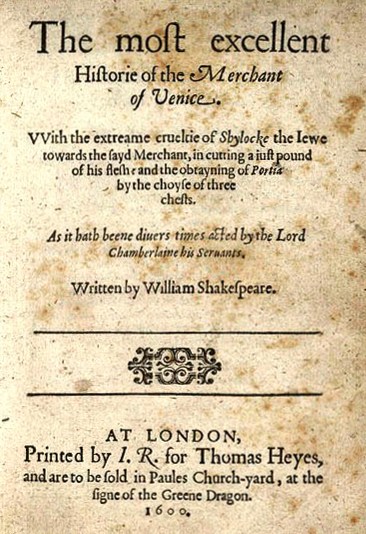
Hath not a Jew eyes? hath not a Jew hands, organs, dimensions, senses, affections, passions? fed with the same food, hurt with the same weapons, subject to the same diseases, healed by the same means, warmed and cooled by the same winter and summer, as a Christian is? If you prick us, do we not bleed? if you tickle us, do we not laugh? if you poison us, do we not die?Often it is quoted in isolation, where it can serve as a powerful statement against antisemitism; that the Jew and the Christian are equally human. Yet the speech continues:
and if you wrong us, shall we not revenge? If we are like you in the rest, we will resemble you in that. If a Jew wrong a Christian, what is his humility? Revenge! If a Christian wrong a Jew, what should his sufferance be by Christian example? Why, revenge! The villainy you teach me I will execute, and it shall go hard but I will better the instruction.The point of the passage was simply to state Shylock's motivation for vengeance after the heroes have lured him away from his house on business, robbed his home, and absconded with and converted his daughter and only heir (thus cutting off all connections with family and tribe) on top of all the indignities of bigotry that he and his community had suffered. Furthermore, Shylock is not treated as fully human until after he has been forcibly converted at the conclusion of the trial in Act IV. Though many commentators have noted that the Christian characters are portrayed as having many of the same vices as Shylock, he cannot receive mercy either before the court or in the divine sense, until he has left Judaism behind and become a Christian. While Shylock is a far more humanized portrayal of a Jewish character than his predecessors in English theatre (Marlowe's The Jew of Malta is so absurdly over-the-top that it was hard for me to be pained by Barabas' villainy) the anti-Semitic logic of the The Merchant of Venice remains: Only the Christian characters are blessed with the grace to be forgiven their vices; only they are fully human. The indignities they visit upon Shylock does not damn them, and in fact, they are oft times portrayed in a positive light because they are Christians. Indeed, the revenge speech indicts Shylock as engaging in hubris simply because he is not made fully human to Shakespeare's contemporary audiences until the end of Act IV when he submits to conversion under threat of death. (Yes, there is a complex set of ironies and contradictions contained within the play, but the anti-Jewish logic remains intact.)
What does this have to do with my portrayal of Arlecchino, the stock character of the commedia dell'arte?
In the full-length version of Arlecchino Am Ravenous (not the abridged ten minute version performed at the PuppetSlam this past weekend) Arlecchino visits both Heaven and Hell in his quest for food. I make no excuses, Arlecchino Am Ravenous is a work of comedic blasphemy and violence. Arlecchino is, unlike Dante Alighieri, an illiterate vulgarian incapable of grasping his journeys into Paradiso and Inferno except in terms of his hungers, lusts, frustrations, and the barely understood parables he's learned from his encounters with clergymen.
As I read The Merchant of Venice two connections struck me. The first was that the Gobbos, father and son, are of the same zanni archetype as Arlecchino. The second was that one epithet slung at Shylock with great frequency is "devil": Sometimes Shylock is said to be like a devil, and sometimes he is explicitly said to be the Devil (and young Launcelot Gobbo has a rather notable comic monologue in which he does just this.) It seemed quite reasonable to me to assume that once Arlecchino, being like the Gobbos, finally meets "Signor Diavolo Lucifero dell'Inferno" that he would say:
Who the diavolo you think you are?Once before, at a performance at the Gulu-Gulu Café in Salem, Massachusetts, I self-censored this brief passage. While at Blood for a Turnip, I engaged in no such act of censorship. (The entire journey to Heaven and Hell were left out when I performed at the PuppetSlam the following night, but those cuts were more because of time more than content.)
[Smiles in recognition, and bows.]
Oh! Buon Giorno! Signor Diavolo Lucifero dell’Inferno! Everyone say you look like Shylock, but no…
[To audience:]
…Shylock more handsome…
[Back to Lucifer. Mimes putting arm over Lucifer’s shoulder.]
…Signor Diavolo no look like Jew! More like goat.
Obviously, though some of Arlecchino's blasphemy may have shocked some in the audience, it was this brief passage that clearly made some in the audience uncomfortable (as well they should.) My own intent was to portray Arlecchino as being a product of the prejudices of his milieu: 16th century Italy while at the same time giving him the insight that despite what the Venetians of his era say: The Devil doesn't look Jewish, thus the Devil is not a Jew.
But is this what my audience gets from my performance of my play? Is this too much to ask the audience to ponder my meaning in the middle of a half-hour of physical comedy in a monologue conveyed largely in a made-up dialect?
Of course, there is also the question: can I be more clear with my intentions without breaking character?
I do not get a free pass on criticism because I am a Jewish theatre artist, nor do I get a free pass on this because I have taken other theatre artists to task when I have perceived anti-Semitic content (such as Peter Schumann's trivialization of the Holocaust, or Stephen Adly Guirgis' invocation of the deicide charge in Last Days of Judas Iscariot.) I don't get a free pass because Total War is about the historical legacy of antisemitism: While a full accounting would include these; I would still be accountable.
Likewise, to those who might find Arlecchino Am Ravenous' blasphemy disturbing, does my more serious treatment of religion in Total War absolve me? (Probably not.)
Or then again, am I just writing an essay in response to having told a joke in poor taste?
facsimile of the title page of the First Quarto edition of The Merchant of Venice courtesy of Wikimedia Commons.


