It has been quite some time since I have used this blog to discuss my poetry, but the other day I was officially notified that along with New Orleans poet Dave Brinks, I have been invited by the Writers' League of Kosovo (Lidhja e Shkrimtarëve e Kosovës) to represent the United States at Drini Poetik, an international poetry festival in Prizren, Kosovo on June 9th and 10th.
I do not know the full details yet, but I expect to have much to report after I return.
Special thanks to Lediana Stillo, who translated several of my poems into Albanian and without whom none of this would be possible.
Showing posts with label poetry. Show all posts
Showing posts with label poetry. Show all posts
Saturday, April 14, 2012
I'm going to Kosovo!


Friday, October 15, 2010
Jack Powers, 1937-2010
Jack Powers reading D.H. Lawrence, October 26, 1987.
On Thursday, October 14, 2010, the Boston poetry scene one of its elder statesmen, albeit a troubled and sometimes difficult elder statesmen. This hasn't been the first time I've devoted space to the passing of an artist who has influenced me (and probably won't be the last) but this is not the most pleasant of remembrances. I'm only glad that I had a chance to make peace with Jack Powers while he was still alive.
Much of what follows is not flattering but it's an essential part of the story. If you are looking for a hagiography, please look elsewhere. Outside of rumors and clichés, I am mostly limited to the two years and several months during which I was most closely affiliated with Jack. These two years were, in many ways, the beginning of a decline of a proud man who had done much to nurture poetry.
Jack Powers biggest influence on poetry scene was as founder and long time host of Stone Soup Poetry an open mic he started in 1971 as part of the Beacon Hill Free School. Jack was an evangelist for poetry: encouraging everyone to read, write, and speak poetry. Some of this early history would be recounted in a 1999 interview with ArtsEditor:
So we're sitting around this place saying: what can we name this place that will fit anyone? One of the suggestions was "Cakes and Ales," just because it sounded cute. And I said: well we won't have cakes or ales, so I don't think that's gonna work. Then I remembered this English folk tale. I thought "Stone Soup"—whatever you have to put in the soup is what it is.Stone Soup would outlive the Beacon Free School and move from one venue to another, and by the time I walked into a Stone Soup reading in the fall of 1999, it was located at the old Zeitgeist Gallery on Broadway and Norfolk in Cambridge. I was already a cocky "spoken word artist" reading at alternative art spaces and loft parties in between bands. I most certainly over estimated my abilities as a writer at the time, but Jack liked what I was doing and took me under his wing, suggesting I read certain poets (Ed Sanders and Gregory Corso are two who would become favorites), sometimes impulsively giving me hosting duties for the night, and encouraging a listening attitude that allowed me to grow as a writer.
However, there was a dark side to this story. Many old-timers on the poetry scene will say that the high point in Stone Soup's history was during it's 1990s stint at T.T. The Bear's. Others will say it was the 1980s at Charlie's Tap or the Green Street Grill. These were years when famed beats and bohemians like Corso, Ferlinghetti, Sanders, and Ginsberg as well as future Nobel Laureates like Seamus Heaney or Derek Wallcott, or future U.S. Poet Laureates like Robert Pinsky could be expected as features. Stone Soup had fallen on hard times, and much of that owed to Jack's increasingly obvious alcoholism. People who had known him for longer than I had, often had a vision of a man of dignity and compassion. Though his charisma was very much intact, by the time he took me under his wing he had begun to lose himself, and this was often why I was charged to take the mic.
In 2001 Stone Soup had moved from the Zeitgeist to the Middle East Downstairs. Even with a PA system, the room was simply too large for a weekly poetry reading. Only the biggest stars in poetry (or those with a gift for self-promotion) could fill a room that size. The fact that there was a bar in the room was also not good: though very few poets drank at readings, the bar was too much of a temptation, and often he would be too inebriated to handle the hosting duties.
There were some who were becoming concerned about the line of succession, and some of them perceived me as the natural protégé, and though I never wanted this role this talk certainly got back to Jack and by then no amount of apologizing could repair the damage that rumors had created. Things got worse when the management of the Middle East determined that after seven months, Stone Soup was simply too unprofitable to stay on their schedule. I don't know if this was ever communicated to Jack but Jack never told us. I intuited that our relationship with the Middle East was deteriorating and checked the schedule, learning that we had been replaced on the schedule with the Middle East's bread and butter: live music; those audiences were more likely to buy drinks.
By this time, I was part of the board of directors of the organization. In the face of the news, Jack was incommunicative. No one else knew what to do. I quickly found Stone Soup a new home at the Out of the Blue Gallery where, as of this writing, it remains, but I wasn't able to shake the accusations that I was "trying to take over." Over the next few months, Jack would often show up late to the reading, sometimes as much as an hour late, or not show up at al, often leaving me to host.
Finally, at a New Years' Eve reading to mark the end of 2001 and the beginning of 2002, Jack awoke from being passed out on the couch and launched into a long string of verbal abuse at me. This was only one aspect of the evening's unpleasantness as the featured poet and musician, had also decided to show up drunk for the gig, and was herself nodding off during her set (thankfully, this artist did quit the habit a few years later.) That was the point where it dawned on me that bohemia is often very willing to watch its finest citizens self-destruct in slow motion, almost as if it were a long-form performance art piece (and sometimes they would applaud.)
The following week, I quit. Stone Soup would go on without me. A long time denizen of the scene explained it simply: Jack had a pattern of finding himself a younger protégé and giving him more and more responsibilities until Jack finally grew to resent the help. I was not the first and I would not be the last.
My time was not a complete loss. In those years, I had learned a great deal about poetry, and made many friends. My friendship with William J. Barnum and James Van Looy began as a result of my time at Stone Soup led to my studying mime, and the formation of Cosmic Spelunker Theater. For James, who had been a friend of Jack's going back to the 1970s, this venture was a healing process for both of us.
Jack had come to one of Cosmic Spelunker's shows in 2003. I am told he had been moved by the performance, but he and I were unable to reconcile at that point in time.
Chad Parenteau, a friend going back to the spoken word scene of the late '90s, eventually took over the role of the youthful protégé. By this time, Jack had been in and out of rehab programs, but the addiction had lead to a series of strokes. The resulting brain lesions had seemingly killed Jack's addiction and his rage, but had also robbed him of his ability to speak and gesture with his face. Chad had taken it upon himself to repair the schisms that had occurred in the poetry scene over the years and repeatedly cajoled me into coming back.
This eventually happened in 2008, when Chad convinced Bill, James, and myself to reunite Cosmic Spelunker and perform at Stone Soup. Afterwards, the now silenced Jack expressed his appreciation with exuberant gestures. He had become physically very expressive in the years following the stroke. His need to communicate with the world and his refusal to close himself off from any art form had made him embrace mime: we made eye contact and I realized in that moment that all past feuds were over. Chad would have me come back the following year to perform Arlecchino Am Ravenous. Chad was called out of town for work, but I remember Jack thanking me after the show.
I saw him one more time after that when we both came to pay our respects to Brother Blue.
Good-bye, sir: I'm glad we were able to patch things up before the end.
Sunday, December 13, 2009
Copley Square Farmers' Market, 2003
This is an excerpt from Spaces/Places: Voiced Reflections a program presented by Somerville Community Access Television in 2003 to coincide with The Windows Art Project. Lisa Smith produced and Doug Holder was the host.
My piece, Copley Square Farmers' Market, which was originally published in Poesy Magazine, comes in at about 1:30. Because there was a long line of presenters who were mostly reading from the page, the studio was set up in such a manner that I had to modify what was then my performance style to be done from a seated position (yes, that's a green screen in the background.)
Thanks to Chad Parenteau for uploading this. Chad gives a strong reading in this clip.
Tuesday, February 17, 2009
Arlecchino at the Gulu-Gulu Café
Sunday, February 15, 2009:
I arrived in Salem via commuter rail with my costume bag slung over my should and my make-up case in hand, walking the few blocks from the station to the Gulu-Gulu Café. The sun was beginning to approach the horizon and the bricks of the Odd Fellows' Hall on Washington street were taking a warm golden-pink hue. I spied a large carving of Mister Punch (the name Pulcinella took when he moved to England) in one of the shops as I made my way to my destination, I took this as a good omen.
After coming through the front door, I introduced myself to the first staff member I met, explained that I was the evening's feature performer, and ordered an espresso and a glass of water. It was explained to me that Ryan, the host did not normally show up for at least an hour, which was well enough as I needed a time and place to prepare before my set.
After stretching out down in the basement, changing into my costume and make-up, and practicing a few bits, I came up at the appointed time only to discover that the café was much the same as it was when I first went down the steps, except for the fact that a mime in greasepaint and spandex was standing in the middle of the dining room with no idea what was going on. Ryan had not yet arrived. I had no idea who had come for dinner and who had come for the show and no one was approaching the mime to explain the situation to him.
I was soon met by a friendly couple, one of whom had come to read poetry, the other of whom was curious about my masks, but they, too, were uncertain of the evening's agenda. Soon after, a friend of mine, Lynne Sticklor, a poet and performer also known for her stage persona of "The Prize Lady" (not to be confused with the thoroughbred racehorse of the same name) arrived. Lynne had come to see the show but had no clue about Ryan.
Eventually as we checked the grapevine, we discovered that Ryan had been called away due to an emergency, and so as the featured artist of the evening, I took charge by delegating. Knowing Lynne's ability to engage and charm an audience, I persuaded her to take up the role of the evening's hostess. She signed people up for the open mic segment of the evening and started the evening's festivities with all the grace and confidence one would have expected if it had been her regular gig.
Lynne read a few of her own poems as well as works by other poets, including Walt Whitman. Some other poets read. There was a short feature by Rachel Clancy, a stand-up comic. In between the various acts, Lynne made me write a quick bio with which should could introduce me.
I opened with a trio of pieces from my poetry/mime repertoire, though I decided for the evening not to speak the titles, but to present them on cards that would unfold in various ways on string hinges I had made the night before. This repertoire is out of the ordinary so it is often hard to determine whether the audience is receptive at times, though I noticed the audience which had chattered through the other performers had become silent for me. After "Nemo of the Rails", I put on my Arlecchino mask and unfurled the string of cards that announced Arlecchino Am Ravenous.
As mentioned previously, the rehearsals had given me an opportunity to fine-tune the script of this short play, even as I am submitting it to theatre festivals. At the same time, I seem to have created a script that continues to challenge me as a performer to continue inventing new bits of stage business.
[That said, the aspect of me that writes had one bone to pick with the aspect that performs. While the performer is pleased as punch to engage in acts of simulated auto-cannibalism, and satirical acts of blasphemy, I caught myself engaged in a brief act of self-censorship when he cut short a reference to one of the more blatant anti-Semitic epithets from the The Merchant of Venice. However, since it is the writer who is blogging, and not the actor, he can't stop me:
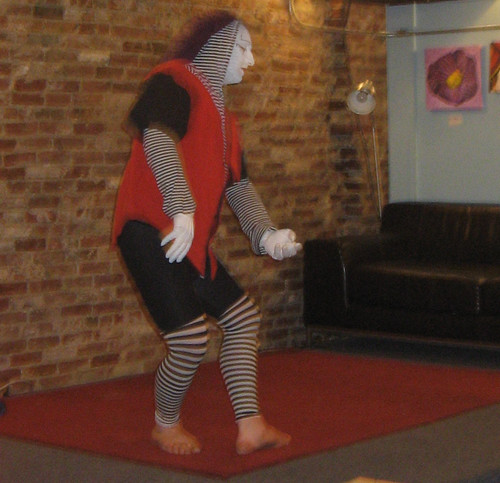
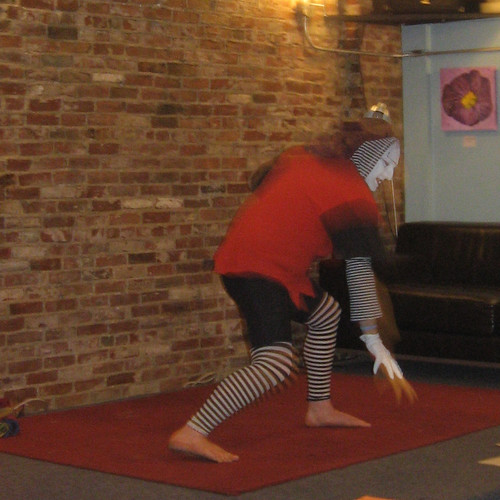

Who the diavolo you think you are?
[Smiles in recognition, and bows.]
Oh! Buon Giorno! Signor Diavolo Lucifero dell’Inferno! Everyone say you look like Shylock, but no…
[To audience:]
…Shylock more handsome…
[Back to Lucifer. Mimes putting arm over Lucifer’s shoulder.]
…Signor Diavolo no look like Jew! More like goat.
The last line was dropped, perhaps out of the actor's fear that the audience would not understand, or that he would be "making trouble." The problem is that the writer likes making trouble.]
I ended with an enraged Arlecchino stepping out into the audience and confronting a haiku poet who had read during the open mic. I returned to the stage, removed my mask and prepared for the finale, during which I overheard a woman explaining to her friends that "It's like Dante's Inferno as told by James Joyce!"
I ended with "A Child's Trip Through the Underworld," bowed, took my props from the stage and ordered a salad of fresh mozzarella, sun-dried tomatoes, portabella mushrooms and greens, ate, cleaned off most of my make-up, changed out of my costume, paid my bill and caught the last train out of Salem, making my way back to Somerville within an hour.
Photos by Lynne Sticklor AKA The Prize Lady, except for facsimile of the title page of the First Quarto edition of The Merchant of Venice courtesy of Wikimedia Commons.
Thursday, February 5, 2009
February 15: Witch City Poetry Presents Su Red and Ian Thal
Sunday, February 15th, 6:30pm - 9:30pm:
I'll be performing as half of a double feature at the Gulu-Gulu Café in Salem, Massachusetts as part of the Witch City Poetry series hosted by Ryan Travis. The other half of the feature will be Su Red who, I am told, will be reading erotic poetry.
I will be performing Arlecchino Am Ravenous along with three or four shorter pieces from my repertoire. Mostly touching on my usual topics of trains, super-heroes, mysticism, memory, Greek mythology, and jazz--most certainly including "A Child's Trip Through the Underworld" which Doug Holder once called a "...a Whitmanesque romp through Brooklyn..."
I created a Facebook page for the event if you happen to like using that service.
Gulu-Gulu Café
247 Essex Street
Salem, MA
View Larger Map
Sunday, October 5, 2008
364.4 Smoots and One Ear
Today, a high school friend of mine and Massachusetts Institute of Technology alumna drew my attention to the fact that MIT was honoring former chairman of the American National Standards Institute and the former president of International Organization for Standardization Oliver Reed Smoot, Jr. for also being the basis of a unit of measurement: the smoot, fifty years ago when the young Smoot was used by his brothers in the Lambda Chi Alpha fraternity to measure the Harvard Bridge that connects Boston and Cambridge on Massachusetts Avenue.
The Boston Globe has run a story on the ceremony honoring Smoot.
In the intervening decades, the story has became such an important part of Boston area folklore that in 2003 that when I premiered my performance piece, "Beacon Hill Panorama with Paper Airplanes" (a piece inspired by James Van Looy's habit of flying paper airplanes off of Bill Barnum's roof during Cosmic Spelunker Theater rehearsals) at Green Street Studios, the passage that received the strongest audience reaction was:

Paper airplanes trace arcs
dragging eyes over the Longfellow Bridge
as it sends red and white 01700s to and fro
a Cambridge cityscape sunset silhouetted
under mammoth crane-hoisting scaffolds
and then towards the three hundred and sixty-four point four smoot
and one ear length of Mass Ave Bridge
spanning the Charles meander meander waters
and past the defunct Citgo sign still flashing
marking Kenmore Square under a Venusian firmament pin-prick.
The full text of the poem later appeared in BOOM! For Real edited by Ian Dooda and Steven Coy and published by Better Non Sequitur.

Monday, May 5, 2008
Bagels with the Bards, Volume 3

The Bagel Bards. a group of poets I sometimes meet with on Saturday mornings for coffee and baked goods has published the third volume of its annual anthology Bagels with the Bards. As with the previous volumes, Volume 3 was edited by Molly Lynn Watt and designed by Steve Glines. Regie O. Gibson provided the introduction to this year's edition. My poem "Nemo of the Rails" which was inspired in part by my travels with Cosmic Spelunker Theater is included in this volume.
You can purchase volume three from Lulu.
Friday, July 20, 2007
On Reading the First Folio

One unusual decision that David Letendre (our director) and Brigid Battell-Letendre (our producer) have made in this production of Macbeth is to take our script directly from a facsimile of the First Folio of Shakespeare's works. For those readers who are unfamiliar with the term, "The First Folio" refers to a single volume edition of 36 of his plays prepared by the actors John Heminges and Henry Condell and published in 1623, as such, we are reading the original spellings.
Something exciting happens when one recites and rehearses Shakespeare's words as they were written by members of the King's Men. The spellings are those of the early 17th century, not those to which we are accustomed to reading in more modern editions (the better of which are incredibly valuable due to all the scholarly notes) but as David pointed out in the first rehearsal, the spellings often provide hints as to where to place emphasis. Indeed, what I have discovered is that by reading the First Folio phonetically, I do not need to think about iambic pentameter-- I hear it as I recite the lines, nor do I have to think about my accent-- the accent is there in the spellings. It may not be the accent of modern Scots-English (and perhaps not the accent of any historical Scottish king), but it is certainly not the theatrical Queen's English I heard as I watched the various Thames and BBC television productions of Shakespeare on my local PBS station (or indeed, any of the British film and television imports) as I was growing up. The long-vowels are longer than any of the mishmosh of North American English accents I speak or understand.
Consider one modern edition (edited by M.A. Shaaber):
...On Tuesday last
A falcon tow'ring in her pride of place,
Was by a mousing owl hawked at and killed.
With largely modern spellings, the actor is left with the option of speaking in his or her native accent or a stage accent. Pronunciation of certain words is ambiguous. Are the "-ed" suffixes pronounced as separate syllables or are they simply consonant sounds? Some of the options will read as poetry others as prose, some as awkward prose.
Compare that to the first folio:
...On Tuesday last,
A Faulcon towring in her pride of place,
Was by a Mowsing Owle hawkt at, and kill'd
Reading from the first folio edition, there is no ambiguity as to how many syllables are taken by "Hawkt" and "kill'd" nor with the ending consonant sounds. The spellings of "Faulcon" and "Mowsing Owle" also emphasize the vowel sounds and demand an accent that falls right on the stressed syllables of the iamb-- and the stresses emphasize that these are birds of prey-- something that "mousing owl" fails to do. Wonderful!
Wednesday, July 18, 2007
Spoonful #0
Spoonful, the new poetry journal of the Stone Soup Poets, has, through the hard work of Chad Parenteau and Lynne Sticklor published an online issue #0. Despite my having left the fold of Stone Soup many years ago, Chad's powers of persuasion can be largely credited with my decision to contribute to this project. The poem, "Numbers" was originally composed for a reading at the New England Holocaust Memorial organized by Stone Soup in 2001. The accompanying portrait is by Bill Perrault-- and I think it well selected. The poem has previously appeared in print in Out of the Blue Writers Unite and I Refused to Die.
Monday, May 21, 2007
Re: Should Somerville Have a Poet Laureate?
After some debate over whether such a position should exist in the first place, Allen Bramhall has declared himself Poet Laureate of Boston. Across the river, Cambridge is also toying with the idea. While here in Somerville, Doug Holder has begun to campaign for Somerville to have its own Poet Laureate on both his blog and his column in The Somerville News.
[Note: the fellow pictured in Holder's blog is not a 'villen at all, but a Briton named Luke Wright.]
Holder quotes me as saying:
Ian Thal (Poet/Mime/Performer): “The question should be: ‘Would having a poet laureate serve Somerville in a manner that the Somerville Arts Council does not already?’ The Somerville Arts Council does a better job than most cities in Massachusetts supporting the arts/artists (certainly better than Boston). The laureate position should add something to what is already there.”
Just to clarify my statements: Outside of the experience of having my poems in Boston City Hall (the poems were written and submitted while I still resided in Boston), I have found that most of the support I have received for my art inside of Boston has been from artist-run organizations like Mobius or Artists at Large, Inc. while the Cambridge Arts Council and the Somerville Arts Council are very visible in the community, the result being a friendlier and supportive environment for artists relative to the situation on the other side of the river. My experience of Brookline, Cambridge, Somerville are school systems in which the arts are integrated into the curriculum, while in Boston, arts education exists only at the discretion of visionary administrators at specific schools.
The point being that anything Boston might do to raise the status of any art form would be a great improvement while Somerville's proposed laureate position should come with a mandate to further enhance Somerville's efforts.
Saturday, May 19, 2007
"Sine Waves and Canadian Geese" at Boston City Hall
As mentioned previously, my poem, "Sine Waves and Canadian Geese" was chosen by Charles Coe as part of an exhibit sponsored by the Mayor's Prose and Poetry Program at Boston City Hall. As I had just received a digital camera as a birthday present, I decided to document the poem before the exhibit ended on May 23rd. This was the second time on of my poems had been selected.
As I toured the entire exhibit, which spanned nearly every floor of City Hall, and photographed some of my friends' poems as a favor to those without digital cameras, including work by Elizabeth K. Doran, Chad Parenteau, Mignon Ariel King and James E. Van Looy, my frequent colaborator in Cosmic Spelunker Theater. I was particularlly taken with a poem by Ellen Steinbaum for having evoked the paintings of Childe Hassam an American Impressionist painter who so often captured scenes of Boston.
On my way out, I decided to sign and date my poem posted by the elevators-- I thought it might be of interest to city archivists.
Friday, May 18, 2007
May 17th: "I Refused to Die" Reading at McIntyre and Moore
On the evening of May 17th, after my stroll through Boston City Hall, I attended a reading for Susie Davidson's anthology, I Refused to Die at McIntyre & Moore Booksellers in Davis Square. The book is a collection of essays oral histories by Holocaust survivors and camp liberators living in the Boston metropolitan area.
Typically, Davidson's appearances are with Kovno ghetto survivor, Rosian Zerner, and Dachau camp liberator, Cranston "Chan" Rogers. Zerner was unable to attend that evening and Rogers was running late, so Davidson spent time describing the process of putting together the book, (which included a cross country trip on a Greyhound bus to organize her assembled notes without the distraction of home) and read excerpts from the tales of other survivors. In addition, as the book also includes contributions from local poets, she asked Rafael Woolf and me to read. Woolf's poem was a polemic directed at Holocaust denier, Bradley Smith.
Because there are so many accounts of great literary merit written by actual survivors and I am not a trained historian, I have thus far avoided writing directly on the subject, but this sublimation appears to manifests itself in confronting theological anti-Judaism, exposing Holocaust denial, such as the play I am currently developing. Somehow, in the process, I've also written a couple of poems.
The first, "Numbers" is one I wrote because I had been invited to participate in a poetry reading at The New England Holocaust Memorial for no particular reason beyond the fact that I am Jewish. It was in memory of a cousin of mine who had survived Auschwitz-Birkenau. I long considered it an act of pretentiousness on my part, so I read it so infrequently, but editors keep asking permission to reprint it, so I must be the one in error. The second is entitled "Metathesis of the Books" and was inspired by a series of paintings by Samuel Bak, a child survivor of the Vilna ghetto, whose allegorical works have inspired me for many years.
Chan Rogers, a native of Florida, arrived and spoke informally in a gravelly Southern accent about his experiences as a sergeant in the 45th Infantry Division often taking questions. After the war, he went on to study at MIT and became a civil engineer who designed many features in the Boston area including the Cambridge Street underpass that goes under the Harvard University campus. He explained that he and other veterans never spoke much about their World War II experiences for years since after the war, so many of them ended up going to school and working with other men who had had similar experiences, and it was a matter of passing these stories on to other generations that has caused him to speak.
Rogers spoke of April 29, 1945, the day when 45th Thunderbird Division entered the Dachau concentration camp by way of a railroad bridge after a surrender had been arranged by the Red Cross. (In 2001 I was present to hear a friendly disagreement between a veteran of the 45th and one from the 42nd Rainbow Division over whose division was the first into Dachau as the 42nd had entered the camp from the other direction.) Rogers explained that while he had already seen much carnage already in the war, he was unprepared for Dachau, having only been told that it was a prison where "Hitler kept his enemies." Senior SS officers had abandoned the camp in advance of the surrender, leaving their underlings to be captured by advancing American forces.
He also made mention of the Dachau massacre that occurred that day after troops from both the 45th and 42nd discovered not only the starvation, disease, and overcrowding of the 32,000 prisoners, but thousands of corpses, including the 39 rail cars each filled with over 100 bodies. Rogers' own research indicates that trains had come from the Buchenwald concentration camp and that the prisoners had died primarily of starvation having been shipped out without food in advance of American troops who liberated the camp on April 11th. The Dachau massacre resulted in the death of 35 captured SS "Death's Head" guards, for which several American soldiers faced court-martial, though General Patton decided they deserved no further punishment.
Rogers made a number of parallels to current events, most notably the recent Holocaust denial conference hosted by Mahmoud Ahmadinejad, noting that the deniers' agenda in this particular was clearly to de-legitimize Israel's right to exist.
Given the informality of the event Rogers also recounted a number of anecdotes, including an encounter with the daughter of German-American Bund leader, Fritz Kuhn, who taunted Rogers and his troops with threats that the German Army would return to rout the Americans out. He grinned as he quipped, "That never happened."

Monday, May 14, 2007
Tokens: Contemporary Poetry Of The Subway
Tokens: Contemporary Poetry Of The Subway, edited by Peggy Garrison, and David Quintavalle, and published by their P & Q Press was the first book for which a poem of mine ("Into the Station") was selected for publication, so imagine my pride when I learned that the New York Transit Museum had selected it for its teacher resource curriculum!
Of course, this would not be the last poem I would write about subways or rail travel in general.

Thursday, May 10, 2007
Reading Poetry on the Trolley

Your flamboyant author. (All photography by Gloria Mindock.)
Sunday, May 6, 2007:
I arrived a few minutes before 3:00pm in front of the Davis Square T-Stop to catch the trolley on which I planned to read. This, however, would be the day when the trolley would be ahead of schedule and so I missed it, leaving me unable to read with Carolyn Gregory as previously announced. So instead, I sat on a concrete pylon dressed rather flamboyantly and waited another half-hour for the next trolley.
As an aficianado of rail travel, I should note that "trolley" is a misnomer here. The vehicle in question is a sightseeing bus rented by the City of Somerville to ferry people about during Somerville Open Studios. The upper body is styled like a trolley of the late 19th and 20th century, made of wood and wrought metal as street cars were before the PPC Streetcar became widely used. A proper trolley is light rail car that is powered by electricity from overhead cables. I last rode a genuine pre-PPC trolley back in 2005.
Due to the fact that I was terribly conspicuous, people kept expecting me to be passing out maps. Apparently, in a city where George Washington first took command of the Continental Army, anyone dressed in a facsimile of 18th century garb must be involved in the tourist industry. The fact is that I had been to a yard sale the week before, and just as I was buying a copy of The Theatrical Notebooks of Samuel Beckett: Krapp's Last Tape (Beckett wasn't using them anymore) I looked up and said "what an extraordinary coat!" Normally I am immune to impulse purchases, but I fell in love with the full costume of a flamboyant 18th century pirate. (The tricorner hat was too large and the long coat was too opulent for a mere colonial.) Needless to say, that I had to wear it that day, though I added a sweater because I felt a cold coming on.
At 3:35pm the next "trolley" pulled up. On board were Timothy Gager, Dick Lourie and Gloria Mindock of Červená Barva Press who had organized the readings. I asked to read with them, and so Tim, Dick, and I played read a round robin, passing the microphone in between poems. Tim, I have known for a while as a short story writer and poet, but Dick was someone I knew only by reputation as both a poet and blues musician. Gloria was present mostly as the organizer and an audience member. Tim took the role of master of ceremonies.
Enough of the poems I had selected had to deal with trains and subways, that Russ, our driver, asked me if I had ever worked as a conductor.
Ian with Tom Daley and Russ
Tim and Dick debarked at Union Square, to be replaced by Tom Daley and Luke Salisbury. Tom, as well as being a poet I admire, is a fellow curmudgeon who is sometimes the subject of derision in our poetry community because he wants to read good poetry. Luke mostly read from his novel, Hollywood and Sunset, a picturesque novel about the early film industry.
Ian and Luke Salisbury, reading from Hollywood and Sunset
About an hour later I was in Davis Square again-- and two and a half hours after that I would be at a theatre audition.
More photos from the event can be seen here
Thursday, May 3, 2007
May 5th and 6th: Poetry on a Somerville Trolley
In coordination with Somerville Open Studios, Gloria Mindock of Červená Barva Press has organized a poetry reading on a trolley that will connect Davis Square with the future Medford Street Station in Somerville, in honor of the future Green Line Trolley extention. Readings and the Trolley will run noon to 6pm on May 5th and 6th. I will be reading on the trolley leaving Davis Square at 3pm on Sunday, May 6th with Carolyn Gregory. Click here for a full schedule of poets and trolleys!
Friday, April 20, 2007
Walt Whitman and I
Last June, Doug Holder, in his review of Alexander Levering Kern's anthology Becoming Fire: Spiritual Writing from Rising Generations refered to my poem "A Child's Trip Through the Underworld" as "...a Whitmanesque romp through Brooklyn...". So I simply could not resist this pairing the following November, as I visited The National Portrait Gallery with my family .
I celebrate myself, and sing myself,
And what I assume you shall assume,
For every atom belonging to me as good belongs to you,
Whitman, "Song of Myself"
Photo credit: Jay Thal
Monday, March 26, 2007
Bagels with the Bards
Several months ago, I joined a crew of local poets who meet on Saturday mornings for coffee and baked goods. The group, founded by local poets Doug Holder and Harris Gardner, are a boisterous bunch of coversationalists with whom to swap stories and talk shop.
Thanks to the efforts of Molly Lynn Watt (editor) and Steve Glines (designer), we now have Bagels With The Bards: Bagel Bard Anthology, Volume 2 available at lulu.com. The work of over fifty poets, including myself, are represented.
Bagels With The Bards:
Bagel Bard Anthology, Volume 2
Introduction by Afaa Michael Weaver
Edited by Molly Lynn Watt
Designed by Steve Glines
Wednesday, March 14, 2007
Poem at Boston City Hall
Once again, one of my poems was selected for exhibition at Boston City Hall as part of the Mayor's Prose & Poetry Program. The previously unpublished poem "Sine Waves and Canadian Geese" was one of 44 selected by guest juror Charles Coe and can be found on the third floor by the South Elevators.
Of course, this will only affirm G. Tod Slone's view that I am part of the literary establishment. (Charles Coe, in his work with the Massachusetts Cultural Council has also been the target of Slone's attempts at cartooning, though I find it interesting that when Slone finally decided to lampoon an African-American writer, he deliberately left Coe faceless.)
Boston City Hall is in Old Scollay Square, accessible by way of the Government Center, State Street, and Haymarket Subway Stations. The current selection of poems will remain on display until May, 23, 2007.
Boston City Hall
One City Hall Plaza
Boston, MA 02201
Boston City Hall is open Monday to Friday, 8:30am to 5:30pm.
Friday, February 23, 2007
American Dissident outs Stalinist Clown!
 Due to many years spent in school, first as a student, and later as a teacher, I have been the subject of a number of informally distributed cartoons and caricatures. I have even caricatured myself at times, however, for the first time to my knowledge, I have been the subject of a cartoon that another illustrator has seen fit to post to the web.
Since the cartoon first appeared I have been stopped on the street by someone who believed that I was the illustrator. Another thought I had been "outed," apparently as a wearer of red shoes.
A lie, I say; I have never owned a pair of red shoes.
(But now the thought seems ever so tempting!)
I have seen fit to respond in four parts:
Part I: In which I say the cartoon is not well drawn.
First, let us examine the cartoon:
P. Maudit is a nom de plume of George Tod Slone, Founding Editor of The American Dissident, which he describes as "A Literary Journal of Critical Thinking In the Samizdat Tradition of Writing against the Machine."
To call the artwork in a simple cartoon bad is akin to shooting the messenger in order to avoid or divert attention from the message.
- G. Tod Slone, in an email dated February 14, 2007
Maudit/Slone's cartoon is crudely drawn and clearly based on two separate photographic sources: the first is a photograph that appeared in The Boston Globe in 2004 in which I was clad and made up as a mime; The second was a portrait of me that was used as a poster for a 2002 performance at Club Passim. Oddly enough he portrays me with four fingers and a thumb on my right hand yet only three fingers and a stub on my left hand, though as of this writing, I have all ten of my digits.
Yeah, that hand sucked.
- G. Tod Slone, ibid.
Slone's inability to render the human form (even a caricature of the human form) is an inability to illustrate me engaged in a genre in which I do perform. I am a mime, a clown, and a commedia dell'arte performer: essentially, my ability to control my body is just as much, if not more, important to my stagecraft than my oratory skills. However, due to his miniscule technique, Slone/Maudit is reduced to portraying me using a microphone at a stand-up comedy venue.
Though I have nothing against stand-up comedians, imagine the comic possibilities if the cartoon portrayed me engaged in my typical stage antics! We could have seen:
1.) Ian Thal in a knot as twisted as his logic!
2.) Ian Thal manipulating an object in an inappropriate manner as he utters a mixed metaphor, non sequitur, or illogical statement!
3.) Ian Thal debating a hand puppet!
4.) a hand puppet agreeing with Ian Thal!
5.) Ian Thal engaged in any of the stereotypical mime routines such "trapped in a glass box" or "tug-o-war" just to show that his arguments are illusionary!
6.) Ian Thal in tights—thus allowing some vulgar humor about his buttocks or "package"!
7.) Ian Thal in a dress!
These are but several suggestions. There are many other possibilities that more talented cartoonists would have chosen had they wanted to lampoon me.
Part II: In which I refute any doubt that I am a clown.
Because the cartoonist represents me speaking as a book critic (something I have not done for a few years) while dressed as a clown sans make-up, one can only conclude that the humor is meant to hinge on the incongruity of being a clown and a critic.
I for one find it pitiful that a poet would choose to masquerade as a clown. It simply emphasizes what little respect Thal holds for the métier…
- G. Tod Slone, ibid.
I do not masquerade as a clown. As anyone familiar with my performances can attest: I am a clown. I am proud to be a clown. I am a serious about clowning, its history, and traditions. In my stage work, I hope to honor the many great clowns who came before me: the countless zanni of the commedia dell'arte, Shakespeare's fleet of fools, and kitchen servants, Charlie Chaplin, Buster Keaton, the Marx Brothers, Bill Irwin, Mump & Smoot, Dario Fo, and (despite a recent matter that resulted in my quitting a production) Peter Schumann.
Clowning is serious business, it is the theatrical art of absurdity, be that the absurdity of our existence, our passions, our endeavors, or our society. Indeed, I find nothing incompatible with my roles as a clown and those of poet, or critic.
Since Slone likes cartooning, I would recommend Joe Lee's The History of Clowns for Beginners. The illustrations are excellent.
So while the insult intended, the bolt has missed the targeted fool.
Most importantly, though, the quote is completely out of context.
Part III: In which I do recount a quarrel upon a lie seven times removed.
How is it that I came to be the subject of Doctor Slone's wrath?
Doug Holder, publisher of the Ibbetson Street Press, brought my attention to a cartoon in which Slone, as "P. Maudit", labeled poets Andrei Codrescu and Lawrence Ferlinghetti as "fascists." I recognized this as a slur, and malicious untruth.
Fascism is an extremist nationalist ideology that celebrates unchecked authoritarianism, a conception of masculine sexuality defined by militarism and violent potential, populist rhetoric combined with contempt for democratic institutions, and contemptuousness for Enlightenment traditions of human dignity and rational inquiry. In the aftermath of the Second World War and the Spanish Civil War, fascism has become such a despised ideology, that even politicians and pundits with fascistic leanings will refuse to be known as "fascists."
(I highly recommend Umberto Eco's essay "Ur-Fascism" which is a discussion of the fascist ideology and the family resemblance between different fascist regimes, as viewed by someone whose childhood was spent under one such regime. Note, that it is not a description of how such regimes govern—but the culture of fascists.)
Obviously, calling either Ferlinghetti or Codrescu “Fascists” is an alarming claim, as nothing in their biographies indicates anything other than anti-authoritarian and anti-militarist tendencies, and so I said so to Holder (in terms perhaps more vehement than necessary), who passed my comments on to Slone, who in turn responded by email on January 28, 2007:
It is the very attitude of the Ian Thal leftists that is destroying the left. In other words, THOU SHALT NOT CRITICIZE THE LEFT! If we heed this ban on critique of the left, how can the left possibly improve? Without criticism, there are no problems, and if there are no problems, there is no need to improve. Sounds like a good Stalinist line, no?
So rather than substantiate his claims that either Codrescu or Ferlinghetti were fascists, he likens me to a Stalinist for defending the reputation of two poets who happen to be leftists. Also note that rather than responding to criticism, he accused me of attempting to censor him. I take freedom of speech so seriously, in that I believe it includes the freedom to criticize the speech of others.
Slone claimed that both Codrescu and Ferlinghetti receive fifteen thousand dollars per speaking engagement and then, while accusing me of hero worship, quoted his own pantheon of heroes as justification for his endeavors:
…life be a counter friction to stop the machine.
- Henry David Thoreau, as quoted by Slone in an email dated January 28, 2007
Go upright and vital, and speak the rude truth in all ways.
- Ralph Waldo Emerson, ibid.
Horseshit from the right or horseshit from the left is still horseshit.
- Pierre Falardeau, ibid.
He closed with a demand that I send him a photograph so that he could make the above cartoon. I decided that since there are enough photographs of me on the web, he could simply use Google.
Again, I pointed out to Slone that he had not substantiated his claim that Codrescu and Ferlinghetti were fascists, to which responded with a second email stating that since neither poet had been interested in Slone's criticism of their work, they clearly had fascist tendencies. He then proceeded to claim that Ferlinghetti's Doctorate was an honorary one (Lawrence Ferlinghetti earned his Doctorate from the Sorbonne in 1950, long before he was famous) and continued with his claim that there is a fascism of the left, which I have chosen not to dispute.
That some leftists are also fascists (just as some rightists are fascists) and Ferlinghetti and Codrescu are also both leftists does not necessitate that one conclude that Ferlinghetti and Codrescu are thus fascists. .
- Thal, in an email dated January 28, 2007
Slone turned the discussion to how he had been persecuted by Stone Soup Poets (a literary organization for which I briefly served in an official capacity—though I was not privy of any plans to persecute him), the Lowell Celebrates Kerouac Festival, the authorities at Walden Pond, and apparently the entire literary establishment.
On January 30, 2007 I sent a final email from which the out-of-context quotation in the cartoon appears in the final
Part IV: In which I append the email from which the cartoon takes its quotation.
Doctor Slone:
I find it amazing that it takes a day and a half to craft such a disorganized response filled with attempts to pin the behavior and opinions of others onto my person.
To answer your question regarding [my former affiliation with] Stone Soup [Poets, Inc.] :
For a literary organization to receive tax-deductible donations, and receive grants for activities such as publishing books (which Stone Soup Poetry would do sporadically) it must comply with the 501c3 regulations for non-profit organizations, grant-giving institutions and private donations are less likely to be forthcoming. Having a board of directors is one of those legal requirements-- it provides a level of accountability with regards to grants and donations.
I was elected to the board of Stone Soup in 2000. I began to dissociate myself from the board and from the organization in late 2001. While I have no interest in describing my reasons for leaving. It should be obvious that I do not want to be affiliated with said organization or the behavior of some of its officers. Obviously, they are not my "buddies."
On neither of the two visits I made to Walden Pond during that time period, [did I] witness any protesters. You and I have, to the best of my knowledge, never met. I am not party with your conflicts with the organization and some of its members and I am frankly uninterested. Far too much of my time and energies were wasted on the organization.
Stone Soup is apolitical as an organization (which it must be as a 501c3 non-profit.) Whatever political stances Jack Powers or John-Paul Pirolli (who uses an assortment of aliases, notably "Buddah" [sic]) may take, their stances do not form coherent political ideologies, and are just as likely to express right-wing sentiments as anything else. Neither of them are leftists, though I am certain you may have heard express leftist sentiments from time to time.
Like you, both men have a tendency to divide the world into "us and them" or often "me and everyone else."
* * *
>>That some leftists are also fascists
>> (just as some rightists are fascists)
>> and Ferlinghetti and Codrescu are
>> also both leftists does not necessitate
>> that one conclude that Ferlinghetti
>> and Codrescu are thus fascists.
> Clearly, that statement is accurate. Yet it is really
> irrelevant to the argument.
It is relevant, because it is the argument that I am interested in making.
I do not use the word "fascist" lightly as it is a name of an extremist ideology, and when applied to an individual who is not strictly a member of a certain constellation of extremist groups, movements, regimes, or ideologue, admirer or imitator of the former, then it closes down any form of free debate, which I consider to be essential to a democratic society.
By that standard, some of the people you name [Hilary Clinton, Michael Moore, Rush Limbaugh, George W. Bush, Andrei Codrescu, Lawrence Ferlinghetti] are clearly not fascists in any sense that still gives the word some meaning. Two of the folk, by my count, might be seen as fascistic from a certain point of view (but that can be debated.)
You have failed to substantiate your claim that Codrescu and Ferlinghetti are fascists. You have presented no facts, and your line of reasoning is demonstrably filled with errors.
Your ignorance of even the most commonly known biographical details of Codrescu or Ferlinghetti are laughable.
> Are you actually denying that both celebrities
> receive sizeable cachets?
No. I am just pointing out that it was the only fact that you did present, and thus, assuming it is true, and since you mentioned it, seems more likely the cause of your resentment than these unfounded accusations of fascism.
> you apparently did not read that part of
> my email stating both Codrescu and
> Ferlinghetti closed to critique.
Given the general inability you have demonstrated to state your views logically, substantiate your claims, or even state these views without invoking some self-serving tale of how the-powers-that-be are persecuting you, it gives little surprise that some people choose to ignore you. You contribute nothing to any debate.
However, since I have no details about your interactions with Codrescu or Ferlinghetti, there is nothing for me to address.
I generally address people whom I do not know personally by their title. It is an idiosyncrasy of mine-- nothing more.
It's true that many poets do not appreciate honest criticism. Doug Holder can testify to the number of angry letters that he received when I was a reviewer for Ibbetson Street Press. I don't really mind if my criticism is unpopular, but because I present my arguments in a certain manner, and I substantiate my arguments, I am generally taken seriously, even by those who disagree. I don't take your views seriously.
Make any other contrafactual assumptions you wish about my person. However, I request that you cease from insinuating that I am a Christian.
Ian Thal
Subscribe to:
Posts (Atom)


