Monday, August 31, 2009

Call for Actors: Staged Reading of "Total War": October 11

N.B.: As of September 1st, Trudi Goodman will be playing the Officer.

N.B.: As of September 20th, Kendall Stewart will be playing the role of Erica Weiss. The roles of Jonah and Duane are still open.

N.B.: As of September 22nd, Dan Schneider will be playing the role of Jonah Gringer. The role of Duane is still open.

N.B.: As of September 30th, Matthew Zahnzinger will be playing the role of Duane McCormack.

Having found the previous staged reading a rewarding experience both in terms of working with the actors, and degree to which it gave direction to the rewriting process, I will present a reading of the latest draft of Total War. Once again, the reading will be on Sunday, October 11, at 8pm at Outpost 186 in Cambridge.

Most of the cast has elected to reprise their roles but I will be be recasting the some of the roles. As this is simply a reading of a work in progress in front of a small audience, there will be no blocking. My concern is not so much the look or age of of the actors but their interest in the story and enthusiasm and insights into the characters. I will be available to answer any questions actors have about the characters prior to the reading. I will schedule read-throughs with any actors not comfortable with a cold reading.

To quote the press release:

Total War is a five-act play set at a Catholic university where the student newspaper has published a Holocaust denial advertisement. While faculty and staff attempt to show solidarity with the small Jewish community on campus, an anarchist-cell using the nom de guerre of “Total War” begins a campaign of guerrilla art attacks before a predictable dialogue on free speech and religious pluralism can begin.


If you are an actor and this sounds interesting, continue reading:

Dramatis Personae:

Jonah Gringer: Male, mid-to-late 20s. Jewish. Graduate student in philosophy at a Catholic university. His views and actions tend towards absurdism and non-violent anarchism

Erica Weiss: Female, early 20s. President of Jewish Student Association, at a Catholic university. Senior in political science. Were it not for the anarchists showing up in Act II, she would be the protagonist of this play.

Duane McCormack: Male, early 20s. Editor-in-Chief of The Dustbowl Pulpit, the student newspaper. He attempts to be a responsible student journalist but is perhaps the only person on his staff to realize how ill-equipped they are to cover the situation his paper has helped create.

Campus Police Officer: Appears in only one scene; would be doubled in an actual production. Professional, but with a sardonic sense of humor.

I'm sorry that my budget does not allow for a stipend for the actors, but snacks and beverages will be provided. There will be a talk back session after the reading for the actors and audience to share their observations.

Interested? Drop me a note about the role that interests you. Resumes are helpful but not necessary.

Sunday, August 30, 2009

Look Ma! I'm Part of the Curriculum! Part II

Once again, Matthew Isaac Cohen, of the Department of Drama and Theatre at Royal Halloway, University of London, is offering his class on Bread and Puppet Theater. I note this in part because my Breaking with Bread and Puppet is on the reading list. The class focusses on using the techniques Peter Schumann developed in the students' own theatre making, something that, despite my own political disagreements with Schumann, I fully endorse. I as I wrote back in October of 2007:

Despite my misgivings with what I view as Peter Schumann's forays into antisemitism and trivialization of the Holocaust, I have always thought there was great artistic value to his better works, both in techniques and content-- and I certainly see a legitimate need for theatre artists in training to become familiar with this sort of work. Had I not, I would not have worked with the troupe for as long as I did.

Monday, August 3, 2009

Open Air Circus in the Boston Globe

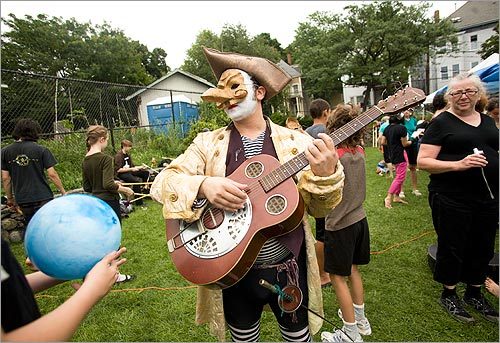
The Boston Globe sent photographer Erik Jacobs to cover this past weekend's performances of the Open Air Circus, the Somerville, MA based youth circus where I have been teaching mime and commedia dell'arte for the last four-and-a-half years. Somehow, the The Globe chose to feature two photographs of me in the gallery:


Photo by Erik Jacobs for The Boston Globe click here for full size.

Jacobs caught me back in clown alley before the show, warming up while also making sure my commedia players were in costume and mask. As this year's theme at the circus was "Broadway musicals," we seized upon the standard plot of "let's put on a show" for the scenario. Circumstances allowed me to try my hand at playing Il Capitano for the first time which amounted to barging in about halfway through the skit, bullying my way into being the star of the show. My guitar chops were rusty, but by the final show of the weekend, I had developed a lazzo of singing the bloody Captain's lines from Macbeth to the tune of "La Bamba" as well as swinging the Capitano's sword around erratically and warning audience and fellow troupe members to be "careful of Capitano's sword, it is very dangerous." The kids did a good job of making up their own lazzi or creating their own variants based on my suggestions. I shall be experimenting more with this character in the future.


Photo by Erik Jacobs for The Boston Globe click here for full size.

Jacobs later caught another one of my personae during the intermission, palm spinning out in Nunziato field. This year's mime piece was based on "Seventy-Six Trombones" from Meredith Wilson's The Music Man so again the theme was "let's put on a show." The choreography mostly involved teaching the kids how to mime the musical instruments from the song along with whatever I could remember about marching from when I was in Safety Patrol in elementary school. I am not sure if the choreography we performed on stage was what I taught in rehearsals though!

Monday, July 20, 2009

After the Staged Reading: Rewriting "Total War"


A couple of weeks ago, I completed the latest set of rewrites to Total War. It was an intense bit of work that began with a trimming of both the longer passages and more philosophically dense passages and an extension of the more character driven drama, trying to expand upon some of the ironies that Thomas Garvey noted during the talk-back session at the end of the April 26th staged reading.

Another important structural element was seeing that each of the five acts had their own themes, and that an epistemological question dealt with in the first act did not need to be reintroduced in the fourth act except in the most oblique manner.

Trudi Goodman, who had also been in the audience, had some interesting notes about the derivation of the Yiddish slur, "shiksa" that also managed to find its way into the rewrite.

Mikey DiLoreto's reading of the character of Donald was somewhat unexpected and caused me to rethink the character to a point where I recited the mantra of "Donald is the type of guy who..." whenever I worked on a scene in which he appeared.

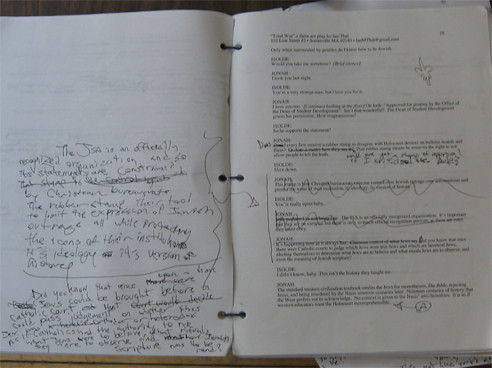
The final stage of the rewrite was helped along by the sudden arrival of summer weather in the first week of July, during which I could spend some time on my back porch along with my modest garden of basil and mint plants with a copy of the script, a pen, and a large mug of coffee, proofreading, and cutting unnecessary repetitions. Every twenty or thirty pages or so, I would get out of the sun, and type up those changes.

The result is a draft with a stronger ending (oddly enough, revolving around the same three characters), more character-based drama, and a shorter page count.

The next staged reading is booked for the evening of October 11, once again at Outpost 186, but I'm going to wait a few weeks before I start putting a cast together. Afterwards, I will see what else I need to change.

Thursday, April 30, 2009

The Staged Reading and What I Learned


Cast of the April 26th reading of Total War at Outpost 186. Note that Anthony DiBartolomeo has been replaced by Stuart G. Levy. The author regrets not taking more photographs.


Despite whatever the lone protester outside of Outpost 186 during the staged reading of Total War was attempting to do, the main event was inside.

Over the previous few days of read-throughs with some of the actors, and conversations with my stage manager, Anika Hannibal-Colvin, certain problems with the current draft became evident. Corrections were often made on the fly and and some notes regarding the next draft were written down. Some of these issues were reaffirmed when I listened to the staged reading with script in one hand and a pen in the other.

Before I engage in some-lengthy self critique, I should note that on the positive end, most of the comedic banter seemed to work, the more poetic florishes were effective, the characters came across as fleshed out, and the audience seemed engaged by the subject matter and storyline, but I had not produced the reading for the purpose of self-congratulation or solicitation of allocades. The purpose was to identify the flaws, and to give direction to the next rewrite.

The Reading:

As I listened, I noted that the second scene of the first act, which had been effective as a piece of written text and would likely work well if staged by a competent director, is dreadfully boring as a purely spoken text. While there are a few good dramatic moments in the scene, but it's basically an info-dump. I still think the play needs the scene, but the scene needs trimming.

The repetitions through the play were not nearly as bad as I feared during the read-throughs, but "not nearly as bad" does not mean "great."

The last scene was somewhat anticlimactic (as I had feared,) and while I am certain a good director could stage it so that it would be more dramatically satisfying, it seemed to me that the director's job is not to make up for the authors' short-comings.

The Talk Back:

Nika took charge during the talk-back, allowing me to take a minimal role in the conversation that followed between the audience and actors. I tried to take whatever notes I could, since the goal was neither to explain nor defend the work, but to listen to others.

Andrew Hicks, amongst the actors, was the most forthright in his criticism of over-reliance on "dialectics" in certain scenes. If I understand correctly that he means philosophical back and forth about epistemology that strays away from the more concrete issues explored by the rest of the play. Jonah, the character Andrew portrayed, certainly should be concerned with epistemology, but for him to go on at length about epistemology without reference to Jewish-Catholic relations or Holocaust denial (the two historical issues the play dwells upon) amounts to a distraction and fails to convey how intertwined Jonah's emotional and intellectual life are. Some of the audience (again, otherwise engaged by other aspects of the story) stated that they felt somewhat alienated in those sections.

A number of other notes from the audience concerned simply placement of scenes, or emotional content of specific scenes. One phenomenon I noticed more than once was that when members of the audience (even in one case, a veteran actor) questioned the emotional tone of certain scenes or relationships between the characters, the actors playing those scenes were quick to defend the emotional aspect. This, I suppose, might a consequence of the very different ways the actors and audience experience the characters.

While some would balk at inviting a critic to attend the reading of a work-in-progress, Thomas Garvey's presence was invaluable during the talk-back. Besides complementing my use of several layers of irony, and his exploration of the less-than-noble qualities of the protagonist, he keenly identified the central conflict arc, and how it failed to advance beyond a certain point, though also pointing out that to fully develop this arc would require a substantial rewrite.

Observations:

The play is not hurt by the research I conducted, but there is such a thing as putting too much of my research into the dialogue. The characters who are motivated by ideology (whether political or theological) were made authentic by the research, but if I made an error, it is that I felt the need to present a logical proof of their authenticity.

Scenes are weighed down by dialectics about historiography, truth in the post-modern era and theology, and a few audience members reported not being able to follow the discussion even if they were engaged by the rest of the story. It's not just a matter of shortening these passages: the lines from these scenes that use more metaphorical or allegorical language are more successful: they convey the emotion and they give the actors and audience more with which to work. After all, Plato's dialogues are rarely performed on stage, and to the extent anyone outside the world of Plato scholarship remembers any part of his ouvre, it's because of a notable allegory or sensual subject matter. Those who enjoy dialectics should be able to extrapolate the argument from the poetry, but for the rest, give them poetry.

I was working with a smart group of actors, but there were several points where I let them down at times by inserting jokes that not only required specialized knowledge to understand (and therefore deliver) but they were further obscured by the fact that the script did not even provide a hint to the actor as to where the could look up the concept being lampooned. (Even from my perspective, they were not the funniest jokes in the play.) Telling the actors (as I did to Andrew Hicks and Tom Sprague during the read-throughs) that "deliver anything that looks like a joke as a joke" simply isn't giving the actors a chance to inhabit the characters.

And now, to begin the rewriting...

Monday, April 27, 2009

Total War Picketed in Cambridge!

Before I recap the staged reading of Total War, a process that has helped me immensely as a playwright attempting to develop his first full-length play, I have have to share with you the performance that was going on outside of the venue.

The reading had attracted a protestor. Total War is primarily about Jewish-Catholic relations, and secondarily about Holocaust denial, it doesn't portray student journalists in a very kindly manner. So one might imagine that a reading, which has been mostly promoted through the blogosphere and social networking sites, were it to be protested at all, might be protested by, say, a traditionalist Catholic group, but instead we have:


Close-up. Slight photo manipulation to make signs more legible. Note Hamas-flag and rejection of a two-state solution to Israeli-Palestinian conflict on signs.

This is not the first time I have encountered this man, who, as one can see, practically wraps himself in the Palestinian flag. He first came to my attention when he and a group identified as Boston Anti-Zionist Action (BAZA - website hasn't been updated in over a year) were heckling a bill of genocide survivors who had come to speak at a rally in solidarity with the people of Darfur. I later discovered that his name was David Rolde, former Party Secretary of the Green-Rainbow Party of Massachusetts, and at least as of October 10, 2007, was still listed as serving on the GRP State Committee. (On October 29, 2007, Nathanael Fortune, Co-Chair of the GRP informed me, that Rolde had resigned from the party.)

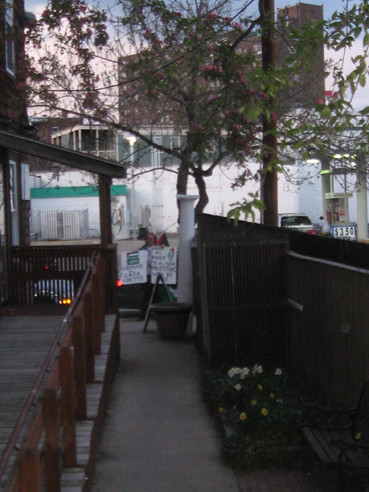
The oddest thing about Rolde's "protest" was that Total War is not about any aspect of the Middle East conflict: it's about Jews and Catholics. However, this did not stop Rolde from shouting "Jewish murderers!" as nauseum in a whiny voice while partially blocking the footpath between Outpost 186 and the sidewalk. I suppose he takes his street performance anywhere there might be an event that could be termed "pro-Jewish."

Periodically as the actors were preparing, I would step out onto the patio of Outpost, unable to restrain a chuckle as I could not make any sense of why he was protesting Total War. Eventually, I called out to him something along the lines of:

"Excuse me, do you know what tonight's play is about?"

To which Rolde responded, "It's a play about Holocaust denial but you're denying the genocide in Palestine! You're a Holocaust denier!"

"I'm not sure you understand the meaning of the word 'genocide.'" said I, only to take on a more condescending tone, "You could, of course, use the word to mean anything you please just because you know is has emotional resonance, but that doesn't mean you know what you're talking about. Would you like to come inside and see the play and maybe learn something?"

Rolde scuffled a few feet down the sidewalk so that my view was largely occluded by the fence. He quieted down for a few minutes. I have no idea of he scared any potential audience members away, though he apparently had a verbal altercation with at least one late arrival.

Next: The reading itself, and what I learned.

Tuesday, April 21, 2009

Motionary Contest

Agata Stadnik, a graduate student at Mass College of Art and Design, and MIT, initiated the Motionary project as part of her work. She had come to my recent performance at Stone Soup and invited me to participate. Part of that participation was a contest in which I was asked to improvise a definition of four words using only movement.

These are all first passes, unrehearsed, and should not be taken to be completed pieces. The YouTube audience is invited to vote on the pieces as part of the contest. There's a whopping $50 at stake!

Sensors:
(My personal favorite of the bunch)


Vote or comment here.

Narrative:


Vote or comment here.


Visualization:


Vote or comment here

Gesture:


Vote or comment here.