
The Bagel Bards. a group of poets I sometimes meet with on Saturday mornings for coffee and baked goods has published the third volume of its annual anthology Bagels with the Bards. As with the previous volumes, Volume 3 was edited by Molly Lynn Watt and designed by Steve Glines. Regie O. Gibson provided the introduction to this year's edition. My poem "Nemo of the Rails" which was inspired in part by my travels with Cosmic Spelunker Theater is included in this volume.
You can purchase volume three from Lulu.
Monday, May 5, 2008
Bagels with the Bards, Volume 3


Sunday, May 4, 2008
Digg Posts Deleted
Just a note:
I deleted several posts to this blog that were posted by accident. I use a number of social bookmarking sites, including Digg. Yesterday, while looking over past bookmarks I had, quite by accident, published some of my "diggs" to this blog. This isn't an act of self-censorship; I merely wanted my "diggs" to stay on Digg. I prefer to use this blog for a different type of writing.
Thursday, May 1, 2008
When Wikipedia Renders One an Un-Person
Frequent readers of this blog will note that I frequently link to Wikipedia articles on and in most cases, I have found the articles I cite to be reasonably good introductions the topics I mention in passing. When I found myself to be written into a Wikipedia article only to be made an "un-person" a month later in what appeared to be a ideologically motivated revision, I decided to dig deeper into a world of topsy-turvy wiki redaction. In this case, it was not an example of editors determining that I was not a notable individual, but rather an anonymous user erasing certain inconvenient facts, such as myself. This story begins when my attention was called to an article on Peter Schumann because I was mentioned as a critic of his:
the series ["Independence Paintings: Inspired by Four Stories"] was the subject of a sermon by Burlington Rabbi Joshua Chasan on Rosh Hashanah [2] and made longtime company contributor Ian Thal cut relations with Bread and Puppet Theater over the paintings and over the fact that the content of the new B&P show The Battle of the Terrorists and the Horrorists[sic][3].
The revision came from an anonymous editor from the IP address 76.19.64.64, which belongs to server that appears to be based in Mount Laurel, New Jersey and is owned by Comcast. The revision is dated February 8, 2008, the week that Bread and Puppet Theater was performing in Boston. While Greg Cook would not publish his series to The New England Journal of Aesthetic Research that included interviews with both Schumann and myself for another day, his preview of the show had already appeared The Boston Phoenix.
Leaving aside the need for proofreading, the article was incomplete in that it spoke about the dispute surrounding Schumann's work on the Israeli-Palestinian conflict yet gave scant attention to any of his notable accomplishments (of which are many.) This is not the worst flaw in a Wikipedia, as articles are collaborative endeavours, someone would be expected to eventually fill in the details, however far off into the future "eventually" may be. What caught my eye was not so much that I was mentioned but this particular passage:
Schumann denied any such accusations [of anti-Semitic content], pointing to how his family escaped from Nazi rule when he was 10, accusing his critics of "over-interpreting" his work and saying :I’m not saying that what’s happening in Palestine is the same as what happened in Warsaw...but it's certainly a reminder. [4].
The citation was from Ken Picard's Septemeber 19, 2007 article for Seven Days, "Over the Wall" in which Picard writes:
For his part, Schumann has repeatedly denied the accusations of anti-Semitism and Holocaust denial — after all, he and his family fled Nazi Germany when he was 10.
Note that Picard did not specifically state that Schumann claimed to be a refugee from Nazi Germany as the anonymous author from 76.19.64.64 had done. Picard may very well have made a statement that he mistakenly believed to be common knowledge (an error that few, if any, have never made.) However, this is contradicted by other statements made by Schumann, such as in this interview conducted by Rosette Royale that appeared in the March 2, 2006 edition of Real Change News:
I was born in Silesia, which was German. It became Polish in 1945, after the war. It was part of Germany that was given to Poland by the Yalta Conference. Ninety-nine percent of the population of Silesia was made into refugees at the end of the War and we were part of that 99 percent.
Without going too in depth into the complex
An article in the August 5, 2007 The New York Times tells a parallel story:
[Schumann] was born in Silesia, now part of Poland, in 1934, the son of a Lutheran schoolmaster. During World War II the family fled to northern Germany, where, as refugees, they lived on scraps gleaned from local farms.
Which indicates that Schumann's family fled from Silesia not due to redrawing of borders but by the advance of Soviet troops or Allied bombing campaigns, not from Nazi Germany, but rather deeper into Nazi Germany. Other articles tell similar stories.
Though I first commented on what I presume to be Picard's error on this blog, I also broached the topic in a letter to the editor which led to a stimulating email exchange with Picard. However, because of my understanding of Wikipedia ethics, I felt constrained from correcting or altering the Peter Schumann article, and instead left a note in the discussion section attached to the article on February 15, 2008:
Obviously, since I am named in this article, it would be inappropriate for me to contribute directly, but I should note that there appears to be a major factual error regarding Schumann's childhood[....]
The points being, 1.) It appears to be an error; and 2.) my understanding of wiki ethics requires that I not touch the article, 3.) somebody else needs to fix it.
However, on March 20, 2008 revision, an anonymous contributor with the IP address of 68.56.17.70 (a server operated by Comcast out of Cherry Hill, New Jersey) to the article changed the text to:
In 2007 Schumann premiered "Independence Paintings: Inspired by Four Stories" in Boston and Burlington, Vermont [2]. The series was inspired by ten days Schumann spent in the Occupied Territories of Palestine, as well as John Hersey's The Wall", a graphic account of the birth, development, and destruction of the Warsaw Ghetto, the largest of the Jewish ghettos established by Nazi Germany during the Jewish Holocaust. Though some members of the Jewish community deemed Schumann's equation of the concentration camps for Palestinians in the Occupied Territories with the concentration camps of the Jews in Nazi Germany "offensive", the general reception to the work was quite positive. Schumann denied accusations of anti-Semitism, emphasizing how his family escaped from Nazi rule in his childhood. [3].
The heading was also changed from "Accusations of anti-semitism" to "Palestine Exhibit." The writer from 68.56.17.70 stated:
I've edited political distortions out of the "Anti-semitic accusations" section, as well as created a section on the Domestic Resurrection Circus, which I can update again soon.
The writer from 68.56.17.70's removal of the "political distortions" included:
a.) repeating a politically sanitized myth about Schumann's childhood and misrepresenting his family as victims of the Nazis, so to deny any criticism that his work may have an anti-Semitic character or in anyway misrepresents the history of the Holocaust;
b.) deleting the names and acts of any of the exhibit's critics and content of their critiques, thus trivializing the criticism;
c.) trivializing concern regarding antisemitism by using scare-quotes around the word "offensive" as if the likening of the Palestinian West Bank to the Warsaw Ghetto were merely impolitic as opposed to a distortion of known facts; and
d.) characterizing the reception of the exhibit as "quite positive" when press coverage from Seven Days, The Burlington Free Press, The Boston Phoenix, and WCAX; blogs such as my own and The New England Journal of Aesthetic Research, and Joshua Chasan's letters indicates that the reception in both Boston and Burlington was best described as "contentious."
Essentially, the writer from 68.56.17.70 has engaged in a form of politically motivated vandalism, possibly motivated by some personal affinity for Peter Schumann or Bread and Puppet Theater or an affinity for the causes Schumann espouses, but most certainly not out of an affinity for Wikipedia's mission to be a high quality free encyclopedia. The lesson that can be gleaned is that while parts of Wikipedia may be well policied by the community of editors, it is possible for less frequently visited articles to either carry unintentional distortions and that articles covering particularly contentious subjects might be manipulated by partisans and must read with vigilance .
Thursday, April 24, 2008
Cosmic Spelunker Theatre Reunion
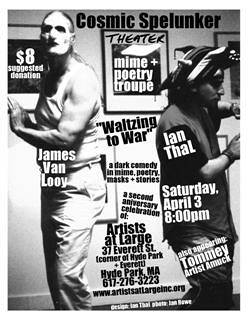
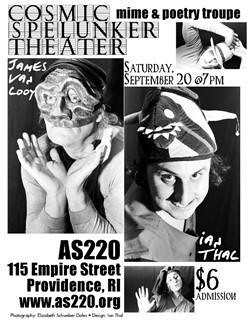
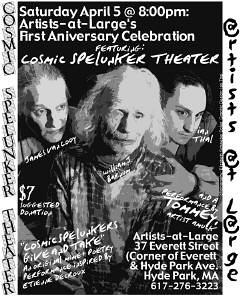
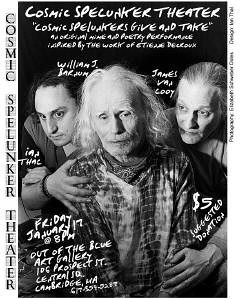
Somehow, after a long hiatus, Cosmic Spelunker Theatre is rehearsing again-- not the incarnation of Cosmic Spelunker Theatre that produced Waltzing to War but the original trio of myself, William J. Barnum, and James Van Looy. The three of us had not performed together since the last Movement Works in Progress at the original Mobius Arts Space on Congress street in Fort Point. By coincidence, I had just screened an excerpt from this show for Art Hennessey's class at Emerson College.
Bill had broken his wrist sometime after and took time off from working with James and myself and eventually lost interest in coming back. James and I regrouped as a duo, eventually receiving a modicum of recognition. Chad Parenteau who has in recent years taken over the soon to be thirty-seven year old poetry venue, Stone Soup Poetry had steered our countless exchanges towards persuading me to return to Stone Soup. Despite our friendship, I had been reluctant due to events that had occurred when I had been on the Board of Directors long before Chad had become involved with the series (though I did become involved with Stone Soup's online journal, Spoonful.) More recently, Chad suggested a Cosmic Spelunker Theatre reunion to both Bill and James-- they agreed and once he had Bill and James on board, I agreed as well.
In an email dated March 28, 2008, Chad wrote back:
I'm so stoked you're coming back. I thought when I asked James to contact you that I was basically doing my impression of Lorne Michaels trying to reunite The Beatles.
Which besides begging the question as to how Stone Soup became solvent enough to offer us a check for US$3,200-- makes me wonder how it was a performance art troupe managed to become the Beatles of the Boston Poetry Scene during our hiatus. (The British rock analogy I was working with at the time however was that of the "power trio" in part because we were aiming for the sensory overload associated with such groups as The Jimi Hendrix Experience and Cream.) Obviously, we had an impact on somebody.

Currently, rehearsals seem to be aimed at recreating our performance at Mobius for the much smaller room at the Out of the Blue Gallery (incidentally, Cosmic Spelunker's first show was in the original Out of the Blue location) with some material from Waltzing to War and some of Bill's compositions.
The Cosmic Spelunker Theatre Reunion show will be on Monday, May 4th at 8pm at the Out of the Blue Gallery at 106 Prospect Street, Cambridge MA near the Central Square.
Wednesday, April 23, 2008
Formaggio di Amore
I'm currently in rehearsals with i Sebastiani in a show entitled Il Formaggio di Amore ("The Cheese of Love"). This time, as well as playing Arlecchino, I've found myself in the additional role of choreographer.
Ultimately, in a troupe where improvisation on a scenario is the norm, choreography is a collaborative effort, but it's given me a chance to craft some complex physical gags, be more involved in the blocking of scenes, and even help my fellow cast members develop the physicality of their characters as well as trying to solve problems suggested by the director. In the process, I've even choreographed my first (albeit brief) fight scene.
In playing Arlecchino, I find myself continuing with the character I developed in my interpretation of "The Starving Zanni" with healthy dose of inspiration from Harpo Marx and Animal from The Muppet Show thrown into the mix.
The first performance of Il Formaggio di Amore will be at the Barony of Carolingia' s annual May Day celebrations at Brandeis University in Waltham, Massachusetts on Sunday, May 4th at about 5:30pm. The event is free and open to the public, but as the Barony is affiliated with the Society for Creative Anachronism, an attempt at pre-1600 clothing is requested.
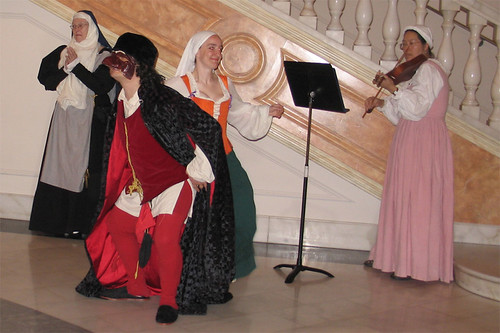
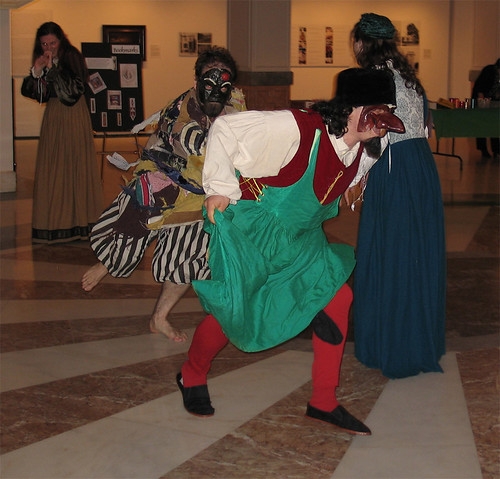
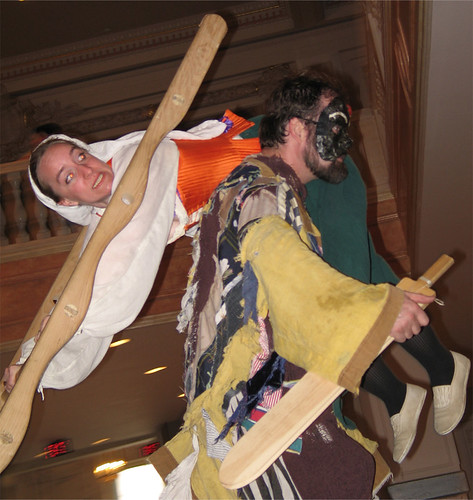
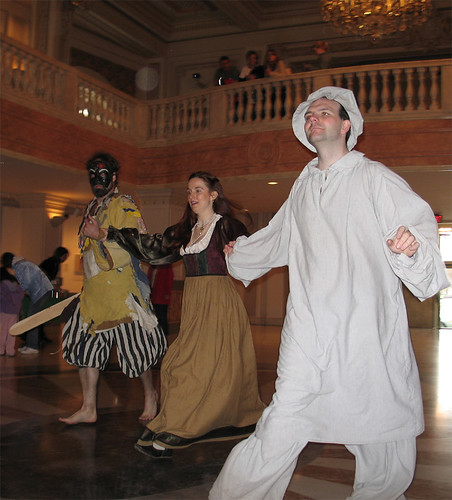
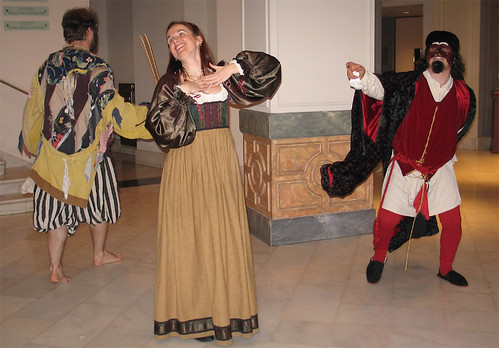
In the meantime, enjoy these photographs from i Sebastiani's April 1st, 2007 first performance at the National Museum of Women in the Arts in Washington D.C. I blogged last year about our second performance in the museum's auditorium. This first performance was in the museum rotunda. Photographs are by my father, Jay Thal. Catherine Crow was Isabella, Alex Lehman was Oratio, Michael McAfee was Pedrolino, Kristin Page was Mother Superior Olivia, Carl West was Arlecchino and Sophie, whose last name escapes me, and I had only met that weekend, played Flaminia.
A comparison between the photographs of each performance will reveal that I began the day with a beard and that later, I was clean shaven, though in actuality I was always clean shaven as the beard was prosthetic. The problem being that as a very physical performer, my sweat has a tendency to dissolve spirit gum, the adhesive used for theatrical make-up. At some point during a tumble, my beard went flying into the audience, so I decided to do without the beard for my second performance as Pantalone.
Click here for the full set of photographs.


Sunday, April 6, 2008
Can You Identify These Puppets? Part II
Last summer, I asked my readers if they could identify two Javanese Wayang Kulit puppets I had acquired at a yard sale.
So far we have had a number of opinions, but still no definitive identification of our two figures, other than a consensus that they are Javanese and not Balinese in origin (which is what the seller informed me)-- one anonymous poster identifies them as being specific to Central Java.
The first figure, who has a red face, an elaborate headdress and a gold body certainly seems to be of noble or royal office, but we are still no closer to putting a name to him. One friend of mine suggested that he was Rāvana from the Rāmāyaṇa but that contradicts the seller's statement that both figures were from the Mahãbhãrata. Indeed the previously cited anonymous poster suggested:
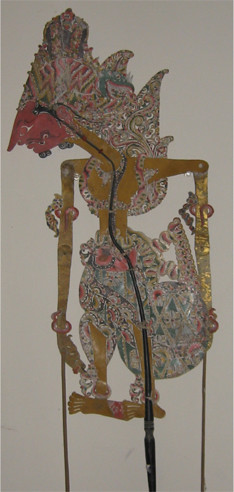
the first charachter might be Baladewa [...] definitely not Ravana.
Of Baladewa, I know nothing, and of whom I have yet to find an English language reference-- I do not even know if he goes by another name.
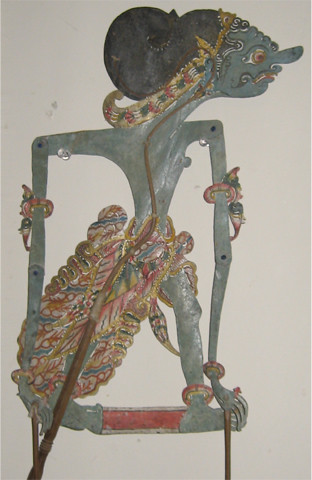
The second, smaller, blue figure was clearly of a lower status than the more elaborately dressed figure, and I was eager to assume that he was one of the comical figures of the Wayang known as punokawan but my anonymous poster seems vehemently opposed to that hypothesis.
The second (the blue guy) is definitely NOT a punakawan.
Once again, can any reader identify these puppets? How can one know that they are one figure and not another of similar status? I would so like to know their names so that I can learn their stories.
Teatro Punto Workshop
Two weeks ago, I attended a day-long commedia dell'arte workshop conducted by Carlos García-Estévez and Katrien van Beurden of Teatro Punto. As commedia dell'arte is a rich tradition with a long history a day-long workshop could never be adequate to teach all there is to know, but neither is the time I have put in working first with the short lived Teatro Commedia, and currently with i Sebastiani, nor could the class I teach at Open Air Circus could have taught me all that I need to know as a commedia performer. Conversely, any opportunity to add to my knowledge, skills, insight, and experience with commedia is desirable.
Teatro Punto's approach to commedia is not that of historical recreation, but to take the archtypes represented by the masks and discover them in the contemporary world. All of the historical techniques of commedia are still relevant as ever, but the goal is not to indulge nostalgia, but to reflect a world that the audience recognizes.
The workshop began with a series of exercises revolving around being prepared to act in and react: an ability needed in the world of improvised theatre. Standing in a circle, we had to respond to any number of tasks, each round introducing a new tasks: tossing and catching balls, trading places with one other, passing objects, singing, stomping one's feet (this last one was quite simple for me owing to my kathak studies) all while staying in communication with one another. When one is multitasking in this manner, one realizes just how often one's mind has a tendency to drift, even in the altered state of performance.
Afterwards, we experimented with the physical stance of different characters-- something I have been doing since my earliest studies as a mime-- how different characters are made manifest by emphasis or inclination of the pelvis, abdomen, chest, or head. One insight I did gain was that while some of these stylizations are typical of specific of various comic archtypes, they are also representative of different theatrical genres, the puffed up chest that would serve an innamorato, or an arrogant Capitano while not appropriate for tragedy might also be appropriate for melodrama.
During the lunch break a few other workshop participants and I joined Carlos, Katrien, Judith Chaffee, a theatre professor at Boston University, who was acting as the host for the the workshop (check out her website, Commedia-dell-Arte.com.) During lunch Carlos and Katrien discussed their time studying with Antonio Fava and how their approach to commedia differs, and we local participants discussed the difficulty in building an audience for any sort of physical theatre in the Boston area.
On returning to the classroom and began work on our own lazzi, encouraged to use mime, grammelot (nonsense syllables that resemble an actual language.) Afterwards, we were given a primer on the technique of the traditional leather mask-- how to hold it when placing it on the face and also how one is supposed to use the face behind the mask: Counter-intuitively, the face does not become passive when covered: all masks require holding one's eyes wide open, and certain masks (some of the vecchi, for instance) demand that one cover one's teeth with one's lips.
Katrien explained that in the early days of commedia, the actors were often hungry and desperate, and this did not only force them to innovate, but it meant that the tragic dimensions were as visible as the comedic. In modern western societies, there simply is little reason for an actor to be literally starving. Since withholding food was not an option as we had all eaten lunch, a new technique was added to create desperation: Carlos acted as an interlocutor for every one of us-- often disrupting the lazzo we had created earlier, with questions about our character's backstory, whether we are keeping our eyes open under the masks, and whether we were making contact with the audience or just going through our rehearsed lazzo. This was the most difficult part of the workshop, with many unexpected results.
A workshop is not just an opportunity to show off the technique one already had, or to learn new techniques, but to learn about one's own short comings as a performer. In my case, I realized that my own dedication towards developing my technique-- both in terms of the precision and skill of my mime work, and the detail with which I craft my routines, while an attraction to the audience, is also a shield I put up to avoid being vulnerable to the audience-- and so, something that this performer must overcome. That said, I highly recommend Teatro Punto's workshops to any performer interested in commedia dell'arte.
Subscribe to:
Posts (Atom)


