Showing posts with label teaching. Show all posts

Wednesday, September 7, 2011

How I Spent My Summer, Part 1: OpenAir Circus

This was my seventh summer teaching at OpenAir Circus, a youth circus based in Somerville, MA, working with many of the same students, parents and fellow teachers as in previous years, teaching mime and commedia dell'arte.

Maschere e Bottacio
Masks and bottacio (slapstick). Photo by self.

Clown on Tent StakesI have been asked not to do this anymore since I am supposed to be a role model for young clowns. Photo by Victoria Wolfson.

Arlecchino in Clown AlleyDemonstrating the lacing technique on my Arlecchino costume. The design is based on the clothing of late-medieval Italian peasants, before belts, buckles, and buttons were common fasteners. Costume by Cherie Konyha Greene. Photo by Victoria Wolfson.

Commedia dell'OrreryPart of the challenge of this year's theme of "OpenAir Circus in Space" is how to make it work with the commedia dell'arte segment of the show. I opted to have the Dottoressa give a lecture on the solar system with the commedia characters arranged a working model of the planets, essentially a living orrery. Here she is with the sun and the moon. Photo by Victoria Wolfson.

Commedia dell'OrreryRotalinda (either the wife of, or female equivalent of Pulcinella) interupts the Moon in his orbit within the Dottoressa's orrery. Photo by Victoria Wolfson.

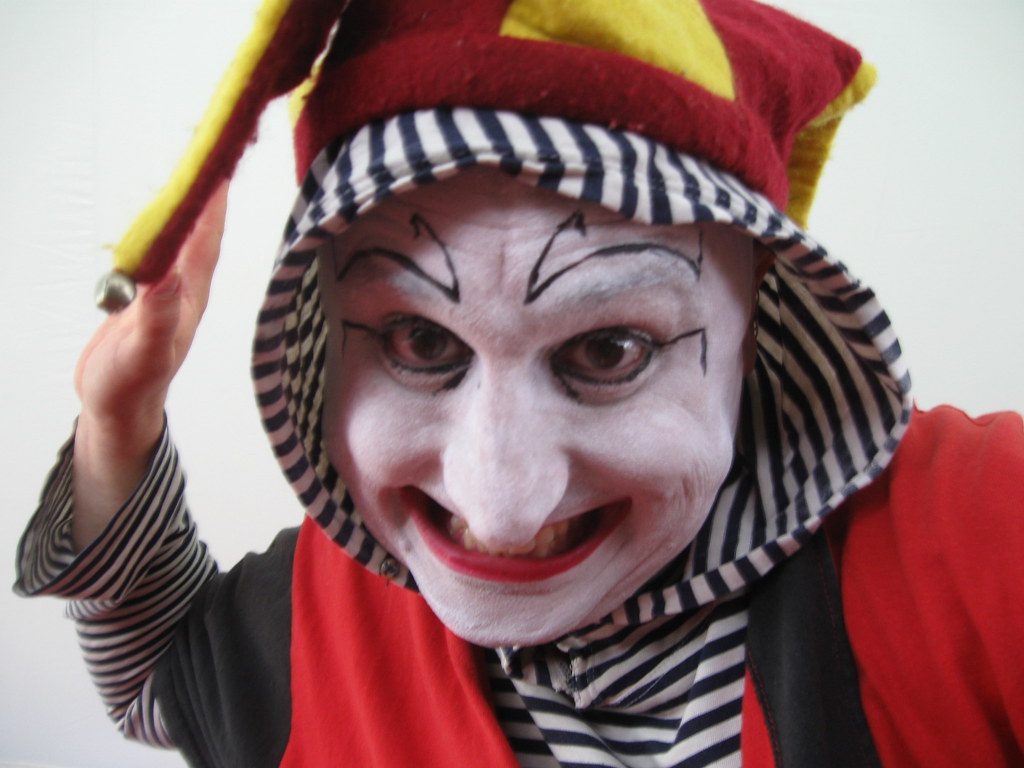
Ian Thal,Self-Portrait

Thursday, August 18, 2011

Gulliver's Travels

One of my gigs this summer has been as a teaching artist at Riverside Theatre Works in the Hyde Park neighborhood of Boston, where I have been teaching and choreographing puppetry for a troupe of young actors and puppeteers who will be performing in Don Fleming's stage adaptation of Jonathan Swift's Gulliver's Travels. Maggie Diller directs.

Showtimes are Friday August 19th at 7:30pm, and Saturday, August 20th and Sunday, August 21st at 3:00pm.

Friday, August 5, 2011

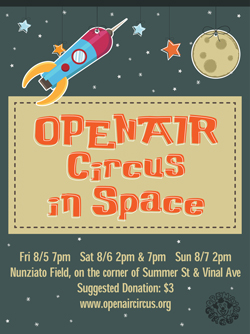
This Weekend: Open Air Circus in Space


This is my seventh summer teaching at the Somerville-based youth-circus, Open Air Circus. My mime and commedia dell'arte students will be performing alongside jugglers, unicyclists, stiltwalkers, and other assorted young performers, in Nunziato Field in Somerville, MA.

Show times are Friday, August 5th at 7pm, Saturday, August 6th at 2pm and 7pm, and Sunday August 7th at 2pm. Suggested donation is $3.

The theme is "OpenAir Circus in Space" and yes, there will be a commedia dell'arte scenario about the solar system.

Tuesday, July 27, 2010

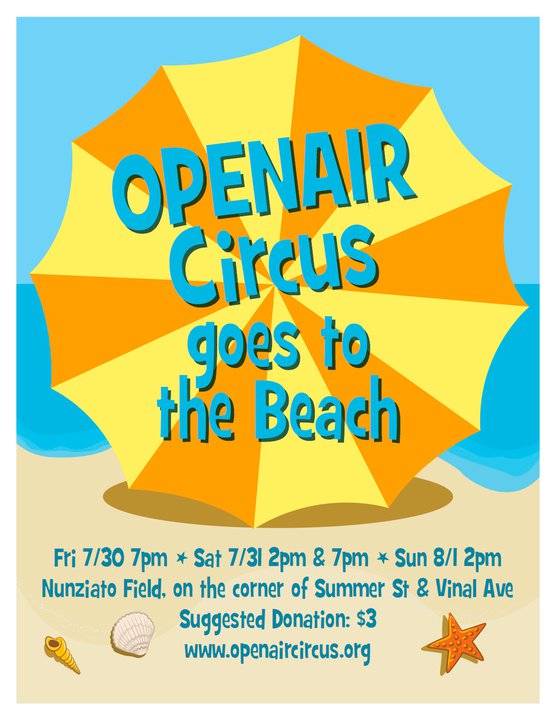
This Weekend: OpenAir Circus Goes to the Beach


That's just the theme of the show. OpenAir Circus is performing at Nunziatio Field in Somerville as always.

My mime and commedia students will be performing as part of the annual Somerville-based youth circus. I've even made new masks!

Come see over 170 children of all ages (and a few adults) perform what they have learned this summer! The show is approximately 2 hours long with one intermission. Refreshments, souvenirs and circus equipment will be available near the entrance to Nunziato Field.


Showtimes:
Friday, July 30st at 7pm
Saturday, July 31st at 2pm and 7pm
Sunday, August 1st at 2pm

Suggested Donation: $3.00

If you like RSVPing on Facebook, you can do so here.

Monday, July 19, 2010

Shadow Circus at Wheelock Family Theatre

IMG_1316
This summer I had a week-long gig co-teaching a puppetry class at Wheelock Family Theatre. It was my first time teaching puppetry. For two hours and forty-five minutes a day over the course of five days, my co-teacher, two assistants, and I, met with a group of roughly two-dozen nine-to-eleven year olds. Our objective was to teach them both puppet making and puppet performance. For me one imperative was that the kids came away introduced to at least three styles of puppetry and the associated techniques-- the other was that they created the work themselves.

On day one, we introduced them to the construction of rod puppets, and gave them the homework assignment to bring in a found object that would be modified into puppet. On the third day, I introduced them to shadow puppets using an overhead projector (a style of shadow puppetry covered extensively in Theatre on a Tabletop: Puppetry for Small Places by Kuang-Yu Fong and Stephen Kaplin of Chinese Theatre Works)

(All photos by yours truly while I was operating the overhead projector.)

IMG_1315
The kids were split into teams of three and sent to create circus-themed acts, which proved to be some of the most well-received aspects of the show they gave on Friday.
IMG_1312
And now, a human tower on a unicycle!
IMG_1311
Don't worry, folks: we have a net!
IMG_1310
A tight-rope, a unicycle, and an elephant!
IMG_1309
And now, ladies and gentlemen! The fire-breather!
IMG_1306
Can the most fearsome of beasts jump through a hoop of the most fearsome of elements?

Wednesday, June 23, 2010

Running Back to the Circus


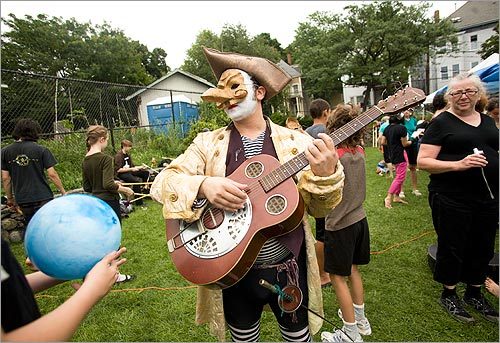
Photo by Erik Jacobs for The Boston Globe click here for full size.

Starting another summer teaching mime and commedia dell'art at the Somerville-based, Open Air Circus. This will be my sixth summer with the community-based youth circus and in addition to teaching, I am learning stilt-walking (and finding it surprisingly easy.)

There's still time to register for classes! Contact Peter Jehlen at peter_jehlen@openaircircus.org

Sunday, August 30, 2009

Look Ma! I'm Part of the Curriculum! Part II

Once again, Matthew Isaac Cohen, of the Department of Drama and Theatre at Royal Halloway, University of London, is offering his class on Bread and Puppet Theater. I note this in part because my Breaking with Bread and Puppet is on the reading list. The class focusses on using the techniques Peter Schumann developed in the students' own theatre making, something that, despite my own political disagreements with Schumann, I fully endorse. I as I wrote back in October of 2007:

Despite my misgivings with what I view as Peter Schumann's forays into antisemitism and trivialization of the Holocaust, I have always thought there was great artistic value to his better works, both in techniques and content-- and I certainly see a legitimate need for theatre artists in training to become familiar with this sort of work. Had I not, I would not have worked with the troupe for as long as I did.

Saturday, July 5, 2008

Ian, Capocomico!

I am spending another summer teaching mime and commedia dell'arte to the children at Open Air Circus. Slowly, over the years, my classes have been attracting more and more students as kids from previous years keep returning to me, and bring new students with them, so this summer, I'm teaching two mime classes and one commedia class. The commedia class has gone from five students last year...

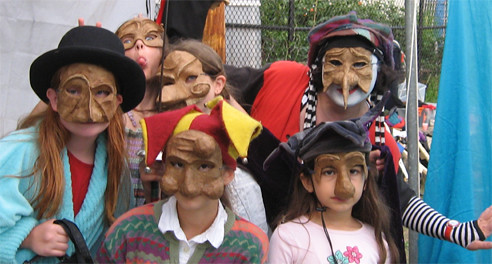
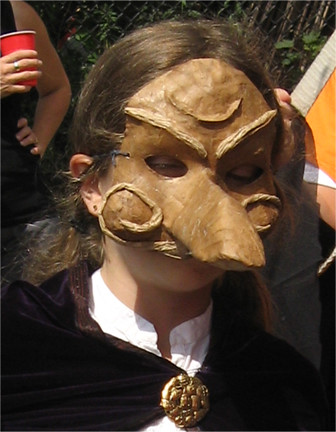
...to eight this year, thus necessitating that I sculpt at least three more masks in time for or final show. In the mean time, feast your eyes upon the masks I made last summer worn by the students who inhabited these characters.

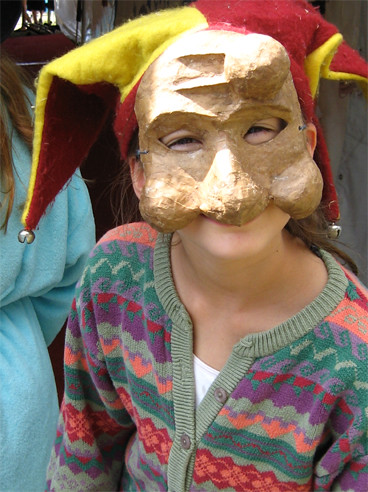
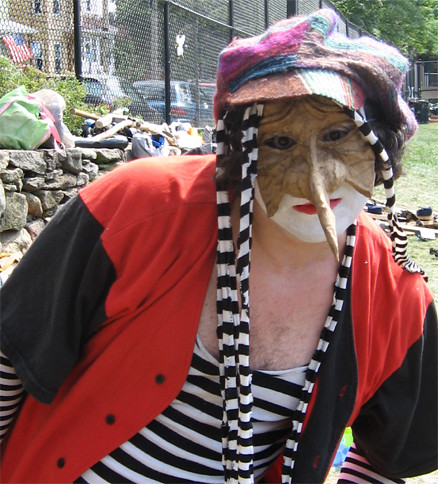
This is Arlecchino-- and this is the same mask I've come to wear this past year when I play the character with i Sebastiani. The motley on her head was made by my father as a gift and are the school colors of Boston College, which I was attending at the time.

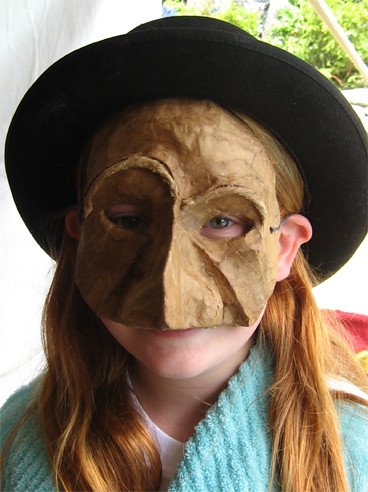
This is Pantalone. I thought a formal brimmed hat might befit a more modern version of the character. My students often see him as the archetype for Montgomery Burns on The Simpsons.

Il Dottore is a parody of all learned professionals. The hat has been part of my collection since 1994. Once while wearing it at a coffeehouse, studying for exams, a woman called me "Il Dottore" and proceeded to introduce me to some of the characters of the commedia dell'arte. The girl playing Il Dottore is the sister of the girl playing Arlecchino.

Il Capitano is parody of every blustering, lying, narcissistic bully who ever walked the earth. He is often the villain and he is often from out of town. The pin that ties the cape was a wonderful borrowing from the player's mother since it features the faces of a number of commedia characters.

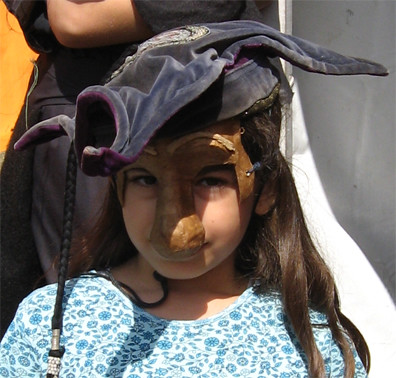
Franchescina is sometimes known as Columbina. Like most female characters, she is not traditionally masked in the commedia but I did not want anyone left out of the fun of wearing a mask so I invented something.

The story about the making of these masks can be found in this earlier post. Right now though I'm at work on three more masks: Pulcinella, Brighella, and Flaminia.

Sunday, April 6, 2008

Teatro Punto Workshop

Two weeks ago, I attended a day-long commedia dell'arte workshop conducted by Carlos García-Estévez and Katrien van Beurden of Teatro Punto. As commedia dell'arte is a rich tradition with a long history a day-long workshop could never be adequate to teach all there is to know, but neither is the time I have put in working first with the short lived Teatro Commedia, and currently with i Sebastiani, nor could the class I teach at Open Air Circus could have taught me all that I need to know as a commedia performer. Conversely, any opportunity to add to my knowledge, skills, insight, and experience with commedia is desirable.

Teatro Punto's approach to commedia is not that of historical recreation, but to take the archtypes represented by the masks and discover them in the contemporary world. All of the historical techniques of commedia are still relevant as ever, but the goal is not to indulge nostalgia, but to reflect a world that the audience recognizes.

The workshop began with a series of exercises revolving around being prepared to act in and react: an ability needed in the world of improvised theatre. Standing in a circle, we had to respond to any number of tasks, each round introducing a new tasks: tossing and catching balls, trading places with one other, passing objects, singing, stomping one's feet (this last one was quite simple for me owing to my kathak studies) all while staying in communication with one another. When one is multitasking in this manner, one realizes just how often one's mind has a tendency to drift, even in the altered state of performance.

Afterwards, we experimented with the physical stance of different characters-- something I have been doing since my earliest studies as a mime-- how different characters are made manifest by emphasis or inclination of the pelvis, abdomen, chest, or head. One insight I did gain was that while some of these stylizations are typical of specific of various comic archtypes, they are also representative of different theatrical genres, the puffed up chest that would serve an innamorato, or an arrogant Capitano while not appropriate for tragedy might also be appropriate for melodrama.

During the lunch break a few other workshop participants and I joined Carlos, Katrien, Judith Chaffee, a theatre professor at Boston University, who was acting as the host for the the workshop (check out her website, Commedia-dell-Arte.com.) During lunch Carlos and Katrien discussed their time studying with Antonio Fava and how their approach to commedia differs, and we local participants discussed the difficulty in building an audience for any sort of physical theatre in the Boston area.

On returning to the classroom and began work on our own lazzi, encouraged to use mime, grammelot (nonsense syllables that resemble an actual language.) Afterwards, we were given a primer on the technique of the traditional leather mask-- how to hold it when placing it on the face and also how one is supposed to use the face behind the mask: Counter-intuitively, the face does not become passive when covered: all masks require holding one's eyes wide open, and certain masks (some of the vecchi, for instance) demand that one cover one's teeth with one's lips.

Katrien explained that in the early days of commedia, the actors were often hungry and desperate, and this did not only force them to innovate, but it meant that the tragic dimensions were as visible as the comedic. In modern western societies, there simply is little reason for an actor to be literally starving. Since withholding food was not an option as we had all eaten lunch, a new technique was added to create desperation: Carlos acted as an interlocutor for every one of us-- often disrupting the lazzo we had created earlier, with questions about our character's backstory, whether we are keeping our eyes open under the masks, and whether we were making contact with the audience or just going through our rehearsed lazzo. This was the most difficult part of the workshop, with many unexpected results.

A workshop is not just an opportunity to show off the technique one already had, or to learn new techniques, but to learn about one's own short comings as a performer. In my case, I realized that my own dedication towards developing my technique-- both in terms of the precision and skill of my mime work, and the detail with which I craft my routines, while an attraction to the audience, is also a shield I put up to avoid being vulnerable to the audience-- and so, something that this performer must overcome. That said, I highly recommend Teatro Punto's workshops to any performer interested in commedia dell'arte.

Monday, October 22, 2007

Mime Workshop in Gloucester

A couple of weeks ago, I went up to Gloucester to teach a mime workshop for the local high school's drama club. They were rehearsing Jonathan Rand's play Check, Please. I was unfamiliar with the play but have since discovered that it is one of the most popular contemporary plays performed by high school theatre troupes in the United States. The play included mime-character in one of the scenes who engages in a number of the cliché moves often associated with mime, such as "being trapped in an invisible box" and "pulling on a rope." However, the company, which is very much guided by the students' interests, also wanted some grounding in basic mime technique for the sake of developing some choreographed stage business.

Arriving at the Gloucester train station at about 11:20, I did what I always do when my artistic career takes me to another town, which is to play tourist. I had last been to Gloucester the summer before to perform at the now defunct Fishtown Artspace and so knew my way around.


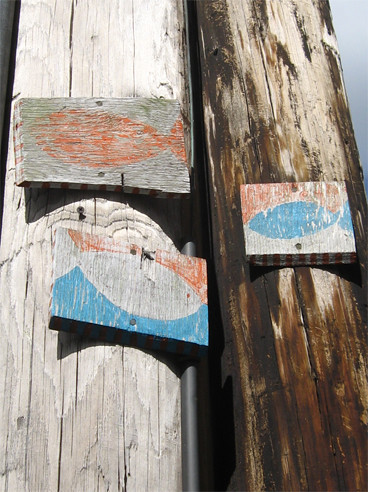
Artifacts of a counter culture: Signs on telephone poles marking outside the original location of the now defunct Fishtown Artspace.

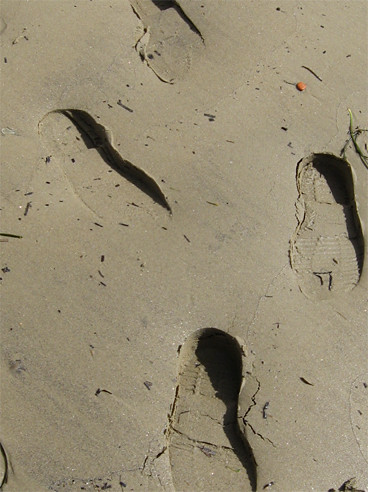
Ever a bibliophile, I took advantage of the sale on used books at Mystery Train Records, and came out with perhaps as many theatre books as I wanted to lug around that day at a cost that I would normally expect to pay for a single book at a used store in Boston, Cambridge or Somerville. A walk on the beach was particularly interesting when I noticed that due to the low tide, the wet sand would sink two or three inches under my boot-steps.

After my lunch, I strolled maybe a mile-and-a-half and arrived at the school shortly before the dismissal bell and squared away the business issues with the drama teacher before being led to the auditorium where the drama club was beginning to gather. I took off my shoes, introduced myself, and briefly explained my view of mime's relationship to everyday body language as poetry's relationship to everyday verbal language-- reciting Shakespeare's 28th sonnet as an example. I then invited the student actors onto the proscenium stage.

The student techies and production staff alternated between attending to their own business and observing as I introduced the actors to the corporeal mime scale, in all three dimensions (lateral, depth, and rotation.) Mime is a difficult form to learn, and even a two-hour workshop is only sufficient to give the most skeletal of introductions, but the students were enthusiastic and willing to learn. They also had the advantage of being a bit older than my students at Open Air Circus, and so have more developed nervous systems and were better able to imitate my isolation work, as well as articulate their interpretations of the meaning of some of the isolations and sequences (the way a lateral translation of the head might represent listening, while a forward translation of the head is more representative of looking.)

After our isolation exercises, I was ready to teach them their first illusion: "the wall." The methodology I have developed is to have the students place their hands on a genuine wall, so that they can experience the flatness and verticality of the wall's plane, and then experience each isolation (including relevés and pliés) of the body with their hands fixed on the wall, asking them to make observations about the focus of their eyes and the compensations they need to make in order to keep their hands fixed to the wall. I also asked them to observe how their hand automatically relaxes when pulled away from the wall. I noted that as with Aristotle's note that the "soul (psuche) is analogous to the hand; for as the hand is a tool of tools, so thought is the form of forms" (On The Soul, III 8 432a1) the hand in it's ability to grasp forms" that in mime theatre, the hand is analogous to the mind, in that it takes the form of the character's thoughts. I then had them experience taking steps along the wall so they could feel just how far they could go before needing to release their grasp of the wall. After several minutes of these experiments, meant to demonstrate that a mime's craft relies heavily on naturalistic observation, I invited them back to the stage, both to demonstrate that with this new found knowledge of walls and an ability to move the whole body in an articulate matter, one sells the reality of the imaginary wall far more than one would with a simple hand gesture, and gave them several minutes to experiment on their own, as I walked amongst them making minor corrections.

Being inquisitive students, they asked me questions in between exercises:

Q: What is the relationship between mime and European clown traditions?

A: In the European context, mime and clown are close cousins, with a common ancestor in commedia dell'arte.

Q: Is there a rule that mimes have to perform silently?

A: No. Many perform silently in observance of mime's independent standing as an art form much as painting and sculpture are independent of one another, but there is no reason why one cannot speak and mime simultaneously. I performed some of my first mime pieces with poetic recitation.

Q: Do mimes always perform with white makeup?

A: No. If a mime chooses to wear makeup, it can be any color, or alternately, the mime can perform without makeup, or with masks. All such things are acceptable.

All this allowed for digressions on the history of mime, allowing me to discuss Charlie Chaplin, Étienne Decroux, Jean Louis-Barrault and Marcel Marceau.

Our next set of exercises were in rope pulling (both horizontally and vertically) and a tug 'o war exercise (a favorite with younger kids, who seem to find walls too abstract) to emphasize ensemble work, as well as to demonstrate the principles of oppositional and sequential movement. After a brief break (due to the techies noting that I had kept the actors working for an hour and a half straight through) explored the extremes of rhythmic dynamics: shock, fondue, and immobility and spent the last few minutes creating tableaux with some of the skills we covered over the previous two hours.

Tuesday, October 9, 2007

Look Ma! I'm part of the Curriculum!

While glancing at technorati, (a search engine for the blogosphere for those of you who are new to blogs) I discovered that my earlier entry, "Breaking with Bread and Puppet" is being read by a class in the Department of Drama and Theatre, Royal Holloway, University of London. The class, which has set up its own blog is investigating the techniques and history of Bread and Puppet Theater with the aim of having students attempt to use similar methods to create their own work over the course of the semester. The professors are Nesreen Hussein and Matthew Cohen.

Despite my misgivings with what I view as Peter Schumann's forays into antisemitism and trivialization of the Holocaust, I have always thought there was great artistic value to his better works, both in techniques and content-- and I certainly see a legitimate need for theatre artists in training to become familiar with this sort of work. Had I not, I would not have worked with the troupe for as long as I did. I will be curious about how the class reacts to my criticism of the work they are attempting to emulate.

Wednesday, August 22, 2007

Teaching Mime at Open Air Circus

In my previous post I described the commedia dell'arte class I taught this summer at Open Air Circus. In this one, I will describe the mime class. Though I do not have any photographs to share of this particular class, The Somerville Journal did post a slide show that include some photographs of my mime class in session as well as some narration that came from an interview I gave.

This was my third summer teaching mime at Open Air, and I've come to have many of the same children signing up for my class year after year.

Given the very short teaching schedule (cut short by a week due to peculiarities of the calendar and another week due to rain), I was left with very little opportunity to do more than teach the concept of isolations, Decroux' corporeal mime scale, and rhythmic dynamism and get a skit together for the final show

Isolations are an essential part of any mime technique, and even when taught systemically, they are difficult for many children to learn due to the fact that their nervous systems are just not fully developed, but into my third summer, I have a group of students who are very eager to please, and at a youth circus, being known as "the weird teacher" really isn't a problem.

The nice thing about any of the traditional repertoire of mime illusions is that they can all be used as lessons in technique, but even more so, they can be used as lessons in teamwork and working with your partner.

This year I decided to work on the rope-pulling illusion and revive "The Spaghetti Sketch" that I had created for the circus two years prior. The "Spaghetti Sketch" has two acts: The first being a tug-o-war competition, the second a spaghetti dinner between the two teams who are even more competitive at dinner than during the competition, where I play both referee and head waiter. The first night (given this year's theme of "Rock'n'Roll") we use Bill Haley's "Rock Around the Clock" for the spaghetti dinner. By the first matinée the music has changed to "Union Jack" by Big Audio Dynamite for the tug-o-war segment and an excerpt from "The Barber of Seville" for the dinner sequence. I have the kids develop their own individual spaghetti related lazzi while I improvise different bits of business each show. One that seems to work is substituting my top hat for a saucepan. The kids are particularlly excited that we've revived this piece as while a few had been in the first iteration from two years prior, many of them had seen it from the audience.

Peter Jehlen, the circus' artistic director, recruits me into incorporating my mimes students into the unicycling segment. He's chosen the music "Grease Lighting" from Grease and I borrow a couple of unicycles and build up some choreography based on various object manipulations (some of our experiments are seen in the slide show). Peter has another idea, which involves having four mimes playing air guitar to "Sergeant Pepper's Lonely Hearts Club Band" during the opening sequence of the show, so I end up spending the beginning of the show acting as a conductor-- showing my "guitarists" how to play strict 4/4.

(I discover during the finale of the last show of the weekend that as we play the "Sergeant Pepper's Lonely Heats Club Band (Reprise)" that the tatkar I have been learning in my kathak classes fits perfectly.)

Thursday, August 16, 2007

Teaching Commedia at the Open Air Circus


Click here for the full photo set

As I was preparing to teach another summer at Open Air Circus I thought back the past year's experience performing with i Sebastiani I lobbied to teach a class in commedia dell'arte as well as mime.

This quickly led to a problem, most of the children who gravitate to my classes have been girls, and traditionally, the masked characters of commedia have been male with actresses playing unmasked (and thus, less grotesque) female characters. I puzzled over how to give my girls the opportunity to play masks. I thought back to this past November when I saw Plunket & Tremolo, featuring Mark Jaster and Sabrina Mandell, perform commedia. In their show, Mandell took on a mask to play Smeraldina, a cook. portraying her as something of an older, craftier version of the Franchescina character we often use in i Sebastiani, I realized that there was nothing wrong with creating a mask for a female character if the mask was appropriate to the character. In addition, since we are all taught that the theatre of the English renaissance featured boy-actors playing women, there was no reason not to cast girl-actors as men. Once I solved those two problems, I was left only with the girls' willingness to play male masks.

So I began work on sculpting the masks from papier-mâché-- I was fortunate to discover that my skills had developed significantly since I last worked in that medium, and by the first day of class, I had masks for Arlecchino, Il Capitano, Il Dottore, and Pantalone. My class comprised of five girls and while I got a great deal of laughs from my depiction of Isabella as I introduced the characters, I decided, that owing to the age group, to dispense with the romance subplots. The girls all had an immediate sense of the vecchi, Dottore and Pantalone, and quickly came up with a lot of good verbal lazzi. The girls seemed to have a great deal of fun lampooning foolish men.

I went home and began work on a Franchescina mask-- reasoning that I wanted it to cover less of the face than most commedia masks and to have both the furrowed brow of a hard working zannia as well as some seemingly delicate features one would attribute to a young commedia heroine.

Over the next few weeks, I led them through exercises in projecting their voices, walking like the different characters, basic slapstick, and playing out brief character scenes in which they would all take turns playing the different masks. I encouraged them to borrow each other's jokes (including mine.) During this time, I began wondering what character I would play and if I could come up with a brief scenario that could use all of the characters and stay within the allotted time.

Eventually, I settled upon the character of Zanni, one of the very oldest of commedia characters-- whose name, a diminitive of "Giovanni", has become the generic label for all the servant characters as well as the origin of the word "zany". Zanni is a porter, and so, because of the relative size of the actors, Zanni could carry any of the other characters on his back. I described him as Arlecchino's uncle, and one of the girls, very intuitively corrected me with "No, Zanni is like Arlecchino's great-great-grandfather!"

I came up with the scenario during the final week of rehearsals, borrowing two elements from the scenario Michael McAfee dreamed up for the i Sebastiani anti-Masque we performed for Vision of the Twelve Goddesses: that Pantalone is staging a theatrical event in the hope of raking in the ducats and that Il Capitano wants to be the star of the show.

In this scenario, however, Pantalone is the producer for the circus. We have a series of lazzi in which Zanni is misidentified as a steed (by Pantalone as a horse, Il Dottore as an elephant, and Il Capitano as a giraffe, and Arlecchino as whatever anyone else says) and repeatedly ridden around, as Il Dottore lobbies for a more gourmet menu at the concession stand (more work for Franchescina, and more confusion for Arlecchino,) Il Dottore misdiagnosing Il Capitano as a corpse, Capitano swearing vengeance on Il Dottore and Pantalone, Franchescina standing up to Il Capitano, and Arlecchino and Franchescina riding off stage on Zanni's back.

One rather funny mistake: on the last performance, the performers playing Franchescina and Arlecchino, instead of climbing onto my back at the end, somehow both leapfrogged right over me, but there are no mistakes: incorporate it into the next show!

Now: to dream up a scenario for next year.

See more photographs on my flickr account.

Sunday, August 5, 2007

Open Air Circus, August 10-12 in Somerville, MA


Come see my mime and commedia dell'arte students perfom with the Open Air Circus, Somerville's own youth circus, this coming weekend at Nunziato Field in Union Square.

This is my third year teaching mime and my first teaching commedia to the wonderfully funny bunch of kids at Open Air.

Show times are:

Friday, August 10 @ 7pm
Saturday, August 11 @ 2pm & 7pm
Sunday, August 12 @ 2pm

Tickets are $3