Sunday, April 6, 2008

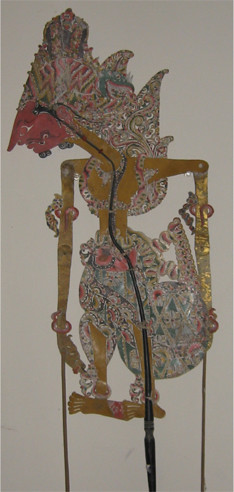
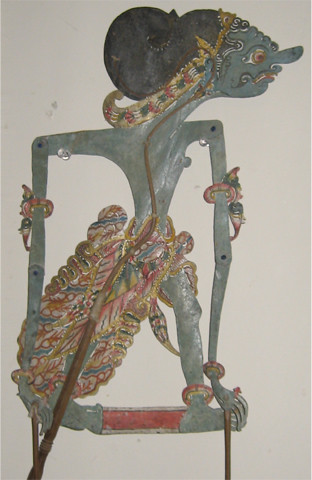
Can You Identify These Puppets? Part II

Last summer, I asked my readers if they could identify two Javanese Wayang Kulit puppets I had acquired at a yard sale.

So far we have had a number of opinions, but still no definitive identification of our two figures, other than a consensus that they are Javanese and not Balinese in origin (which is what the seller informed me)-- one anonymous poster identifies them as being specific to Central Java.

The first figure, who has a red face, an elaborate headdress and a gold body certainly seems to be of noble or royal office, but we are still no closer to putting a name to him. One friend of mine suggested that he was Rāvana from the Rāmāyaṇa but that contradicts the seller's statement that both figures were from the Mahãbhãrata. Indeed the previously cited anonymous poster suggested:

the first charachter might be Baladewa [...] definitely not Ravana.

Of Baladewa, I know nothing, and of whom I have yet to find an English language reference-- I do not even know if he goes by another name.


The second, smaller, blue figure was clearly of a lower status than the more elaborately dressed figure, and I was eager to assume that he was one of the comical figures of the Wayang known as punokawan but my anonymous poster seems vehemently opposed to that hypothesis.

The second (the blue guy) is definitely NOT a punakawan.


Once again, can any reader identify these puppets? How can one know that they are one figure and not another of similar status? I would so like to know their names so that I can learn their stories.

Teatro Punto Workshop

Two weeks ago, I attended a day-long commedia dell'arte workshop conducted by Carlos García-Estévez and Katrien van Beurden of Teatro Punto. As commedia dell'arte is a rich tradition with a long history a day-long workshop could never be adequate to teach all there is to know, but neither is the time I have put in working first with the short lived Teatro Commedia, and currently with i Sebastiani, nor could the class I teach at Open Air Circus could have taught me all that I need to know as a commedia performer. Conversely, any opportunity to add to my knowledge, skills, insight, and experience with commedia is desirable.

Teatro Punto's approach to commedia is not that of historical recreation, but to take the archtypes represented by the masks and discover them in the contemporary world. All of the historical techniques of commedia are still relevant as ever, but the goal is not to indulge nostalgia, but to reflect a world that the audience recognizes.

The workshop began with a series of exercises revolving around being prepared to act in and react: an ability needed in the world of improvised theatre. Standing in a circle, we had to respond to any number of tasks, each round introducing a new tasks: tossing and catching balls, trading places with one other, passing objects, singing, stomping one's feet (this last one was quite simple for me owing to my kathak studies) all while staying in communication with one another. When one is multitasking in this manner, one realizes just how often one's mind has a tendency to drift, even in the altered state of performance.

Afterwards, we experimented with the physical stance of different characters-- something I have been doing since my earliest studies as a mime-- how different characters are made manifest by emphasis or inclination of the pelvis, abdomen, chest, or head. One insight I did gain was that while some of these stylizations are typical of specific of various comic archtypes, they are also representative of different theatrical genres, the puffed up chest that would serve an innamorato, or an arrogant Capitano while not appropriate for tragedy might also be appropriate for melodrama.

During the lunch break a few other workshop participants and I joined Carlos, Katrien, Judith Chaffee, a theatre professor at Boston University, who was acting as the host for the the workshop (check out her website, Commedia-dell-Arte.com.) During lunch Carlos and Katrien discussed their time studying with Antonio Fava and how their approach to commedia differs, and we local participants discussed the difficulty in building an audience for any sort of physical theatre in the Boston area.

On returning to the classroom and began work on our own lazzi, encouraged to use mime, grammelot (nonsense syllables that resemble an actual language.) Afterwards, we were given a primer on the technique of the traditional leather mask-- how to hold it when placing it on the face and also how one is supposed to use the face behind the mask: Counter-intuitively, the face does not become passive when covered: all masks require holding one's eyes wide open, and certain masks (some of the vecchi, for instance) demand that one cover one's teeth with one's lips.

Katrien explained that in the early days of commedia, the actors were often hungry and desperate, and this did not only force them to innovate, but it meant that the tragic dimensions were as visible as the comedic. In modern western societies, there simply is little reason for an actor to be literally starving. Since withholding food was not an option as we had all eaten lunch, a new technique was added to create desperation: Carlos acted as an interlocutor for every one of us-- often disrupting the lazzo we had created earlier, with questions about our character's backstory, whether we are keeping our eyes open under the masks, and whether we were making contact with the audience or just going through our rehearsed lazzo. This was the most difficult part of the workshop, with many unexpected results.

A workshop is not just an opportunity to show off the technique one already had, or to learn new techniques, but to learn about one's own short comings as a performer. In my case, I realized that my own dedication towards developing my technique-- both in terms of the precision and skill of my mime work, and the detail with which I craft my routines, while an attraction to the audience, is also a shield I put up to avoid being vulnerable to the audience-- and so, something that this performer must overcome. That said, I highly recommend Teatro Punto's workshops to any performer interested in commedia dell'arte.

Wednesday, March 26, 2008

Presentation at Emerson College

Art Hennessey, playwright, actor, and director who works with the Essayons Theatre Company and whose Mirror Up to Nature blog I frequently read invited me to be a guest presenter in his "Arts, Entertainment and Society" class this past Monday at Emerson College. The class is part of Emerson's certificate program in Cultural Journalism which provides journalists with the background to report on arts and culture.

I brought along some video and a couple of masks to demonstrate my work, but the presentation, led as much by the questions posed by Hennessey and his students as by what I was interested in discussing was free-wheeling and ranged from how I came to be in the arts, how I came to be a mime (which allowed me the opportunity to show video of my work with Bill Barnum and James Van Looy in Cosmic Spelunker Theater), to how do I reach my audiences, my interactions with the press, the rising importance of blogs for dialogue about the arts, as well as how outside economic pressures structures what form art work takes and how it is presented.

I even demonstrated a short excerpt from my "Arlecchino Ever Ravenous."

Hennessey and I, being both writers and performers shared the observation that sometimes maintaining our blogs seems to cut into energies we should be devoting to our "real" writing and rehearsing, while at the same time noting that it is becoming a more important outlet for writing than ever before. In my case, my blogging has had influence on controversies in Burlington, Vermont, been included on the reading list of a course at Royal Holloway, University of London, led to my being interviewed and even allowed Hennessey and I to talk about the more structural aspects of playwriting as we shared the subway ride home.

Monday, March 17, 2008

This is Not A Protest (1999)

Chad Parenteau posted a previously unpublished account of prankster and spoken-word artist, Rich Mackin's performance piece "This is Not a Protest" in which I played a small role. The year was 1999, an innocent time before the so-called "death of irony."

Before and during this non-event, [Mackin] offered the following written statement on a small flyer: "The week of 8/8/99 the cover story of US News & World Report was '1000 years ago'; Time and Newsweek both featured 'The Blair Witch Project'—No news is good news.

"The First Amendment guarantees our right to freedom of speech–even though we have nothing to say! Forcefully assert your apathy!"


Read the rest of the article here.

If memory serves me correctly, the "Sarcastic People for Apathy" sign was my creation.


Pictured: Joselyn Almeida, Zoz, Rich Mackin, and Andrea Kulish

Wednesday, February 20, 2008

Photos from the February 9th Show


Thanks to my friend, Shannon O'Connor, I have photographic documentation of my recent show at Willoughby and Baltic. As well as being a showcase for some of the repertoire I have been developing over the past several years, the show was an opportunity for me to try some new material out on an audience. One new piece was a corporeal mime and mask piece entitled "O, Mister Sun" and the other was a my first attempt at a solo commedia dell'arte piece that was inspired by the Dario Fo's performance of La Fame dello Zanni, a classic lazzo from the traditional repertoire. My version includes a visit to both Paradisio and Inferno in Arlecchino's quest to fill his growling belly. The full photo gallery begins here.

Special thanks to Meredith Garniss of Willoughby and Baltic for inviting me to perform again.

Somerville's newest newspaper, The Powderhouse posted a review of the show to its website

Tuesday, February 19, 2008

Notes on the NEJAR interview with Peter Schumann

As noted earlier, Greg Cook interviewed both Peter Schumann and myself regarding Bread and Puppet's recent show at the Boston Center for the Arts and the controversies surrounding his recent work on the Israeli-Palestinian conflict. In his email interview of me, excerpts of which appear both on this site and on the New England Journal of Aesthetic Research, Cook asked me to respond to some of Schumann's statements.

There were also a series of questions that Cook posed during a face to face conversation on February 1st, which while not transcribed, were thought-provoking and I will attempt to explore these issues as I comment on some of Schumann's other statements. Boldface italics represent Cook's questions; plain italics represent Schumann's responses. The first quotes come from part two of the NEJAR interview:

Well, it’s something that we can’t talk about because it’s so electric. It’s very difficult to even begin a discussion. It seems like you’re consciously going there because of that.

Yeah, I think it’s unfairly so. I think it’s awful that the Western community does not interfere with what Israel’s doing as an occupation force. The Western community does not do anything about it. They don’t even speak up against it. They don’t do anything. They basically serve as the Israeli propaganda for the events there. They give us what the embedded reporters give us from Iraq, which is the picture of the perpetrators.


I'm not certain as to which "Western community" Schumann refers. Given such incidents as the British Broadcasting Corporation's 2002 reports of a "Jenin Massacre" in which hundreds of non-combatants were allegedly slaughtered, was later dispelled as propaganda, it would seem that the largest news agency in the world has for some time been serving as anti-Israeli propaganda. In addition, we can look at the failed attempt to sponsor a boycott of Israel by the National Union of Journalists (a union that serves journalists in both the United Kingdom and Republic of Ireland.) Neither conform to the picture Schumann presents. Indeed, if we examine the media of most other Western nations, it is quite probable that we will see quite the opposite of a pro-Israeli bias (I haven't done such a study, and clearly, neither has Schumann-- however the Anti-Defamation League has done a study of European attitudes.) Indeed, this claim that "The Western community [...] serve[s] as [...] Israeli propaganda" seems very similar to the old canard of Jewish or Zionist control of the media.

[Your critics]seem to say your work doesn’t represent that the Israelis are doing this to fight terrorism from the Palestinians. And so that by not representing the Israelis’ problems you’re being unfair.

I don’t know. It’s like when you go to any war naturally the guerillas who rise up against occupation forces are to be blamed for atrocities they commit, but that’s not on the same page with the atrocity of the occupation. Take an extreme case like the Nazis in Poland. Naturally what the Polish and the Russian guerillas probably did against the Nazi soldiers was probably pretty horrible, dismembering them or burning them or putting them into cement walls, or whatever they could to, probably, to punish them. Is that on the same page as the very fact of the invasion?


Leaving aside that Schumann is again comparing Israelis with Germans (which he claims not to be doing) he is conflating the distinction between guerilla warfare and terrorism. Guerilla warfare is generally understood to be the tactics used by small mobile armed groups against larger, less mobile military organizations. Terrorism, on the other hand, is violence against civilians in order to pursue ideological or political objectives, often by irregular forces. While both are acts of violence, it is terrorism, not guerrilla warfare, that the Israeli government considers an obstacle to peace with an entity representing Palestine.

However, this conflation of guerilla warfare with terrorism, is just one conflation among many-- such as the likening of the West Bank Wall with the Warsaw Ghetto Wall, that is, the likening of a non-lethal anti-terrorist strategy with a tool of genocide, that first inspired my parting company with Bread and Puppet, criticism from Rabbi Joshua Chasan, criticism by arts writer, Ric Kasini Kadour, and ultimately a breakdown in civility at last year's ArtHop in Burlington, Vermont.

The other disturbing element of this answer is the repeated word "probably" in the phrase, "what the Polish and the Russian guerillas probably did against the Nazi soldiers was probably pretty horrible, dismembering them or burning them or putting them into cement walls." [My emphasis.] No doubt such behavior would be against the Geneva Conventions regarding the treatment of prisoners of war, but rather than state such atrocities did occur, or that there were contemporary reports of such actions, he stated that such acts of sadism probably happened.

There is no ethical excuse for any of this violent dealings and revenging and so on. There isn’t. Ethically this is wrong. But a state always takes exemptions from these ethics. So as the U.S. does. And so does Israel. It’s a fascist democracy just like the U.S. is. And these fascist democracies that are not real democracies, but fake democracies, they do as they wish. They build their ethics with the help of ethics professors as they go. They just have to find the right ethics professors, and they do all the time. They pay enough and so they find another ethics professor. That’s the sad story.


This is an interesting quote because it forces us to ask several questions of Schumann: If there is no ethical excuse for revenge, then why the opposition to the West Bank Wall, which barring a working peace settlement, is the only non-lethal means of short circuiting any perceived cycle of revenge currently on the table? What are the criteria by which the U.S. and Israel are fascist, not real democracies? If that is the case, are the forces against which Israel is defending itself democratic and anti-fascist? What is the model for "real democracy?" How is this fable of "searching for the right ethics professor" different than Schumann's own pronouncements on truth and ethics?

The sad thing is that "Fascism" has become little more than an epithet and that is precisely how Schumann uses the word-- instead of as an analytical tool to describe ideologies or systems of governance. (Umberto Eco has an excellent essay that attempts to restore some meaning to the term.) However, this an on-going problem with Schumann's rhetoric, as evidenced in this quote from the first part of the interview on NEJAR:

[...]as the show shows [...] Guantanamo is the logical result of the prevailing consumerism and capitalism in its shape as it is right now. It’s not illogical, it’s not an aberration, it’s a totally logical result of that. So I’m saying the School of the Americas or Abu Ghraib or Guantanamo are not ‘rotten apples,’ as Bush called them, but are directly philosophically correct, pin-pointable climaxes of the system.


While I would certainly agree with Schumann that the torture and rendition programs are not aberrations to an otherwise functioning system, as they have been, time and time again, demonstrated to be the direct result of government policy, it is absurd to say that the institutions of torture, "secret" prisons, and detention without due process are products of either capitalism or consumerism. Feudal, communist, fascist and tribal societies have all tortured and held prisoners without due process. The phenomenon is unchecked power over human bodies, and as shown by philosophers from Friedrich Nietzsche to Michel Foucault, there is neither a singular rationale nor a singular meaning. Societies always include elements of the societies that precede them. If capitalism uses torture as a tool, it is because it follows and interacts with societies that have used torture as a tool.
Tuesday, February 12, 2008

Some Additional Excerpts from the NEJAR Interview

Here is some additional material from the interview Greg Cook conducted with me in the New England Journal of Aesthetic Research regarding my criticism of Peter Schumann's presentation of the Israeli-Palestinian conflict and the Holocaust. While Cook and I did have a face to face conversation on the evening of February 1st, the interview was mostly conducted via email on January 25th except for the first question and response which were from a follow-up on February 5th:

NEJAR: Do you really mean to compare Schumann to [Leni] Riefenstahl? That is a powerful charge. Aren't you basically calling him a Nazi?

Thal: I think the picture is far more ambiguous than that. The analogy I make is of how an artist interacts with the world of politics, not of the artist's ideology.

From documentaries and articles I've seen and read about Leni Riefenstahl, the picture I have of her is that of an artist whose work was accomplished and innovative (as is Schumann's) but who enjoys the patronage and association with extremists. In Riefenstahl's case, the extremists were Nazis, in Schumann's case they are Holocaust deniers like Vermonters for a Just Peace in Palestine/Israel or the International Solidarity Movement who support violent terrorism. At the same time Schumann pleads innocence when his association with extremism or the extremist content of his own work is questioned, just as Riefenstahl pleaded that she was just an apolitical filmmaker-- and she did in fact make some good apolitical films early in her career.

Remember: Riefenstahl was not a war criminal. She was a selectively amoral propagandist who could never take ethical responsibility for her art.

Schumann's decision to use misrepresentations of the Holocaust in order to completely demonize Israel and then, depending on the interview, either defend this representation, or state that this was never his intent, is a similar personal moral failing, though lacking the patronage of a powerful nation-state, it's a failing on a much smaller scale.

* * *

NEJAR: Have [your feelings about Bread and Puppet and Peter Schumann] changed at all since a year ago? Or since last fall?

Thal: They solidified further [...] when I discovered his support for the International Solidarity Movement (ISM) which uses western activists as human shields to protect arms smuggling operations for terrorists based in Gaza, and when he worked with Vermonters for a Just Peace in Palestine/Israel (VTJP) whose official website includes Holocaust Denial materials.

* * *

NEJAR: Clearly, comparing people to Nazis (whether intentional or not) shuts down all discussion.

Thal: False charges of genocide, which is ultimately what using the iconography of the Warsaw Ghetto as a metaphor for the Palestinian West Bank, even by insinuation, only enables genocide and war-crime deniers everywhere-- be they Holocaust deniers in Europe, America, and the Middle-East, or Armenian Genocide deniers in Turkey, Japanese deniers of the Rape of Nanking, or Communist deniers of the atrocities of Lenin, Stalin or Mao.

NEJAR: But the Israeli-Palestinian matter is such an important and dear and tense issue that it seems hard for us to talk about it at all. What's your sense of why it's so difficult for our community to talk about?

Thal: It's difficult because too many of the people with strong opinions are unwilling to deal with the complexity of the situation-- consequently they attempt to impose simplistic schema that are completely inappropriate to the subject matter. There's a refusal to address the role that neighboring states have played in perpetuating the conflict for their own political gain. There's often a refusal to see the role that antisemitism and Arab racism against other minorities in the region have had both as a motivating factor and as window through which the situation is viewed. There's a refusal to see how the Palestinians are violently oppressed by the very political parties that claim to represent them.

NEJAR: What might be some ways to aid in a discussion?

Thal: Research. Learn how to distinguish between well researched history and propagandistic pseudo-history.

* * *

NEJAR: Are you going to see the Bread and Puppet performances at the BCA next month? Or Schumann's new paintings there, which he says are about a young Palestinian man whom he believes was falsely imprisoned by the Israeli government? Will you perform with Bread and Puppet this time around? Ever? How come?

Thal: I'm performing my own show at Willoughby and Baltic in Somerville on February 9th, so I'm rather busy, but even if my schedule were not at issue, there would be both ethical and practical matters.

[...]

Given the content of any of Schumann's work regarding the Israeli-Palestinian conflict seems to come from animus and not from a commitment to truth (even the sort of truth found in allegory or satire) it's not worth my while. The experience the past year has left me with grave doubts regarding his intentions and his sincerity-- and I can't work with an artist whom I can no longer trust. I certainly cannot trust his perceptions of what constitutes "a fair trial." The Israeli courts often decide in favor of Palestinians who sue the government-- what makes this situation special?