Showing posts with label dance. Show all posts

Sunday, May 22, 2011

New Play Map Source Code Released!

NewPlayMap1Back in January, I presented my initial thoughts regarding the New Play Institute's New Play Map, a platform for an open-source, user generated, map of the new play sector. The Institute has since continued work on developing the code for the map, while I have noticed that in my greater Boston metropolitan area, more "generative artists" (a term that embraces both playwrights and collaboratives), and presenting organizations have slowly begun to appear on the map. Locally, the playwright development organization, Playwrights' Commons has even launched a campaign to map Boston area plays and playwrights.

On May 19th, the New Play Institute announced that the source code for the latest version of the New Play Map has been posted to GitHub.

Of course, the immediate question is: what could be done with this code now that it has been open sourced? The Institute asks:

We're dying to find out what you could imagine doing with it.

(Theatre organizations in other countries: Why not take the source code to map the theatre infrastructure of your own country? That would be the simplest and easiest adaptation of this project.)


Since the introduction of the Map, I have considered what other art sectors would be well served by the platform. Plays are not the only works that can be tracked in this manner. My attention went to some of the other performing art forms: dance, opera, (and for a lack of a better term, "performance art"), are amongst a number of composed pieces that can be performed and presented in any number of venues, by various performers, presenting organizations, and can even go through a development process of workshops, conferences and festivals.

So why not a New Dance Map? New Opera Map? New Performance Map?

Saturday, July 24, 2010

Improvising with Karen Montanaro


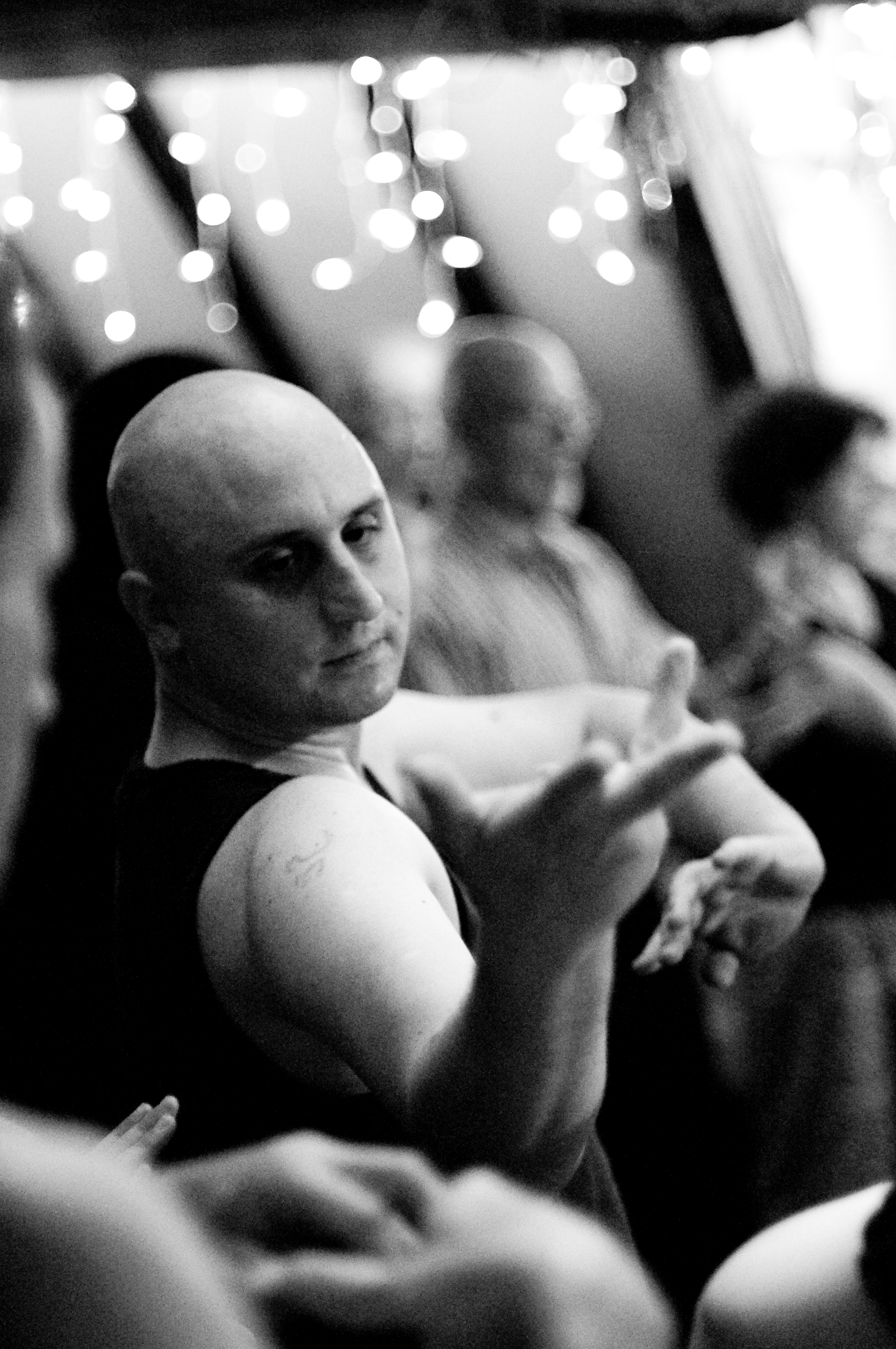
Ian with Karen Montanaro. All photographs by Justin Moore, check his Flickr page for additional photos from the July 10, 2010 Improv Org Event

I met Karen Montanaro this past spring at the Arlington Center for the Arts where she was performing a set of improvisations to the music of Ginger Ibex a chamber music/progressive rock ensemble featuring pianist/composer, Sharon Crumrine and violist Betty Widerski. I had met Sharon in a coffee house where I had been auditioning actors for a staged reading of Total War, apologizing if my reading lines with actors was disturbing her, where upon we she mentioned her band, it came up that we knew many of the same musicians and that I was a mime.

That's when Sharon asked me if I knew Karen Montanaro. I only knew Karen by reputation and as co-author with her late husband, the celebrated mime, Tony Montanaro, of Mime Spoken Here. One of the best books I've read on mime theatre, which is probably one of the reasons I never got my copy back after I loaned it out!

Months later I found myself in Arlington. Having arrived early, Karen recognized my willingness to get on a stage and invited me to sit in with her ad hoc ensemble that this evening included the twin dancers Billy and Bobby McClain. We had a good rapport and so I stayed on stage for much of the show.

Mali Sastri, composer and singer for Jaggery was also in the audience that night. Not only did she join in improvisation, but it inspired the theme of her next Org event: Improv Org. Org is a series of performance related events at a location I shall not disclose that Mali organizes-- and she prefers to keep to a theme. I'd like to think that the city has many many more such "secret" event series for artists to perform in between public appearances.


With Johanna Bobrow who was sitting in on violin with Ginger Ibex that evening.

So sometime later, after Mali had started to put together the line-up, Sharon emailed and asked me if I would like to dance with Karen again. I agreed immediately, and along with Naomi Davis, became part of Karen's ad-hoc dance troupe. We were originally scheduled to perform in the garden, but because of flash floods that hit the Boston area that day, we were relocated indoors to the attic loft known as the Cloud Club.


From top to bottom: Johanna Bobrow, Ian Thal, Naomi Davis, the other part of Karen's ad-hoc dance troupe.

In between songs, Karen would often discuss her philosophy of improvisation: that no matter the body type or the level of training, each and every body had a certain poetry that could express itself if simply allowed to move. Eventually, she brought members of the audience to improvise with us.


The evening would include a story by Evan O'Sullivan, a raga sung by Molly Zenobia, Guitar Circle New England and a jam featuring members of Walter Sickert and the Army of Broken Toys, Jaggery, Amanda Palmer and others.

Saturday, May 24, 2008

June 1st: Solo by Sixty: Chhandika's Sixth Annual Student Kathak Concert


It has been a while since I last blogged about my kathak studies under Gretchen Hayden but I've not ceased my studies. In fact, I am performing kathak for the first time as one of the beginning students in Chhandika's Sixth Annual Student Show, Sunday, June 1st. Hopefully, over the next several days, I'll post additional reflections on my training.

Solo by Sixty:
A voyage through the phases of a classical kathak dance concert


Sunday, June 1, 2008
4:30pm - 7:00pm
Peabody School Auditorium
70 Rindge Ave.
Cambridge, MA


General: $15
Children 12 and under: $5
Tickets available at the door.

Friday, January 4, 2008

Belated Follow-Up to Sarod & Kathak Concert

Happy New Year!

I have not updated my blog in a few weeks as I have been rather occupied with some other creative projects. I will write about the status of those projects shortly.


But first, a belated follow-up to the Sarod & Kathak concert I mentioned previously. Firstly, two corrections: 1.) Pandit Ramesh Misra had to cancel his appearance, 2.) I was mistaken in the identity of the tabla player: Nitin Mitta played tabla that evening.

As I have come to a greater understanding of the rhythms of kathak dance (even at my status as a beginner) I found that I could listen to George Ruckert's playing ragas on sarod and better grasp the structure of the melodies of Hindustani music which before I probably only appreciated for its timbral qualities and emotional content. Perhaps someday I will be able to hear it with the same understanding I have when I listen to jazz or rock.

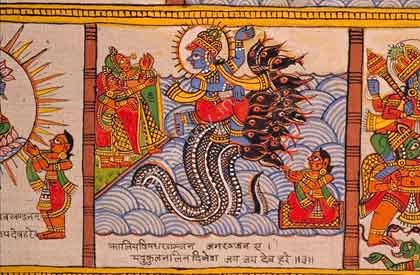
Of course, I had come to see Gretchen Hayden, my teacher, dance. One highlight was a piece from the story-telling repertoire that is taught to kathak students at Chhandika: the tale of how Krishna, as a child, conquered the water-snake demon, Kalia Naag, while fetching his ball after it fell into the Yamuna river. When we practice the story in class or in workshops, the game is one of keep-away, but that evening Gretchenji improvised a game of baseball, miming the pitches, the swings, the spitting on the ground, and the arguing with the umpire. Georgeji began to improvise a melody based on "Take Me Out To the Ball Game".


The effect was such I had to watch The Cameraman when I got home and compare it with the scene in which Buster Keaton playing a news reel cameraman, discovers that the New York Yankees are playing out of town, so he mimes a game for the camera:


My expectation that Gretchenji would be so energized from the concert that she would push us extra hard in class the next day did not come to pass however, as class was canceled due to the nor'easter that came through our region that next day.

Wednesday, December 12, 2007

Sarod and Kathak Concert, December 15

My kathak teacher Gretchen Hayden and her husband, sarodist, George Ruckert, will be performing a concert this Saturday, December 15th at 7:30pm at MIT's Kresge Auditorium. They will be joined by Pandit Ramesh Misra on sarangi and Aditya Kalyanpur on tabla.

Judging from the last Saturday night concert she gave I expect that come Sunday morning, Gretchenji will push us to our very limits during class.

Thursday, December 6, 2007

Gretchen Hayden profiled in Boston Globe

This past Saturday, the Boston Globe profiled my kathak teacher, Gretchen Hayden who was performing a concert with the band Natraj that night. While Gretchenji had many a time told us stories about her own training with Chitresh Das, I had never known how it was that she came to kathak dance. Hopefully, the publicity will bring good things to Gretchenji and Chhandika, the school she founded.

Natraj is a Boston-based group that fuses jazz with both Indian classical music and West African traditional repertoire, and includes percussionist Jerry Leake who last month came to our Kathak intensive to discuss the role of tabla and of bols in Hindustani music.

The band takes its name from Shiva's incarnation as the cosmic dancer or "King of the Dance", and so the concert began with an invocation to Shiva, danced and mimed by Gretchenji. Gretchenji returned to the stage to perform with Natraj when they played Hindustani and Hindustani-inspired repertoire, including a comical tale of the young Krishna as a sweet butter thief (which I had seen Gretchenji perform in 2003 before I had become a student one of her students-- indeed a similar story of Krishna by another dancer had been my introduction to the storytelling and mimetic aspects of Indian classical dance.) The concert ended with a complex call and response, in which Gretchenji and Jerry Leake exchanged bols (the verbal notation of rhythmic motifs) whereupon Gretchenji translated these bols into the percussive footwork for which kathak is known and the musicians each responded with improvisations based on these phrases.

The next day, perhaps energized by the concert the night before, Gretchenji presented a more challenging than usual Sunday class. Particularly memorable were the 32 spins or chakkars we had to execute just as we were coming out of a ta thei tata thei a thei tata thei motif. I must be improving as I managed to get somewhere past my 24th chakkar before losing count and finding the momentum had was actually making it difficult stop. Once we did I was far less dizzy than expected. I resolved that I had more bols to recite and memorize before the next class. This week my project has been dha tere kita taka tuna kat dha tere kita taka tuna kat.

Sunday, November 18, 2007

Kathak Intensive

Last weekend was the third weekend intensive I have attended since I began studying kathak at Chhandika under the tutelage of Gretchen Hayden. It has been a great undertaking to attempt to learn one of the classical dance forms of India, but what worthy undertaking is not difficult? In the past year, while I am still in the level I classes, I have attained some small amount of technique, confidence, and knowledge. The advantage of the weekend intensives is that it is a way of broadening one's understanding of kathak, often touching on subjects and exercises for which we have little time in our regular Sunday classes.

At one point Gretchenji had us dance tatkar in tintal (a sixteen beat cycle) in a circle, as one by one, one of us had to enter the circle and improvise a rhythmic motif and then return to the tatkar-- it was a circle where I was the only level I student in a room of level II and III students and having far less mastery over far fewer bols than my classmates left me anxious about an exercise that was difficult for many more advanced students, but when pushed to let go of my anxiety, Gretchenji pointed out that the important thing was that I attacked the improvisation with intensity even if my technique has far less developed. Again she taught me the same lesson when the more advanced students had to do a particularly difficult series of chakkars (spins on the heel of the foot-- different from the ballet pirouette which is done on the toe or ball of the foot) while traveling in a straight line across the studio space (difficult even for some advanced students) when it seemed impossible for me, she had me walk the line that the others danced, and I delivered the intensity that has come from my years as a mime. The lesson I took was do not let my awareness of what I don't know prevent me from dancing in the moment.

Later, when joined by some other level I students, we were assigned to develop our own tihais a dance phrase built on the same rhythmic motif or palla repeated three times in this case, a seventeen beat motif created from three five beat phrases with two one beat pauses in between. We had to create, rehearse, and perform our tihai -- again, a challenge to which we were unaccustomed in the level I classes.

Through the weekend we also had the chance to attempt more advanced repertoire like the storytelling from which my interest in Indian classical dance in general, and kathak in particular, first emerged. Appropriately, our intensive being on the taking place during the festival of Diwali (my friend from the blogosphere, Sindhu has posted a piece on Diwali on her blog) one of those stories we worked on was the defeat of the prideful Lord Indra by when Krishna lifted Govardhan hill to shelter the cowherds and their cows and again I realized, that for all my shortcomings with my footwork, I enjoy acting the part of Indra.

The intensive was also an opportunity to have musicians give extended presentations on how tabla, vocal music, and poetry relate to our dance studies, ultimately leading me to better understand how the rhythmic elements of the music relate to movement. Now the matter is getting my feet to learn what my mind is beginning to grasp.

Saturday, October 27, 2007

That other Macbeth

As mentioned previously, the Macbeth production I had been in was cancelled, so when I attended previews for the Actors' Shakespeare Project's production of the "Scottish Play" as an usher, I could not help but compare the two productions in my mind.

First of all, ASP's Macbeth is excellent. Much of the scuttlebutt about the Boston scene was about the decision to use an all female cast. However, rather than creating some campy Macbeth in drag, they delivered a striking production that involved some first rate actors in roles that they normally would not be allowed to play. After all, if a director can choose to cast (in my case) an male Ashkenazi Jew as a multitude of Scotsmen, why not women (of any ethnicity) as Scotsmen?

As an audience member, I was particularly excited by Marya Lowry's powerful Macbeth, and Bobbie Steinbach's strength and versatility as Duncan, the Porter, Warlike Siward, and one of the witches (this trio of witches, in their second appearance, use some physical comedy to make a vulgar pun that gives some credence to Alan K. Farrar's intuition that in the original production the witches were performed by the comedians in the troupe.) There was one actor (whom I will leave unnamed because the performance was a preview and I have confidence that subsequent performances will be improved upon) who has shown great comedic skills in other plays, but seemed to introduce a sarcastic or ironic tone of voice into what was supposed to be a tragic scene-- but that was the only false note of the show-- and it was a mistake that only someone of talent could make.

As said earlier, I was curious to see how other actors were going to attack roles for which I had rehearsed this past summer. Denise Cormier's version of the Bloody Captain was a fine version, but simply not how I imagined the role-- the joy of a classical repertoire is that roles are constantly being reinterpreted. As I developed the role, my Captain had become more stylized and inspired more by Odissi dancer Sonali Mishra's interpretation of Devi Mahakali (better known in the Anglophone world as the goddess Kālī) and a Samurai puppet piece I had seen twice performed by Paul Vincent Davis; hers was more naturalistic. She was clearly in a situation where she had to put more imaginative work into her more central role as a witch.

To my disappointment, the role of the Old Man, Ross' father, was dropped from this production but did not injure the story. The practice of cutting or rearranging lines, scenes, or characters is actually not uncommon when performing Shakespeare, either due to the length of the play, or due to the logistics of casting. I miss the character and his lines, but I must admit, he is not essential to the plot. The scene between Lennox and the unnamed Lord, from Act III was a joy and I savoured the reading of the Lord's lines even more so because it had been shifted to Act IV, which meant that during intermission I had fretted that the scene had been dropped entirely. In Act V, Cormier now had the role of Seyton, and performed much as I had during rehearsals with the Lollygagging Players which only made me more envious of her costume.

Monday, August 6, 2007

Almost a Year of Kathak

Some of my readers are aware that for much of the past year, I have been studying kathak from Gretchen Hayden of the Chhandika Chhandam Institute of Kathak Dance. Kathak, for those of you who are unfamiliar, is a dance-theatre form (I have read that "dance" is a misnomer resulting from British colonists attempting to translate what they observed into their own categories) that while having ancient roots, began to take its modern form in Northern India and modern day Pakistan, under the influence of the Mughal courts where it took on influences of Persian dance.

Kathak is a classical performance art form in that it conforms to the theories and guidelines of the Natya Shastra written by the sage, Bharata Muni. There appears to be some minor disagreement amongst scholars of whether there are six, seven, or eight schools of dance-theatre that are of classical stature, and since I am not a scholar in the field and have no opinion on the matter.

I had first become aware of Indian dance in general in 2003 when I was present for an informal presentation by foreign student at Open Floor, a sort of workshop and show and tell for movement artists. I immediately saw the formalist storytelling elements, and saw a commonality between Indian dance traditions and European mime (specifically the corporeal mime I had been studying from James Van Looy) as well as the impulse to synthesize movement with poetry-- something I first saw articulated by William J. Barnum. (Cosmic Spelunker Theatre began as a trio between Barnum, Van Looy, and myself.)

I began to seek out every Indian dance concert I saw announced, first becoming aware of Bharatanatyam which developed primarily in Tamil Nadu, before seeing a student show by Chhandika and being exposed to Kathak. I attended a few shows as well as a few open workshops until last fall, when one of the more advanced students noted, "you've been attending our concerts for years and you are a performer, why don't you come study with us?" So I did.

A kathak performance involves a recitation of either a poem or of bols (a composition of syllables used as notation by Indian drummers) while engaged in complex percussive footwork while the upper body mimes the narrative. I was obviously first attracted by the mimetic and poetic elements, but it is the rhythmic footwork that forms the foundation of this dance, and percussion has never been my strong point-- so it has been a steep learning curve for me-- but I have been learning.

Saturday, August 4, 2007

Midsummer Night's Dream on the Common

Last week, I twice attended the Commonwealth Shakespeare Company's free production of A Midsummer Night's Dream, which, provided you can get good seating, was a wonderful show (I went Friday last with a friend who has children and a good half of the stage was obscured by foliage-- while I had a great view, including the other half of the stage, on Sunday when I went alone.) This year's Shakespeare on the Common production was marred by budget cuts that resulted in a scaled back run (one week instead of the typical three weeks) even though the President and CEO of the Citi Performing Arts Center (CPAC), Josiah Spaulding Jr. received a $1.265 million bonus. Bill Marx does a terrific job of following the money trail on his blog.

However, since I am an artist and know nothing of money (said by Charlie Chaplin in contract negotiations with First National films just before stating "I only know that I want one million dollars") let me sketch out what I thought of the production:

While spectacle is a necessity when presenting a play in a big open space like the Boston Common, the scaled back budget did not harm the production values of the show. The minimalist stage merely meant that the spectacle had to come from the actors' performances rather than fancy set designs.

Those familiar with the play, are aware of the three main plot lines each of which involve their own troupe of players. What distinguished these three groups: The Athenians, the Mechanicals, and the Fairies from one another was not just the costuming, but styles of physical acting.

The Athenian lovers -- the most one dimensional of characters in the written script -- are exactly the stock comic lovers of European renaissance comedy (they would be equally at home in the Italian commedia dell'arte) but what made them so effective in this production was that they took the character's adolescent petulance into realms of slapstick: Hermia being flung off the stage, a rageful Helena throwing herself at Hermia and being caught by Lysander and Demetrius, Helena and Hermia climbing onto the shoulders of Lysander and Demetrius as if preparing for a joust.

The Mechanicals were a troupe of capable physical comedians of another order entirely: skilled clowns (I certainly detected a great deal of physical technique in all of them) they certainly gave the appearance of being a cohesive troupe-- indeed just the sort of physical comedy troupe in which I would like to take part some day. Fred Sullivan, Jr. was a great Nick Bottom, and Leslie Harrell Dillen's manic portrayal of Tom Snout (the mechanical who plays "Wall" in the play within a play sequence) caused me to briefly forget Bill Irwin's very different Snout in Michael Hoffman's 1999 film adaptation.

The Fairies were choreographed by my ballet teacher, Anna Myer (whom I have mentioned before), and while they often exhibited the ethereal nature one associates with ballet, she also imbued them with a lusty Dionysian quality-- and while I have read in the blogosphere many comparisons to Cirque du Soleil (whom I happen to adore), I found the effect to be that of a court masque performed by satyrs. They were appropriately otherworldly and without Athenian propriety. (Anna told me after class this past Tuesday, that while her duties were mostly to choreograph the Fairies, she also choreographed the final dance with the Mechanicals, and was consulted on some of the other scenes as well.)

(I'd like to add that J Hagenbuckle's music and sound design also added much to the show-- mixing elements of sound collage, goth-rock, electronica, and a number of genres I'm too out of touch with contemporary pop to identify.)

Monday, July 23, 2007

Central Square Business Association and the Performing Arts

Last week, whilst in the midst of rehearsals both for my solo show and for Macbeth I attempted to resolve a situation that concerns many Cambridge-based performing artists. It had been my hope to deal with this behind the scenes to ensure good will, but my powers of persuasion were not up to the challenge.

In 2005, the Central Square Business Association sponsored the first ArtsCentral. As with many art festivals that receive sponsorship from the business community, the idea is that by allowing artists working in different media to show their work, the audience will then spend their money not just on the arts but also on the goods and services of the sponsors. Seeing this as an opportunity to build a mutually beneficial relationship between the arts and business communities in the Central Square neighborhood of Cambridge, I agreed to donate my services pro bono for that first year.

Two years later, I was to read the Artist Registration Form and noted that all artists had to provide a registration fee. This is not unusual in the case of visual and plastic artists, since they are renting out space to sell their work as vendors, however a fee is irregular with regards to the performing arts at festivals of this nature. This fee is not a rental of a performance space for a period of time in which the performers can sell tickets in some sort of co-production deal common with some fringe festivals. While the form indicates that performers may sell merchandise to offset the fee they have paid, many performers, notably those working in theatre and dance, often do not have merchandise, or the merchandise they do sell is supplemental to whatever income they might take in from ticket sales and fees when performing for a client. The point is that artists were being asked to pay for the privilege to perform. Typically, when I have performed at festivals sponsored by business organizations, I was paid a fee, and my job was as an artist, to keep pedestrians engaged with the festival so that they would spend that extra time and be more likely to also spend money on the wares and services offered by vendors and storefront businesses. The performing arts simply exist in a different economic niche than do the visual and plastic arts.

Artists often donate their work pro bono to educational and cultural institutions-- often as a way of giving back to the community, sometimes we even donate our work in an attempt to create a mutually beneficial relationship with the business community, but here, it appeared that at best, the Central Square Business Association did not understand the economics of the performing arts.

I attempted to explain these issues to Margaret Farmer, the executive director of the CSBA via email, and after an exchange that began on July 16th and ended July 20th, I became convinced that not only did the CSBA not understand the economics of the performing arts, that they had either not included anyone with knowledge of the performing arts community (especially dance and theatre) in the planning, or that they had not listened to the advice and expertise that was offered to them. Indeed, it was explained to me that one of the reasons performers are being charged a fee is because the Business Association is convinced that performers are more likely to show up as scheduled if they have paid-- not realizing that the fee was a disincentive for performers to even want to be on the schedule.

Perhaps, because I was a lone artist speaking my mind, I was unable to persuade, but if you are a performing artist who presents your work in and around Cambridge, perhaps you wish to express your opinion. Please be diplomatic.