
The Italian cultural agency, Associazione SAT, has declared February 25th World Commedia dell'Arte Day so to lobby UNESCO to recognize the Commedia as a World Cultural Heritage. The Washington D.C.-based Faction of Fools has in turn joined in in organizing a day of activities outside Italy: encouraging artists, audiences, scholars, and students to celebrate the legacy of Commedia dell'Arte!
I will be joining Boston University professor, Judith Chaffee (visit her Commedia dell'Arte Website) and Orfeo Group Theatre for a presentation following Thursday night's performance of Pierre Marivaux' The Island of Slaves at Boston Center for the Arts.
Special thanks to Eric Bornstein of Behind the Mask who was originally invited to present, but due to a scheduling conflict asked me to go in his place.
Wednesday, February 24, 2010
February 25th: World Commedia dell'Arte Day with Orfeo Group


Saturday, February 20, 2010
Some Clips from "Errors of Eros"
I was invited to co-host massmouth's "Errors of Eros" story slam as part of a new initiative to build connections between practitioners of different performing arts. The idea is that each event would be co-hosted by a seasoned storyteller (in this case, Laura Packer) and a guest, which this particular evening was yours truly, representing physical theatre and playwriting.
For me, the evening was a great opportunity to step out of both my usual repertoire and usual idioms. There was also some good rapport that developed between Laura and myself over the course of the show, but a lot of that was lost because only one mic was being recorded. Still, I learned a great deal, most notably to stop wearing loose fitting shirts with horizontal stripes.
And now a story about how I learnt that I was a very simple man who wants the same thing over and over again:
Find more videos like this on massmouth The Power of Story
Doria Hughes, who served as our tally counter, dubbed this clip "Ian Parses a Sentence!":
Find more videos like this on massmouth The Power of Story
And now, for the story of how I entered the performing arts:
Find more videos like this on massmouth The Power of Story
I swear: all of these errors of eros are from at least a decade ago! I'm a much better person now!
Sunday, February 7, 2010
February 14th: massmouth Story Slam: "The Errors of Eros"

Join me as I co-host the massmouth Story Slam with storyteller, Laura Packer at Ryles Jazz Club in Cambridge. The theme will be "The Errors of Eros."
What's a story slam? It's a competitive storytelling event in which ten storytellers are given five minutes a piece to tell a story based on a suggested theme. In between stories, Laura Packer and I will tell our own stories and lead improvisational games. I attended my first story slam last week, and it was certainly a great way to end my weekend.
massmouth is the network of Massachusetts storytellers.
Seems as if I am back to where I was ten years ago when I was hosting the annual "Love, Sex & Disappointment" spoken word show at the sadly defunct Bad Girrls Studios in Jamaica Plain. Still, it proves that I will do anything to thumb my nose at any perceived obligation to go on a date on Valentine's Day, but don't let me stop you from bringing your own.
Enough: I need to save some material for next week.
Doors open at 3:45pm.
Ryles Jazz Club
212 Hampshire Street
Inman Square
Cambridge, MA
Tickets are $7, $5 for students and seniors.
Facebook users can RSVP here if they like.
Sunday, January 31, 2010
Aporeia or Dialogue? Guirgis and Thal on "Last Days of Judas Iscariot"
A few days ago, through the comments section of another blog entry, I had an exchange with the playwright, Stephen Adly Guirgis. He took issue with my interpretation of his play, The Last Days of Judas Iscariot which I had written as a letter to the editor some three years ago in response to the Boston's Weekly Dig having picked the Company One production as one of their Best of 2006.
Where we disgreed is that I interpreted the play as hipster revival of the old anti-Semitic canard that places the blame for Jesus' crucifixion on the Jews. Guirgis contends that this was not his intent. I have no reason to doubt his sincerity and at this point choose to look at this as an illustration of the real hazards that Jewish-Christian dialogue can sometimes smash itself upon, even when the interlocutors' intentions are the best. Yet, despite these hazards, this dialogue needs to occur, precisely because of an often horrific shared history.
To begin, a Dig staffer added this bold faced title caption to my letter:
Every point made in a play must be countered by an opposing point consisting of exactly as many words and spoken at a comparable volume. Only that way will theatre come alive again.
Dear Dig,
I wonder by what criteria Jenna Scherer selected to include The Last Days of Judas Iscariot as part of her roundup of the year's best theatre (12.20.06). While I confess that Stephen Adly Guirgis has a gift for writing dialogue that led to excellent performances by some of Company One's better actors, Guirgis's overall sloppiness placed it close to the bottom of my list for 2006.
Numerous scenes were completely irrelevant to the courtroom drama. Lengthy monologues by characters that appear nowhere else in the story implied that Guirgis either had not finished writing the play before opening night, or that he was simply trying to give some of the actors something to do instead of sitting backstage for over an hour. The ending, to the extent there was one, demonstrated that Guirgis was unable to handle any of the cans of worms that he himself had opened.
Leaving aside the structural problems, the second half of the play repeats again and again the old anti-Semitic canard that the Jews are the ones who murdered Jesus (a central theme of the Passion plays, and Mel Gibson's film version). Pontius Pilate even makes a point that he had washed his hands of the affair, and is a saint in the Ethiopian Church. It is not wrong for a writer to create anti-Semitic characters, but to leave their statements un-countered is highly questionable.
The Last Days of Judas Iscariot also has countless moments of misogyny to which there is never any rebuttal. How does a male witness sexually harass a female defense attorney with impunity? Or a male prosecuting attorney sexually harass a female witness? Guirgis seems to like his female characters neatly classified as mothers, whores and nuns, and he appears to take pleasure in humiliating the mothers and the whores.
Guirgis does a great job writing for the mafia characters on HBO's The Sopranos, but theology is well beyond his abilities, as is anything whose form demands that the plot threads be tied up by the end of the evening. Does Jenna Scherer pay any attention to the writing?
Ian Thal
Somerville, MA
This letter, no longer available on The Dig's website, simply floated on my soon to be neglected pages on authorsden (neglected because I desired the greater flexibility of the blogger platform) and on rare occasions referenced here and there.
Eventually, some three years later, on January 28, 2010, on an unrelated blog post, I received this comment from an anonymous poster, apparently identifying himself as Stephen Adly Guirgis:
Mr. ThalTaken at face value, I had to consider Guirgis' point of view as sincere, even if that's not what I saw in his play, so after several hours, I posted this response:
I have learned that one never wins when contacting those who criticize one's work. And yet is it curious to me that my play has been performed all over the world and to my knowledge you are the only person to ever accuse me of perpetuating ant-semitic stereotypes. I don't know what you saw in Boston four years ago that compels you to keep associating me with Hate, but it saddens me because I happen to take racism/anti-semitism/hate pretty seriously. Maybe you were in the bathroom during the cross examination of Caiaphas by El-Fayoumy? Maybe you were asleep when the play pins 2000 years of hate -- not on "The Jews" -- but on the writers of the Gospels? I don't know... Clearly, you're completely entitled to dislike my play, dislike me, and say whatever you want to say. And you're not alone in criticizing the play -- some like it, some don't. I only hope that when hurling accusations of anti-semitism, that you feel you've done your due diligence to study the subject matter sufficiently so as to to feel confident in your own mind that you're correct in your assertions. You're an artist yourself so you know the deal: you put your stuff out there and people say what they're gonna say. So, I'm not complaining. My play is wildly imperfect, lots and lots of flaws. But, however you received it, I can assure you it was not written in hate. It was written, in all it's imperfection, with love. And with that, in this late night hour, I send love to you. I just wanted to say my piece. So, thanks. And best wishes to you and yours. SG
(Allow me to assume that Anonymous is exactly whom he claims to be.)Now the question is: is this an aporeia or an opening for further dialogue?
Dear Mr. Guirgis,
Thanks for writing. I much rather have a dialogue where in the end I can say "I stand corrected" than persist in some intractable feud.
Because of this, I have to accept your stated intentions at face value, and explore why I felt that quite the opposite of those intentions were communicated to me.
Keep in mind that the production I saw of Last Days of Judas Iscariot was some three-and-a-half years ago: July of 2006, to be exact, and the criticism I wrote was from a few months later after the play was picked for a "Best of 2006." I assure you that I did not nod off or leave for the bathroom during the performance.
I definitely did not get the impression that your play pinned the blame on Christian antisemitism on the Gospel writers , as neither they, nor their sectarian agenda (to make the young Jesus movement appealing to gentiles by stripping it of its Jewish context) was placed on trial.
Instead, the appeal on behalf of Judas (whom some scholars now view to be a fictitious personification of "the Jews") was largely based on finding an alternative Jewish culprit such as Caiaphas, as a representive of the Temple priesthood.
Frankly: I don't remember after all this time whether the other usual suspects of the Pharisees (that is, the Rabbis) and the crowd that chose amnesty for Barabbas were brought up.
And of course, as I mentioned, Pilate and his government are absolved simply because he says he's a Saint in the Ethiopian Church. So it turns into a situation of seeking amnesty for one Jew by finding an alternative Jewish scapegoat.
Now, had there been that meta-textual/meta-mythical turn after the intermission that brought Matthew, Mark, Luke, and John and their sectarian agendas to task (as many "left-leaning" Catholics like James Carroll do,) then much of my criticism would have been invalid. However that leap was never made, and since the motion to simply grant Judas divine forgiveness was denied, the mechanics of the play demanded that the deicide charge be pinned on someone else: either a different Jew or Jews in general. So I found that it brought everything back to the bad old days before Nostra Aetate opened up lines of interfaith dialogue.
Again, maybe you feel that you had subtly done just what I suggest, in which case, it was completely lost in Company One's production which seemed more interested in finding "the real culprit."
Saturday, January 23, 2010
American Dissident Strikes Again!
G. Tod Slone, publisher and editor of the small press literary journal, American Dissident, now has a blog and has decided to repost some of his older cartoons which mostly aimed at poets whom he thinks are complicit in whatever it is he's against.
I once criticized a cartoon of his that had been forwarded to me by Doug Holder, so as a consequence, Slone felt the need to lampoon me in this cartoon that he has reposted here along with his addendum  I'm not sure what the point of the cartoon is "Look! That Ian Thal guy is clown!" which is a pretty non-controversial claim as I freely admit to being a clown. Perhaps Slone can elaborate:
The cartoon was created because poet clowns or court jesters serve the established order by rendering poetry PG smiley-faced. And PG smiley-faced is the kind of poet to whom the established-order likes to award prizes for evident reasons. The logic is egregiously present, though perhaps not for a poet clown. You are a clown for the established-order, whereas I am a critic against the established order. (G. Tod Slone, January 22, 2010, in the comments to "Ian Thal, Poet Court Jester."
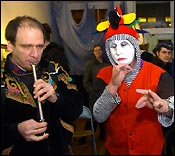
Three years ago I told the story about how I earned Slone's ire, and expressed my dismay that I haven't been lampooned by a better cartoonist. I'm not sure what the "dot comedy" sign has to do with anything, or why I'm portrayed doing stand-up comedy. I'm also not sure why he has pictured me with a mangled hand since this was a year before I ever performed Arlecchino Am Ravenous but then again, maybe I ought credit him with the inspiration. When I brought the cartoon's faults to his attention, Slone complained that it was not his skills, but a lack of a better photo reference.
So that you may judge for yourself these are the two images I believe Slone to have used: one a photograph of Ben Beckwith and myself that appeared in a 2004 article in the The Boston Globe:
 And another photograph that was used for a poster for a 2002 performance at Club Passim:
 If only I had better enemies.
Tuesday, January 19, 2010
Arlecchino Meets Shylock
About two years ago, right about the time that I was improvising on the lazzo of la Fame dello Zanni ("The Starving Zanni"), a process that eventually resulted in Arlecchino Am Ravenous, I was also reading Shakespeare's The Merchant of Venice. As a consequence of this chance juxtaposition, the two have become bound up in my imagination.
The Merchant of Venice's reputation as an anti-Semitic text that relies on anti-Semitic stereotypes and has often been used to deliberately stir up anti-Semitic passions is well known. There are also numerous efforts to acknowledge this history and even find means to create a more complex reading that redeems the play in the eyes of our more modern, liberal sensibilities on ethnic and religious pluralism. After all, it's Shakespeare whom many argue to be the single greatest contributor to English language literature and drama.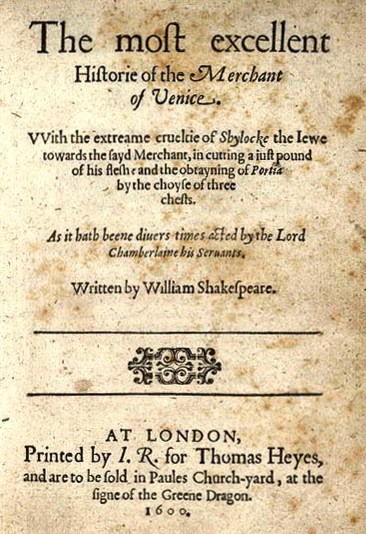 Some cite the following passage from Act III, Scene 1 as evidence that Shakespeare was actually philo-Semitic:
Hath not a Jew eyes? hath not a Jew hands, organs, dimensions, senses, affections, passions? fed with the same food, hurt with the same weapons, subject to the same diseases, healed by the same means, warmed and cooled by the same winter and summer, as a Christian is? If you prick us, do we not bleed? if you tickle us, do we not laugh? if you poison us, do we not die?Often it is quoted in isolation, where it can serve as a powerful statement against antisemitism; that the Jew and the Christian are equally human. Yet the speech continues:
and if you wrong us, shall we not revenge? If we are like you in the rest, we will resemble you in that. If a Jew wrong a Christian, what is his humility? Revenge! If a Christian wrong a Jew, what should his sufferance be by Christian example? Why, revenge! The villainy you teach me I will execute, and it shall go hard but I will better the instruction.The point of the passage was simply to state Shylock's motivation for vengeance after the heroes have lured him away from his house on business, robbed his home, and absconded with and converted his daughter and only heir (thus cutting off all connections with family and tribe) on top of all the indignities of bigotry that he and his community had suffered. Furthermore, Shylock is not treated as fully human until after he has been forcibly converted at the conclusion of the trial in Act IV. Though many commentators have noted that the Christian characters are portrayed as having many of the same vices as Shylock, he cannot receive mercy either before the court or in the divine sense, until he has left Judaism behind and become a Christian. While Shylock is a far more humanized portrayal of a Jewish character than his predecessors in English theatre (Marlowe's The Jew of Malta is so absurdly over-the-top that it was hard for me to be pained by Barabas' villainy) the anti-Semitic logic of the The Merchant of Venice remains: Only the Christian characters are blessed with the grace to be forgiven their vices; only they are fully human. The indignities they visit upon Shylock does not damn them, and in fact, they are oft times portrayed in a positive light because they are Christians. Indeed, the revenge speech indicts Shylock as engaging in hubris simply because he is not made fully human to Shakespeare's contemporary audiences until the end of Act IV when he submits to conversion under threat of death. (Yes, there is a complex set of ironies and contradictions contained within the play, but the anti-Jewish logic remains intact.)
What does this have to do with my portrayal of Arlecchino, the stock character of the commedia dell'arte?
In the full-length version of Arlecchino Am Ravenous (not the abridged ten minute version performed at the PuppetSlam this past weekend) Arlecchino visits both Heaven and Hell in his quest for food. I make no excuses, Arlecchino Am Ravenous is a work of comedic blasphemy and violence. Arlecchino is, unlike Dante Alighieri, an illiterate vulgarian incapable of grasping his journeys into Paradiso and Inferno except in terms of his hungers, lusts, frustrations, and the barely understood parables he's learned from his encounters with clergymen.
As I read The Merchant of Venice two connections struck me. The first was that the Gobbos, father and son, are of the same zanni archetype as Arlecchino. The second was that one epithet slung at Shylock with great frequency is "devil": Sometimes Shylock is said to be like a devil, and sometimes he is explicitly said to be the Devil (and young Launcelot Gobbo has a rather notable comic monologue in which he does just this.) It seemed quite reasonable to me to assume that once Arlecchino, being like the Gobbos, finally meets "Signor Diavolo Lucifero dell'Inferno" that he would say:
Who the diavolo you think you are?Once before, at a performance at the Gulu-Gulu Café in Salem, Massachusetts, I self-censored this brief passage. While at Blood for a Turnip, I engaged in no such act of censorship. (The entire journey to Heaven and Hell were left out when I performed at the PuppetSlam the following night, but those cuts were more because of time more than content.)
[Smiles in recognition, and bows.]
Oh! Buon Giorno! Signor Diavolo Lucifero dell’Inferno! Everyone say you look like Shylock, but no…
[To audience:]
…Shylock more handsome…
[Back to Lucifer. Mimes putting arm over Lucifer’s shoulder.]
…Signor Diavolo no look like Jew! More like goat.
Obviously, though some of Arlecchino's blasphemy may have shocked some in the audience, it was this brief passage that clearly made some in the audience uncomfortable (as well they should.) My own intent was to portray Arlecchino as being a product of the prejudices of his milieu: 16th century Italy while at the same time giving him the insight that despite what the Venetians of his era say: The Devil doesn't look Jewish, thus the Devil is not a Jew.
But is this what my audience gets from my performance of my play? Is this too much to ask the audience to ponder my meaning in the middle of a half-hour of physical comedy in a monologue conveyed largely in a made-up dialect?
Of course, there is also the question: can I be more clear with my intentions without breaking character?
I do not get a free pass on criticism because I am a Jewish theatre artist, nor do I get a free pass on this because I have taken other theatre artists to task when I have perceived anti-Semitic content (such as Peter Schumann's trivialization of the Holocaust, or Stephen Adly Guirgis' invocation of the deicide charge in Last Days of Judas Iscariot.) I don't get a free pass because Total War is about the historical legacy of antisemitism: While a full accounting would include these; I would still be accountable.
Likewise, to those who might find Arlecchino Am Ravenous' blasphemy disturbing, does my more serious treatment of religion in Total War absolve me? (Probably not.)
Or then again, am I just writing an essay in response to having told a joke in poor taste?
facsimile of the title page of the First Quarto edition of The Merchant of Venice courtesy of Wikimedia Commons.
Monday, January 18, 2010
The PuppetSlam Mini-Tour, Part II: Brookline
After the late night drive back to Boston from Providence with Little's Creatures' Jon and Hakim, a shower, some sleep (I had been up just over 20 hours straight), breakfast and lunch, I had to get to work on cutting Arlecchino Am Ravenous into Arlecchino Am Abridged since the 32 minute one man play I performed at Blood From a Turnip on Friday night was not going to fit into the alloted ten minute slot at the PuppetSlam on Saturday night. Essentially, I had to sit down, go over the script and cut anything that wasn't absolutely necessary for telling a story with a coherent narrative. Very quickly, I realized that meant cutting Arlecchino's prayers for food as well as his trips to heaven and hell. The blasphemous theophany was gone, and while I managed to keep a few routines that of my own invention, I had felt that it had the journey was what made Arlecchino stand apart from the material that had inspired it: the traditional lazzo of La Fame dello Zanni ("The Starving Zanni") that I had first encountered by way of Dario Fo.
Nonetheless, because of the need to fit within time constraints forced me hew closer to tradition was, still informed by my own personal interpretation of that tradition, it was a great lesson in flexibility.
As Puppet Showplace primarily serves family audiences, most of their shows are matinées and this gave us a much longer period between load-in and show time. In fact, as I arrived, just a little before 4pm, a number of families were already exiting. This allowed me to catch some of a Q&A that Heidi Rugg (of Barefoot Puppets) was giving to an audience of young people who were interested in how she created a puppet show, from writing, to puppet and stage design. She would perform a piece in the Slam later that evening entitled "Alas, Poor Yorick" which was a puppeteer's reflections on mortality knowing that her puppets may outlive her.
The earlier load-in time gave us time for a tech-rehearsal and a more relaxed preparation for the show. Jonathan, who was hosting the evening, tested out some jokes with us as we ate sandwiches.
The show was dedicated to Kathleen Conroy Mukwashi, the out-going Artistic Director. She had essentially recruited me for the evening's show and she's a great puppeteer in her own right.
I got some very favorable feedback both during intermission and after the show, including from people with intimate familiarity with the commedia idiom, but the next day I would be attending kathak class where I knew I would be experiencing a healthy level of humility.
Notes:
With the exception of Baby Oil, all the performers from the previous night's show at Blood From a Turnip performed at the Slam.
Kyle MacKesey performed his first ever puppet show!
Diane Kordas performed broad political satire with a shadow puppet retelling of Chicken Little. Her husband, Bob, provided accompaniment on banjo.
Paul Sedgwick (no relation to Jim) presented an excerpt from his full length play The Banjo Lesson. The segment told the story of the banjo's origins in the Jola akonting.


