Showing posts with label Gobbo. Show all posts

Saturday, June 12, 2010

Launcelot Gobbo, Old Gobbo and Les Gobbi, Part 2

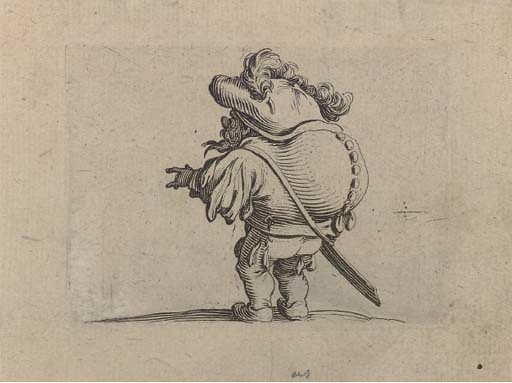
After discovering that Jacques Callot had illustrated a series of sketches of a troupe of dwarf actors and musicians known as Les Gobbi I naturally wondered "what connection might exist between this troupe and the characters of Old Gobbo and Launcelot Gobbo from The Merchant of Venice?" Though the possible connection certainly supports directors and dramaturgs to making some unconventional casting decisions, I confess that my speculation was not vigorously supported by the evidence, as Callot clearly made the illustrations long after the publication of The Merchant of Venice and I had no evidence as to how long the troupe had existed or if an earlier version of the troupe could have been known in England.

However, the Victoria and Albert Museum has in its collection a set of porcelain figures based on Callot's illustrations of Les Gobbi, and their website stated that these "grotesque dwarf entertainers" performed at the Medici court.

I checked the index of Pierre Louis Duchartre's classic work on the history of the commedia dell'arte, The Italian Comedy and found no reference to Les Gobbi, though other troupes of the era are mentioned. Of course Duchartre has some bizarre discomfort with the more vulgar elements of the commedia dell'arte, and might have been tempted to disregard a troupe who could be described as "grotesque" no matter how popular, even if, as the illustrations indicate, at least some of them were masked actors.

John Russell Brown, in his introduction to the Arden edition of The Merchant of Venice also notes that:

John Florio's Italian dictionary, A World of Words (1598), gave "Gobbo, crook-backt. Also a kind of faulkon."
Though A World of Words was likely published after Shakespeare had composed and produced The Merchant of Venice there is some indication that even in England of the 1590s that "gobbo" was used as a term of derision for those with hunched or crooked backs, at least amongst those who had some passing familiarity with Italian. I know Shakespeare well enough to know that he did not shy away from vulgarity, or anything that our 21st century liberal ears would find too cruel to utter in polite society-- and certainly some of Callot's Gobbi are "crook-backt." Of course, there is also some possibility that Shakespeare and Florio were acquaintances and shared a fondness for insults.

Brown also offers the countering hypothesis that since the first quarto often renders "Gobbo" as "Iobbe" (spelling was not standardized back in 1600) that perhaps Shakespeare intended to provide an Italianized form of the Biblical Job. To me, this is doubtful, as the strongest Biblical allusion related to the Gobbi is that of Isaac and Jacob both in terms of Launcelot's tricking his blind father, as Jacob tricked his blind father, and Launcelot's prolific nature which is a somewhat comic parallel to Jacob's own fathering of the Twelve Tribes of Israel (and let us not forget the pun in the younger Gobbo's name: "Lance-a-lot.") If anything, the rendering as "Iobbe" should be taken less as a literary allusion than a hint for how the name should be pronounced on stage.

Knowing Shakespeare, and knowing that The Merchant of Venice was seen by his company and his audiences as a comedy, I'm more inclined to buy the idea that Shakespeare meant Launcelot Gobbo to be understood as "promiscuous crook-backed fellow" and not as some non-existent allusion to Job, the most tragic book in Jewish scripture.

Still, I have no evidence supporting the Callot connection, but given the utter silliness of Brown's Job hypothesis I am amazed I've not come across anyone else making a connection between Les Gobbi of Shakespeare and Callot.

Saturday, May 29, 2010

Launcelot Gobbo, Old Gobbo and Les Gobbi

In a recent conversation with my friend Cherie Konyha Greene about her trip through Italy to research a historical novel, we found ourselves asking "where did Shakespeare get the name for Launcelot Gobbo?" Cherie had found references to "Il Gobbo di Rialto" a statue of a hunched figure in front of the Church of San Giacomo di Rialto: The statue served as a podium for official proclamations and also had a role in the punishment of misdemeanours in that the guilty party would run naked through a gauntlet in the Rialto until kissing the statue. The wikipedia article makes some note that the statue may have inspired Launcelot Gobbo and Old Gobbo from the Merchant of Venice but does not suggest a rationale for drawing the connection, beyond the name "Gobbo" and the city of Venice.

When I did my own looking about I discovered that "Gobbo" is both a surname as well as a vernacular term for "hunchback." This was more promising as there is a long association with physical deformities and comedy. The Gobbi are, after all, the clown characters in the play.

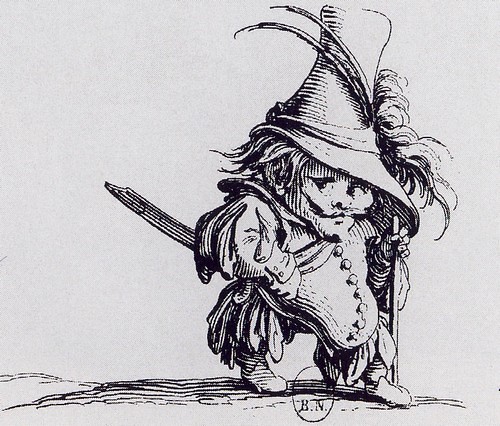
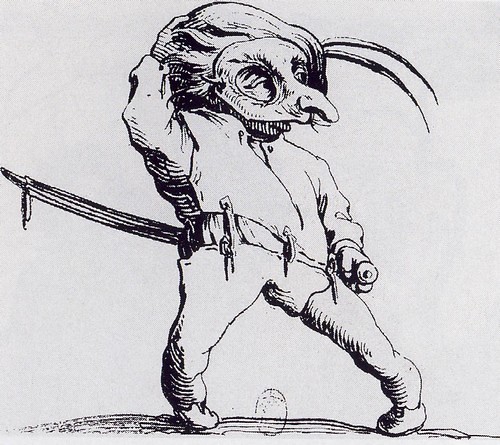
Then came my most promising discovery: Jacques Callot (c. 1592–1635) was a print-maker from Nancy, who worked in the Medici court in Florence. He is of special interest to commedia dell'arte artists, scholars, and enthusiasts, because he created a dynamic series of prints of commedia actors that continue to be used as reference points for the masks, costumes, and physicality of the characters. He also created a series of prints entitled Les Gobbi:

This first character, by all appearances, has the physical proportions we now associate with dwarfism. Some might attribute these proportions to some sort of grotesque caricature, but if one looks closely at the face, it is apparent that this violin playing Gobbo is wearing a mask: there are eye holes and the edge of the mask is clearly demarcated.

From "Les Gobbi" by Jacques Callot (1592–1635)
This one, playing a flute, does appear to be hunchbacked, but is also wearing a mask, (note again the eye-holes and the edge.)

From "Les Gobbi" by Jacques Callot (1592–1635)Here we have another with a hunchback, but he is flamboyantly dressed and carries a sword. Probably not a soldier, but quite likely an actor.

From "Les Gobbi" by Jacques Callot (1592–1635)Again, flamboyant dress and a sword. Which again makes me think that this Gobbo is an actor.

From "Les Gobbi" by Jacques Callot (1592–1635)This one is certainly a comedian. Note the mask, the comic stance, the clothes barely holding together, a sword longer than the wielder is tall, a comically visible erection and "package," and a phallic nose, and we have either Il Capitano, or a zanni recently conscripted into an army.

Obviously, this is just preliminary research. Was Callot drawing inspiration from an actual troupe of dwarf actors and musicians known as Les Gobbi? Or are these simply figures from his imagination? Callot was a child when Shakespeare composed The Merchant of Venice (believed to have been written sometime between 1596 and 1598; first quarto published in 1600), could the Gobbi that Callot illustrated have been the second generation of a troupe from which Shakespeare took the name "Gobbo"? After all, the commedia troupes were often family businesses, and some of them did travel to England.

Not only does this tie in to my not-very-controversial intuition that links Shakespeare's Gobbi with the zanni of the Italian comedy (in particular, Arlecchino) but if any of the answers to the above questions are "yes" then there's a strong argument to specifically cast dwarf actors in the roles of Launcelot and Old Gobbo.

N.B.: I've posted an imaginatively titled follow-up: Launcelot Gobbo, Old Gobbo and Les Gobbi, Part 2.

Tuesday, January 19, 2010

Arlecchino Meets Shylock

About two years ago, right about the time that I was improvising on the lazzo of la Fame dello Zanni ("The Starving Zanni"), a process that eventually resulted in Arlecchino Am Ravenous, I was also reading Shakespeare's The Merchant of Venice. As a consequence of this chance juxtaposition, the two have become bound up in my imagination.

The Merchant of Venice's reputation as an anti-Semitic text that relies on anti-Semitic stereotypes and has often been used to deliberately stir up anti-Semitic passions is well known. There are also numerous efforts to acknowledge this history and even find means to create a more complex reading that redeems the play in the eyes of our more modern, liberal sensibilities on ethnic and religious pluralism. After all, it's Shakespeare whom many argue to be the single greatest contributor to English language literature and drama.

Some cite the following passage from Act III, Scene 1 as evidence that Shakespeare was actually philo-Semitic:

Hath not a Jew eyes? hath not a Jew hands, organs, dimensions, senses, affections, passions? fed with the same food, hurt with the same weapons, subject to the same diseases, healed by the same means, warmed and cooled by the same winter and summer, as a Christian is? If you prick us, do we not bleed? if you tickle us, do we not laugh? if you poison us, do we not die?
Often it is quoted in isolation, where it can serve as a powerful statement against antisemitism; that the Jew and the Christian are equally human. Yet the speech continues:
and if you wrong us, shall we not revenge? If we are like you in the rest, we will resemble you in that. If a Jew wrong a Christian, what is his humility? Revenge! If a Christian wrong a Jew, what should his sufferance be by Christian example? Why, revenge! The villainy you teach me I will execute, and it shall go hard but I will better the instruction.
The point of the passage was simply to state Shylock's motivation for vengeance after the heroes have lured him away from his house on business, robbed his home, and absconded with and converted his daughter and only heir (thus cutting off all connections with family and tribe) on top of all the indignities of bigotry that he and his community had suffered. Furthermore, Shylock is not treated as fully human until after he has been forcibly converted at the conclusion of the trial in Act IV. Though many commentators have noted that the Christian characters are portrayed as having many of the same vices as Shylock, he cannot receive mercy either before the court or in the divine sense, until he has left Judaism behind and become a Christian. While Shylock is a far more humanized portrayal of a Jewish character than his predecessors in English theatre (Marlowe's The Jew of Malta is so absurdly over-the-top that it was hard for me to be pained by Barabas' villainy) the anti-Semitic logic of the The Merchant of Venice remains: Only the Christian characters are blessed with the grace to be forgiven their vices; only they are fully human. The indignities they visit upon Shylock does not damn them, and in fact, they are oft times portrayed in a positive light because they are Christians. Indeed, the revenge speech indicts Shylock as engaging in hubris simply because he is not made fully human to Shakespeare's contemporary audiences until the end of Act IV when he submits to conversion under threat of death. (Yes, there is a complex set of ironies and contradictions contained within the play, but the anti-Jewish logic remains intact.)

What does this have to do with my portrayal of Arlecchino, the stock character of the commedia dell'arte?

In the full-length version of Arlecchino Am Ravenous (not the abridged ten minute version performed at the PuppetSlam this past weekend) Arlecchino visits both Heaven and Hell in his quest for food. I make no excuses, Arlecchino Am Ravenous is a work of comedic blasphemy and violence. Arlecchino is, unlike Dante Alighieri, an illiterate vulgarian incapable of grasping his journeys into Paradiso and Inferno except in terms of his hungers, lusts, frustrations, and the barely understood parables he's learned from his encounters with clergymen.

As I read The Merchant of Venice two connections struck me. The first was that the Gobbos, father and son, are of the same zanni archetype as Arlecchino. The second was that one epithet slung at Shylock with great frequency is "devil": Sometimes Shylock is said to be like a devil, and sometimes he is explicitly said to be the Devil (and young Launcelot Gobbo has a rather notable comic monologue in which he does just this.) It seemed quite reasonable to me to assume that once Arlecchino, being like the Gobbos, finally meets "Signor Diavolo Lucifero dell'Inferno" that he would say:
Who the diavolo you think you are?

[Smiles in recognition, and bows.]

Oh! Buon Giorno! Signor Diavolo Lucifero dell’Inferno! Everyone say you look like Shylock, but no…

[To audience:]

…Shylock more handsome…

[Back to Lucifer. Mimes putting arm over Lucifer’s shoulder.]

…Signor Diavolo no look like Jew! More like goat.
Once before, at a performance at the Gulu-Gulu Café in Salem, Massachusetts, I self-censored this brief passage. While at Blood for a Turnip, I engaged in no such act of censorship. (The entire journey to Heaven and Hell were left out when I performed at the PuppetSlam the following night, but those cuts were more because of time more than content.)

Obviously, though some of Arlecchino's blasphemy may have shocked some in the audience, it was this brief passage that clearly made some in the audience uncomfortable (as well they should.) My own intent was to portray Arlecchino as being a product of the prejudices of his milieu: 16th century Italy while at the same time giving him the insight that despite what the Venetians of his era say: The Devil doesn't look Jewish, thus the Devil is not a Jew.

But is this what my audience gets from my performance of my play? Is this too much to ask the audience to ponder my meaning in the middle of a half-hour of physical comedy in a monologue conveyed largely in a made-up dialect?

Of course, there is also the question: can I be more clear with my intentions without breaking character?

I do not get a free pass on criticism because I am a Jewish theatre artist, nor do I get a free pass on this because I have taken other theatre artists to task when I have perceived anti-Semitic content (such as Peter Schumann's trivialization of the Holocaust, or Stephen Adly Guirgis' invocation of the deicide charge in Last Days of Judas Iscariot.) I don't get a free pass because Total War is about the historical legacy of antisemitism: While a full accounting would include these; I would still be accountable.

Likewise, to those who might find Arlecchino Am Ravenous' blasphemy disturbing, does my more serious treatment of religion in Total War absolve me? (Probably not.)

Or then again, am I just writing an essay in response to having told a joke in poor taste?

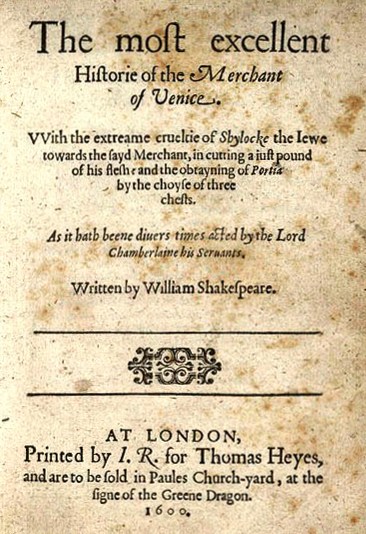
facsimile of the title page of the First Quarto edition of The Merchant of Venice courtesy of Wikimedia Commons.