A couple of weeks ago, I went up to Gloucester to teach a mime workshop for the local high school's drama club. They were rehearsing Jonathan Rand's play Check, Please. I was unfamiliar with the play but have since discovered that it is one of the most popular contemporary plays performed by high school theatre troupes in the United States. The play included mime-character in one of the scenes who engages in a number of the cliché moves often associated with mime, such as "being trapped in an invisible box" and "pulling on a rope." However, the company, which is very much guided by the students' interests, also wanted some grounding in basic mime technique for the sake of developing some choreographed stage business.
Arriving at the Gloucester train station at about 11:20, I did what I always do when my artistic career takes me to another town, which is to play tourist. I had last been to Gloucester the summer before to perform at the now defunct Fishtown Artspace and so knew my way around.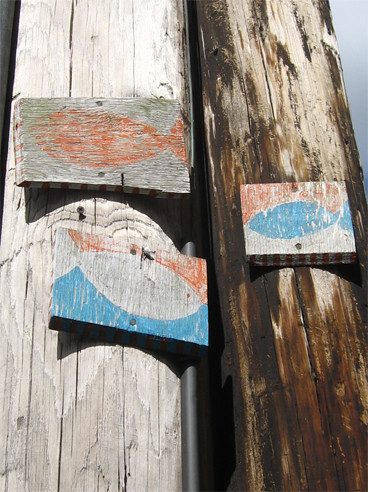
Artifacts of a counter culture: Signs on telephone poles marking outside the original location of the now defunct Fishtown Artspace.
Ever a bibliophile, I took advantage of the sale on used books at Mystery Train Records, and came out with perhaps as many theatre books as I wanted to lug around that day at a cost that I would normally expect to pay for a single book at a used store in Boston, Cambridge or Somerville. A walk on the beach was particularly interesting when I noticed that due to the low tide, the wet sand would sink two or three inches under my boot-steps.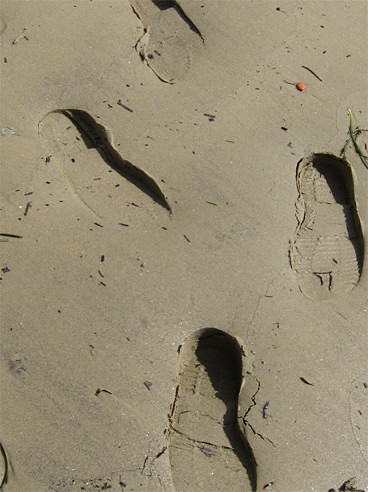
After my lunch, I strolled maybe a mile-and-a-half and arrived at the school shortly before the dismissal bell and squared away the business issues with the drama teacher before being led to the auditorium where the drama club was beginning to gather. I took off my shoes, introduced myself, and briefly explained my view of mime's relationship to everyday body language as poetry's relationship to everyday verbal language-- reciting Shakespeare's 28th sonnet as an example. I then invited the student actors onto the proscenium stage.
The student techies and production staff alternated between attending to their own business and observing as I introduced the actors to the corporeal mime scale, in all three dimensions (lateral, depth, and rotation.) Mime is a difficult form to learn, and even a two-hour workshop is only sufficient to give the most skeletal of introductions, but the students were enthusiastic and willing to learn. They also had the advantage of being a bit older than my students at Open Air Circus, and so have more developed nervous systems and were better able to imitate my isolation work, as well as articulate their interpretations of the meaning of some of the isolations and sequences (the way a lateral translation of the head might represent listening, while a forward translation of the head is more representative of looking.)
After our isolation exercises, I was ready to teach them their first illusion: "the wall." The methodology I have developed is to have the students place their hands on a genuine wall, so that they can experience the flatness and verticality of the wall's plane, and then experience each isolation (including relevés and pliés) of the body with their hands fixed on the wall, asking them to make observations about the focus of their eyes and the compensations they need to make in order to keep their hands fixed to the wall. I also asked them to observe how their hand automatically relaxes when pulled away from the wall. I noted that as with Aristotle's note that the "soul (psuche) is analogous to the hand; for as the hand is a tool of tools, so thought is the form of forms" (On The Soul, III 8 432a1) the hand in it's ability to grasp forms" that in mime theatre, the hand is analogous to the mind, in that it takes the form of the character's thoughts. I then had them experience taking steps along the wall so they could feel just how far they could go before needing to release their grasp of the wall. After several minutes of these experiments, meant to demonstrate that a mime's craft relies heavily on naturalistic observation, I invited them back to the stage, both to demonstrate that with this new found knowledge of walls and an ability to move the whole body in an articulate matter, one sells the reality of the imaginary wall far more than one would with a simple hand gesture, and gave them several minutes to experiment on their own, as I walked amongst them making minor corrections.
Being inquisitive students, they asked me questions in between exercises:
Q: What is the relationship between mime and European clown traditions?
A: In the European context, mime and clown are close cousins, with a common ancestor in commedia dell'arte.
Q: Is there a rule that mimes have to perform silently?
A: No. Many perform silently in observance of mime's independent standing as an art form much as painting and sculpture are independent of one another, but there is no reason why one cannot speak and mime simultaneously. I performed some of my first mime pieces with poetic recitation.
Q: Do mimes always perform with white makeup?
A: No. If a mime chooses to wear makeup, it can be any color, or alternately, the mime can perform without makeup, or with masks. All such things are acceptable.
All this allowed for digressions on the history of mime, allowing me to discuss Charlie Chaplin, Étienne Decroux, Jean Louis-Barrault and Marcel Marceau.
Our next set of exercises were in rope pulling (both horizontally and vertically) and a tug 'o war exercise (a favorite with younger kids, who seem to find walls too abstract) to emphasize ensemble work, as well as to demonstrate the principles of oppositional and sequential movement. After a brief break (due to the techies noting that I had kept the actors working for an hour and a half straight through) explored the extremes of rhythmic dynamics: shock, fondue, and immobility and spent the last few minutes creating tableaux with some of the skills we covered over the previous two hours.
Monday, October 22, 2007
Mime Workshop in Gloucester


Sunday, September 23, 2007
Marcel Marceau, 1923-2007

This morning I received word that one of world's great theatrical artists, and a personal hero of mine, Marcel Marceau, had died at the age of 84. In memory I am reposting a blog entry I wrote some three years ago shortly after I saw him for what would be the first and only time outside his film and television appearances. Marceau was a giant in the field of mime, so much so, that anyone working in the form had to define their work in relation to him. The following entry is slightly modified from its previous appearance.
Meeting Marcel Marceau
Friday, September 17th 2004:
Earlier this year I had the time to participate in a mime workshop given at MIT as part of their January session. It was mostly for newbies, but I learned a few new illusions, offered some fruits of my own knowledge and experience, and had some fun. I stayed in touch with a number of the participants and so when the opportunity came to go as a group to see Marcel Marceau and La Nouvelle Compagnie de Mimodrame at the American Repertory Theatre, I joined them again.
I had never seen Marceau live before this. I had seen brief film clips of performances and many photographs-- mostly from Ben Martin's Marcel Marceau: Master of Mime taken from the late 1960s and early 1970s. These had allowed me to study his form very intently-- even the photographs allowed me to closely observe his immobilities, isolations, and use of fixed points.
After what sounded like a heavy wooden staff being banged upon the stage from behind the curtain, the curtain rose to one of Marceau's students in a fanciful costume and a banner announcing the first act: "The Creation of the World." The lights lowered and she disappeared. When the lights rose again, the 81 year old Marceau was in plié, his hands crossed, his mouth held open like a mask from ancient Greek drama, frozen and eternal like the face of God as his hands enacted the seven days of creation as described in chapter one of Genesis. Then he told the tale of Adam, Eve, the Serpent and their expulsion from Eden in the second chapter. I had seen parts of it reinterpreted by Axel Jodorowsky in Alejandro Jodorowsky's film Santa Sangre (both Jodorowskys had worked with Marceau.) Seated in the second row, I could see every subtlety of Marceau's technique. I could also see that his movements, while graceful and controlled were also that of an old man. However, his age gave this piece even more power. I had seen a similar intense focus and power in the movements of an aged body when working with Bill Barnum, only two years Marceau's junior, the seeming contradiction seemed fitting.
Marceau performed nearly an hour's worth of solo material with just short breaks as the members of his company unfurled banners announcing each piece. The Bip pieces were, of course, very influenced by Charlie Chaplin's Tramp character-- but there is a huge different between a mime on film, interacting with props, a set, and other actors and a mime on stage who creates the illusion of all these things.
After an intermission, La Nouvelle Compagnie de Mimodrame took the stage for three ensemble pieces. The first, "The Wandering Monk", is based on a Japanese ghost story, and the story telling conventions were a little obscure to me but the movements were wonderful and evoked both the corporeal work of Étienne Decroux as well as karate kata. "The Masquerade Ball" was pretty straight forward plot-wise and contained some balletic and acrobatic moments, but my favorite was "The Tiger" which was based on a Chinese tale-- it has comic and dramatic elements represented in mime and Chinese martial arts-- perhaps less corporeal in the sense of Decroux-- but wonderful none the less. The evening's show ended with perhaps five curtain calls and the audience emptied out.
Thanks to one of my MIMEtype friends (what else would mime troupe at the Massachusetts Institute of Technology call itself?) we had arrangements to meet Marceau after the show. Since there were too many of us to visit his dressing room so we were reseated in the first two rows of the theater as Marceau emerged from behind the curtain, still dressed as Bip. After thanking us, he told us how glad he was that we saw the Compagnie, as he wished people to know that the world of mime is something far more than white face, Marcel Marceau, and Bip. He spoke of his debt to his "Master", Étienne Decroux, as well as to his own gifts. He then outlined the eclectic training of his students at his school in mime, acting, dance, and fencing. After taking another bow, he returned to the dressing room. We slipped to one of the side lobbies to talk about the show we just saw, the technique, etc. After an hour or so, Marceau emerged, dressed in tweed and argyle, his once dark curly hair turned blond with age (I had noticed that he was wearing a stylized wig, meant to affect the locks of his younger years.) Though he asked that we take no photographs he was happy to spend a few minutes with us, shaking hands with us one by one, as he asked us our names and signed our programs or anything else we had with us-- always with a short note-- sometimes asking for the spelling. When he reached me, I pulled out my copy of the Ben Martin book. Marceau smiled and flipped through it, asking if it is still in print. I told him that I didn't know as I had found mine at a used bookstore-- I have built up a small library on mime by scouring the used stores. I mentioned that my teachers had been students of Decroux as well. He smiled again, asked me my name and signed with a little illustration of a flower on the title page:
to Ian
in Heartful
remembrance
yours,
Bip
Marcel
Marceau
2004


