Total War, a semi-finalist in the 2009 Dorothy Silver Playwriting Competition, is a five-act play set at a Catholic university where the student newspaper has published a Holocaust denial advertisement. Before faculty, students, and staff can begin the expected dialogue on free speech and religious pluralism, an anarchist-cell using the nom de guerre of “Total War” begins a campaign of guerrilla art attacks.
This will be the third draft of Total War to be presented at Cambridge’s Outpost 186. The first reading, in April of last year inspired a lone protester to picket the reading from the sidewalk.
The reading will feature the talents of local actors, including: Trudi Goodman, Kate Heffernan, Dan Schneider, Savanah Shaughnessy, Tom Sprague, Kendall Stewart and Matthew Zahnzinger. Anika M. Colvin-Hannibal will stage manage. Three more cast members are to be announced shortly.
Though a work of fiction, Total War was inspired by events I witnessed while attending graduate school. The play explores the history (and potential futures) of Jewish-Catholic relations, historical memory, and the conflict between grass-roots activism and institutional power. It is a story made timely after the recent scandal regarding Vatican’s recent lifting of the excommunication against the anti-Semitic Society of Saint Pius X and its Holocaust-denying Bishop, Richard Williamson.
Facebook users can RSVP here
View Larger Map
Thursday, March 18, 2010
March 28th: A Staged Reading of Total War @ Outpost 186


Saturday, March 6, 2010
Call for Actors: Staged Read of "Total War": March 28
Having taken a harsher view than much of the audience of the draft presented at the last staged reading of Total War, I did yet another rewrite. The new draft runs three pages shorter: Much of the craft of playwriting seems to be learning out to strip away the unessential. Most of the cast has elected to reprise their roles but three roles will be recast.
As this is simply a reading of a work in progress in front of a small audience, there will be no blocking. My concern is not so much the look or age of of the actors but their interest in the story and enthusiasm and insights into the characters. I will be available to answer any questions actors have about the characters prior to the reading. I will schedule read-throughs with any actors not comfortable with a cold reading.
To quote the press release:
Total War is a five-act play that addresses the legacy of anti-Semitism after the student newspaper at a Catholic university publishes a Holocaust denial advertisement. Before faculty, students, and staff can begin the expected dialogue on free speech and religious pluralism, an anarchist-cell using the nom de guerre of “Total War” begins a campaign of guerrilla art attacks.If you are an actor and this sounds interesting, continue reading:
Dramatis Personae:
Father Aldobrandini: (Male, early 40s to early 50s.) A priest and university professor. Sees himself as a "traditionalist." Anti-modernist in orientation and argely opposed to the innovations of Vatican II, but his opposition stops just short of becoming a schismatic.
N.B. Martin Comack has been cast as Aldobrandini.
Richard Doncaster: (Male, late 30s to 50s.) Dean of students at a Catholic university. Though a political animal, he has presented modern liberal version of in loco parentis that aims to protect the identity and traditions of the school while also recognizing the increased pluralism of recent years.
Donald Crincoli: (Male, early 20s) Undergraduate who works on the student newspaper. An impulsive and twisted comic vulgarian.
I'm sorry that my budget does not allow for a stipend for the actors, but snacks and beverages will be provided. There will be a talk back session after the reading for the actors and audience to share their observations.
Interested? Drop me a note about the role that interests you. Resumes are helpful but not necessary.
Wednesday, February 24, 2010
February 25th: World Commedia dell'Arte Day with Orfeo Group
The Italian cultural agency, Associazione SAT, has declared February 25th World Commedia dell'Arte Day so to lobby UNESCO to recognize the Commedia as a World Cultural Heritage. The Washington D.C.-based Faction of Fools has in turn joined in in organizing a day of activities outside Italy: encouraging artists, audiences, scholars, and students to celebrate the legacy of Commedia dell'Arte!
I will be joining Boston University professor, Judith Chaffee (visit her Commedia dell'Arte Website) and Orfeo Group Theatre for a presentation following Thursday night's performance of Pierre Marivaux' The Island of Slaves at Boston Center for the Arts.
Special thanks to Eric Bornstein of Behind the Mask who was originally invited to present, but due to a scheduling conflict asked me to go in his place.

Saturday, February 20, 2010
Some Clips from "Errors of Eros"
I was invited to co-host massmouth's "Errors of Eros" story slam as part of a new initiative to build connections between practitioners of different performing arts. The idea is that each event would be co-hosted by a seasoned storyteller (in this case, Laura Packer) and a guest, which this particular evening was yours truly, representing physical theatre and playwriting.
For me, the evening was a great opportunity to step out of both my usual repertoire and usual idioms. There was also some good rapport that developed between Laura and myself over the course of the show, but a lot of that was lost because only one mic was being recorded. Still, I learned a great deal, most notably to stop wearing loose fitting shirts with horizontal stripes.
And now a story about how I learnt that I was a very simple man who wants the same thing over and over again:
Find more videos like this on massmouth The Power of Story
Doria Hughes, who served as our tally counter, dubbed this clip "Ian Parses a Sentence!":
Find more videos like this on massmouth The Power of Story
And now, for the story of how I entered the performing arts:
Find more videos like this on massmouth The Power of Story
I swear: all of these errors of eros are from at least a decade ago! I'm a much better person now!
Sunday, February 7, 2010
February 14th: massmouth Story Slam: "The Errors of Eros"
Join me as I co-host the massmouth Story Slam with storyteller, Laura Packer at Ryles Jazz Club in Cambridge. The theme will be "The Errors of Eros."
What's a story slam? It's a competitive storytelling event in which ten storytellers are given five minutes a piece to tell a story based on a suggested theme. In between stories, Laura Packer and I will tell our own stories and lead improvisational games. I attended my first story slam last week, and it was certainly a great way to end my weekend.
massmouth is the network of Massachusetts storytellers.
Seems as if I am back to where I was ten years ago when I was hosting the annual "Love, Sex & Disappointment" spoken word show at the sadly defunct Bad Girrls Studios in Jamaica Plain. Still, it proves that I will do anything to thumb my nose at any perceived obligation to go on a date on Valentine's Day, but don't let me stop you from bringing your own.
Enough: I need to save some material for next week.
Doors open at 3:45pm.
Ryles Jazz Club
212 Hampshire Street
Inman Square
Cambridge, MA
Tickets are $7, $5 for students and seniors.
Facebook users can RSVP here if they like.

Sunday, January 31, 2010
Aporeia or Dialogue? Guirgis and Thal on "Last Days of Judas Iscariot"
A few days ago, through the comments section of another blog entry, I had an exchange with the playwright, Stephen Adly Guirgis. He took issue with my interpretation of his play, The Last Days of Judas Iscariot which I had written as a letter to the editor some three years ago in response to the Boston's Weekly Dig having picked the Company One production as one of their Best of 2006.
Where we disgreed is that I interpreted the play as hipster revival of the old anti-Semitic canard that places the blame for Jesus' crucifixion on the Jews. Guirgis contends that this was not his intent. I have no reason to doubt his sincerity and at this point choose to look at this as an illustration of the real hazards that Jewish-Christian dialogue can sometimes smash itself upon, even when the interlocutors' intentions are the best. Yet, despite these hazards, this dialogue needs to occur, precisely because of an often horrific shared history.
To begin, a Dig staffer added this bold faced title caption to my letter:
Every point made in a play must be countered by an opposing point consisting of exactly as many words and spoken at a comparable volume. Only that way will theatre come alive again.
Dear Dig,
I wonder by what criteria Jenna Scherer selected to include The Last Days of Judas Iscariot as part of her roundup of the year's best theatre (12.20.06). While I confess that Stephen Adly Guirgis has a gift for writing dialogue that led to excellent performances by some of Company One's better actors, Guirgis's overall sloppiness placed it close to the bottom of my list for 2006.
Numerous scenes were completely irrelevant to the courtroom drama. Lengthy monologues by characters that appear nowhere else in the story implied that Guirgis either had not finished writing the play before opening night, or that he was simply trying to give some of the actors something to do instead of sitting backstage for over an hour. The ending, to the extent there was one, demonstrated that Guirgis was unable to handle any of the cans of worms that he himself had opened.
Leaving aside the structural problems, the second half of the play repeats again and again the old anti-Semitic canard that the Jews are the ones who murdered Jesus (a central theme of the Passion plays, and Mel Gibson's film version). Pontius Pilate even makes a point that he had washed his hands of the affair, and is a saint in the Ethiopian Church. It is not wrong for a writer to create anti-Semitic characters, but to leave their statements un-countered is highly questionable.
The Last Days of Judas Iscariot also has countless moments of misogyny to which there is never any rebuttal. How does a male witness sexually harass a female defense attorney with impunity? Or a male prosecuting attorney sexually harass a female witness? Guirgis seems to like his female characters neatly classified as mothers, whores and nuns, and he appears to take pleasure in humiliating the mothers and the whores.
Guirgis does a great job writing for the mafia characters on HBO's The Sopranos, but theology is well beyond his abilities, as is anything whose form demands that the plot threads be tied up by the end of the evening. Does Jenna Scherer pay any attention to the writing?
Ian Thal
Somerville, MA
This letter, no longer available on The Dig's website, simply floated on my soon to be neglected pages on authorsden (neglected because I desired the greater flexibility of the blogger platform) and on rare occasions referenced here and there.
Eventually, some three years later, on January 28, 2010, on an unrelated blog post, I received this comment from an anonymous poster, apparently identifying himself as Stephen Adly Guirgis:
Mr. ThalTaken at face value, I had to consider Guirgis' point of view as sincere, even if that's not what I saw in his play, so after several hours, I posted this response:
I have learned that one never wins when contacting those who criticize one's work. And yet is it curious to me that my play has been performed all over the world and to my knowledge you are the only person to ever accuse me of perpetuating ant-semitic stereotypes. I don't know what you saw in Boston four years ago that compels you to keep associating me with Hate, but it saddens me because I happen to take racism/anti-semitism/hate pretty seriously. Maybe you were in the bathroom during the cross examination of Caiaphas by El-Fayoumy? Maybe you were asleep when the play pins 2000 years of hate -- not on "The Jews" -- but on the writers of the Gospels? I don't know... Clearly, you're completely entitled to dislike my play, dislike me, and say whatever you want to say. And you're not alone in criticizing the play -- some like it, some don't. I only hope that when hurling accusations of anti-semitism, that you feel you've done your due diligence to study the subject matter sufficiently so as to to feel confident in your own mind that you're correct in your assertions. You're an artist yourself so you know the deal: you put your stuff out there and people say what they're gonna say. So, I'm not complaining. My play is wildly imperfect, lots and lots of flaws. But, however you received it, I can assure you it was not written in hate. It was written, in all it's imperfection, with love. And with that, in this late night hour, I send love to you. I just wanted to say my piece. So, thanks. And best wishes to you and yours. SG
(Allow me to assume that Anonymous is exactly whom he claims to be.)Now the question is: is this an aporeia or an opening for further dialogue?
Dear Mr. Guirgis,
Thanks for writing. I much rather have a dialogue where in the end I can say "I stand corrected" than persist in some intractable feud.
Because of this, I have to accept your stated intentions at face value, and explore why I felt that quite the opposite of those intentions were communicated to me.
Keep in mind that the production I saw of Last Days of Judas Iscariot was some three-and-a-half years ago: July of 2006, to be exact, and the criticism I wrote was from a few months later after the play was picked for a "Best of 2006." I assure you that I did not nod off or leave for the bathroom during the performance.
I definitely did not get the impression that your play pinned the blame on Christian antisemitism on the Gospel writers , as neither they, nor their sectarian agenda (to make the young Jesus movement appealing to gentiles by stripping it of its Jewish context) was placed on trial.
Instead, the appeal on behalf of Judas (whom some scholars now view to be a fictitious personification of "the Jews") was largely based on finding an alternative Jewish culprit such as Caiaphas, as a representive of the Temple priesthood.
Frankly: I don't remember after all this time whether the other usual suspects of the Pharisees (that is, the Rabbis) and the crowd that chose amnesty for Barabbas were brought up.
And of course, as I mentioned, Pilate and his government are absolved simply because he says he's a Saint in the Ethiopian Church. So it turns into a situation of seeking amnesty for one Jew by finding an alternative Jewish scapegoat.
Now, had there been that meta-textual/meta-mythical turn after the intermission that brought Matthew, Mark, Luke, and John and their sectarian agendas to task (as many "left-leaning" Catholics like James Carroll do,) then much of my criticism would have been invalid. However that leap was never made, and since the motion to simply grant Judas divine forgiveness was denied, the mechanics of the play demanded that the deicide charge be pinned on someone else: either a different Jew or Jews in general. So I found that it brought everything back to the bad old days before Nostra Aetate opened up lines of interfaith dialogue.
Again, maybe you feel that you had subtly done just what I suggest, in which case, it was completely lost in Company One's production which seemed more interested in finding "the real culprit."
Saturday, January 23, 2010
American Dissident Strikes Again!
G. Tod Slone, publisher and editor of the small press literary journal, American Dissident, now has a blog and has decided to repost some of his older cartoons which mostly aimed at poets whom he thinks are complicit in whatever it is he's against.
I once criticized a cartoon of his that had been forwarded to me by Doug Holder, so as a consequence, Slone felt the need to lampoon me in this cartoon that he has reposted here along with his addendum  I'm not sure what the point of the cartoon is "Look! That Ian Thal guy is clown!" which is a pretty non-controversial claim as I freely admit to being a clown. Perhaps Slone can elaborate:
The cartoon was created because poet clowns or court jesters serve the established order by rendering poetry PG smiley-faced. And PG smiley-faced is the kind of poet to whom the established-order likes to award prizes for evident reasons. The logic is egregiously present, though perhaps not for a poet clown. You are a clown for the established-order, whereas I am a critic against the established order. (G. Tod Slone, January 22, 2010, in the comments to "Ian Thal, Poet Court Jester."
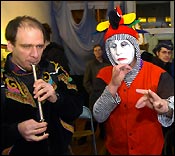
Three years ago I told the story about how I earned Slone's ire, and expressed my dismay that I haven't been lampooned by a better cartoonist. I'm not sure what the "dot comedy" sign has to do with anything, or why I'm portrayed doing stand-up comedy. I'm also not sure why he has pictured me with a mangled hand since this was a year before I ever performed Arlecchino Am Ravenous but then again, maybe I ought credit him with the inspiration. When I brought the cartoon's faults to his attention, Slone complained that it was not his skills, but a lack of a better photo reference.
So that you may judge for yourself these are the two images I believe Slone to have used: one a photograph of Ben Beckwith and myself that appeared in a 2004 article in the The Boston Globe:
 And another photograph that was used for a poster for a 2002 performance at Club Passim:
 If only I had better enemies.


