Last week, I noticed that my blog was receiving an unusual amount of traffic from various cities and towns in Vermont. I was able to quickly discern that most of this new traffic was to my account of parting company with Bread and Puppet Theater over what I regarded as a distortion of the historical record of the Warsaw Ghetto, and misrepresentation of Israeli-Palestinian conflict in Peter Schumann's Independence Paintings: Inspired by Four Stories and in the show which he was having us rehearse, The Battle of the Terrorists and the Horrorists.
I was aware that Independence Paintings was being exhibited, having read it on someone else's blog, but I was more than surprised to read Jack Thurston's article, "Art Display Draws Criticism" on the WCAX website. Rabbi Joshua Chasan of the Ohavi Zedek congregation in Burlington was taking a public stance regarding the exhibition of the painting. To quote Jack Thurston's article:
The rabbi hasn't seen the art. Neither has Channel 3. In fact, only a handful of people in Vermont have because it won't be installed on Pine Street until the end of the week. But based on reviews of when it showed in Boston, [...Chasan stated that] "Peter is a very gifted artist. I have delighted in his art over the decades. I have marched behind his puppets. I think when you make the comparison between the Holocaust and what the Israelis are doing, you've gone across the edge."
Chasan has much more to say in the article, and it is well worth reading.
I did contact Rabbi Chasan by email to thank him for making a stand. He noted that he had read my blog and had found it very helpful, though suggested I might have gone too far by psychoanalyzing Schumann. Perhaps this is a valid criticism, and I will be rereading that particular entry with that in mind. At the time, however, it seemed important for me to discern why certain facts were presented accurately, others were wildly distorted, and why yet other facts were omitted.
Schumann is quoted as making a number of statements in the article but none to which I have not analyzed and responded to previously, although I am compelled to point out one line because of its disturbing implications:
[T]he self-described pacifist sees both nations as guilty of violence, he calls Israel an occupier, even instigator.
I should point out that in neither "Independence Paintings" nor in Battle of the Terrorists and the Horrorists does he ever portray Palestinian violence (except for throwing stones at the West Bank wall) and when terrorism is even mentioned, it is to make light of the deaths it causes. If he sees both nations as guilty, should not his art represent that view?
Thursday, September 6, 2007
Independence Paintings in Burlington, Vermont


Thursday, August 30, 2007
Revising Backwards
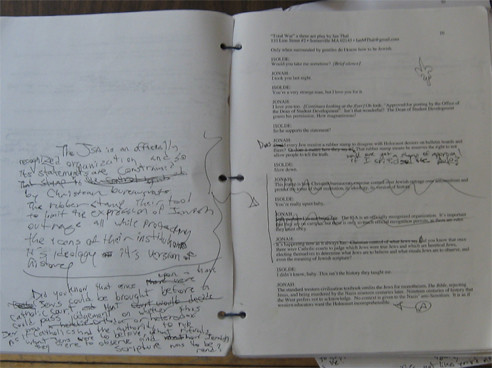
Given the downtime following my stint teaching with Open Air Circus, and the need to spend a lot of my time waiting around the apartment as I interview potential roommates, I have been sitting on the living room sofa revising the script of my play. In order to avoid the phenomenon of having a story whose beginning is well crafted but makes little sense by the end, I decided that this stage of revision will involve working page-by-page starting with the last page, working my way to the front, as I work on tightening the dialogue. Given the fact that English runs left to right, and Hebrew runs right to left, I have been referring to this as the "Jewish revision."
The next phase of the revision process will be an "English phase", working from first page to last, and will involve improving on the structure of the narrative, mostly expanding on the role of some of the supporting characters.
Working on a play on the topic of Holocaust denial, further underlines to me that my break with Bread and Puppet Theater was inevitable after Peter Schumann's "Independence Paintings: Inspired by Four Stories" trod dangerously close to Holocaust denial, and noticeably inflamed anti-Semitic sentiment. Despite that, there is one scene in the play that displays the storytelling techniques I learned during my time with Bread and Puppet. I celebrate complexity-- this is perhaps why I try to weave so many themes into a single blog: the aim is to integrate and synthesize, not compartmentalize.
On the issue of complexity: I have discovered that even as I aim to craft such a darkly themed piece, the influence of commedia dell'arte is present as well.
Saturday, August 25, 2007
Can You Identify These Puppets?
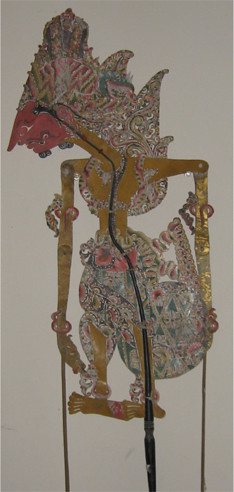
Earlier this summer, I chanced upon a garage sale only a block from home and found these two shadow puppets. After inquiring as to their price I was given an offer I could not refuse. They are part of the tradition of Wayang Kulit, the shadow puppet theatre of Indonesia. I had first seen puppets of this nature at the Smithsonian's Arthur G. Sackler Gallery of Asian Art in Washington, D.C., likely when I was on break from college. While the soon-to-be former owner was able to tell me that these puppets were of Javanese origin (as opposed to the Balinese puppets I had seen at the Sackler) he could only identify them as figures from the heroic epic, the Mahãbhãrata.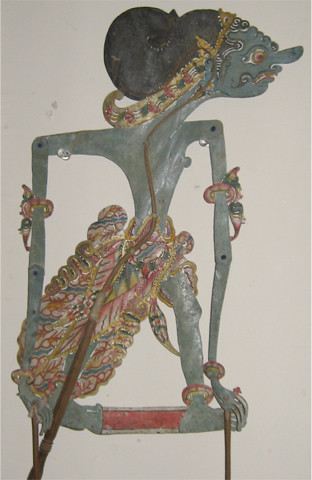
So, dear reader, can you help me identify them? It is clear that the red faced fellow is a prince or noble of some sort, and that the blue fellow is of lower status, but is he a lower-ranked prince? A servant? Perhaps one of the comical figures of Wayong known as punokawan who, from their description, seem analogous to the zanni characters I often play when I perform commedia dell'arte?
Click here for the full photo set. My apologies as they are not my best photographs.
Wednesday, August 22, 2007
Teaching Mime at Open Air Circus
In my previous post I described the commedia dell'arte class I taught this summer at Open Air Circus. In this one, I will describe the mime class. Though I do not have any photographs to share of this particular class, The Somerville Journal did post a slide show that include some photographs of my mime class in session as well as some narration that came from an interview I gave.
This was my third summer teaching mime at Open Air, and I've come to have many of the same children signing up for my class year after year.
Given the very short teaching schedule (cut short by a week due to peculiarities of the calendar and another week due to rain), I was left with very little opportunity to do more than teach the concept of isolations, Decroux' corporeal mime scale, and rhythmic dynamism and get a skit together for the final show
Isolations are an essential part of any mime technique, and even when taught systemically, they are difficult for many children to learn due to the fact that their nervous systems are just not fully developed, but into my third summer, I have a group of students who are very eager to please, and at a youth circus, being known as "the weird teacher" really isn't a problem.
The nice thing about any of the traditional repertoire of mime illusions is that they can all be used as lessons in technique, but even more so, they can be used as lessons in teamwork and working with your partner.
This year I decided to work on the rope-pulling illusion and revive "The Spaghetti Sketch" that I had created for the circus two years prior. The "Spaghetti Sketch" has two acts: The first being a tug-o-war competition, the second a spaghetti dinner between the two teams who are even more competitive at dinner than during the competition, where I play both referee and head waiter. The first night (given this year's theme of "Rock'n'Roll") we use Bill Haley's "Rock Around the Clock" for the spaghetti dinner. By the first matinée the music has changed to "Union Jack" by Big Audio Dynamite for the tug-o-war segment and an excerpt from "The Barber of Seville" for the dinner sequence. I have the kids develop their own individual spaghetti related lazzi while I improvise different bits of business each show. One that seems to work is substituting my top hat for a saucepan. The kids are particularlly excited that we've revived this piece as while a few had been in the first iteration from two years prior, many of them had seen it from the audience.
Peter Jehlen, the circus' artistic director, recruits me into incorporating my mimes students into the unicycling segment. He's chosen the music "Grease Lighting" from Grease and I borrow a couple of unicycles and build up some choreography based on various object manipulations (some of our experiments are seen in the slide show). Peter has another idea, which involves having four mimes playing air guitar to "Sergeant Pepper's Lonely Hearts Club Band" during the opening sequence of the show, so I end up spending the beginning of the show acting as a conductor-- showing my "guitarists" how to play strict 4/4.
(I discover during the finale of the last show of the weekend that as we play the "Sergeant Pepper's Lonely Heats Club Band (Reprise)" that the tatkar I have been learning in my kathak classes fits perfectly.)
Thursday, August 16, 2007
Teaching Commedia at the Open Air Circus
Click here for the full photo set
As I was preparing to teach another summer at Open Air Circus I thought back the past year's experience performing with i Sebastiani I lobbied to teach a class in commedia dell'arte as well as mime.
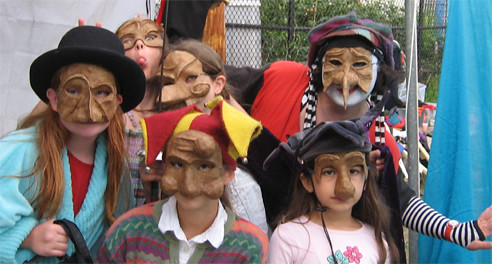
This quickly led to a problem, most of the children who gravitate to my classes have been girls, and traditionally, the masked characters of commedia have been male with actresses playing unmasked (and thus, less grotesque) female characters. I puzzled over how to give my girls the opportunity to play masks. I thought back to this past November when I saw Plunket & Tremolo, featuring Mark Jaster and Sabrina Mandell, perform commedia. In their show, Mandell took on a mask to play Smeraldina, a cook. portraying her as something of an older, craftier version of the Franchescina character we often use in i Sebastiani, I realized that there was nothing wrong with creating a mask for a female character if the mask was appropriate to the character. In addition, since we are all taught that the theatre of the English renaissance featured boy-actors playing women, there was no reason not to cast girl-actors as men. Once I solved those two problems, I was left only with the girls' willingness to play male masks.
So I began work on sculpting the masks from papier-mâché-- I was fortunate to discover that my skills had developed significantly since I last worked in that medium, and by the first day of class, I had masks for Arlecchino, Il Capitano, Il Dottore, and Pantalone. My class comprised of five girls and while I got a great deal of laughs from my depiction of Isabella as I introduced the characters, I decided, that owing to the age group, to dispense with the romance subplots. The girls all had an immediate sense of the vecchi, Dottore and Pantalone, and quickly came up with a lot of good verbal lazzi. The girls seemed to have a great deal of fun lampooning foolish men.
I went home and began work on a Franchescina mask-- reasoning that I wanted it to cover less of the face than most commedia masks and to have both the furrowed brow of a hard working zannia as well as some seemingly delicate features one would attribute to a young commedia heroine.
Over the next few weeks, I led them through exercises in projecting their voices, walking like the different characters, basic slapstick, and playing out brief character scenes in which they would all take turns playing the different masks. I encouraged them to borrow each other's jokes (including mine.) During this time, I began wondering what character I would play and if I could come up with a brief scenario that could use all of the characters and stay within the allotted time.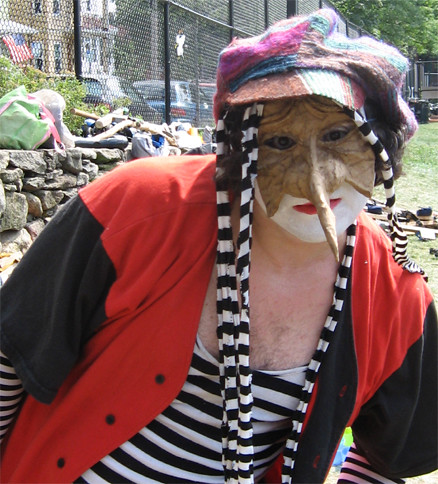
Eventually, I settled upon the character of Zanni, one of the very oldest of commedia characters-- whose name, a diminitive of "Giovanni", has become the generic label for all the servant characters as well as the origin of the word "zany". Zanni is a porter, and so, because of the relative size of the actors, Zanni could carry any of the other characters on his back. I described him as Arlecchino's uncle, and one of the girls, very intuitively corrected me with "No, Zanni is like Arlecchino's great-great-grandfather!"
I came up with the scenario during the final week of rehearsals, borrowing two elements from the scenario Michael McAfee dreamed up for the i Sebastiani anti-Masque we performed for Vision of the Twelve Goddesses: that Pantalone is staging a theatrical event in the hope of raking in the ducats and that Il Capitano wants to be the star of the show.
In this scenario, however, Pantalone is the producer for the circus. We have a series of lazzi in which Zanni is misidentified as a steed (by Pantalone as a horse, Il Dottore as an elephant, and Il Capitano as a giraffe, and Arlecchino as whatever anyone else says) and repeatedly ridden around, as Il Dottore lobbies for a more gourmet menu at the concession stand (more work for Franchescina, and more confusion for Arlecchino,) Il Dottore misdiagnosing Il Capitano as a corpse, Capitano swearing vengeance on Il Dottore and Pantalone, Franchescina standing up to Il Capitano, and Arlecchino and Franchescina riding off stage on Zanni's back.
One rather funny mistake: on the last performance, the performers playing Franchescina and Arlecchino, instead of climbing onto my back at the end, somehow both leapfrogged right over me, but there are no mistakes: incorporate it into the next show!
Now: to dream up a scenario for next year.
See more photographs on my flickr account.
Monday, August 6, 2007
Almost a Year of Kathak
Some of my readers are aware that for much of the past year, I have been studying kathak from Gretchen Hayden of the Chhandika Chhandam Institute of Kathak Dance. Kathak, for those of you who are unfamiliar, is a dance-theatre form (I have read that "dance" is a misnomer resulting from British colonists attempting to translate what they observed into their own categories) that while having ancient roots, began to take its modern form in Northern India and modern day Pakistan, under the influence of the Mughal courts where it took on influences of Persian dance.
Kathak is a classical performance art form in that it conforms to the theories and guidelines of the Natya Shastra written by the sage, Bharata Muni. There appears to be some minor disagreement amongst scholars of whether there are six, seven, or eight schools of dance-theatre that are of classical stature, and since I am not a scholar in the field and have no opinion on the matter.
I had first become aware of Indian dance in general in 2003 when I was present for an informal presentation by foreign student at Open Floor, a sort of workshop and show and tell for movement artists. I immediately saw the formalist storytelling elements, and saw a commonality between Indian dance traditions and European mime (specifically the corporeal mime I had been studying from James Van Looy) as well as the impulse to synthesize movement with poetry-- something I first saw articulated by William J. Barnum. (Cosmic Spelunker Theatre began as a trio between Barnum, Van Looy, and myself.)
I began to seek out every Indian dance concert I saw announced, first becoming aware of Bharatanatyam which developed primarily in Tamil Nadu, before seeing a student show by Chhandika and being exposed to Kathak. I attended a few shows as well as a few open workshops until last fall, when one of the more advanced students noted, "you've been attending our concerts for years and you are a performer, why don't you come study with us?" So I did.
A kathak performance involves a recitation of either a poem or of bols (a composition of syllables used as notation by Indian drummers) while engaged in complex percussive footwork while the upper body mimes the narrative. I was obviously first attracted by the mimetic and poetic elements, but it is the rhythmic footwork that forms the foundation of this dance, and percussion has never been my strong point-- so it has been a steep learning curve for me-- but I have been learning.
Sunday, August 5, 2007
Open Air Circus, August 10-12 in Somerville, MA

Come see my mime and commedia dell'arte students perfom with the Open Air Circus, Somerville's own youth circus, this coming weekend at Nunziato Field in Union Square.
This is my third year teaching mime and my first teaching commedia to the wonderfully funny bunch of kids at Open Air.
Show times are:
Friday, August 10 @ 7pm
Saturday, August 11 @ 2pm & 7pm
Sunday, August 12 @ 2pm
Tickets are $3


