Sunday, January 9, 2011

Burlington Free Press on Peter Schumann's Palestine Controversy

PicnicForJews
On Friday, Burlington Free Press staff writer, Tim Johnson interviewed me for a piece that ran in Sunday's edition, entitled Peter Schumann's Palestine Controversy. There's a brief quote from me that sums up the argument that I have been making since my 2007 essay, Breaking with Bread and Puppet:

Ian Thal, a playwright and Schumann admirer who broke with Bread and Puppet over the spring 2007 exhibit in Boston, said he saw the wall comparison as "inflammatory." To liken Israel's wall, which was intended to prevent violence, to the Warsaw wall, which was a tool of genocide, was "a deliberate misrepresentation," Thal said.
There are several statements that Schumann made to which I shall respond in greater detail in another blog entry, but I will leave you with one to ponder:
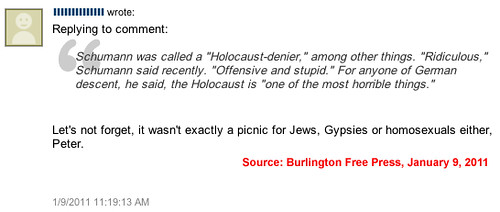
Schumann was called a "Holocaust-denier," among other things. "Ridiculous," Schumann said recently. "Offensive and stupid." For anyone of German descent, he said, the Holocaust is "one of the most horrible things."
To which one anonymous commentator responded:
Let's not forget, it wasn't exactly a picnic for Jews, Gypsies or homosexuals either, Peter.


N.B.: I have posted a follow-up with a more in-depth analysis of Schumann's statements

Analyzing Peter Schumann's Palestine Controversy in the Burlington Free Press

As mentioned previously I had been interviewed by Burlington Free Press reporter Tim Johnson as part of a sidebar article regarding the controversial 2007 exhibitions of a series of murals by Bread and Puppet founder Peter Schumann in which he juxtaposed his stylized images of the West Bank with text from John Hersey's 1950 novel The Wall which is set in the Warsaw Ghetto.

At the time I saw the murals at the Boston Center for the Arts in February of 2007, I was preparing to rehearse with Bread and Puppet for the show The Battle of the Terrorists and the Horrorists as I had done for other Boston area shows with Bread and Puppet over the previous four years. The one thematic link in "Independence Paintings" was between the wall that surrounded the Warsaw Ghetto as a German effort to segregate, confine, starve, enslave, and in 1943, exterminate European Jewery and the West Bank wall that was built with the short-term goals of preventing suicide bombers from entering Israel and eliminating the need for Israeli Defense Forces to launch counter-terrorism efforts thus providing an opportunity for greater stability in the West Bank (arguably, this has worked.) I concluded that the comparison between conditions in the Warsaw Ghetto and the West Bank, likening an act of genocide (over a two-year period 500,000 to 600,000 Jews died from forced starvation and overcrowding in Nazi-run Ghettos (roughly 10% of the deaths in Germany's "Final Solution" to "The Jewish Question") to something that, however controversial, had actually saved lives in the middIe of a protracted conflict amounted to cynical trivialization of the Holocaust in order inflame anti-Israeli sentiment, if not a form of Holocaust denial. He was coy as to what he meant but most audience members, including his supporters, seemed to to understand this as an attempt to pin a genocide charge on Israeli. In fact, his supporters used the phrases "Zionist Nazi" and "Zionist Genocide" in order to shut down any critic. I could not morally justify continuing to associate with either Bread and Puppet or Peter Schumann and so I left after one day of rehearsals. I After being verbally harangued in public over my decision to leave, I decided to recount the reasons for my departure.

I did not see the subsequent exhibition in Burlington, but I followed press accounts. (Also see part 2 • part 3 • Part 4)

In the interview with Johnson, however, Schumann said:

"It wasn't meant as a comparison. I simply quoted from a famous book."
Then why quote from that book unless one wants to make a comparison?

At this point I wish to discuss Schumann's statements on the matter in the Free Press article:
Schumann's work was regarded as offensive by some who saw it as equating policies of the Nazis and of the Israeli government. "Independence Paintings" drew that reaction earlier the same year when exhibited in Boston, where critics saw the juxtaposition of the two walls, and their respective scenes of human suffering, as an odious comparison. Schumann was called a "Holocaust-denier," among other things.

"Ridiculous," Schumann said recently. "Offensive and stupid." For anyone of German descent, he said, the Holocaust is "one of the most horrible things."
I already noted one anonymous commentator's response. Let us unpack this statement further, Schumann describes himself as being of "German descent." In actuality he was born in 1934 in Breslau, Silesia. What Schumann ellipses is that the part of Silesia in which he was born and raised was at the time part of Germany (the remainder of Silesia would be seized by Germany at the outbreak of World War II.) This meant that for the first eleven years of his life, Peter Schumann lived as a child of the Third Reich. He saw his country's territory expand and then shrink as it was defeated in WWII. The Schumann family were amongst the millions of Germans who became refugees as a consequence of, amongst other things, Allied reaction to Germany's immoral earnings off of genocide, deportations, slave labor, and seizures. In a March 1, 2006 interview in Real Change News [N.B.: Real Change News removed the article from their website, but it is available on archive.org.] Schumann stated:
I was born in Silesia, which was German. It became Polish in 1945, after the war. It was part of Germany that was given to Poland by the Yalta Conference. Ninety-nine percent of the population of Silesia was made into refugees at the end of the War and we were part of that 99 percent. We were all looking for a new life, so we live as refugees for a few years.
Indeed, I found it odd that Johnson, despite spending a few paragraphs of a feature length-article on Schumann's life before coming to America, also never mentions the Third Reich, only identifying Silesia as "a region in central Europe now part of Poland." (Note: I did mention this in my telephone interview with Johnson.)
"It's very hard in America to speak about that subject[the Israeli-Palestinian conflict]," Schumann said. "It needs to be said, but it's not being said."
Actually, it's very easy to speak about the Israeli-Palestinian conflict. There are a diversity of views on the topic, and I certainly have little problem finding such diversity. What Schumann's problem is that in America, there is a strong consensus that Israel is the Jewish homeland and that it has a right to exist within secure borders. There is also a consensus that the the desired resolution to the conflict would feature two states, Israel and Palestine, peacefully side by side. Within that consensus there is a heated debate as to how best to arrive at that desired goal and whether the involved parties are constructively working towards that desired goal, and indeed, whether that goal is reachable in the foreseeable future.

However a January 2008 interview with Schumann with Greg Cook, in the New England Journal of Aesthetic research is quite telling regarding Schumann's views on why "it's very hard in America to speak":
I think it’s awful that the Western community does not interfere with what Israel’s doing as an occupation force. The Western community does not do anything about it. They don’t even speak up against it. They don’t do anything. They basically serve as the Israeli propaganda for the events there.
Note that he shifts from arguing that the "Western community does not interfere" to arguing that the "Western community" is actively serving Israel. This is the old anti-Semitic canard of Jews or Zionists controlling multiple governments and the international media.
He said the shows often draw picketers, as have talks by other "friends of mine" -- such as Noam Chomsky or the late Howard Zinn
In our telephone interview, Johnson had mentioned to me that Schumann had complained about picketers. It is hard for me to fathom how an elder statesman of "radical" theatre would complain about being the subject of protests. My work has also been picketed. Perhaps this is a cultural difference, but growing up in a democracy where I was permitted, before attaining adulthood, to read books by Mark Twain, George Orwell, Aldous Huxley, J.D. Sallinger, Yevgeny Zamatyn, Franz Kafka, or Harlan Ellison, attend plays like Candide, view films like A Clockwork Orange, or The Great Dictator, to listen to comedians like Lenny Bruce, the idea of being picketed is a badge of honor. Perhaps for somebody who grew up in Nazi Germany (though he avoids mentioning it) where dissent could send one to a concentration camp, disagreement is to be feared, and being confronted with disagreement is threatening. I write material which is intentionally controversial, I expect criticism, and I have experienced protest. The price I pay for my freedom of expression is having to acknowledge others' freedom of expression.

It's also a badge of honor because when I look at the small handful of picketers, writers of email invective, abusive visitors to this blog's comments section, I see several consistencies: anti-intellectualism, anti-Semitic rhetoric, conspiracy theories, and ad hominem attacks. I am proud that these are the sorts of people who feel threatened by the words I write. Schumann is upset that his critics are, in his own words, "a faction of the Jewish community."

It seems quite odd that an elder statesman of "radical" theatre and his supporters are shocked that his work is viewed as controversial, to the point of his supporters routinely white-wash his biography on Wikipedia.

If Schumann can not handle being called to task for trivializing the Holocaust by either minimalizing the Nazi "Final Solution" or by making insinuations that Israel is pursuing a genocidal program; if he cannot handle the fact that Jews have the same free speech, free press, and free assembly rights as "anyone of German descent"; if his only explanation for the reason why his views are not more widely accepted are because the "western community [... serves] as the Israeli propaganda [apparatus]" then Peter Schumann is an anti-Semite.
Thursday, January 6, 2011

Mark Twain and Censoring the "N-Word"

As many are already aware NewSouth, a Montgomery, Alabama based publisher, is releasing a new edition of Mark Tawin's Huckleberry Finn in which the "n-word" has been replaced with the less racially charged term, "slave." The NewSouth edition features an introduction by Auburn University professor, Alan Gribben:

Gribben became determined to offer an alternative for grade school classrooms and "general readers" that would allow them to appreciate and enjoy all the book has to offer. "For a single word to form a barrier, it seems such an unnecessary state of affairs," he said.

Gribben has no illusions about the new edition's potential for controversy. "I'm hoping that people will welcome this new option, but I suspect that textual purists will be horrified," he said. "Already, one professor told me that he is very disappointed that I was involved in this." Indeed, Twain scholar Thomas Wortham, at UCLA, compared Gribben to Thomas Bowdler (who published expurgated versions of Shakespeare for family reading), telling PW that "a book like Professor Gribben has imagined doesn't challenge children [and their teachers] to ask, ‘Why would a child like Huck use such reprehensible language?' "
Is this really about the offensiveness of the "n-word" or is this about making white southerners less squeamish about their history? (I do not have an answer, but having grown up south of the Mason-Dixon Line, I am very familiar with the disingenuous claims some southerners make about the causes of the Civil War.)

The whole point of Twain's use of the "n-word" was to portray how racism corrupted every element of southern life: even the likable protagonist and narrator, Huck, who befriends a runaway slave, uses the word. It is integral to the novel. People should be horrified by the racism of 19th century America. Hiding its ugliness hides both how far America has come as a nation, as well as hiding the ugliness of those who wish to pull America back to its past.

How does this refusal to look squarely at the role the word had in America's racist history make sense in an era where the "n-word" is so prevalent in pop-culture?

I am not an African-American. I do not have a visceral relationship with the "n-word." My opposition to censoring it, however, is no mere exercise in academic libertarianism. I am a Jew, and I am very conscious that there there is a large body of works important works in literature, theology, philosophy, history, and drama in which some of the most libelous things are said about my people. Keeping these texts available, and teaching them in context is how we grasp just how deep-seated and widespread antisemitism really is in western civilization. For instance, no matter how often nice liberal do-gooders try to pretend that Shakespeare had liberal attitudes towards Jews, we need to confront just how many times his heroes compare Shylock to the Devil (which I have lampooned in my own Arlecchino Am Ravenous):

The devil [Shylock] can cite Scripture for his purpose,-
An evil soul producing holy witness
Is like a villain with a smiling cheek,
a goodly apple rotten at the heart."
(Merchant of VeniceAct I, Scene iii 93-97)


...I should stay with the Jew my master, who (God bless the mark) is a kind of devil; and to run away from the Jew I should be ruled by the fiend, who (saving your reverence) is the devil himself: certainly the Jew is the very devil incarnation...
(Act II, Scene ii 22-26)


Here comes another of the tribe,-- a third cannot be match'd, unless the devil himself turn Jew.
((Act III, Scene i 70-71)


Of course, this is not the complete listing of anti-Semitic slurs in The Merchant of Venice. I don't want these slurs censored. In fact, I want them taught in their full ugliness. This talk of the devil is not a mere figure of speech. In late 16th century, Christians were taught in folklore, popular literature, songs, and sermons to associate Jews with the devil, Judaism with Satan worship, and Jewish messianic hopes with the imminent coming of the Antichrist (see Joshua Trachtenberg's The Devil And the Jews: The Medieval Conception of the Jew and Its Relation to Modern Anti-Semitism.) This was the audience to whom Shakespeare was catering.

To engage in further self-promotion, there's a passage in my own play, Total War in which two of the characters discuss this very whitewashing of history, and how it destroys the present context, and in this case, enable a fictitious Holocaust denier named Hadley:

JONAH: The standard western civilization textbook credits the Jews for monotheism, The Bible, rejecting Jesus, and being murdered by the Nazis nineteen centuries later.

ANDREA: But you’re sort of a minority in western civilization.

JONAH: What you call the Holocaust—the Shoah—is the culmination of that civilization, and yet every page that could have offered context has been torn out: leaving the genocide incomprehensible. Imagine each of Shakespeare’s plays with Acts II, III, and IV excised. Nineteen centuries ripped from the textbook. That Western civilization denies responsibility makes Hadley’s mission all the easier.


We should not pretend that Shakespeare's attitudes towards Jews were liberal, nor should we pretend that in the era that Mark Twain wrote about was a time where southern whites had liberal ideas about the skin-color of the people they enslaved. Twain understood the viciousness of the word and wanted to portray it and the society it represented. Wortham is correct to ask: ‘Why would a child like Huck use such reprehensible language?' but how can we ask that reading a bowdlerized edition?

Tuesday, January 4, 2011

Signs of Our Times


Three of my photographs appear in Signs of Our Times, an online gallery curated by composer and multi-media artist Jane Wang and presented by Mobius Artists Group.

Sunday, November 14, 2010

Teatro delle Maschere: Arlecchino's New Clothes

Teatro delle Maschere
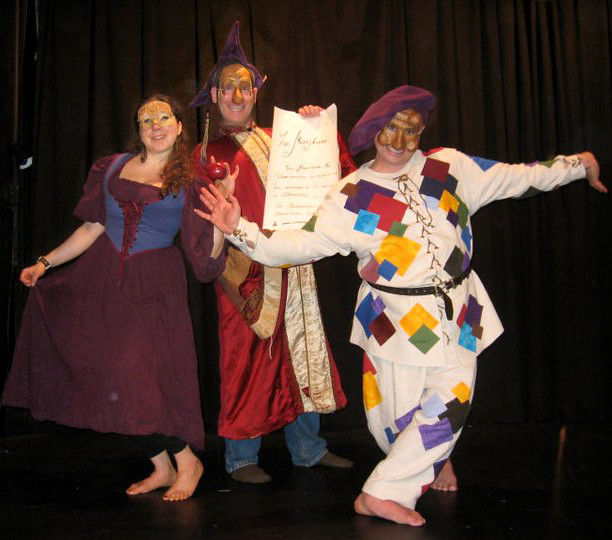
Teatro delle Maschere at Puppet Showplace Theatre: Stacey Polishook as Columbina, Eric Bornstein as Il Dottore, Ian Thal as Arlecchino. All photography by Cherie Konyha Greene
This is the photo of the troupe, and I stress troupe, while they are not the only ones involved (Jonathan Samson made a notable contribution over a period of only three days), Stacey and Eric have been my primary collaborators for since late August when we decided to create a new commedia dell'arte troupe, and I think we've created something special (sadly, Stacey is going is soon to be leaving to study abroad for a few months.)

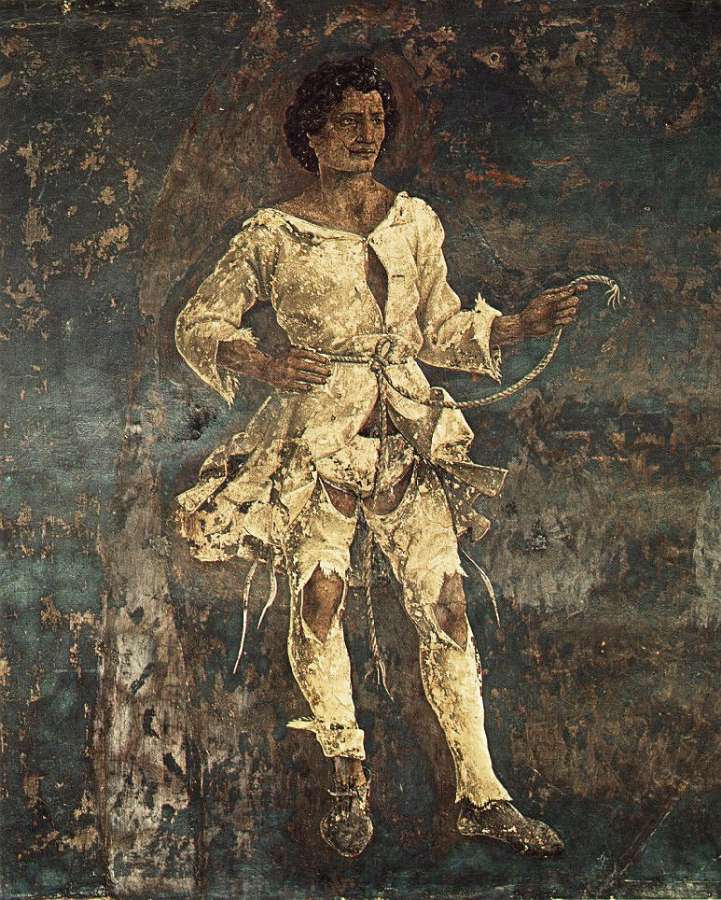
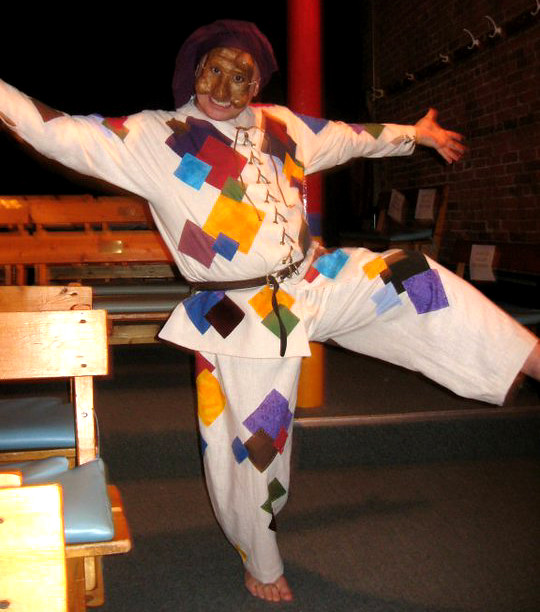
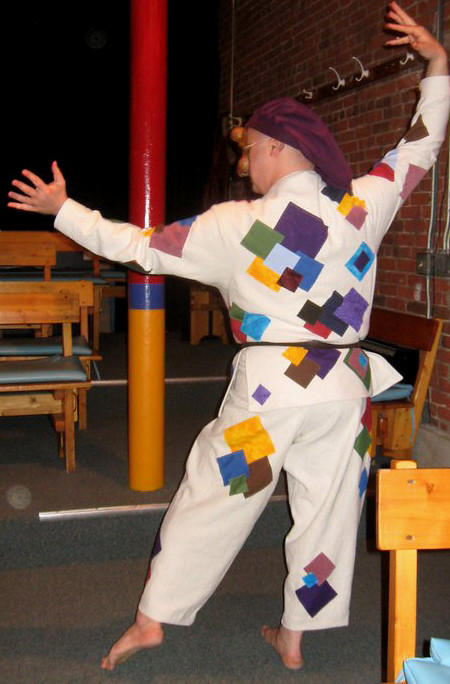
What I really want to show you, however, is my new Arlecchino costume made by Cherie Konyha Greene. Some of you might recall my musing that I might need a new clothing for the hungry zanni who was always appearing in my kitchen when polenta served. Cherie immediately volunteered and we started sharing costume ideas. In dressing Arlecchino we wanted to factor in something closely resembling what an actual peasant of the Italian renaissance might have worn, and so we decided to start with the peasants seen in Francesco del Cossa's (ca. 1430- ca.1477 or 1487) fresco The Allegory of March or Triumph of Minerva:

From there, I wanted something distinctive that would identify the costume as my Arlecchino. I got the idea of replacing the traditional diamond or triangle patterns with squares, while substituting the regularity with asymmetrical and overlapping patterns, drawing inspiration from Piet Mondrian:

Or Theo van Doesburg:

I gave Cherie some sketches and the results were this:
TdM20101114bCropped
And from behind:
TdM20101114eCropped
So spanning five centuries of art history!

Photography by Cherie Konyha Greene. Francesco del Cossa, Piet Mondrian, and Theo van Doesburg art courtesy of Wikimedia Commons.

A New Experiment: Talkbackr

We're trying a new experiment. Did you see Teatro delle Maschere perform last night at the PuppetSLAM? Would you like to give us feedback on what you saw?

[N.B.: The Talkbackr page for this event has expired 3/1/2011]

Sunday, November 7, 2010

Teatro delle Maschere does the PuppetSlam: November 13, 2010

Teatro delle Maschere will be appearing at Puppet Showplace Theatre's PuppetSLAM this coming Saturday, November 13th at 8pm.

We shall be reviving The Esteemed Dottore of Bologna Offers His Authoritative, Erudite, and Thoroughly Supercilious Meditation on the Mask for those who missed it last time and for those of you who have seen it before: expect it to be just a little different! Different cast members result in different improvisations!

Dottore: Eric Bornstein
Columbina: Stacey Polishook
Arlecchino: Ian Thal

Puppet Showplace Theatre is at 32 Station Street, Brookline, MA

Tickets are $15, $13 for PST members and students. Facebook users can RSVP here