Showing posts with label The Arts Fuse. Show all posts

Wednesday, September 16, 2015

On The Arts Fuse: New Rep's Boston Premiere of Arthur Miller's BROKEN GLASS

On The Arts Fuse I review New Repertory Theatre's production of Broken Glass, a play by the major American playwright, Arthur Miller, that first premiered in 1994 had to wait until his centenary before it was ever presented in the Boston-area.

A major theme of the play is anti-Semitism: Both the violent anti-Semitism that erupted in Germany in November 1938, in a pogrom now known as Kristallnacht and the more polite form it takes in America. Most radical is Miller's treatment of the internalized anti-Semitism exemplified in the figure known as the "self-hating Jew":

Today’s dramas about identity politics are usually confident tales of empowerment. Miller goes in a far more radical direction: he creates a harrowing portrait of Jewish self-hatred. “Self-hating Jew” is a charge that has been leveled by and against Jews from a number of directions — religious and secular, the ideological left and right. Typically, this involves Jews adopting or excusing the attitudes, beliefs, rhetoric, and behaviors of anti-Semites – often with the benefit of increasing their status as individuals amongst anti-Semites.

Philip works as the head of the mortgage department at the Brooklyn Guarantee & Trust Company. (He brags he is the only Jew employed at a company owned and operated by what would later be known as White Anglo-Saxon Protestants.) However, when Philip first meets Margaret Hyman (Eve Passeltiner), he is offended when she mistakenly addresses him as Goldberg; he even goes so far as to insist that he’s not Jewish, but Finnish. He will only affirm his Jewish identity when it confers special status: he is not just the only Jew at Brooklyn Guarantee, but the only one to set foot on the yacht owned by his boss, Stanton Case (Michael Kaye). Philip imagines that his son, an Army captain and West Point graduate, will someday become the first Jewish general in the U.S. Army (in truth, that title may belong to Civil War-era Brigadier General Frederick Knefler).

I also consider the historical contexts of the play: Its 1938 setting, the on-going atrocities in Rwanda and Yugoslavia when it premiered in 1994, as well as the human rights crises faced by the world in 2015.

Read the entire review on The Arts Fuse!

Wednesday, August 19, 2015

The New Play Exchange: Some Brief Recommendations


Earlier this year, I joined the New Play Exchange, a platform that may end up radically changing the new play sector of the theater industry.

Under the old model, playwrights would submit their work to theaters and hope to get someone interested in the work they had labored upon. On the other end of this submission process developed a class of of theater professionals whose duties included the appraisal of new theatrical texts -- often known as dramaturgs or literary managers. For playwrights, the experience is something I have elsewhere called "the dramaturgical black box." On top of this process is the natural tendency amongst those making the selections to privilege the cohort with which they are affiliated, meaning that often attempts to reform widely perceived biases within the system reaffirm the privilege of social capital that comes from attending the right school with the right people, writing plays that neatly fit into the right genre, living in the right metropolitan area at the right point in one's career, and receiving prestigious fellowships and awards (often chosen by other people with associated with the right schools.) In short, the social capital of the people associated with the play often ends up being more important than the play itself.

The New Play Exchange serves as an alternative model in which playwrights upload their plays to a database, affix metadata about the genre, themes, and cast breakdowns. The metadata then allows directors, dramaturgs, and producers to search out and discover plays rather than wait for one to come in over the transom, or rely primarily on their professional cohort.

Other metadata are recommendations posted by users. Since most of my current writing about theater has been in my capacity as a critic, I have not yet posted a great many recommendations to the New Play Exchange, but I will share those I have posted thus far, and soon, I will post some of the recommendations I've received.

This year, I reviewed two plays by Cassie M. Seinuk. Last week it was Wax Wings' production of her Eyes Shut. Door Open. which is described as a modern update to the Cain and Abel story (my full review can be read here.):


Seinuk knows her mythology, and drawing upon not just Genesis but also Greek and Norse mythology. Her allusions to and repetitions of mythological violence elevates Eyes Shut. Door Open. above the popular plot formula of dark domestic secrets revealed at a family reunion.

I reviewed her earlier play, From The Deep (full review here when it was presented by Boston Public Works:

From the Deep manages to be psychologically realistic despite being set in a rule-bound imaginary space. Seinuk deftly acknowledges the political and social realities off-stage without taking the focus off of the struggle that Ilan and Andrew face as they attempt to maintain their sanity.

Asher Wyndham is something of a New Play Exchange hero, having, as of this writing, written fifty-eight recommendations, including four for my plays. While his play Allegra Gray is still in development, I was impressed with how he dealt with the ethical conundrum faced by his protagonist:

ALLEGRA GRAY treats the protagonist's decision to either keep or abort a pregnancy as a very personal drama: As a local celebrity, she is forced not only consider how her decision will affect her family, but her career, and ability to live in her city, as she becomes the target both of well-wishers and advocacy groups unafraid to engage in public shaming. Wyndham's play avoids simple moralizing, rather dealing with how individuals must navigate the myriad balance ethical demands they can only face on their own.

I was particularly interested in reading Trish Harnetiaux' play, If You Can Get To Buffalo because of its setting. LambdaMOO is an online community founded in 1990 that predates Facebook, Myspace, and even tribe.net, and Friendster -- and in which I had participated since 1996. If You Can Get To Buffalo is adapted from Julian Dibbell's 1999 book My Tiny Life: Crime and Passion in a Virtual World and his 1993 Village Voice article, "A Rape in Cyberspace, or How an Evil Clown, a Haitian Trickster Spirit, Two Wizards, and a Cast of Dozens Turned a Database into a Society". Both Dibbell and PBS talkshow host Charlie Rose appear as characters in Harnetiaux' play:

Speaking as a long-time denizen of LambdaMOO (though my time began a few years after the events of 1993), I find that "If You Can Get To Buffalo" captures the creative approaches to identity (and in many cases, ethics) that marked the milieu -- as well as the trouble that people had articulating just what life was like in this new frontier -- not just to those for whom the internet was still unexplored, but even to those who were experiencing it daily.

Having seen a reading of an early version of Meron Langsner's Burning Up the Dictionary in 2011 and later, in a full production by Vagabond Theatre Group, I had this to say:

"Burning Up The Dictionary" very cleverly tells its story of a couple negotiating the intimacy of their private language after their break-up. Particularly smart is the final scene actually forces the audience to question whether they may need to reevaluate their understanding of what had been said and done; it's not a plot twist, so much as a semantic twist.

Up next: Recommendations I have received and if I have learnt anything from them.

Tuesday, August 18, 2015

On The Arts Fuse: Double Edge Theatre's "Once A Blue Moon"

Last week, I travelled to the rural town of Ashfield, Massachusetts, to review Double Edge Theatre's summer spectacle, Once a Blue Moon (Cada Luna Azul).

What sets Double Edge Theatre apart from other troupes is that it has always forged an intimate link between the world of physical theater and the world of literature and ideas.

As I note that while Once a Blue Moon is a devised piece featuring contributions from many collaborators, the particular role that, Double Edge's artistic director, Stacy Klein, has in shaping the performance:

Those who have thrilled by Double Edge’s performances in conventional theater spaces have had a glimpse of director Stacy Klein’s expansive imagination. (My first encounter was a 2007 production of Republic of Dreams at the Charlestown Working Theater). But you don’t really know just what she is capable of unless you see Klein working on her home turf. She uses music, sound effects, dialogue, and the movements of actors and puppets to guide the attention and focus of audience members. In some ways, Klein is like a highly skilled filmmaker who uses camera pans and zooms to control what appears on the screen. Of course, in the theater Klein is working in real time, in three-dimensional space. There’s no editing room here.

Of course, Klein knows that the human visual cortex remains a far more powerful instrument than Hollywood’s most expensive cameras.

You can read the entire review on The Arts Fuse!

Wednesday, August 12, 2015

On The Arts Fuse: I Review EYES SHUT. DOOR OPEN. By Cassie M. Seinuk

I haven't blogged about the last few reviews I did for The Arts Fuse in part because they came out so close to their closing date.

My latest review is of Wax Wings Productions presentation of Cassie M. Seinuk's Eyes Shut. Door Open. -- a Cain and Abel story set on the SoHo arts scene:

Seinuk, of course, knows her mythology, and the allusion to and repetition of mythological violence elevates Eyes Shut. Door Open. above the popular plot formula of dark domestic secrets revealed at a family reunion.

I also admire the acting from the three person ensemble of Victor Shopov, Melissa M. DeJesus and Michael James Underhill as well as Rose Fieschko’s fight choreography. However, I feel let down by some of the production design choices:

Lighting designer Christopher Bocchiaro (whose work I generally admire — particularly in ASP’s recent production of Measure for Measure, and Apollinaire’s Blood Wedding) and sound designer Patrick Greene made some messy missteps here. Turner’s PTSD flashbacks were conveyed through a number of unsubtle and clichéd choices: Red-lit chiaroscuro, voices slowed down, distorted, and pitch-shifted down an octave or more. The upshot was memories of trauma made campy rather than cathartic – the episodes were suited to a straight-to-cable horror movie.

Read the whole review on The Arts Fuse!


Monday, June 15, 2015

On The Arts Fuse: THREE by Emily Kaye Lazzaro

On The Arts Fuse, I review Emily Kaye Lazzaro's Three currently running at the Boston Center for the Arts. The play, directed by A. Nora Long, and presented by Boston Public Works, is, sadly, a huge disappointment. For several months, I have championed the mission of Boston Public Works, a theater company centered around a collective of playwrights producing their own work (see my 2014 interview with four of BPW's member playwrights), however, with Three I saw what may be the weakest script I have ever seen receive a full, professional production. Prior experience is that similarly bad scripts never get further than a staged reading or student production, so even though I had seen my share of bad plays this season, nothing prepared me for the cheap plot devices, characters who are no more than one-dimensional stereotypes, and pretensions to social relevance.

In truth, Three is not much of a play at all, but an anthology of “very special episodes” (possibly season finales) of an unproduced television or web series. Many young playwrights seem to be going this route. It may be too soon to tell if this trend is good for television or the web, but it’s certainly not good for the stage, even though Lazzaro has a good ear for turning the vernacular of her generation into pseudo-naturalistic dialogue.

[...]Lazzaro makes an effort to label Three a feminist work, but she sets the bar pretty low – this is feminism as brand identity with little political or social commitment. Yes, the play is about three women and was written by a woman, but the three characters are passive. They never take an active role – they don’t even take a reactive role; life just happens to them. Maybe there are people who would be shocked to learn that there are women who enjoy both alcohol and penises, but I doubt they attend fringe theater productions. Moreover, I know of 20-something women in my immediate social circles who are quirkier, wittier, funnier, more socially aware, and who lead more interesting lives than the females in Three Perhaps Gen-Xers and baby boomers will come away thinking that they have learned something about the millennial generation, but it is like going to an Olive Garden restaurant for authentic Italian cuisine. There are excellent contemporary plays written by women, featuring all-female, or mostly female, casts – I’ve reviewed some – but Three isn’t one of them.

I dubbed Three a "vanity project" -- a label to which fellow playwright, Andy Boyd objected:


Read the full review on The Arts Fuse and decide for yourself if I made my case.

Tuesday, June 2, 2015

On The Arts Fuse: Actors' Shakespeare Project's "Henry VI, Part 2"

On The Arts Fuse, I review Actors' Shakespeare Project's production of Henry VI, Part 2, which despite being the origin of the oft-quoted line, "The first thing we do, let’s kill all the lawyers", is rarely performed. This presentation, currently running at The Modern Theatre at Suffolk University through June 7, is masterfully directed by Tina Packer. I was particularly taken with the character of Jack Cade, the villain of Act IV, played by Allyn Burrows:

However far he may depart from his ‘real life’ inspiration, Cade (Burrows) is unprecedented amongst Shakespeare’s characters: a truly lethal clown – through much of Act IV he and his followers ravage England, lopping off the heads of one nobleman after another to great comic effect. He even has his own convoluted claim on the crown, reciting his questionable pedigree — a parody of York’s own claims — even as he strikes the figure of a lord of misrule, espousing an incoherent philosophy that is alternately a parody of anarchy and communism (Shakespeare’s distrusted the hoi polloi as a political class). Behind the mayhem (York’s and Cade’s) is a thirst for absolute dictatorship – the famous line about killing all the lawyers (an ambiguous rallying cry for both tyrant and anarchist) comes from one of Cade’s followers. The historical Cade might have been less of a clown, but the theatrical one comes off as an unacknowledged forerunner of Alfred Jarry’s famous Père Ubu (as well as Mister Punch and Fredrico García Lorca’s Don Cristóbal) He is also a prescient parody of the political extremists and tyrants who have shaped the past century for the worse. Burrows’ portrayal of an ignorant but bloodthirsty imp of perversity is a rip-roaring joy.

I also suggest that perhaps the current pop-culture zeitgeist makes the time ripe for this particular play to be revived more often:

Given the current pop-culture climate in which audiences thrill to stories of cynical realpolitik handily trumping the virtues and idealism of public service (as in the case of popular series such as House of Cards, and Game of Thrones) – the zeitgeist is ripe for Henry VI, Part 2 to be revived – and perhaps, with the taste for long form storytelling so prevalent, Parts 1 & 3 may deserve some love as well. Nonetheless, Part 2 is sufficiently self-contained, beginning with the marriage of Henry and Margaret and ending with the First Battle of St. Albans and start of the Wars of the Roses. Familiarity with the oft-staged Henry V and Richard III provide more than adequate background on what happened before and what happens next.

Read the full review on The Arts Fuse!

Tuesday, May 19, 2015

On The Arts Fuse: Matthew Spangler and Benjamin Evett's "Albatross"

Back in February I reviewed Albatross, a theatrical adaptation of Samuel Taylor Coleridge's narrative poem, Rime of the Ancient Mariner. I judged the play, written by Matthew Spangler and Benjamin Evett, performed by Evett, directed by Rick Lombardo and produced by The Poets' Theater quite highly, noting its all around excellence, and I expressed hope that it could be remounted (preferably elsewhere, as a representation of what Boston's theater scene can offer.)

My hope has born some fruit, and Albatross is bing remounted at New Repertory Theater, May 21-24.


Read my review on The Arts Fuse!

Wednesday, May 13, 2015

Playing It Safe With Film Critic Wesley Morris: At the Literary Managers and Dramaturgs of the Americas Conference, Boston 2014, Part III

Note to the Reader: The following account of the June 26-29, 2014 Literary Managers and Dramaturgs of the Americas conference in Boston was originally written for The Arts Fuse, to which I am a senior contributor but for various reasons, was not used.

-I.T.

newplay on livestream.com. Broadcast Live Free

As one of only four film critics to be awarded the Pulitzer Prize, former Boston Globe contributor, Wesley Morris, now a staff writer for Grantland, might have seemed to be equally an inspired and odd choice as a keynote speaker, given his minimal involvement with theater. Perhaps this would be for the best, a theater critic might have expressed a strong opinions on plays that at least some of the attendees had worked on and anybody of similar or greater stature in the theater world (say, an elder statesman like Robert Brustein who was conspicuous by his absence) would have likely been divisive in a room filled with theater professionals.

Morris walked a fine line between his own expertise as a critic of popular culture, and a guest who needed to flatter his hosts, “I feel like you are the conduit between those two experiences: the creative act, and the one where I am on my sofa weeping.” The result was that he alternately described his role of a critic as a “glorified civilian movie-goer” who “[likes] to think I want the same thing from my plays and movies as anyone wants,” while also saying that, “objectively speaking, I see [what I do as] crime reporting” elaborating that with regard to race and gender, “sometimes movies do crazy things that don't make sense.”

During the question and answer session after his address, Morris was asked about changing roles of criticism on both the web and in print -- a question that placed his address into context. He affirmed that the web might be the last refuge for long form criticism written for a general audience, noting that on Grantland, he can publish a 3,300 word article addressing a single topic, something that would be impossible with a daily, or even weekly, newspaper. Given the decreased page space given to criticism in print publications, and how much of our cultural discourse has been reduced to sound bites, slogans, and tweets (tweeting was in great evidence at the LMDA conference) – a phenomenon that websites like The Arts Fuse (for which this essay was originally intended) exist, in part, to counter.

Morris mostly stayed away from discussing theater in depth. The topics that garnered the greatest attention, were his praise for the Netflix-produced television series, Orange is the New Black, (which, judging by reactions from the audience, and the number of mentions it received in plenary sessions, appears to be very popular with LMDA members) and his 2011 review of The Help which was informed by his own encounter with a “mammy” doorstop in a west Texas restaurant as the only African-American among a predominantly white group of friends which underlined to him just how ambiguous the symbols of America's racial (and gendered) history can be, and the cognitive dissonance they continue to cause. Quite simply, Morris discovered that while he and his liberal white friends saw Mammy as a racist stereotype, the white proprietor viewed Mammy as an homage to the black woman who raised her.

When he did speak about theater, Morris was appreciative but far less profound, often contrasting the medium with television. In discussing gender, he stated that, “The thing I love about the theater[is that] there is such a dearth of interesting women on TV [and] the theater is much more women-oriented or open to women's experience.” While at the same time, noting the moral simplicity in most television, which he described as currently wallowing under “misinterpretation of what it is to be an antihero,” Morris praised theater's sophistication, stating that, “theater is much more open to the fluidity of morality.”

Most of the attention that Morris was able to directly address towards theater was with regard to theater on television and film. Referring to PBS's longsrunning series, Great Performances, he noted, “They have nine cameras. You just need one camera.” Arguing that there is an essential difference between being seated in the auditorium and having one's eyes guided by camera work, made timely now that major theaters present high-definition footage of their performances to cinema screens for paying audiences, he commented, “I don't know why you have to cut [...] Just put a camera in the best seat in the house.” Morris concluded that, “For twenty-five dollars I want to see the fucking stage. I don't need to see the close up; she's not acting for the close up.”

I would suggest that the problem is not necessarily the number of cameras, or number of edits, but as I have noted elsewhere, the often poor quality of the camera work and editing. Strong directors and actors are very skilled at drawing audience members' eyeballs to various points on the stage or upon the actor's own body – mimes like Marcel Marceau and Dario Fo were absolute masters of this. The issue isn't a matter of one camera in the best seat of the house versus nine cameras scattered around the theater, but of whether or not the camera (and the editing) is guided by the visual dramaturgy of a given performance -- and quite often, it is not. Filmed theater is simply a different medium from both film and theater. Cameras are not eyeballs – the human eye is attached to a sophisticated complex of cerebral wiring that has evolved over hundreds of millions of years.

Perhaps this is a problem with Morris being a film critic and only a casual (yet articulate) theater-goer. He stated his appreciation for many of the plays that have been circulating on the main stages of America's regional theaters in recent years, but his own comments missed the subtleties -- so when he decried the use of stage plays being adapted to feature films, using the example of Roman Polanski's 2011 adaption of Yasmina Reza's God of Carnage, he complained that Polanski's signature style changed the meaning of the play. What Morris missed is that while film-goers are accustomed to there being a “definitive” take on a story, the strength of some plays is that they can admit any number of strong, but contradictory productions -- and this is why many audience members and critics will flock to see multiple productions of a favorite play: to experience the differences.

Monday, May 4, 2015

Theresia Walser & Karl-Heinz Ott's "The Whole World" Reviewed on The Arts Fuse

On The Arts Fuse I review the grotesquely funny domestic comedy, The Whole World by German playwrights, Theresia Walser and Karl-Heinz Ott which was presented in a staged reading by German Stage at the Goethe-Institut Boston, on April 23rd. The reading was directed by Guy Ben-Aharon.

Walser and Ott’s version of middle-class monstrousness isn’t about pointing out how animal urges are trapped under a civilized veneer (Harold Pinter). The play focuses on the incoherence that lurks underneath the narratives we tell about ourselves: it is about the slippage from the innocent self-mythologizing we do to make ourselves the protagonists of our own stories to a condition moves into the realm of pathological lying. The couples do not begin in conflict – Tina and Dolph are seeking friendship with a couple they imagine to be very much like themselves, merely different in an interesting fashion – only to discover that Regina and Richard aren’t even remotely similar to anything Tina and Dolph would care (or dare) imagine existing in the ‘whole world.’ It isn’t a playground conflict or workplace struggle (Yasmina Reza) that incites the psychic savagery between the couples, but the nihilism that lurks underneath the price we pay for our bourgeois comforts. This shouldn’t lead you to think that The Whole World plays like some sort of psychological horror show; as in the plays of Edward Albee, Pinter, and Reza, the audience’s laughter increased with every twisted revelation of disfunction.

Saturday, April 6, 2013

Joshua Sobol interviewed on "Sinners."

In February, The Arts Fuse's Editor, Bill Marx and I sat down for an email interview with Israeli playwright Joshua Sobol while his play, Sinners was being presented as a staged reading by Israeli Stage.

The play is a powerful one dealing with the fate of intellectually and sexually independent women in Islamic-fundamentalist societies. I hope that Guy Ben-Aharon gets to stage this play in the near future.

Sobol's answer to one question was particularly interesting-- since it revealed the degree to which political-correctitude often means an abandonment of humanist values:


AF: What were the obstacles presented in dramatizing a story that had neither an Israeli nor Jewish theme or setting?

Sobol: The main obstacle to overcome was the so-called politically-correct, recently established taboos. As a white, atheist male, I am told it is none of my business to deal with what’s going on in the so-called de-colonized societies enforcing their religious laws on their citizens. But as a human being, I cannot and should not respect that dictum, and as a dramatist, it is exactly my affair and my responsibility to give a voice to the voiceless victims of inhuman savagery. A woman sentenced to death for having loved a man who is not her husband, and thus being buried alive up to her bosom and waiting for a crowd of wild males to stone her to death, is the epitome of the voiceless victim, whose voice should shatter the fundaments of our world. The duty to carry this stifled voice from one end of the world to the other has nothing to do with being Israeli, Jewish, or Christian. It has to do with being human or giving up one’s humanity.

Friday, April 5, 2013

Yale Repertory Theatre's "The Servant of Two Masters."

(Part of a series in which I make up for not updating my blog recently.)

As one of Boston's more verbose commedia dell'arte enthusiasts, it was only natural that I was asked to review Yale Repertory Theatre's presentation of Carlo Goldoni's The Servant of Two Masters when their tour brought them to ArtsEmerson this past winter.

As I write in The Arts Fuse:

This inventive adaptation opens with light pouring through a doorway that opens upon a dark stage. Two silhouetted figures enter with flashlights, discover and open two large crates, and then discuss the contents in an Italian grammalot. The pair list off the names of the iconic masks of the commedia dell’arte: Pantalone, Dottore, Brighella, and of course, the eponymous servant, Truffaldino. It as if they are discovering something vital stored away.

Soon after the flashlights become fireflies dancing against a night sky, over a maquette of Venezia. The sun rises over a city square. Under the Paramount’s own proscenium stage stands a much smaller proscenium from which the cast emerges. Katherine Akiko Day’s stage concept brilliantly references the earliest commedia troupes, while Chaun-Chi Chan’s lighting design evokes the blazing sun under which these troupes performed as well as forecasting the arrival of dusk at the story’s end.

Goldoni’s comic gift comes down to a genius for narrative design: he arranges a convoluted story of mistaken identities, disguises, miscommunications, and matters of honor by which true lovers are kept apart and then, as if by clockwork, are finally brought together. Goldoni lacks the poetic gifts and thematic depth of Shakespeare, but the Bard of Avon never plotted so tightly. Goldoni’s plot becomes so complex that he seems compelled to include a recap of the plot for the audience in the final scenes of his comedies.


Note that I also wrote about a modern adaptation of The Servant of Two Masters when I reviewed Richard Bean's One Man, Two Guvnors.

Wednesday, April 3, 2013

Theresia Walser's A Little Calm Before the Storm

(Part of a series in which I make up for not updating my blog recently.)

In December, I attended German Stage's presentation of a staged reading of Theresia Walser's A Little Calm Before the Storm featuring Johnny Lee Davenport, Jeremiah Kissel, and Ted Hewlett, playing three actors waiting to be ushered before the camera of a television talk show.

As I wrote in The Arts Fuse:

In Theresia Walser’s A Little Calm Before the Storm, three actors sit in the green room waiting to be part of a televised discussion on the challenges of playing Hitler. The 2006 play has been both popular in Germany (reportedly a five-year run) and controversial. Consul General Rolf Schütte, who was in attendance at the staged reading, said that he could not imagine such play being produced in Germany 15 years prior.

[...]On one level, A Little Calm Before the Storm is only a prelude to a discussion about how evil can be portrayed in art. During the one-act play Prächtel, Söst, and Lerch talk about this difficult topic and then dance away from it. Walser provides plenty of comic distraction: Prächtel becomes exasperated that he cannot get a glass of tap water in the television studio; Söst attempts to coach Lerch on how to pull off irrelevant talk show banter. Waiting for the television host who never comes, the impatient actors begin to taunt each other, appraising each other’s performances, questioning if the other actor can do justice to such a hated historical figure as Hitler.

Tuesday, April 2, 2013

Gilad Evron's Ulysses on Bottles

(Part of a series in which I make up for not updating my blog recently.)

Back in November I attended Israeli Stage's presentation of a staged reading of Gilad Evron's play Ulysses
on Bottles.
It's a powerful piece that explores the Israeli-Palestinian conflict with some subtlety and moral complexity. Hopefully, director Guy Ben-Aharon will be able to give it a fully-mounted production sometime soon.

As I wrote in The Arts Fuse:

At first, no one quite knows what to make of the prisoner (played by Johnny Lee Davenport). Neither the Defense Ministry, prosecutors, nor defense attorney Saul Izakov (Jeremiah Kissel) can make sense of his actions. He offers no political argument, expresses no sympathy for the Hamas regime in charge of Gaza, no animosity towards Israel (he seems wholly content with his life as an Arab citizen of Israel). Of course, Ulysses’s actions would make sense if his cargo had been food or medical supplies or even if he were a terrorist sympathizer. However, Ulysses only asserts his conviction that “the Gazans are dying to study Russian literature. It’s a breeze that rises higher than the kites they fly on the shore.” Psychiatrists determine that, however quixotic his mission, the man is quite sane.

The issue of food and medicine is central to Izakov’s other client: the Defense Ministry. Izakov meets with an official named Seinfeld (Will Lyman) to sort out the latter’s legal conundrum: how to legally contend with the population of a Gaza governed by a de facto state-within-a-state constitutionally sworn to Israel’s destruction? Despite the hostilities, the blockade makes the government “responsible for their food, their drink, their sewage, their literature,their security, their iron, their contraceptives, their toys, their pots and pans, their spices, their flowers, their meat, their electricity, their paper, their medications, their engines [. . .] even their anti-diarrheal pills!” Seinfeld wants to make sure that no one under his command can be charged with crimes, but he also understands that, given the political stalemate, abiding by the law will not ward off armed conflict, such as the one that began just days before the November 18th reading. Izakov grasps that the law to which he is dedicated is not sufficient to help his most powerful client.

Monday, October 29, 2012

Review of "Voltaire & Frederick"


Meanwhile, over at The Arts Fuse as a follow-up to my discussion with Detlef Gericke-Schönhagen and Annette Klein of the Goethe-Institut Boston and artist-in-residence, Guy Ben-Aharon about German Stage, the Goethe-Institut's new initiative to bring German theatre to Boston audiences, I review a reading of Gericke-Schönhagen's play Voltaire & Frederick: A Life in Letters.

The reading, which is directed by Ben-Aharon and features Thomas Derrah as Voltaire and John Kuntz as Frederick II of Prussia, is touring both in New England and Canada.

[T]he letters frequently touch on issues as relevant today as they were in the eighteenth century: Voltaire’s objections to the repeated attempts of theologians to use state power to limit freedom of thought and expression echo powerfully in an era when creationists are attempting to ban the teaching of evolution or when Salman Rushdie lives under a fatwa for writing a novel. Voltaire’s arrest at the hands of Frederick’s government illustrates the degree in which leaders are imprisoned by the public roles they play. Frederick’s meditatations on the gap between his ideal of how the world should be and his responsibility to face the world as it is revealed an irony that Voltaire must have appreciated: the king had a strong distaste for the wars he was so good at winning.

There is also a surprisingly lively discussion in the comments section between Gericke-Schönhagen and my editor at The Arts Fuse, Bill Marx.

Friday, October 12, 2012

In The Arts Fuse: A Conversation on German Theatre in Boston


In The Arts Fuse, I have a discussion with theatre director Guy Ben-Aharon, and Goethe-Institut Boston Director Detlef Gericke-Schönhagen and Program Curator Annette Klein about their new project, German Stage, a series presenting contemporary German plays to Boston audiences. The program runs in parallel to Ben-Aharon's other series, Israeli Stage, which similarly presents work by Israeli playwrights.

German Stage makes its premiere on October 15th with Voltaire and Frederick: A Life In Letters which is based upon the correspondence between Voltaire and Frederick II of Prussia and was conceived by Gericke-Schönhagen.

Amongst the topics we discuss are the differences between German and American theatre:

Ben-Aharon: Though American playwrights are not well-paid, their work is looked at with great respect by American theatres and directors. One could say American theatre is a playwright’s medium; their dialogue is never changed without permission, and the chronology of a play is something one would never tamper with, unless in a workshop context with the playwright in the room. German directors seem to have a greater ‘power’ than the power of their American counterparts: they are freer to explore and re-explore a play’s theme or story by changing its course, i.e. German directors will take a script and direct the scenes in a different order than what was originally written. This is something American directors would never imagine doing.

As well as the relevance of Voltaire and Frederick II in the 21st century (particularly on Boston stages which last year saw the acclaimed Mary Zimmerman helmed production of Candide at the Huntington as well as the superficial name dropping of David Adjmi's Marie Antoinette at American Repertory Theatre:)

Gericke-Schönhagen: The questions raised by the Enlightenment are more relevant today than ever before. They have shifted from a European level to a global level. If you read how Frederick and Voltaire discussed questions of religion, superstition, so-called blasphemy and persecution from their very first letter on, when Frederick was 24 and Voltaire was 42, you feel as if it was today and you are reading a discussion in The New York Times. Frederic hated the superstitious European monarchs of his time, who often were intellectually uneducated and thus overly influenced by intellectually superior, power-driven advisers from the churches. Frederick was not a democrat, but he was an intellectual, highly educated, radically secular yet tolerant of religious belief.

The conversation continues in The Arts Fuse!

Monday, October 1, 2012

Arts Fuse Review: Les 7 Doigts de la Main's "Séquence 8"


This past weekend The Arts Fuse ran my review of Montréal-based nouveau cirque troupe Les 7 Doigts de la Main's Séquence 8:

The agility of Les 7 Doigts de la Main’s acrobats may be the spectacle that draws audiences in to see Séquence 8, but it’s their decision to treat acrobatics and other types of circus virtuosity as a form of acting that offers a new, intimate direction for the nouveau cirque genre.

Séquence 8 runs through to October 7th at ArtsEmerson.

Arts Fuse Interview: Lenelle Moïse's "Expatriate"

"Rebel" from Lenelle Moise on Vimeo.


While not updating this blog, I also managed to have an email conversation with Lenelle Moïse, whose show, Expatriate is coming to Boston this weekend:

AF: Though American expats can be found all over the world, the Parisian expatriate experience is as much part of American mythology as venturing into the frontier. Traveling to Europe plays a particularly significant role in African-American cultural history when one considers the number of Black artists and intellectuals (many of whom were also queer) who moved to Paris to escape the tyranny of pre-civil Rights America. What’s the symbolic role of Paris today?

Moïse: A lot of people associate French culture with pleasure and protest. From escargot to Picasso to the Marquis de Sade to Bastille Day, the French maintain a global reputation for being revolutionary, stylish, occasionally scandalous, and often cool. I think Black American artists—some of them women, some of them queer—share this reputation. Unfortunately, post-civil rights America still marginalizes creative professionals, women, LGBT folks, and people of color. Even President Obama has to deal with people not thinking he’s American enough because he’s of African descent. I wonder if Black expatriates can only feel American when they’re in exile? James Baldwin and Nina Simone had to relocate to France to feel respected as artists. Much of their work focused on American identity politics, but we remember it because it was skillful and beautiful. The French “get” beauty.

I also spoke to Abe Rybeck, founder the The Theater Offensive, a Boston based theatre company whose work focuses on LGBT themes:

AF: You started TTO in 1989, making it roughly contemporary with political movements like ACT UP (AIDS Coalition To Unleash Power) and Queer Nation. This means that for over two decades, as well as producing its own work, TTO has also been a presenting organization for queer artists from all over the nation and world. What changes have you seen in the world of queer theater?

Rybeck: Yeah, we grew out of a queer, guerrilla street theater troupe called United Fruit Company that started doing AIDS and liberation-themed activism in 1985. So we actually predated ACT UP by a couple years [ACT UP was founded in 1987]. One of the enormous changes I’ve seen is that in big city theater scenes, queer work isn’t so scarce anymore, which is great. These days, no major theater company in a city like Boston would program its season without discussing what might be of interest to gay men. That puts many gay theater groups around the country in a real competitive tough spot.

On the other, sadder hand, many folks in our community—especially women and people of color—still don’t feel seen or understood or represented by those plays.

You can read the rest of these interviews on The Arts Fuse!

Arts Fuse Review: A.B. Yehoshua's "Hand in Hand Together"

Sorry for the long silence on the blog. As you will see from the next couple of posts, I have been writing, just not here.

A couple of weeks ago I wrote a review of Israeli playwright A.B. Yehoshua's Hand in Hand Together. The play was presented as a reading by Israeli Stage, whose founder and artistic director, Guy Ben-Aharon directed and provided the translation. The play told the tale of a series of 1934 meetings between Labor Zionist (and later Israeli Prime Minister) David Ben-Gurion and Revisionist Zionist leader Ze'ev Jabotinsky.

While some plays, when translated, become part of the canon of world drama. The experience of this play caused me to question the limits of theatre in translation, especially political theatre when transported from its native environment:

[...] the didactic nature of Hand in Hand Together is a potential obstacle towards a successful staging for a non-Israeli audience. It no doubt plays well when performed in the Knesset, where many elected officials see either one of the protagonist’s as their ideological forebears, or for an audience that is steeped in Israeli history. But to an American audience the distinctions between Ben-Gurion and Jabotinsky may come off as a purely academic exercise.

This disconnect leads to an important question raised by theater in translation: how should one stage a play outside its home country? Will an American audience be riveted by two men debating about early twentieth-century Zionism? Should it be staged with a nod towards naturalism, or given the importance of its ideological and historical discussions, would the story be best brought to the stage with theatrical effects and puppets used in a Brechtian manner? Perhaps an explanatory dumb show as the heroes debate? Would that self-conscious approach improve the storytelling, or would it be seen as mocking the central conflict? When a play is performed outside of its native country, should the mode of theatrical presentation become another part of the translation?

Monday, August 20, 2012

"Shylock Sings The Blues" Review and Interview


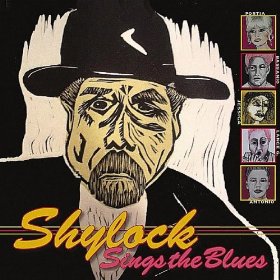
In The Arts Fuse, I review Shylock Sings the Blues a new musical based on Shakespeare's The Merchant of Venice with lyrics by David Sokol, music by Dennis Willmott, and recorded by the Venetians.

...It is only natural that some artists would draw on the cultural mystique of The Merchant of Venice as source material for their own work. Burlington, Vermont-based lyricist and illustrator David Sokol (who did all the album art) and composer Dennis Willmott replace Shakespeare’s iambic pentameter and prose with blues, rock, and country songs in a concept-album entitled Shylock Sings the Blues. The story has been shifted from the Venetian Republic of the sixteenth century to 1950s Venice, New Jersey...

I also interview David Sokol (who as well as being a lyricist, is an illustrator who provided the cover art):

Sokol: I chose the blues number one because I am most familiar with it. Also the blues is the music of an oppressed people. I would love the stage presentation of Shylock Sings the Blues to have a black Shylock. I have just been turned down by a local radio station who refuses to play any songs from the album because “it is too dark! “How can blues be “too dark”? And there is humor in the musical—Jessica can be comedic and Launcelot is the truth telling fool.

The depth of anti-Semitism is intertwined with the darkest of human misery—and the Devil represents the latter. The fundamental basis of anti-Semitism is the belief that Jews don’t just act evil but that they embody evil itself. Possibly the lineage of European theater, morality plays, etc. and their depiction and teaching of good and bad through the use of devils and angels contributed to the Devil’s visits to the play. Also, in my quest to be entertaining and not pedantic, the Devil is a universal and simple dramatic tool.

Read more in The Arts Fuse!

Thursday, May 24, 2012

Arts Fuse Review: Beau Jest's "Ten Blocks on the Camino Real" By Tennessee Williams

My review of Beau Jest Moving Theatre's production of Tennessee Williams long neglected one-act, Ten Blocks on the Camino Real is online on The Arts Fuse. While I caught it at Charlestown Working Theater where it recently closed, it is opening tonight at Lucid Stage in Portland, Maine.

Ten Blocks on the Camino Real is a largely neglected play in Tennessee Williams’s canon, generally regarded as a one-act first draft of the 1953 full-length Sixteen Blocks on the Camino Real and not as a separate play in its own right. First composed in 1946 while traveling through Mexico and workshopped by Elia Kazan at the Actors’ Studio, the expanded and reworked play made its Broadway premiere in 1953. Sixteen Blocks closed after 60 performances and was seen as a financial and artistic failure. Some argue that the play’s experimental approach, which presaged Williams’s later work, alienated audiences whose expectations had been formed by The Glass Menagerie or A Streetcar Named Desire; Elia Kazan would later say that his naturalistic directorial approach was incompatible with the play as written.


Here is Beau Jest artistic director Davis Robinson speaking about the play:


I should also note that Beau Jest posted a very informative dramaturgical blog on the play entitled "30 Days to TEN BLOCKS".